
Translated material
"Leviathan" | Colta.ru
This film is indeed the habits of Leviathan: he swallows the viewer at the very first minute and spits back into the darkness of the hall - dumbfounded, helpless - only on the final credits. The opening quote from the book of Job, written out by Gothic font - “There is no similar on earth” - is not lying. Finding analogues of this movie experiment in history is really difficult, if possible.
Anthropologists by education, the directors of Lucien Kasten-Tylor and Virina Pavel met in the Sensory Ethnography Lab -an experimental laboratory of visual anthropology in Harvard. It sounds in a scientific representative, but, as the Casten-Tylor notes ironically, this laboratory is called experimental not because some important empirical studies are being conducted there: “We just don’t really understand what we are doing there.” Such a scientific frivolity allowed them to go beyond their own science and beyond the framework of documentary cinema. Because “Leviathan” is, of course, a visual exercise in anything, not in anthropology.
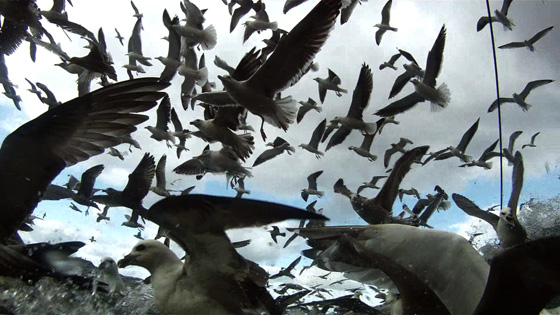
Formally, the film is about the everyday life of a fishing trawler, however, it was shot in a unique perspective. He offers an inhuman view of things: seagulls, fish, slopes and other sea bastards are equated with a camera in their rights to fishermen. If not to say more, the human point of view is supplanted here on the periphery. "What is the bat?" - The philosopher Thomas Nagel in the famous article of the same name assured that we could never answer this question. “Leviathan” with the inherent cinema lightly refutes the impeccable logic of Nagel: in an hour and a half you will visit the skin (more precisely, scales) of fish, and in the shell of mollusk, and at the same time learn what a seagull.
 © Atelier v
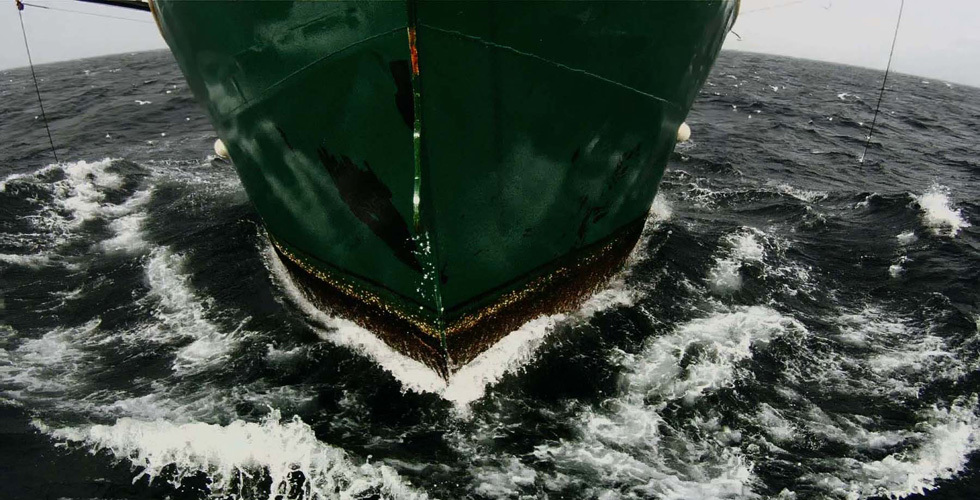
The technical secret of the film lies in the lightest digital cameras of GoPro , which the directors attached to everything in a row: to the heads of fishermen, networks and tutors, the nose of the ship and decapitated fish carcasses. The camera sways to the beat of the sea, dives under water and jumps to the surface, like a flying fish. She looks at the fishermen, but her gaze is faced with the surface of the deck - we see only the soles of the rubber boots, giant beaks and the bulging eyes of dying fish, which, like you, have a helplessly flutter on the deck.
In Leviathan, nothing happens and nothing changes: the fish is caught, the fish is cleaned - they ripped off the belly, and they are thrown into the sea, the cycle is repeated. That's all. No salary comments, no environmental criticism, no Marxist compassion. Emotions and morality - human, too human - are thrown overboard as unnecessary ballast. There is a pure ontology: ocean, trawler, fish. And the even, deaf rhythm of the waves, which is saturated with the first to the last frame. "Paradise for bachelors and hell for girls."