
Translated material
Letter of forty -two: for and against
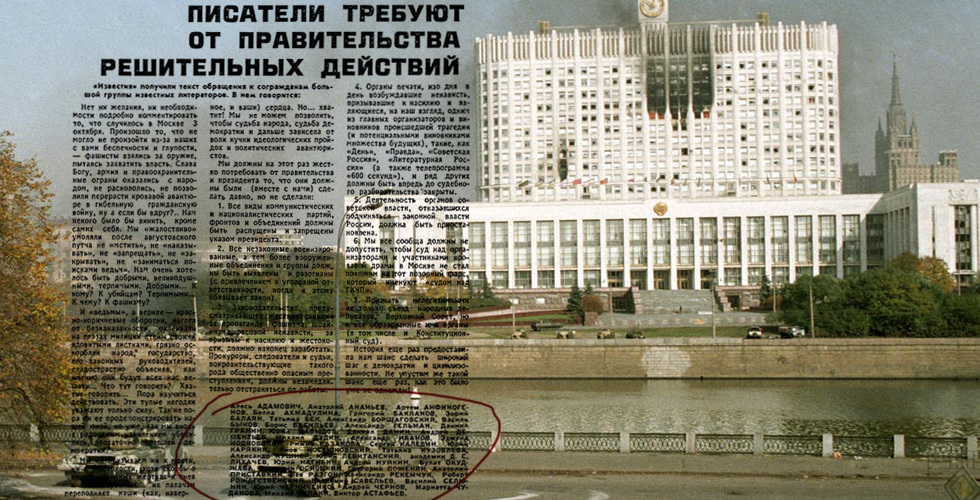
A letter of forty-two writers in support of Boris Yeltsin and with a call for decisive measures against the communist-nationalist opposition, published in Izvestia on October 5, 1993, and twenty years later continues to share the literary community. We asked the writers who signed this document at one time, and their colleagues, who took the opposite position, recall the October days of 1993.
Vladimir Krupin
Marietta Chudakova
Alexander River
Alexander Gelman
Yuri Kublanovsky
Vladimir Krupin
There was a letter on the eve of the October events * Union of Writers in support of the Supreme Council. I did not sign this letter, but I do not object to him at all. How can you be against it? After all, by this time everything had already collapsed. The West, British intelligence successfully advanced Gorbachev to power. Gorbachev is a flattering fool, he is a girder in front of Thatcher. Yes, there was already Yeltsin. But Gorbachev became a step for Yeltsin. A drunk with a club came and began to wave. That's whom they put in power. Ligachev, too, you know, a club smeared with honey. So we had no one to hope for. And in the Supreme Council there were two goats, Rutskoy and Hasbulatov, and led the rams to the abyss. Did I think then about them? I treated them very wary, very much.
This letter was then printed in several newspapers. I remember how Lyudmila Zykina soon abandoned her signature. It may have been harsh, this letter. Even consciously, some topics brought to exacerbation. But, you know, this tolerance is very disgusting. Tolerance - it is only in the house of tolerance. There is also political correctness. So far we are correct, while we call for tolerance, people die for real. It must be said directly that what happened in Russia is anti -Russian, anti -Orthodox achievement. And democracy, as Father John of Kronstadt wrote, only in hell. What democracy, there can be no democracy. She still holds in America with a club and dollars. With us, she holds on so far chatter and the same club.
I read the letter of writers-patriots then in the newspaper and approved it. Yes, they did not invite me to sign it, but what an insult there. Do you think the liberals all signed what they composed for them there? Astafyev simply tied up to the letter , which called for execution. The old man had already been fed at that time, Yeltsin had already published collected works. They called Astafyev, and Marya Semenovna screams out the window: "Viktor Petrovich, they wrote a letter there, ask you to sign." “Come on, Marya, sign it.” So it was then explained. In general, I was always deeply disgusted by dissidentism. There was one thing in the kitchen, another at work, with his wife, the third. And our paths with Astafyev then spread sharply. Although how can I condemn the old man? But for him, of course, it hurt me.
The liberals always had concern about their fate. I knew many of them personally. It was a group: here, they say, how so, they signed everything, but how can you not sign it when the one and that signed.
I can talk about these events by the clock. Just these days, when the mess began, we came with our wife to the Supreme Council, then the first time people were beaten from the barricades. We stood in the place where the chapel was now built. There is a deputy, I do not remember the last name, I recognized me. Says: "Vladimir Nikolaevich, go." “How I go, no one will miss me.” - "Come on, go." He showed his certificate at the entrance and said: "This is my assistant." So they missed me. There, inside, I looked like all floors, looked at people. Such a combat barrel, Cossacks. The faces are very good, I liked it. Then they all washed off somewhere: Barkashovtsy, Cossacks, military. And then they do not let me out. He began to look for his deputy and found him in the deputy, they met endlessly there. They didn’t let us go there, I only saw: at the table completely excited by Rutskoy, and Khasbulatov, he, on the contrary, sat with dangling. My deputy wrote me a pass, issued me right there as an assistant. And on this pass I later came again.
The second time - it was September 27, for a crusad. There was a prayer service right on the street. They served a prayer service, bypassed the Supreme Council with the procession. After a prayer, a rally, with Govorukhin, we went to perform. The rally was long for a long time. In the beginning, I and Govorukhin were shown to the people, and then they were held on the balcony to the very end, the balcony towards Krasnaya Presnya went out. You know there, all these performances seemed very warlike, but, on the other hand, very romantic. Rutskoy, for example, starts himself, shouts: "The ninth army is already coming, it is already on the march, cheers, cheers!" Well, stupidity, right?
On the same day, we went on a radio there, the radio station was called the "17th floor." Then they learned that we were jammed, and when the snipers were shot from the American embassy, the first shell was on the 17th floor. No, Rasputin in these days I don’t remember in the Supreme Council, he was in Irkutsk then. Belova, Kurbatova, Bondareva, Lichutin - no, I don’t remember how Mikhalkov. There was Sergey Alekseev, Sergey Lukoshin. There was, in my opinion, the son of the secretary of the Central Committee of the CPSU Zimyanin, fit, confident, he was friends with writers. Somehow it was all in such a nervous state that you can’t remember much.
After the rally, I call my wife, she says: “Tomorrow my mother comes, you know how much she brings.” The mother -in -law dragged out -of -end bags from the south, she loaded her relatives there. And then I thought that I would meet her in the morning, and then again here, to the Supreme Council. The situation was already very tense, everything was already heated. You know, they also do not relate to cattle, as Yeltsin treated people - turned off the light, turned off the sewer. I never stayed there to spend the night there, but that night I just wanted to stay. And he would have stayed if not for my mother -in -law. The next morning I met, returned, but my pass was invalid, it was taken away instantly. And then we were already drove with batons in Presnya. Such holding there stood there. I remember I began to scream one captain: "You are a Russian person." He replies: “I have an order” - and the face becomes cast iron.
Then I came on the day of the shooting. And everything thought: why did I not stay then to be killed and so that this shame would not be experienced? The shame is complete - the Russians shoot the Russians, and the whole world enjoys this. CNN, in my opinion, carried out a live broadcast: there is a shooting, and here is an advertisement. My God, how all this was humiliating, how embarrassing for the people who shouted to the side of "Hurray" there. Hurray - when the projectile flew across the bridge. It is impossible to imagine this that Jews in Jews, Georgians in Georgians ... shame, shame: for the delight of the world they arranged a show for the whole world. And Thatcher then won - with the help of our fools.
That's another. My son, shortly before, went with an excursion to Altai. And they invited Altai schoolchildren to us there. In our house, these days were a man of twelve children. The whole apartment was in children. We also managed to see something in the center with them before that. And on the morning of October 5, when everything has already ended, American tourists on New Arbat from children bought a dollar. The sleeves there were strewn, and the boys were delighted with these sleeves gathered. And so I go with the boys, some man, as I grabbed by the shoulders, shook, cry and says: "Eh, Krupin, Krupin." I don't know who it was. I remembered this as the disappointment of the people in the writer of the people: what are you, chatted about Russia, but here it is, shot.
I then swore that I would never look in this direction. And now twenty years have passed, and I have never looked at this house. We drive by car - I will turn away. Funny, of course, children's protest. But by gravity, it was, perhaps, the main event of my life.
* Voronin Yu.M. Harding Russia: Political and Economic Portrait of Yeltsinism. P. 209-210.
Marietta Chudakova
I will say right away: “ The letter of the forty -two” I would sign it today - without hesitation. Let this have in mind those who keep the deaths of the signed and neatly report on the Internet from time to time: “Deal”. And continues to be mistakenly considered himself Orthodox.
Now to the origins of this letter. I do not remember exactly who suggested that I sign it. I only remind you that there were several letters - in a row.
Since August 1993, when many thinking people became clear that urgent political actions were needed, otherwise the country has come to a dead end, a group of people who equally evaluate the situation has developed. I remember that it was in August that I flew off somewhere, there was an hour before leaving the house. They brought me an open letter, offered to sign. Not everything liked everything in the text - in a form to which I am always attentive. But they said that it was too late to rule, many signed this particular text. It was only possible to sign or not sign. I understand perfectly that there are situations when not up to the style. With the content of the letter, I agreed. And signed.
Autumn 1993 was another fork in the history of Russia. Those who do not understand this are unlikely to understand our dramatic story of the past century.
Returning, I found out that President Yeltsin read our letter and invited the signed to meet and discuss the situation. This meeting lasted five hours. The president was preparing to declare early elections and clearly needed our support.
Russia is too big a country to afford dual power. At each meeting of the Supreme Council, the chairman of the Khasbulatov publicly (then, I remember, all the meetings were broadcast) mocked the president, decisively tore all his initiatives - with the noisy approval of the pro -Soviet majority. He was a completely different person, not the one that I saw on the balcony of the White House in August days of 1991 by an absolute supporter of Yeltsin.
I have my own psychological explanation for instant metamorphosis that occurred to him at the end of 1991. Just fogging head anger. Why is it not to him, the professor of the economy, but Yeltsin, the collapsing economy of Russia, entrusted to anyone led by Yegor Gaidar?
I am sure: Yeltsin did not have another choice in September 1993, only the dissolution of the Supreme Council and the announcement of new elections (and we supported his decision, I remember, another letter). But the deputies had a choice - between the armed rebellion in the capital and another, bloodless decision. They love to say: by his decree No. 1400, Yeltsin drove the deputies into a trap. Not at all. They had a decent exit, they could declare the whole world that they did not agree with the president, but for the sake of peace in the country they obey the decree and go to new elections. They did not do this - out of fear (quite justified) that they would not be chosen.
Moreover, the president had no choice on how to suppress the armed rebellion in the capital that had begun by the deputies with all the means at his disposal. Any president of any country would be obliged to do this.
The president had few funds. The police, which was supposed to operate in the city, then inactive. The police in Moscow on the night of October 3, one might say, did not exist. At half the night, I left the Savelovskaya metro station and went alone for Russian television familiar Muscovites in the shortest way - through the courtyards of the printing house of Pravda. I went through the turnstile - not a soul. In half an hour of the journey through these yards, which, of course, had to be guarded, I did not meet a single policeman or guard.
She went to the six -story building - darkening, as in war. Two windows burn with weak light. It turned out later: the office of CEO Lysenko and the studio. Behind the closed gates are a dozen police officers in helmets. I did not see such dead from the fear of young people either before or after: they waited for the assault from a minute and realized that they would last against well -armed Makashovites for no more than five minutes.
At the end of my live broadcast, I turned directly to Rutsky: “General Rutskoy, you disgraced yourself! You, a Russian officer, sent some Russians to kill others. ” The air is over. The correspondent Berezin confusedly said: "You are a brave woman." I laughed: "Maybe just stupid?"
We both knew with him: it is not known who in the morning will be the President of Russia-Yeltsin or Vice President of Rutskoy, already appointed by the Supreme Council for the position of president.
Did I think at the time of signing a letter about the consequences, negative or positive, for my professional activity and career? I can assure you, in those days there was by no means a career.
It was the second putsch. The second attempt to return Soviet power to Russia - with well -known consequences for everyone. I could not help resist this in all ways available to me.
When, after speaking at half a night, I was taken by car across Moscow, from Pravda Street to Belyaevo, I did not see a single policeman (I did not take my eyes off the streets all the way. Moscow was ready for surrender.
Personally, I was not going to hand over Moscow either to the drunken Makashov, who yells “beat the Jews”, or Rutskiy. Many remember the television, where he screams: “Pilots! Raise the cars! Fly to bomb the Kremlin! "
Yeltsin, the next morning, was supported by the army. God sees, I have never been a fan of General Grachev. But with one of his phrase, heard on October 5 on TV, I agree today. He said: “On October 3, a civil war was supposed to begin in Russia. On October 4, the army stopped her. ”
On the conscience of our journalists, they invented by them and the fixed catchy and false phrase “execution of parliament”. The “execution” in the Russian language is when they bring out unarmed and often connected, which is unable to resist a person and shoot.
I will explain on the points.
Firstly, the White House was stuffed with a weapon.
Secondly, there was no parliament in Russia then.
Thirdly, not a single deputy of the Supreme Council received a scratch.
In 2006, I held a written contest among schoolchildren in many areas of the country "Russian language is told to you!" Among the many questions there was this: “Do you consider it correct to use the word“ execution ”in the expression“ execution of parliament ”in modern journalism in modern journalism in relation to events in Moscow on October 3-4, 1993?”
How much more sane than journalists were more sensible ... The vast majority responded as the eleventh grader Igor Ponomarev from the village of Chemal in the Altai Republic (on the edge of Russia): “I think this is wrong. For example, we can say “shooting at the parliament building”, “shelling of parliament”. And the word “execution” is more acceptable to living beings. ”
I consider it a big mistake of the Duma and amnesty to the participants of the armed rebellion, and the refusal to investigate those events. It was necessary to establish the cause of the death of everyone . If the sniper bullet is whose sniper. About 150 people died, everything is known by name. Then they said: no, ten times more. But this is refuted by the only question that I at the same time asked: where is their mother ?
Well, what kind of mother in those days would be silent, would not ask a question that all the media would be transmitted vying (I will remind those who have forgotten over the years - we had freedom of speech then). Why did no one ask: where is my son, he left and did not return?!
Yes, in that letter I did not like everything. But I was sure that I was obliged to maintain actions president. I keenly felt how hard it was for him to decide on it. And I respected his determination.
He did not let the wheel of history a second time in three years in the opposite direction. I would like to believe that we will not allow this either today or tomorrow - including Thanks to collective letters. In a situation of lack of liberal opposition parties in the Russian political field, this genre is not outdated.
Alexander River
Let me tell you what I remember about the October events, and then back to what happened before. You ask where I was October 4. On this day, or, probably, the day before, critic Valentin Skutskiy, a prominent figure in the democratic movement, called me. It was about a letter, which was then called "a letter of forty -two." I arrived at the Central House of Artists and signed it. On October 5, after all the events at the White House, Izvestia published this letter. That is, published a day after those tragic events. I was not interested in who wrote this text. It was so close to the fact that I thought and worried at that time that it did not occur to the handwriting somehow. And to those who else signed it, I was not interested either, this was not the first writing letter to Yeltsin. Almost the same signatures stood under the August message.
And we did not discuss this with each other: we understood each other so well at that time. It was absolute unity. Just in case, I’ll tell you that if they put this letter on the table today, I would sign it again.
And then I went to work, to the PIK Publishing House. Do you know that it was we who published the first book of Yeltsin, Confession on a given topic? The editors were on New Arbat, house 21. This is a high-rise of a garden ring, a publisher’s room on the 11th floor. When we came to work, it was already clear what was happening below, at the White House - screams, shots. But we worked. And immediately after the explosions began to thump, when the tanks beat at the White House, they began to shoot at our windows. All windows of these heights on the New Arbat were collapsed. They shot from the roofs not at the tanks, not by the army, shot at civilian buildings on the street. We are all from this floor, all the organizations who were there fled to the restroom, because she was in the end of the building. And bullets right in the windows. A couple of days later, Sergey Yushenkov, a deputy of the State Duma, came to me, ten years ago he was killed. А тогда я ему показывал дырки от пуль. Лежали еще пули между рамами: они пробивали первое стекло и дальше, потеряв инерцию, отскакивали. Вот мы стояли с Юшенковым у окна и рассматривали пули. Зачем стреляли по нам, по мирным людям? Кто это делал? Тогда говорили, что стреляли люди Хасбулатова из Чечни. Слушайте, это не самое приятное воспоминание в моей жизни. Я, заставший войну, бывал в такой обстановке дважды: в Сталинграде в 1942-м, мальчиком еще, и в 1993-м на Новом Арбате.
О том, что было в течение двух недель до этого, я ничего интересного не могу вам рассказать. Я на эти митинги не ходил. Даже из любопытства этим не интересовался. Брезгливость не позволяла идти слушать лидеров движения, которое развязало все, что потом случилось.
Но мало кто помнит, что за два месяца до всех этих событий, в августе, было другое письмо, и там тоже есть моя фамилия. Да, кажется, тоже звонил Оскоцкий. Мы написали Ельцину, что мы крайне встревожены тем, что происходит в стране. Противостояние было очевидно. И что добром это не кончится, тоже было понятно. Мы просили его быть твердым человеком и не отдать идеалы, за которые боролись уже много лет. И при советской власти («Апрель», объединение писателей в поддержку перестройки, появился еще в СССР), и потом. Где-то в сентябре стало известно, что Борис Николаевич хочет встретиться с писателями. Эта встреча откладывалась несколько раз. Говорят, что Ельцин болел. А за несколько дней до встречи 15 сентября я ходил в Кремль к Вячеславу Костикову, пресс-секретарю Ельцина. Спрашивал, что слышно. И он сказал: «Грядут события».
Как тогда в Кремль ходили, всех этих бюрократических подробностей я, честно сказать, не помню. Мне был пропуск заказан, а с Костиковым мы были знакомы еще по Парижу, он работал в ЮНЕСКО. И как раз он сказал, что Ельцин на днях все-таки встретится с писателями.
Понимаете, уже никто не ждал, что это рассосется само собой. Накануне 15 сентября мне позвонили из Союза писателей, из «Апреля» точнее, и сказали, что мы собираемся в Кремле. Оттуда нас на автобусах привезли в Теплый Стан. Огороженная территория на краю города. Вот там в резиденции АВС (читать надо кириллицей, автоматическая станция какая-то) мы говорили с Ельциным. Первое, что он нам сказал: «Мы встречаемся в резиденции ГКЧП, отсюда руководили мятежом 1991 года. Мы, — говорит, — конфисковали ее у КГБ и сейчас используем ее как загородную резиденцию президента». Был разговор на несколько часов. Говорили Мариэтта Чудакова, Роберт Рождественский, да почти все, кто подписал потом это письмо. Булата Окуджавы не было, к сожалению.
Ельцин отзывался на наше письмо, так что тема была понятна. У меня зафиксировано в дневнике. Он сказал: «Видимо, события будут трудные, но мы сделаем все от нас зависящее, чтобы обойтись без кровопролития». И еще на ту же тему я записал фразу Татьяны Кузовлевой, у нее вообще было очень интересное выступление. А в конце она сказала: «Борис Николаевич! Если вам не жалко наших внуков, подумайте о своих». Понимаете? Острота положения тогда уже всем была понятна.
После официальной встречи мы перешли в другую комнату, там было небольшое застолье. Помню, что Юрий Черниченко и, кажется, кто-то еще принесли со своей домашней пасеки мед. Борис Николаевич налил водки, размешал с медом и сказал, что это очень вкусно.
Ни с Беллой, ни с Робертом, ни с другими я это письмо потом не обсуждал. Мы настолько тогда были едины, что нам не нужно было напоминать друг другу об этом. Это наша общая жизнь. Потом разобщение пришло. Но это общая жизнь.
А такими ценностями, как выгонят с работы или перестанут печатать за то, что подписал письмо, мы тогда не жили. Убьют или не убьют — вот какой был накал событий.
Повлияло ли подписание писем с той или с другой стороны на человеческие отношения? На отношения с Маканиным, который тогда Ельцина не поддерживал, — нет. Со Станиславом Куняевым мы оба были секретарями московской писательской организации, Куняев до сих пор ведет семинар в Литературном институте. Мы пожимаем друг другу руки, но сказать, что мы дружески общаемся, — это будет натяжкой. Но это, знаете, не связано с событиями 1993 года. Это все раньше началось и еще не кончилось.
Я не могу говорить, кто тогда победил. Можно ли говорить о победе, зная кровавый финал этой трагедии? Но демократические писатели точно не ошиблись. И просчеты ельцинского окружения, и сам эпизод передачи президентской власти — это все то, о чем мы пытались его тогда предупредить. Сами понимаете, кто победил.
Александр Гельман
У меня нет о событиях 1993 года никакого личного сюжета. Я не помню, кто сообщил мне о «письме сорока двух», не знаю, кто его написал, не интересовался, кто подписал его до меня, ничего в его текст не добавлял и не зачеркивал. Ни с кем, кроме домашних, я содержание письма не обсуждал.
Будучи пристальным наблюдателем, а порой и участником происходящих в ту пору событий, я бы уверен, что меньшим из двух зол для моей семьи и для общества будет поддержка президента Ельцина и тех людей в руководстве страны, которые объединились вокруг него. О последствия для моих профессиональных интересов я тогда не думал. Я думал только о последствиях для судеб тех демократических начал, которые только-только стали укореняться в обществе, о последствиях для соблюдения прав человека. Одного активного участия в событиях тех дней на стороне Хасбулатова такого откровенного и яростного антисемита, как генерал Макашов было для меня более, чем достаточно, чтобы неколебимо быть на противоположной стороне.
Эти письмо на мою дальнейшую жизнь никак не повлияло. Какого-то серьезного его обсуждения с теми, кто его подписал, не помню. Знаю, что несколько человек позже отказались от своих подписей. Что касается меня, я продолжаю быть уверенным, что занимал тогда единственно для меня возможную позицию. Уверен, если бы в октябре 1993 года пришли к власти Хасбулатов, Руцкой и Макашов, положение страны сегодня было бы еще хуже, чем есть.
Несколько раз в последующие годы я подписывал письма в связи с нарушениями прав человека, против цензуры, против попыток реабилитировать сталинщину. Пока такого рода устремления не прекратятся, письма в защиту прав граждан в качестве публицистического жанра не устареют. Было бы неплохо, кстати, издать сборник писем-протестов, оглашенных в последние тридцать лет.
Юрий Кублановский
Вернувшись в Россию из эмиграции в 1990 году, я старался посильно участвовать в общественно-политической жизни. Но в отличие от столичной прогрессивной общественности очень быстро понял, что мы имеем дело не с построением демократического общества и цивилизованного рынка, а с тем, что кто-то верно тогда назвал великой криминальной революцией. И к этой революции я встал в оппозицию. Но, разумеется, из этого никак не следует, что я был солидарен с Верховным Советом. Во-первых, потому, что он был достаточно красным, просоветским, а я стоял и стою на позициях антикоммунистического патриотизма. А во-вторых, я видел, что и там хватало бесстыдного, загребущего — достаточно вспомнить, как большинство депутатов приватизировало свои квартиры совершенно по-наглому. Хотя мировоззренческий спектр в Верховном Совете был гораздо больший, чем это представляла тогда либерально-демократическая печать.
Это 3 октября, последнюю ночь перед расстрелом Белого дома, мне уже никогда не забыть. Я приехал туда где-то ближе к полуночи, пробирался между мотками колючей проволоки. Само здание было погружено в темноту: уже давно отрезали электричество. Площадь перед Белым домом, наверное, напоминала петроградские площади 1917 года. Горели костры, и в свете их пламени кто-то пел советские песни («и снег, и ветер, и звезд ночной полет»), кто-то читал Бердяева, священник в рясе здесь же проповедовал. Очень разные устремления, но все эти люди, безусловно, стояли на бескорыстных патриотических позициях. И как же далека была от них верхушка Верховного Совета, занятая своим политиканством! С ужасом думаю, вспоминая эти лица, что, наверное, большинство этих людей наутро погибло, что жить им оставалось тогда всего несколько часов. Наутро я приехал снова к Белому дому, на этот раз стоял напротив, в самом начале Нового Арбата. Вдруг с Кутузовского подъехали танки. Потом началась стрельба. Всего этого, конечно же, не забыть. В какой-то момент я прикурил у мужчины неподалеку, отошел чуть в сторону, а тот рухнул на землю убитый. Выстрела не было слышно. Кто стрелял, откуда? В десяти шагах от меня убили человека, с которым мы только что переговаривались, у которого я — минуты не прошло — прикурил.
Вот что меня шокировало тогда невероятно: группа людей рядом при каждом залпе танка аплодировала. Я выглядел среди них белой вороной и даже получил на этот счет замечание, мол, что-то, Кублановский, вы не радуетесь победе демократии — так это прозвучало под грохот танков. Меня узнали, хоть и не часто, но я все-таки мелькал и в прессе, и на телевидении, а это была явно группа интеллигентов.
Перед тем, конечно, как многие москвичи, в течение этих двух недель в конце сентября — начале октября я не раз заглядывал на Краснопресненскую набережную. Иногда слушал ораторов-демагогов, видел, как ОМОН разгоняет тех, кто поактивнее. Но вот так, вплотную столкнулся с этими людьми впервые накануне той трагедии.
К Белому дому я, конечно, ходил один, зачем подвергать близких риску? А уж когда пришел пик противостояния, я тем более предпочел одиночество.
Никаких коллективных писем я тогда не подписывал — по душе не мог подписать. Не мог занять твердую позицию одной из сторон, и у тех и у других я видел большие изъяны. Но почти сразу в те дни написал стихотворение «Прямой наводкой» о событиях 4 октября, и оно было одновременно опубликовано в воинственно либеральной тогда «Литературной газете» и в прохановской «Завтра». С Прохановым, разумеется, никаких отношений у меня не было, но позвонил Владимир Бондаренко, отвечавший в этой газете за литературную часть, и спросил, можно ли его перепечатать. I agreed. Ведь это стихотворение над схваткой. Это русская драма, которую переживает стихотворец, и только так, по-моему, и можно было тогда чувствовать. Требовать крови, кровищи, жесткости — никогда. Раздавить гадину, как тогда повторяли, — это мне было омерзительно.
Конечно, я досадовал на тех, кто поставил свои имена под «письмом сорока двух». С доэмигрантских еще времен я был знаком и с Булатом, и с Беллой Ахмадулиной. Да, это были мои друзья, и мне было больно, что мы с ними так разошлись. Гранину-то я знал цену — он был одним из гонителей альманаха «Метрополь». А Астафьев от своей подписи позднее отмежевался. Недавно в Иркутске вышел том его переписки, где он утверждает, что его подпись поставили без спроса. Но не в этой подделке, конечно, дело, ведь многие действительно подписали это письмо вполне искренне. Честно сказать, я объясняю это недостаточной мировоззренческой глубиной. Всем надоел тогда ведь социализм, а деятельность Верховного Совета воспринималась как однозначно просоциалистическая. Хотя в самом Верховном Совете идеологически было все намного сложнее.
А с Булатом мы говорили незадолго до его смерти. Помню его слова: «Юра, я тогда был идеалистом. Сейчас я разочарован в этом во всем». С Беллой, нет, мы к этому не возвращались. Но не здороваться, не подавать руки, не общаться? По-моему, это идиотизм. Вот Льву Ошанину я не подал бы руки после того, как он обличал Пастернака. Есть вещи непрощаемые — как травля Пастернака, как выступления против Солженицына. Но когда речь идет о чем-то мировоззренческом... Думаю, те, кто подписал это письмо, защищали Ельцина и ельцинизм не из корыстных соображений, они действительно мыслили так, а не иначе. Так что ж тут ссориться? У каждого свой путь, свое понимание реальности.
Но я никогда, например, не был и сторонником «Слова к народу» , которое появилось после путча в 1991 году с подписями Распутина и того же Проханова. Нет, и в этом лагере я не мог быть — прежде всего из-за его прокоммунистической составляющей. Ведь в 1982 году я, собственно, и лишился родины из-за своих антикоммунистических убеждений. Тем более я никогда не мог разделять симпатий к Сталину, которые сегодня опять, увы, расцветают пышным цветом.
Думаю, мне повезло, мое видение было тогда объемней, чем у других. Я прожил до этого восемь лет в эмиграции и знал проблемы, с которыми сталкивается европейская демократия. Понимал, что мир гораздо сложнее, чем такая поляризация: Россия с одной стороны и так называемый свободный мир с другой. Я пожил в свободном мире и видел, что все мы, в общем, в одной упряжке. Сейчас-то об этом говорят все, от Кремля до оппозиции, а тогда это было еще не столь очевидно таким людям, как Булат. Требовали раздавить гадину, потому что считали, что Руцкой и Хасбулатов — олицетворение коммунистического режима.
Правда, тогда, в 1993-м, серьезных мировоззренческих разговоров ни с кем у меня не было, да и не хотелось, честно сказать, мне обо всем этом рассуждать. Слишком болезненно переживал я случившееся. И ясно видел, что ничего хорошего Россию не ждет. Так случилось: война в Чечне, березовщина, вся эта олигархическая беспросветная бесстыжая жизнь. Солженицын говорил, что мы должны строить Россию нравственную или уж никакую, тогда и все равно. Нравственную, как видим, пока что не получается.
Подготовила Елена Рыбакова