
Translated material
October lessons: Was there an alternative?
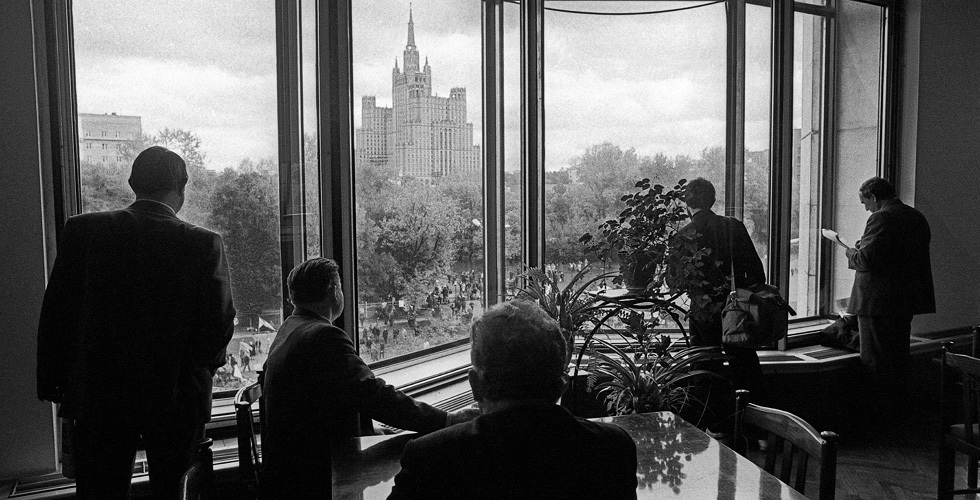
We asked Russian public intellectuals - sociologist, historians, journalists, political scientists who adhere to a variety of political views today - to answer the question: was an alternative to the course of history in 1993? And if so, what?
Boris Dubin
Gleb Pavlovsky
Maxim Sokolov
Alexander Morozov
Modest Kingov
Andrey Zorin
Kirill Rogov
Boris Dubin
I think the return to the events of 1993 is now caused not just by a round date - they say, twenty years have passed. The question of a possible alternative to what happened then and then is usually asked in situations where the results of the incident are surprised, do not suit, disturb, depress, torment, finally. That is what our case today ("otherwise his name is different"). It is worth saying that there is nothing unique in this case or the moment, as in the feelings accompanying him, “the lost victory”, if we assume that Yeltsin defeated the assault on the White House - this is a kind of basic model of Russian history, and on its “forks” the acting persons of the front plan are more or less consistent, although far from a century, the worst option has been chosen over the century (about this a few years ago substantiated And expressively wrote by I. Karatsub, I. Kurukin and N. Sokolov in the book “Choosing their history”). It is clear that similar, speaking by backet words, CAP Au Pire is specified by the very nature of the authorities, from which any other groups and layers of society are removed, and any alternative receives the status of a conspiracy, undermining, digging, treason, riot, rebellion, etc.
The choice of alternatives-although again the question remains how conscious he was then-occurred, in my opinion, before and rather even occurred several times. And they chose at the same time - in the new conditions! -Not only people, as they say, making decisions (we will call them power), but also the groups who prepared and broadcast these decisions (intelligentsia in power and mass media), as well as much wider masses, these decisions with their voting and the elections supported. In order not to delve far into history, I will say briefly that the first and decisive choice was voluntarily or involuntarily made in August 1991, although he matured, of course, even earlier-it was the transition of power and support from Gorbachev to Yeltsin with the following, several months of Yeltsin inaction. The second point is the transition from the Soviet economy to the post -Soviet, the choice of the model of this transition and the tactics of its implementation (privatization and shock therapy). The third transition developed throughout the 93rd year, and it was actually a transition from a “parliamentary” model of a political structure to the presidential. Behind him, as the French historian and sociologist Aleksis Berelovich noted in the 2009 article, “A chance to have a chance”, there was actually a transition from democracy to authoritarianism, although he was presented as a path from the Communists to the Democrats in the Lexion of the authorities and in the mass media (almost all the words would have to be included in the quotes, but I do not want to be distracted by their explanations). Finally, the last point that year was set by the December elections with the release of V. Zhirinovsky’s model figure (a parody of the authoritarian leader - the present and the future) and the third place received by the Communists. Further, I will add, again, several months of the characteristic Yeltsin inaction, which were violently resolved by the Chechen war, followed.
The final meaning of all these transitions formulated, and by March 1994, Yuri Levada (article “Public opinion in the year of crisis fracture”). He saw him as the “end of the mobilization society” and identified two phenomena of Russian politics and political culture, then against the background of the previous mobilization - they looked new, and since then they became quite familiar, more and more - they later formed the power regime of zero and subsequent years. This is a massive apathy in relation to politics (not at all - in private life) and the mass distrust of power under, I emphasize after the Levada, which prevails generally supporting the current Status quo .
As a matter of fact, no alternatives to this briefly and coarsely described by the described course of events and the arrangement of forces in them over the past decades have not been indicated. Neither the “other” power, nor the “other” media, and, finally, the “other” people in cash, according to the memorable Stalinist letters, was found. The first more or less distinct hint of a possible alternative point of view and a model of behavior, except for increasing capsulation of power, primitivization of media and passive decreasing adaptation of the majority of the population, appeared/manifested in the known events of December 2011 and followed by them (however, the then millionth queues for the Bogoroditsa belt and mass Orthodox standing should also be taken into account). One way or another, this is an object for a completely different conversation. I only note that the mentioned “alternative” is formulated in terms not political, but civil and ethical; The hypothetical translation of these statements and applications to the field of politics is a separate big question.
Gleb Pavlovsky
The 1993 was inhabited by Gothic beasts: “Dual power”, “Fatal struggle of the branches of power”, “fascist threat” and “red-brown council”-phantoms of a neurotic, deciding how to simplify the situation, preventing himself from considering it. Hence the nonsense of disputes about alternative scenarios - they are supposedly only fantasy for losers. The Russian way to discuss the facts is not based on the prerequisites (after all, they are contemporary!), But on supposedly accomplished facts. Fait Accompli , or translated into Russian “What has been done is done”: a normal gangster approach that leaves the “Facts” with whom the knife is. When the narrative and a map of the political situation consist entirely of such “facts”, you have not left any maneuver - except for a tank.
But before the facts were accomplished, there were no these facts or they did not seem possible. When Yeltsin in August 1993 announced that he would conduct “artillery” and “go on the offensive”, he did not at all hint at the literal firing in the center of the capital. However, only 6 weeks passed, and the cannonade was heard on Krasnopresnenskaya to the accompaniment of the shooting of Kremlin snipers-provocateurs on passers-by. “Impossible-93” is more likely what happened than what failed.
What was not in September-October 1993? Banal: normally, in a half-dumped, dirty-compromise, immoral-thorough output. A relatively simple decision was to make a long -prepared new constitution of Russia - with which the Kremlin himself pulled for months, until the Sun deputies also joined the constitutional sabotage. A constitutional crisis has arisen? If you wish, find a way out of the crisis, find a political exit. Oddly enough, the simplest alternative was not to sign the decree 1400. But having entangled the White House with a thorn, like a funny concentration camp, the Kremlin himself erected the scene of the second Kremlin , provoking the deputies of the Supreme Council. And for yourself - a seductive simple tank target.
Churchill’s intellect and morality are not needed to crawl out on his belly from a modified place: Yeltsin would be enough for his skin caution and a bit of mistrust to the advisers and ministers-players. With a firm unwillingness of the politician to shoot at the fellow citizens (a sign of moral health, nothing more) and the resignation of the president at the same time as the vice president would leave politicians a chance to get away from madness. But opening shooting for Strengthening the constitutional order, power changed orientation and identity. Changing the civilization code to one where each new madness is explainable from the previously committed. And now “Russia is fate” (c).
Maxim Sokolov
Theoretically, if we assume that all the parties involved in the conflict were distinguished by outstanding humility and prudence, we can imagine that thanks to these excellent qualities they managed to avoid a direct clash that we observed on October 3–4, 1993. And even develop a stable political compromise - God has a lot of miracles. But in the then specific post -revolutionary situation, when it recently spread, like a wet newspaper, which had recently seemed indestructible to the Soviet Union, it was very difficult to expect from the participants in the conflict of laudatory caution.
The ideas about the limits of the possible and permissive in such a situation are eroded to extreme - if the Soviet Union collapsed, then the unstable post -revolutionary regime will be even easier to collapse, and what prevents acting in this direction, not offending by means? The instinct of obedience, holding from sudden movements, is extremely weakening in such a year. As a result, what happened happened, and only the thought that could be much worse. Better - hardly.
Alexander Morozov
Sedakova has a poem written to the death of the Soviet leader. Requiem . And there is an image of power as a bottomless barrel. The authorities drink as a horse of Munahusen and will never get drunk. The gerlo of power sucks everything, devours everything and gives rise to emptiness. This is a strong and accurate image of "power centralism." The more powers, charisma, social energies are taken by the personal power of the head of state, the more distinct the paradox: the very image of this superpower loses its content and is made only by the contour that protects the void. An important discovery for those who are approaching the center of power is a sudden detection of emptiness. The center is empty. A lot of rhetoric, symbolic gestures, “agendas” and so on, and so on, are made along the contour. But inside the contour is an expanding emptiness ... This emptiness involuntarily causes a desire to hoax it. And then - "Demistification." And then it is mystified again.
This is the lesson of October 1993. As it turned out, after the euphoric struggle with the 90s in 2000-2003, in the second half of the zero Russia in its post-Soviet being, it failed to build a modern state and rolled away exactly to the state of the mid-90s. All "mirror": instead of the reformist team of Gaidar - continuous reforms of the "technical government" Medvedev. Instead of “Semibankershirs” - seven “Friends of Putin” at the head of giant holdings. Instead of MMM and Khopra - 40 million adults, Zakredi with banks. Instead of the destruction of the industry research institutes - again destruction, now the wounds. Instead of the super -presidentiality of Yeltsin, Putin is exactly the same omnipotence. Dezhavu spreads up to any petty institution. In 1993, the Presidential Council was shaking under Yeltsin. In 2013, the HRC shakes at Putin. The development plan of the institutions, which was nurtured at the beginning of the zero for Putin and was even supported by him, had long failed. No at least conditionally autonomous political entities - neither trade unions, no parties, nor authoritative guilds. The 1993 Yeltsin mistake could be corrected on the route somewhere in the 2003-2006 zone, but instead Galera resolutely fell on the reverse course. Now, instead of “institutional design”, we again have a huge empty funnel in the center of political space, which sucks people, ideas, resources. This emptiness is a mystified Kremlin. It is impossible to even make a claim to such a structure of power about the absence of a “plan”, “project”, “strategies” or at least “vector”, “directions”. Because the very content of this funnel is the "absence".
Most likely, political time in this funnel flows differently. The horror is that the population - sometimes in propaganda species called the "people" - looking towards this funnel, is in the zone of its hellish gravity. The self-generation of any proto-institute immediately meets a heart-rending cry: “Ahhhh, they want to capture a funnel!” (Kremlin, center). “Navalny wants to become Putin,” the opposition wants to sit in the place of the thief and also steal and so on. Most amazes the naivety of the "reformists" at the funnel. Any of their plans in the zone of this gravity are interpreted as the intention to “saw” or create additional conditions for theft. The one who holds the “contour of the void” for a long time begins to turn into an anecdotal character himself. This is now happening with Putin. This happened with Yeltsin and Brezhnev. The moment when the physiological details of the “Holder of the Void”, his family, his quirks are increasingly significant. Ballerina Kshesinskaya, adviser Rasputin, “ministerial Czech”, faceless governors ... October 1993 is well described in the newly released novel by Sergey Shargunov “1993”. There was nothing for Eltsin's enthusiastic resistance. The point is not even that Makashov -Barkashov and other daring, who took up the weapon, were glued to the confrontation of the Supreme Council. And the point is not that Khasbulatov -Rutskaya later clearly discovered any absence of their own scale as politics or public figures. And the point is not that they "dispersed the advice." I agree that Igor Klyamkin writes today: and these advice was only the legacy of the “Soviet”. It would not have been such a new post -communist system of institutions, not so people would have to be located on their land and improve it.
How? How to enchant this horseshoe of the "Russian power"? How to melt it, cross? Or rather - how to change its molecular composition? In my opinion, by the 20th anniversary of October 1993, it is necessary not to talk about the fight of Khasbulatov with Yeltsin, but about why in 2003 it was not possible to take advantage of the chance to jump off this centralist scheme. The time is now that Gref, Dmitriev, Illarionov, Pavlovsky, Cordonsky made the same book as Koch and Aven did about Gaidar. Now it’s interesting to talk not about 1991-1993, but about 2001-2003. The ten -year anniversary of the second fall into the hole of centralism, which burns out all the vitality of society, makes a root, cripples, oppresses ... He will never gain his own content, but will only be a chain dog protecting the failure, a hole in the center of national history. In the “One History for Children” textbook, this pit will be quite difficult to describe.
Modest Kingov
I was among those who, upon the call of Gaidar, came to the Moss Council Square on the evening of October 3. Among those thousands who on the afternoon of October 4 came to support the assault on the White House and themselves fell under fire from there near the US Embassy. I could not see and did not see in the Union of Khasbulatov, Rutsky, Makashov and democratic intellectuals any democratic and legal idea. I am now convinced that the coup committed by Yeltsin on September 21, 1993 was no less constitutional than the resistance to him from the White House sectors. Behind Yeltsin there was hope for regular statehood, behind the Supreme Council of the RSFSR - already shimmering through the land of chaos. Obviously, it was an act of civil war. The alternative to him could only become a growing turmoil. Indeed, in the Civil War, not law wins, but the order for which the right follows. Or his attempt. Yes, October 1993 turned out to be an attempt to order and law. Just an attempt.
Andrey Zorin
There is always a historical alternative to what happened. As for the answer to the question of what kind of alternatives we are talking about, it depends on which date we choose as a possible fork. If we talk about the events of the end of September - early October 1993, then the historical alternative could be the victory of the opposite side with the mass terror and civil war arising from it. Then many of those who curses Yeltsin today for the “execution of parliament” would curse him, if, of course, they survived, for not acting then hard enough. It is enough to recall how Grigory Yavlinsky at night from October 3 to 4, hysterically demanded from the president to use force, and then voted for impeachment Yeltsin for applying it, and in a very homeopathic dose.
If, for example, take the moment, which came immediately after the famous referendum “Yes-yes-no-yes”, then, then, then, then the president had the opportunity to cut this knot with less shocks and losses, instead of recognizing the meaningless decision of the Constitutional Court, which drove the situation into the final dead end. It is clear that on the basis of a slightly grabbed constitution of the abolished state, it was impossible to resolve the crisis in any case. If you look back in an earlier period, then, perhaps, the presidential side had some other rational decisions that would help to avoid a power confrontation. It is clear that it was extremely risky to leave the Supreme Council in the hands of bandits and adventurers, but it is much more difficult to say how this could not be allowed. Obviously, the leaders of the group, which opposed the president at that moment, were, in principle, they were inconsistent. It is possible that with more thorough and consistent political work, it was possible to tear off some part of their supporters, but it is easier to teach large historical figures than acting in a deadly crisis and on the verge of a disaster.
Be that as it may, the historical result of the events of the fall of 1993 is already in general terms. The worst then, thanks to Yeltsin and Gaidar, was avoided, but the consequences of this collision were more than sad, and Russia continues to get out of them to this day.
Kirill Rogov
Мне дважды не нравится выражение «историческая альтернатива ходу истории». Первый раз оно не нравится своим общим концептом: что можно в одной точке перевести стрелки и получить другой ход истории.
Кажется, что можно. Например, если бы Руцкой, скажем, был не Руцкой, а какой-то более содержательный человек, то, наверное, многое было бы не так. Но Руцкой был Руцким тоже не совсем случайно. Ельцин вытащил его на поверхность в рамках какого-то другого, предыдущего компромисса, который имел свою логику и казался на тот момент благом. Но к осени 1993 года это «благо» уже выглядело ошибкой и большой проблемой. И если смотреть под этим углом зрения, то мы можем сказать так: если бы и тогда, осенью 1993-го, был найден некий компромисс, то это еще не значит, что не было бы некой следующей драмы 1994 года, про генезис которой мы бы говорили «ее корни лежат в компромиссе 1993-го».
Я еще вернусь к воображаемой «драме 1994 года», но сначала скажу, почему мне не нравится это выражение второй раз. Оно второй раз не нравится мне, потому что это такая главная (или единственная!) фишка традиционных русских рассуждений об истории: надо найти точку и некоторого ответственного человека, откуда и из-за которого все пошло не так. Это такой смысловой предел популярного русского историософствования: найти точку и ответственного. А дальше — ступор. Предполагается, что если бы в этой точке было принято правильное решение и был бы вместо неправильного человека правильный человек, то все пошло бы дальше в каком-то более благоприятном направлении. Но с чего мы это предполагаем, если практически про каждый поворот русской истории мы думаем: там просто сидел неправильный человек и он сделал неправильную вещь. Ясно ведь — в этой консерватории что-то не так.
Мне кажется, события 1993 года были частью российской революции или даже — частью крушения старого режима. Они выглядят частью революции даже по тому удивительному скоплению случайных людей, неведомыми путями всплывших на поверхность исторического движения, которое мы там наблюдаем. Они были частью исторического разлома, отложенного, не оконченного в 1991 году. Строго говоря, были три составные части этого кризиса: 1) конституционный кризис, связанный с неурегулированностью конструкции полномочий и разделения властей, ее неприспособленностью к функционированию в режиме автономного государства; 2) экономическая реформа; 3) слабость нового государственного образования, слабость системы государственной власти. С таким кризисом сталкивается практически каждая революция.
Нет сомнений, что легальных оснований указа 1400 не было. С другой стороны, у меня нет никаких сомнений, что то, что делали Руцкой, Хасбулатов и поддерживавшие их депутаты, — это был прямой путь в хаос. Без каких бы то ни было альтернатив. Они, собственно, успели продемонстрировать это, полностью утеряв контроль над событиями за несколько дней, когда Белый дом буквально наполнился полуфашистским вооруженным сбродом. И в этом смысле то, что сделал Ельцин, было, безусловно, ответственным поступком. Хотя и выходившим за рамки правового поля. Сформулируем так воображаемую «историческую альтернативу». Если бы Ельцин не расстрелял Белый дом, то сегодня историки рассуждали, а журналисты спрашивали бы примерно так: «Не кажется ли вам, что была историческая альтернатива — был шанс избежать драматических событий 1994 года, если бы Ельцин проявил твердость осенью 1993 года при подавлении путча в Москве и не вверг своей нерешительностью Россию в пучину хаоса и безвластия? Не кажется ли вам, что именно в этот момент демократия не сумела защитить себя?» Но так как Ельцин сделал то, что он сделал, то историки и журналисты ставят вопрос противоположным образом: «Не кажется ли вам, что, «расстреляв парламент», Ельцин поставил крест на российской демократии?» Оба вопроса имеют смысл. Второй вопрос имеет смысл хотя бы потому, что выбор Ельцина действительно подрывал легитимность нового режима. Это очень хорошо видно по динамике опросов — динамике общественного мнения. До этого момента экономические трудности вызывали ропот, недовольство, но не обрушили некоторого доверия к новой власти, понимания логики происходящего. После этого момента происходит массовый крах доверия. И это очень важно для понимания дальнейших событий и траекторий. Ельцин выбрал меньшее зло, но — в контексте всего происходящего — оно все равно оказалось достаточно большим.
Оба вопроса имеют смысл. Но оба не являются ответом. Это и есть историческая альтернатива.
Подготовил Глеб Морев