
Translated material
Team "Yeltsin" vs. Team "Rutskoy"
Gulnara, 20 years old, student
I know about the events of autumn of the 93rd from the course of history at school. The teacher placed a fright of emphasis on "Tanks entered Moscow!" And as if she returned in her thoughts 20 years ago (she then lived on Tverskaya, military equipment walked under her windows). If then there was a twitter, the story of autumn-93 would look like this:
#Decree1400
#Schoolstockino
#shooting -headed
#Daytraur
Sergey Goryashko, 20 years old, student
It would be strange if I remembered what happened in Russia, and indeed in the world in 1993. It would be very strange, because in 1993 I was only born. From the era of the nineties, only the 1996 presidential elections, default and the death of Princess Diana, clearly crashed into memory. I also remember how in Volgodonsk, Buinaksk, and then in Moscow they blown up at home, but this is already 1999.
Ninety -third year for most representatives of my generation no more than four digits in the passport. Even if they are interested in the history of modern Russia and thoroughly studied the chronology of the constitutional crisis. Even if they understand the disagreement between Yeltsin and Khasbulatov, they remember that there was a vice president named Rutskaya in Russia, and understand how the defenders of the White House were different from the same White House defenders two years later. It's not about academic knowledge. “Decree No. 1400”, “Referendum“ Yes-yes-N NE-DA ”,“ Deputies of the Supreme Council ”,“ Taman Division ”,“ Red Prestery ”,“ Ostankino ”-for us these are simply words from a textbook on history or Wikipedia. We will never understand what happened in 1993 in Moscow. We can read the chronicle by books, study eyewitnesses, ask older relatives. But we will not be able to feel these events. Perhaps this is for the better. Although, as you know, when people forget history, it is repeated. And it is repeated three times - in the form of a tragedy, in the form of a farce and for idiots.
Shooting live people doesn’t matter whether they are politically supporters or not - it’s not cool, not cool and not at all in the spirit of democracy.
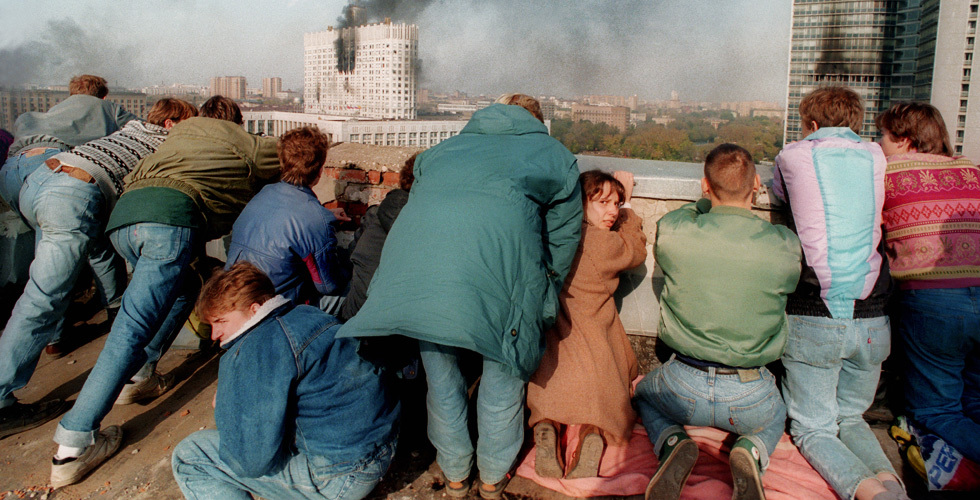
The October events of 1993 are reflected in school textbooks of history a little more than in any way, and this, of course, is the trouble. If I remember correctly, they highlighted one and a half pages of chaotic text, which are crowned with a photograph of the Alpha fighter against the backdrop of a blazing White House. I collected all my idea of the political crisis of 1993 from various sources, in the objectivity of which I still have doubts. What is ninety -third for me from the point of view of the history of modern Russia? The year when the new government for the first time in a large way deceived us all. Was there another way out at that moment by Yeltsin? Don't know. What do I remember when I look at the photo of the blazing building of the Supreme Council? Pelevin with his “and the smoke of the fatherland is sweet and pleasant for us. Parliament". Who read Generation P will understand.
The only thing that really impressed me when I read about the October events of twenty years ago is one old site made almost in Latvia. There were no photographs or detailed eyewitnesses on this resource. There are simply collected short biographies and evidence of the death of those who died in a meaningless slaughter near the White House, the Ostankino and the Stadium on Krasnaya Presnya. For the last year, disputes about who was still right twenty years ago and what would happen to the country if Yeltsin had lost. And in these disputes everyone somehow forgot about those whose bodies then put on the altar of a democratic revolution. And it seems to me that now is the time to remember these people.
Kirill, 24 years old, journalist
My mother worked in the White House as a translator, and, as she says, she managed to take some Japanese diplomat to the airport just a couple of hours before shelling.
I know that Yeltsin went into conflict with parliament and applied tanks to resolve this conflict in his favor. There were defenders of the White House, and now there is a memorial next to him in the park.
Ksenia Gubanova, 20 years old, student
I know not very much. From what I remember in essence. Team "Yeltsin" (government, Chernomyrdin, Luzhkov and other guys who supported Yeltsin and his policy) vs. Team "Rutskoy" (Supreme Council with Khasbulatov and Raid Communists and Socialists). The powers of the Armed Forces were some almost limitless, and the very fact of its existence and functioning contradicted the principle of separation of powers in the country, which, according to Yeltsin and the company, was quite sad in the conditions of the new Russia. The legislative power very disturbed economic reforms, and they, of course, the country was very necessary. Yeltsin issued a decree on the dissolution of the Supreme Council and the Congress of People's (I would like to say “commissars”, but no) deputies and under the then constitution, about which I do not know anything about at all, automatically lost the authority of the president after that. But he did not fold the powers. The Armed Forces accused him of the implementation of the coup, but not that Yeltsin took care of it.
The country is a constitutional crisis. In Moscow, supporters of the Supreme Council rally, fight with riot police, are trying to capture Ostankino. The Armed Forces itself was blocked in the White House at the direction of Yeltsin. There were attempts at negotiations, but they fell, it seems, because of Khasbulatov.
As a result, the White House was stormed with tanks and turned under the control of the internal troops, which obeyed Yeltsin as the president. The tragic moment: fire was opened to defeat, and the defenders of the White House died. About 200, it seems, victims, and there are a lot of wounded.
As a result - the new Constitution, Russia is the presidential republic. Yeltsin said that he went to a coup d'etat because he did not have another - the state structure existing in Russia needed reforms and a complete personnel renewal, but within the framework of the Soviet Constitution, which was slightly outdated since 1977 (1978), this was impossible. In general, I understand this topic not as good as it should. Ashamed. Therefore, I can’t have a clearly formulated opinion on the topic of 1993 events, probably. Yeltsin fought for new Russia and delivering it from its decaying nomenclature, which paralyzed economic reforms and in every possible way interfered with the democratic development of the country, and it is cool and great. Shooting live people doesn’t matter whether they are politically supporters or not - it’s not cool, not cool and not at all in the spirit of democracy.
So the events of 1993 are, in my eyes, the eternal question of the goal and means, which seems to be not an answer to which. In the sense, damn it, I know what happened, but I do not fully understand who is good, who is bad-perhaps due to the fact that my knowledge is not so deep-and I am ashamed not to have this understanding on such an important issue. It was always scary that someone would ask, but I do not know what I think about it ...
Ekaterina Morozova, 20 years old, student of a yurfak
The main events of the Autumn of 1993 are the constitutional reform announced by Yeltsin, which poured into the confrontation of the President and the Supreme Council, the execution of the White House, the riots, the referendum on the trust of Yeltsin, the referendum and the adoption of the new Constitution. I believe that the use of force in this situation was an unjustified step. From a legal point of view, the actions and decisions of Yeltsin directly violated the current constitution-the Constitutional Court recognized the decree (I do not remember the number, was called “On Constitutional Reform” or something like this) anti-constitutional. My attitude to these events is ambiguous: on the one hand, the need to reform the country, on the other hand, the selected methods did not clearly meet the solution of the tasks.
Alexander, 21 years old, student
About the 93rd year-I did not hold a candle, but those people whose opinion is important to me, they say and write that it was a real feast of spirit (not a pyrdukh, but seriously). So, perhaps, I will join them.
Prepared by Tamara Velikodneva