
Translated material
Arctic in our opinion
Greenpeace, Gazprom and the battle for the shelf
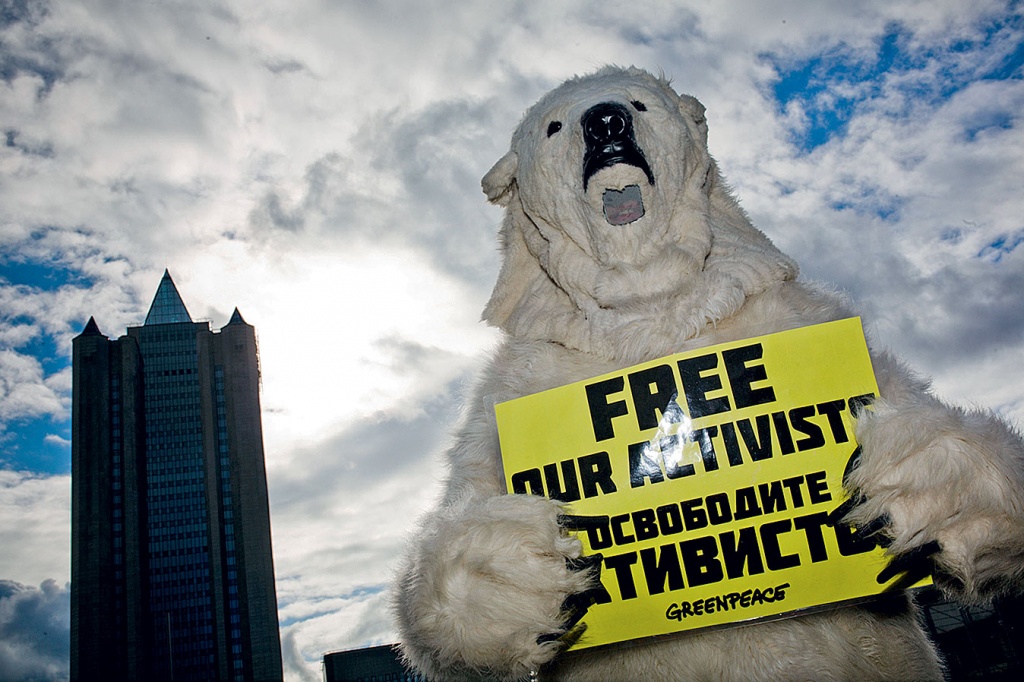
Corresponding sovereignty over the Arctic, where, according to the US Geological Service, there are up to 13% of the global oil reserves (90 billion barrels) and up to 30% of gas (47.3 trillion cubic meters), all border states dream of. So Vladimir Putin called “complete stupidity” the proposal of one of the Russian scientists to transfer the Arctic to international administration: Russia made it clear to the president, it would not stand at the region and at the price. It was said on October 3. And literally on the same day, 30 activists from Greenpeace, detained after the protest on September 18, at the Gazprom oil platform in the Pechora Sea, were charged with piracy. Only four of the prisoners - Roman Dolgov, Denis Sinyakov, Andrei Allahverdov and Ekaterina Zappa - Russians. Our security forces deliberately went to the international scandal, for the first time overlap with a tough article by the Criminal Code a large group of foreigners. The Netherlands, under whose flag the Greenpeace was floating, began the arbitration process against Russia. The battle for "Our Arctic" seems to have begun
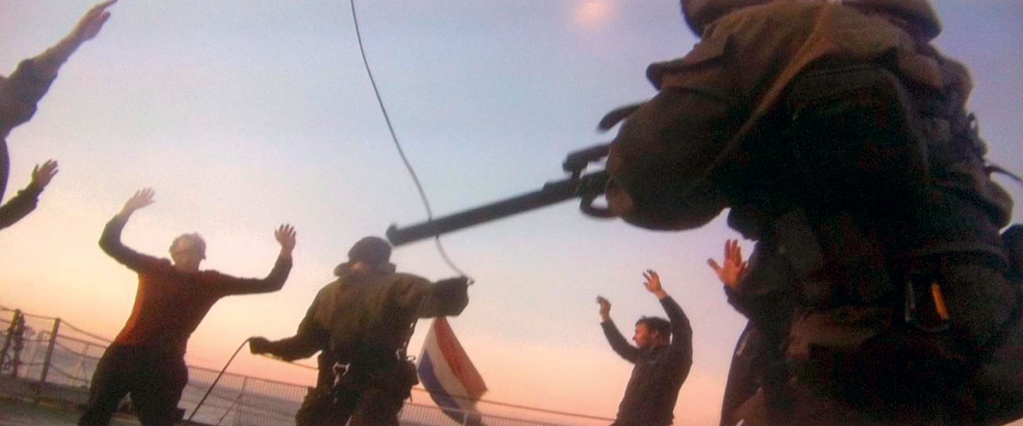
Arctic Sunrise assault on the Russian FSB. 19 September 2013
On September 29, the former Soviet political prisoner Pavel Litvinov, one of those seven who, in protest against the entry of Soviet troops into Czechoslovakia, went to Red Square in August 1968, wrote on his Facebook: “Dima spent four years in a Siberian link with me. It is unlikely that this period will be counted. ”
Pavel Litvinov now lives in the United States, and Dima is his son, 51-year-old Dmitry Litvinov, press secretary Greenpeace, citizen of Sweden and the USA, grandson of the writer (and also dissident) Lev Kopelev and the great-grandson of the Stalin People's Commissar of Foreign Affairs Maxim Litvinov. On that day, the 29th, Dmitry was on the other end of the Earth, in the Murmansk pre-trial detention center, and was waiting for the indictment, which the whole world now knew: he is the pirate of the Pechora Sea.
"They are like dissidents ..."
“He is my adoptive son, but I call him a son ... When we emigrated, he was 12 ...-says 73-year-old Pavel Litvinov. - In America, he studied at the same school where I taught, received a university diploma of an anthropologist, lived with the Indians in Ecuador for two years, says (in addition to Russian, English and French) in Kechua - the oldest Indian language in the world ... "
Life turned coolly in 1987, when Soviet perestroika was already thundered throughout the world. “Dmitry then helped with the faculty for Greenpeace, and then someone asked them there:“ Do we have one of the Russian speakers? ” He turned out to be the only one. "
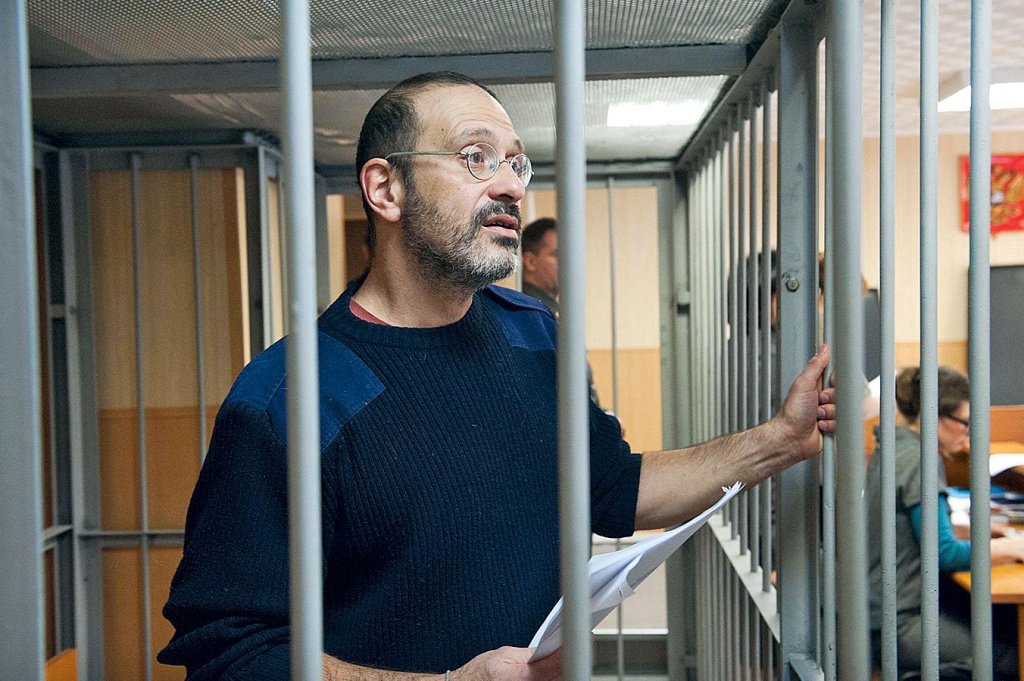
Dmitry Litvinov has three children, the youngest - 16, the family lives in the suburbs of Stockholm. Dmitry’s wife is a Swede, a social worker: it helps to rehabilitate the prisoners who have had served his time: “Dima taught it to the Russian language, because they lived in Moscow for several years when he established the work of the Russian Greenperap.”
Dmitry did not say either to his father or sister about the expedition to the Arctic. “We learned a day or two after they sailed ... there, in the Murmansk chamber, it’s now cold, and he has a rheumatic card, arthritis of the joints of the fingers, he probably began an exacerbation, he is not a boy, health is not that ...”
Why the Arctic? “Until now, no one has stormed (oil), the whole world has abandoned this idea, but Gazprom wants to start drilling,” Pavel Litvinov tries to explain in accessingly, “and this is very dangerous, because in those places a very fragile edition-it is easy to pollute, and then it is almost impossible to clean due to the ice cover ...”
“Their principle is a non -violent protest, like the Quakers, Gandhi, Tolstoy,” says Pavel Litvinov about the work of his son. - The guys are all sincere, obsessed with justice. They cause fire on themselves, but never give change. With this idea, they have lost all the seas. They are like dissidents - aimed at the success of a hopeless business. And Dima - he is generally very similar to his grandfather, by nature - a copy of Kopelev, as stubborn, knows how to speak, and most importantly, kind. That's just the experience of a Russian prison he does not have. He was a child in exile with me in Siberia, in a pure, under Chita, but a link is not a prison. It is impossible to be prepared for the prison ... "
On business!
| *The captain of the ship, American Peter Wilcox, commanded the Rainbow Warrior, which belonged to the Greenpevis, which was sunk in 1985 off the coast of New Zealand with French secret services. The sabotage led to the death of a photographer-ecologist Fernando Pereira, the international scandal and resignation of the French Minister of Defense Charles Ernyu, and the International Court ordered Paris to pay Greenpeace $ 8.1 million compensations. |
On September 14, 2013, the icebreaker Arctic Sunrise (“Arctic Sunrise”), bought by Greenpisovites back in 1995, starred with anchors in the Norwegian port of Kirkines and headed for the Pechora Sea. On board - 30 people, 16 of them are members of the crew hired Greenpeace International*, 12 - activists from different countries. The team was also accompanied by two freelancers: photographer Denis Sinyakov and video operator Englishman Brian Kiron. Among the activists were five climbers who assigned a key role in the action. The Englishman Philip Edward Ball, by profession, a video operator, on the first climbing courses from the BBC television company, when the filming needed the appropriate skills. Another Englishman, Anthony Jan Perret at home carries out the trees. He is an active member of Greenpeace in England and even created a company that conducts trainings for volunteers who want to participate in promotions. Sini Saarela arrived from Helsinki, in the Pechora Sea she for the second time, a year ago she took part in the same expedition, but the photographer-freelancer from Argentina Kamil Epesiala, on the contrary, first ended up on a sea ship, and generally in Europe. The activist from Switzerland Marco Paolo Weser has been working as a trainer in the Swiss climber of Greenpeace, and he has been engaged in climbing for 20 years, but for the Poles of Tomash Demyanchuk Greenpeace, he is just a hobby, he works as a culture manager at the University of Gdansk.
The expedition was preceded by large -scale training. Greenpeace International Head office with headquarters in Amsterdam-it is in charge of three ships (Arctic Sunrise, Rainbow Warrior, Esperanza) of the organization’s fleet-hired the crew of the vessel. The remaining details of international operations, including activists, are each time discussed by Greenpeace’s regional offices. In the case of Arctic Sunrise, these were Russia, Denmark, Norway and Canada, which have previously agreed on the information message of the expedition: there should not be oil production in the Arctic. No!
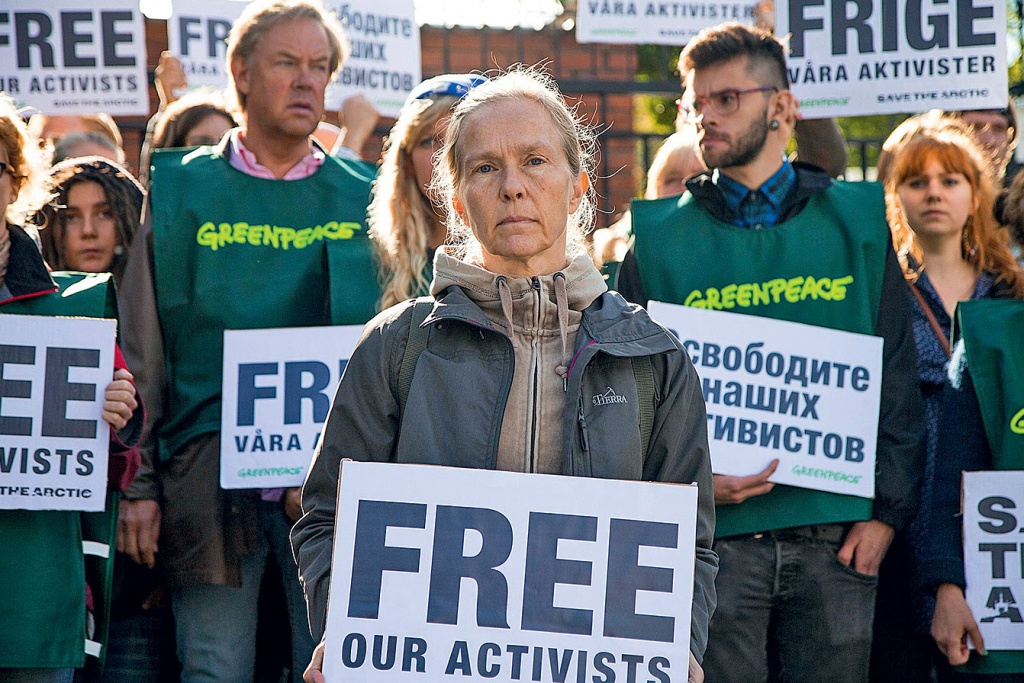
Wife Dmitry Litvinov Anita for protest rally at the Russian Embassy in Stockholm 09/29/2013
“At first we determine who is required to the team, then the selection begins,” Vladimir Chuprov, head of the Greenpeace of Russia, explained the New Times, “in addition to skills, say, in climbing, it is necessary that the person needs documents, so that he speaks English, has been working with Greenpeace or Greenpeace, non-conflict and effective. This is not a walk. ” The cost of tickets to the departure point and the experience of participation in past expeditions are taken into account. “Most of our volunteers do not work in Greenpeace,” I will find the New Times Executive Director Greenpeace International Kumi, “they just take leaves, spend their personal time. And believe me, every time any expedition is being prepared, there is not a single activist Greenpeace who would not dream of participating in it. ”
Greenpeace International also assumes the main expenses for the expedition, local offices pay only tickets of volunteers*. According to Vladimir Chuprov, the cost of the ARCTIC Sunrise day is about € 10 thousand, that is, the budget of a 20-day operation in the Arctic is approximately € 200 thousand. “This is not much,” says Vladimir Chuprov, “the daily cost of the atomic icebreaker, for example, € 100 thousand”.
| *More than 90% of the Greenpeace budget, which amounted to € 274 million in 2012, is formed due to private contributions from 3 million donors around the world. Funds are received to the accounts of local Greenpeace, which make a fee in Greenpeace International. Russia, on the contrary, is a “scarce” country: more than half of its budget, the Russian branch of Greenpeace, on the contrary, receives from Greenpeace International. |
Prisogromny platform
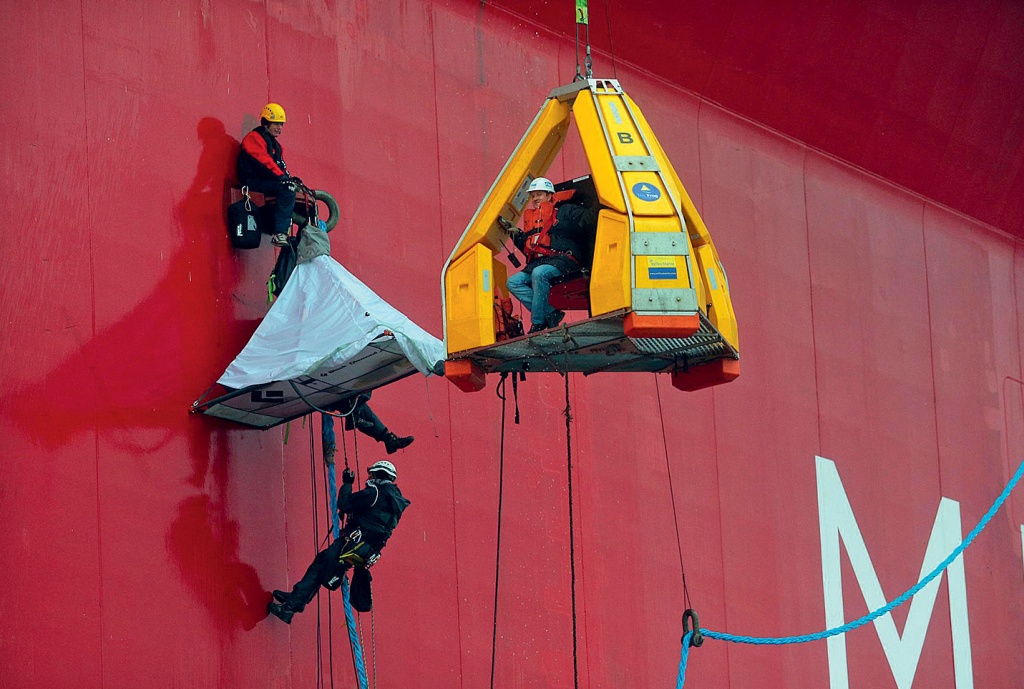
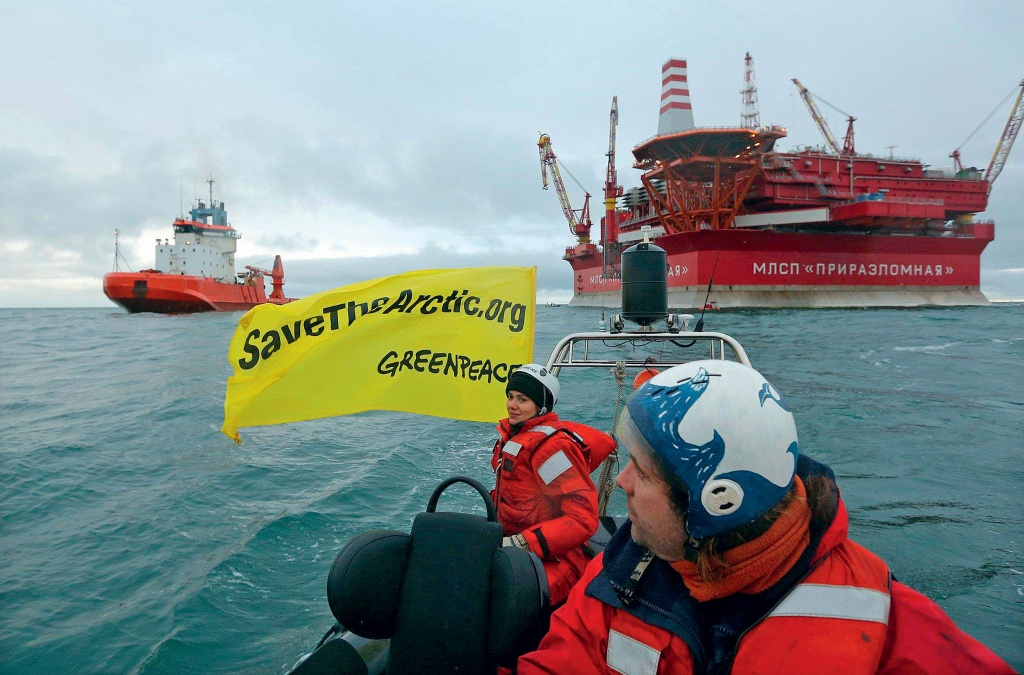
On September 18, Arctic Sunrise sailed to the Prirazlomnaya and, without going into the three -mimic safety zone distilled by Gazprom himself, lowered two inflatable boats, one of which was added to a special capsule, which was planned to be fixed on the platform, placing inside and blocking the work of the “dungeon”. The boats approached the platform, violating the 500-meter security zone established around it, according to international standards. Two activists, Sini Saarela and Marco Weber, threw cats to climb the 15-meter height of the platform, but the guard cut the cables, so that activists fell into the water, where they were picked up by the Ladoga border ship. Procedes "Prirazlomnaya" simultaneously opened "warning fire to the water",
Having damaged one of the boats. The next day, the 19th, the FSB special forces from the helicopter stormed by the Arctic Sunrise, the ship was carried to Murmansk, where all 30 members of the team were detained for a period of two months. They were immediately made to understand that they could be accused of piracy.
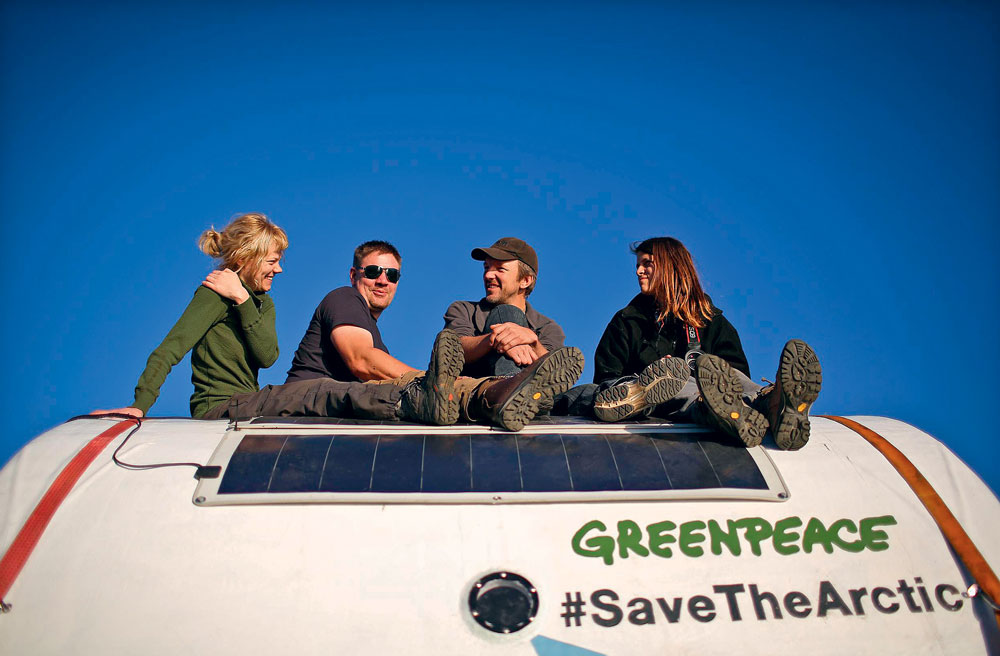
Sini Saarela, Anthony Perret, Philip Bolla and Camille Epesiala (from left to right) on the capsule, which was planned to be fixed on the "Prirazlomnaya". Greenpeace activists were supposed to live inside the capsule
On September 25, President Vladimir Putin, speaking at the Arctic Forum in Salekhard, said that Greenpeace activists, although they violated international law, were not pirates. However, the Investigative Committee of the Russian Federation is an unheard of business! - He did not take into account the opinion of the president.
34 thousand scenarios
The Prizrazlomnaya platform, owned by Gazprom Neft LLC Oil Shelf, whose vice president, by the way, was appointed 31-year-old Andrei Patrushev, the son of the ex-director of the FSB, the head of the Security Council of Nikolai Patrushev, stood on the agenda of the ecologists not yesterday. The Arctic is part of the climate and ocean programs of Greenpeace, the Green began to fight against the oil workers back in 1989, when, as a result of an accident on the Exxon Valdez tanker, which belonged to Exxon, 41 million liters of oil were in the sea off the coast of Alaska. Since then, no activist Greenpeace has cast doubt on the destructiveness of any oil development in the Arctic: in addition to the difficulties with eliminating the consequences of disasters in extreme climatic conditions, such projects accelerate the melting of arctic ice. When Gazprom brought to the Pechora Sea “Prirazlomnoye” in 2011, environmentalists could not stay away. “This is an unfinished platform, partially collected from written off details,” the head of the Internet and public campaigns of Greenpeace Russia Alexei Kiselev explained to The New Times, “if its foundation was made at the Sevmash factory, then the top is written off by the Norwegians in 2002 and supposedly the renovated Hutton platform (with acquisitions with acquisitions. The corruption scandal is connected by this platform: at the initial cost of $ 29 million, Russia bought it through intermediaries for $ 67 million).
"
Gazprom has only 7 vessels to eliminate a possible oil spill. The consequences of an accident on the BP platform in the Gulf of Mexico in 2010 eliminated 6 thousand vessels
"
Protesting against the commissioning of Prirazlomnaya, Greenpeace seized the first expedition back in 2012. “I myself was in that expedition, the guard simply stood aside and did not bother us. We stopped the work of the platform for 15 hours, and then left, ”I will find Kumi Kumi. The goals were the same as now: to force Gazprom to go on a dialogue and admit that the company is not ready for prey in compliance with all safety standards. ”
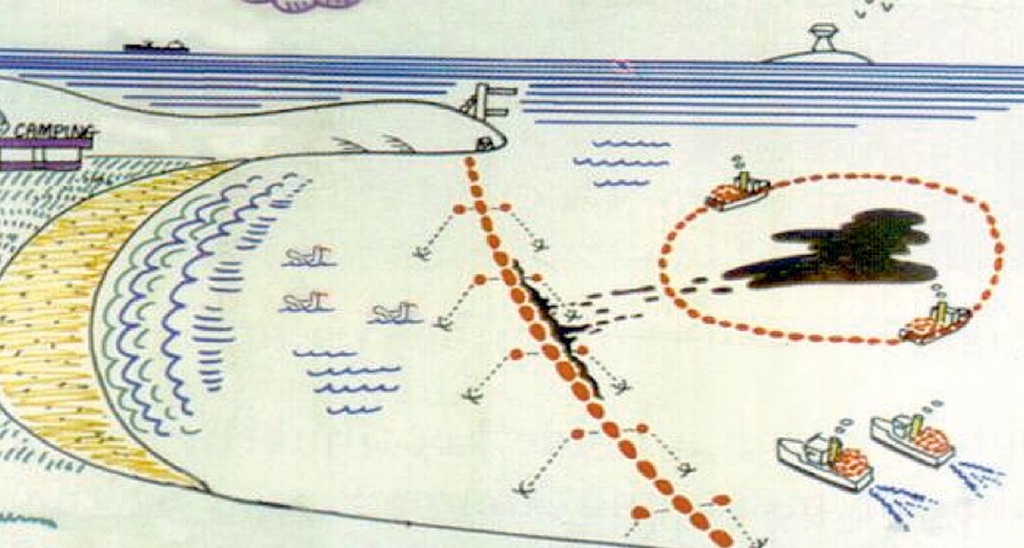
The activity of ecologists was successful: Greenpeace, together with the WWF, managed to achieve from Gazprom recognition of the results of independent studies of the Center "Informatics of Risk", which analyzed 34 thousand scenarios of possible accidents. It turned out that in the case of a leak of 100 million liters of oil, which can be stored in the platform tank, the oil spot will cover the water area with an area of up to 140 thousand square meters. km, polluting 3,500 thousand km of the coast, on which, in particular, there are reserves.
The nearest rescue station is 1000 km from Prirazlomnaya, and oil can reach the protected areas in 16-18 hours. If we take into account that in the world there are no effective oil cleaning technologies at all (and no technologies for cleaning from ice in the winter), and Gazprom has only seven vessels to eliminate the spill (for comparison: the consequences of the British Petroleum (BP) platform in the Gulf of Mexico in 2010 eliminated six thousand courts), the consequences Environmental disaster is easy to imagine.

The assurances of our monopolist is that there will be no spills, environmentalists did not believe: Russia is a champion in oil leaks, only according to official figures, in 2011, 872 leaks occurred at ground deposits and pipelines. At the same time, Gazprom laid only $ 175 thousand for environmental risks insurance.*
| *The 2010 accident in the Gulf of Mexico cost British Petroleum $ 41.3 billion |
In 2013, Gazprom stated that all problems with safe prey were resolved, and Prirazlomnaya is ready to work. “In fact, on their website there was a not-so-intelligible document with some kind of children's drawings as illustrations. It's funny. This did not convince us that Gazprom had technologies that had no one before, nor anyone else, ”says Alexei Kiselev. That's why Greenpeace decided to repeat the last year’s campaign at Prirazlomnaya.
“Gazprom Neft Shelf”, however, is ready to cooperate with ecologists, but only, as the executive director of the company Gennady Lyubin says, then “when people hear each other”: “They (ecologists) call an oil spill to eliminate insolvent, and the platform does not provide a regime of safe development of the field. At the same time, they say for any statement: “It will not go, it’s bad, it’s wrong, you are doing wrong,” the top manager complained to reporters.
What's at stake?
Ecologists question not only the environmental safety of oil production on the Arctic shelf, but also its economic expediency. “The de facto in the Arctic today no one is trying to produce oil,” says Vladimir Chuprov, “it became clear to all major international players that it is dangerous, expensive and, most importantly, economically ineffective.” So, the British company Cairn Energy, spending $ 1 billion in search of oil off the coast of Greenland, turned the project, remaining with nothing. Shell oil giant (until recently, who was the main target of Greenpeace in the Arctic), stopped all projects, spending $ 5 billion on them. The reasons are the same: too dangerous and expensive. The next evidence of the inability to guarantee the safety of the work was the accident with the Kulluk oil platform, which was focused on the storm on January 1, 2013.
In 2012, the general director of the French Total, Christophe de Margerie, opposed the Arctic Shelf, said the Norwegian President of Finland Sauli Ninist, the Norwegian parliament voted for the ban on oil and gas developments in the Arctic on September 25, stated on September 25. Even the Vice President and one of the main shareholders of Lukoil, Leonid Fedun, said in April 2013 in an interview with The Financial Times, which would not put a penny into the development of the Arctic. “Only Rosneft and Gazprom remained in the Arctic, however, in partnership with Exxonmobil, the Italian ENI and even the Norwegian Statoil,” explains Vladimir Chuprov.
What lies at the stake? In 2008, the US Geological Service presented a report that stated that 13% of the world oil reserves, which was about 90 billion barrels, are contained under Arctic ice. However, it turned out that oil is included in these calculations, which Russia has long and successfully produces, including in the Yamalo-Nenets and Khanty-Mansi Autonomous Districts, as well as the Komi Republic. “If we discard all the ground deposits, then there will be no oil there,” Vladimir Chuprov is sure, “at least in the territory of the exclusive economic zone of Russia. Even if you take data from the Ministry of Natural Development, we are talking about a maximum of 400 million tons. ”
"
“It seems that they are not going to get anything on the“ Prirazlomnaya ”, the main thing is to download as much money as possible to manage it for their pleasure as possible. Well, in general, it is necessary to explain where $ 4 billion went! ”
"
If we take into account that the total reserves of Russia are from 13 to 25 billion tons, we can talk about the increase of only 2-3%. The cost of oil, excluding transportation, will at the same time be $ 30 per barrel, which is three times higher than the cost of oil mined on Earth. To date, Gazprom has already invested about $ 4 billion into the Arctic project, of which $ 247 million for the construction of two Mikhail Ulyanov and Kirill Lavrov tankers. “There are tankers, but there is no oil! - exclaims Vladimir Chuprov. - And what to do with this scrap metal if it does not appear? "
Экологи также отмечают, что у арктической нефти нет самого главного — рынков сбыта: Европа старается сократить потребление углеводородов, а в США набирает обороты сланцевая революция, так что «Приразломную» может ждать судьба газового Штокмановского месторождения, которое тот же «Газпром» до поры до времени закрыл. «Освоение Арктики станет вторым БАМом, — уверен Владимир Чупров, — миллиарды долларов будут похоронены подо льдами безо всякой пользы».
«У меня вообще такое впечатление, что ничего они на «Приразломной» добывать не собираются, — вторит ему коллега по Гринпису Андрей Киселев, — главное, закачать в проект как можно больше денег, чтобы управлять ими в свое удовольствие. Ну и вообще надо же объяснить, куда ушли $4 млрд!»
Другое время
Деньги, конечно, не пахнут — даже нефтью. Но чем объяснить столь решительную и жесткую реакцию российских властей на акцию у «Приразломной», ведь год назад в Печорском море гринписовцев отпустили с миром.
Военные эксперты обращают внимание на то, что за истекший год резко усилилась военная составляющая в арктической политике России: борьбу за «контроль над Арктикой» решено усилить испытанными методами. А вопросы национальной безопасности не предполагают диалогов с иностранцами, пусть даже и экологами, здесь вступает в силу старый советский принцип: граница на замке. 16 сентября президент Владимир Путин на селекторном совещании в Минобороны объявил о воссоздании военной базы на Новосибирских островах (в море Лаптевых) и восстановлении там заброшенного аэродрома Темп. Эта мера, по словам Путина, поможет эффективно контролировать эту часть российской Арктики. Кроме того, в сентябре в Арктику направлен отряд из десяти боевых кораблей и судов обеспечения Северного флота во главе с атомным ракетным крейсером «Петр Великий» — они совершили переход к архипелагу Новосибирских островов. Все эти мероприятия власти анонсировали как часть масштабной программы Минобороны по возобновлению постоянного военного присутствия России в регионе.
Наконец, 3 октября Владимир Путин на встрече с секретарями первичных отделений «Единой России» сообщил, что правительство РФ планирует поддержать группировку ледокольного флота в регионе. «Этот регион очень богат минеральными ресурсами, в этом его ценность», — отметил Путин. На этой же встрече он назвал «полной глупостью» идею профессора ВШЭ Сергея Медведева передать Арктику под международное управление (очевидцы говорят, что президент даже назвал его «придурком»).
Впрочем, военный эксперт Александр Гольц не связывает жесткую реакцию властей именно с возросшим стратегическим значением региона: «О том, что Арктика для нас — одна из приоритетных зон, говорится чуть ли не с 2000 года. И можно вспомнить множество показательных акций, направленных на подтверждение этих слов, — например, экспедицию на Северный полюс в 2007 году, когда экспедиция Артура Чилингарова водрузила на дне Северного Ледовитого океана титановый российский флаг. Сама Арктика и все эти разговоры о добыче нефти и других природных богатств в регионе — одна из магических надежд российских властей, не справляющихся с очевидными базовыми проблемами в стране». Тем не менее собеседник журнала согласен с тем, что арест активистов Гринпис — сигнал другим странам: Арктика — наша, не суйтесь сюда: «Конечно, они уверены, что Гринпис и другие международные организации — это агенты зарубежных спецслужб». Там, где идет речь о геополитике, тут же возникает конспирология — в путинской России это аксиома.
«Дима и его товарищи будут сидеть еще два месяца как минимум, — напоминает журналу об избранной Мурманским судом мере пресечения в отношении сына Павел Литвинов. — Димина мама — Майя Львовна — больна, у нее был инсульт, она лежит полупарализованная, и может случиться, что она его вообще не увидит больше...» Знаменитый диссидент неожиданно вспоминает, что его сын-эколог впервые попал на Кольский полуостров в перестройку. Гринпис послал тогда корабль с акцией протеста на Новую Землю — там судно, прямо как сейчас в сентябре 2013-го, перехватила советская береговая охрана. Всех, включая Литвинова-младшего, повязали и привезли в Мурманск: «Их тогда освободили по личному распоряжению Горбачева, из Мурманска уезжали героями, окрыленные, их по-моему даже в тюрьме тогда не держали... Время тогда было другое...»
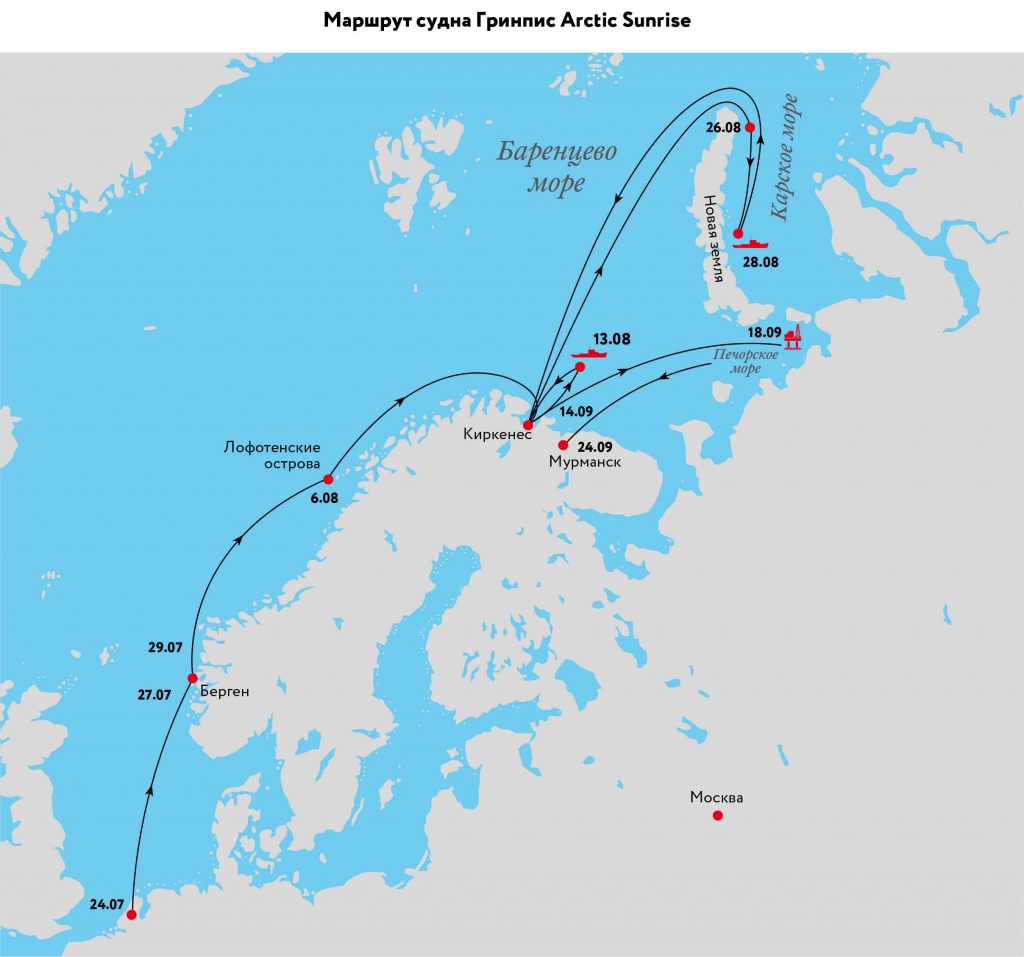

24 июля : Arctic Sunrise выходит из Амстердама.
27–29 июля : остановка в норвежском Бергене
6 августа : Arctic Sunrise присоединяется к протестному лагерю «Природа и молодость» на Лофонтенских островах, где собрались более 400 активистов Гринпис и других экологических движений
12 августа : прибытие в норвежский порт Киркенес, недалеко от границы с Россией
13 августа : Баренцево море. Активисты на резиновых лодках подошли к разведочному судну «Академик Лазарев» и развернули баннеры «Роснефть убивает Арктику»
24 августа : отправление из Киркенеса, курс — Карское море Экологи отправляются в экспедицию несмотря на трехкратный запрет администрации Северного морского пути
26 августа : Карское море. Российская береговая охрана проводит инспекцию Arctic Sunrise, требуя, чтобы судно покинуло пределы исключительной экономической зоны России
28 августа : Карское море. Экологи попытались провести акцию рядом с судном «Геолог Дмитрий Наливкин», проводящим сейсмическую разведку для «Роснефти» и ExxonMobil. Из-за угроз открыть предупредительный огонь акцию решено не проводить. Arctic Sunrise покидает Карское море и возвращается в Киркенес
14 сентября : отправление из Киркенеса. Курс - Печорское море.
18 сентября : попытка проведения акции у платформы «Приразломной», принадлежащей «Газпрому». Задержание экипажа сотрудниками ФСБ и погранслужбы
24 сентября : доставка Arctic Sunrise в Мурманск, арест экипажа
«Захват платформы - нарушение российских границ» Виктория Жданова, ведущий юрист компании «Инмарин», эксперт по Морскому праву:
Активистам Гринпис предъявили обвинения по ч. 3 ст. 227 УК РФ «Пиратство» — «нападение на морское или речное судно в целях завладения чужим имуществом, совершенное с применением насилия либо с угрозой его применения». Это самая тяжелая часть 227-й статьи — пиратское нападение, совершенное организованной группой, или же нападение, повлекшее смерть человека, — она предполагает наиболее суровое наказание: лишение свободы на срок от 10 до 15 лет со штрафом в размере до 500 тыс. рублей*.
| *«или в размере заработной платы или иного дохода осужденного за период до трех лет либо без такового» |
Лично я не вижу в действиях гринписовцев состава преступления по данной статье. Не нарушили они и статью 101 Конвенции ООН по Морскому праву — в ней дается определение пиратства: это любой неправомерный акт насилия, задержания или любой грабеж, совершаемый с личными целями экипажем или пассажирами частного судна и направленный в открытом море против другого судна или против лиц или имущества, находящихся на их борту. Активисты Гринпис не стремились завладеть чужим имуществом в корыстных целях, а именно это всегда является основным мотивом пиратства. Их акция вообще не предполагала получения личной выгоды от захвата платформы. Тем более странным выглядит предъявление таких обвинений фотографу Денису Синякову. 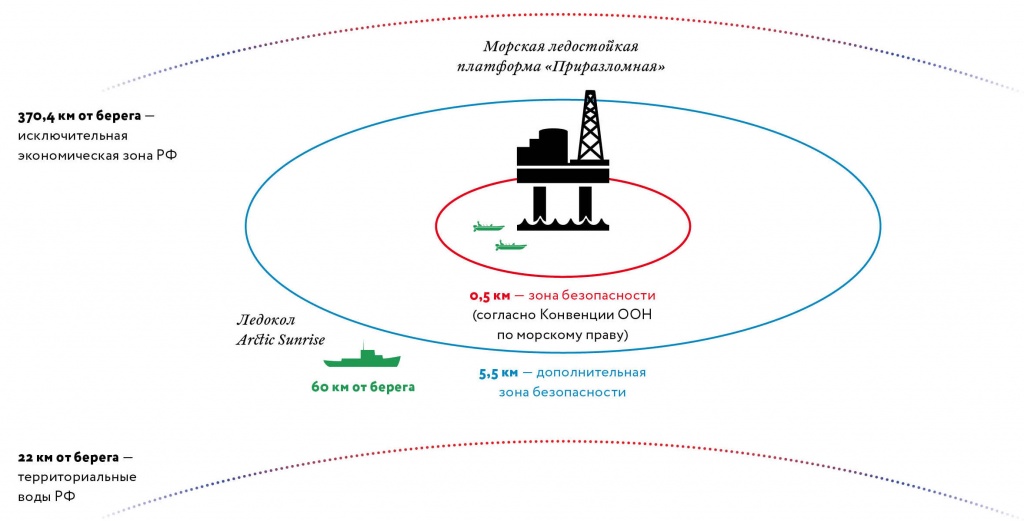
Почему наши правоохранители выбрали именно 227-ю статью — непонятно. Ведь действия активистов вполне логично подпадали под другую статью — ст. 322 УК РФ — «незаконное пересечение государственной границы». Согласно Международному морскому праву, в зоне российской юрисдикции находятся воды в районе 44,5 км от берегов России, платформа же находится дальше — примерно в 60 км от берега, то есть расположена в исключительной экономической зоне, где права России должны соблюдаться только при разработке и охране природных ресурсов. Так что особого разрешения на свободное плавание в этих местах иностранные судна получать не должны. Однако сама «Приразломная» — это собственность российской компании. Грубо говоря, это территория России, и захват платформы — нарушение российских границ. Статья 322 не такая жесткая, как 227, — она предусматривает не только лишение свободы, но и штрафы. Так что по ней активистам вполне можно было вменить штраф до 200 тыс. рублей каждому и отпустить. Это было бы разумно, и наказание соответствовало бы тяжести деяния.
Согласно той же Конвенции ООН, любое государство может захватить пиратское судно и арестовать находящихся на нем людей. Но есть в этом документе и ст. 106, которая говорит, что если судно подозревалось в пиратстве и было захвачено без достаточных на то оснований, то государство, которое это судно захватило, должно будет ответить перед государством, которому это судно принадлежало, «за любой ущерб, любые убытки, причиненные захватом». И, вероятно, России теперь самой грозит волна исков, тем более что на борту Arctic Sunrise находились представители 18 стран. Само судно ходило под голландским флагом, и Нидерланды уже планируют подать иск против России.
Пираты vs Россия
— В июле 2009 года на пути из Финляндии в Алжир финское судно Arctic Sea было захвачено пиратами. Моряки Черноморского флота освободили корабль южнее Кабо-Верде, восемь пиратов были захвачены, семерым предъявили обвинение по ч. 3 ст. 227 УК РФ («пиратство», захват судна организованной группой). Все получили сроки от 3 до 12 лет.
— 5 мая 2010 года в районе Аденского залива сомалийские пираты напали на судно «Московский университет». Экипаж освободили российские военные, десять пиратов задержали, один был убит. The RF IC opened a criminal case under Part 3 of Art. 227 УК РФ («пиратство», захват судна организованной группой). Однако всех задержанных отпустили — не нашли оснований для задержания.
— 11 ноября 2010 года сомалийские пираты захватили панамское судно Hannibal. Среди членов экипажа был один россиянин. Судно и экипаж находились в плену до марта 2011 года, всех отпустили только после получения выкупа $4 млн. Южное следственное управление СК РФ возбудило уголовное дело по ч. 2 ст. 227 УК РФ («пиратство», захват судна с применением оружия).
— 22 ноября 2010 года на российский танкер NS Spirit напали нигерийские пираты. Ограбив судно, скрылись. Два члена экипажа были ранены. The RF IC opened a criminal case under Part 3 of Art. 227 УК РФ («пиратство», захват судна организованной группой).
— 8 октября 2011 года пираты захватили у берегов Нигерии танкер Cape Bird, которое плавало под флагом Маршалловых островов. На судне находились трое моряков из Новороссийска. Ограбив танкер, пираты скрылись. Южное следственное управление СК РФ возбудило уголовное дело по ч. 3 ст. 227 УК РФ («пиратство», захват судна организованной группой).
— 28 августа 2012 года недалеко от побережья города Ломе (Тоголезская Республика) пиратами был захвачен греческий танкер Energy Centurion. Почти весь экипаж судна состоял из граждан России. Пираты заперли команду в каютах, забрали их личные вещи, похитили почти три тонны нефтепродуктов, после чего покинули судно. СК РФ возбудил уголовное дело по ч. 2 ст. 227 УК РФ («пиратство», захват судна с применением оружия). 

фотографии: Денис Синяков/Greenpeace/AP Photo, Евгений Фельдман, Laurent Gillieron/AP Photo, AP Photo, Дмитрий Шаромов/Greenpeace, Greenpeace