
Translated material
With the king in the head
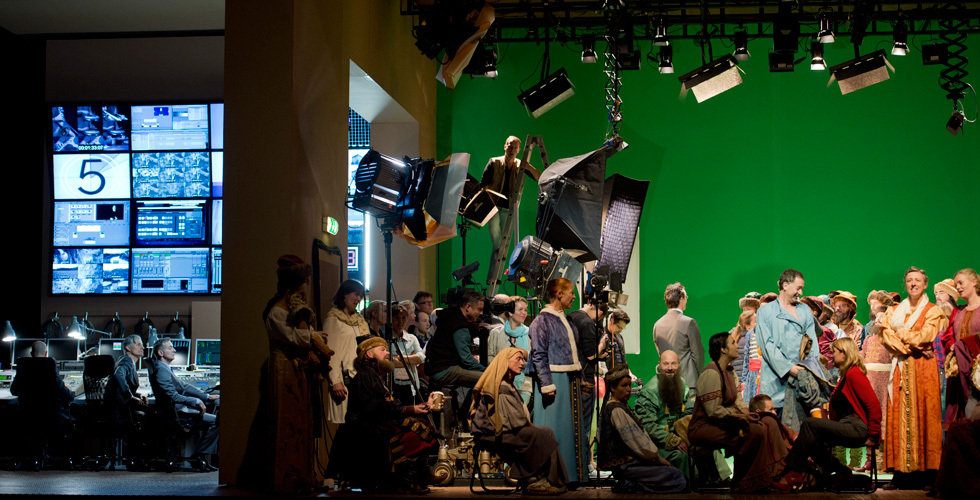
The new work of Dmitry Chernyakov is the “royal bride” of Rimsky-Korsakov. That is, the Russian director set the Russian opera. But this did not happen at all at the Bolshoi Theater, which would seem to coincide with the current official Russian sentiments, but in the Berlin Statatsoper, where this exotic was the first premiere of the season. The Tsar’s Bride is the third joint work with Chernyakov, the artistic director of the theater Daniel Barenboym, after the “Boris Godunov” by Mussorgsky and the “player” of Prokofiev. The glorified maestro, despite the reproaches at the wrong pace and other insane, purposefully, with varying degrees of success diving into the dark waters of the Russian opera (this time it spoiled the indistinct choir, not all ensembles were ideal, but the orchestra did not miss the possibility of creating the necessary nervous atmosphere). In the same season, a new production with the same casting will move to another theater - La Scala led by the Barenboim. This is the way about the repertoire policy of large world opera institutions.
On the other hand, is this “royal bride” do the Bolshoi Theater need? In the information placed in the Berlin booklet that the performance of 1966 lives on the main Russian stage to this day (this season it will just appear in a restored form), by golly, the irony is heard. Still, this tradition of kokoshniks and domes is incredibly difficult, which reaches for the Russian opera! Even in the wild, outside the country and the Bolshoi Theater, Chernyakov begins his story about Martha, Lyubash and dirty with a warning that there will be no fairy tale, the museum will not be: here you are a huge, costumed video from the time of Ivan the Terrible - and that’s enough, the cameras drive away, the statists shoot the caftans and take out his sandwiches, then they will have to look at the story of the story of We want us whether we want it or not.
 © Monika Rittershaus
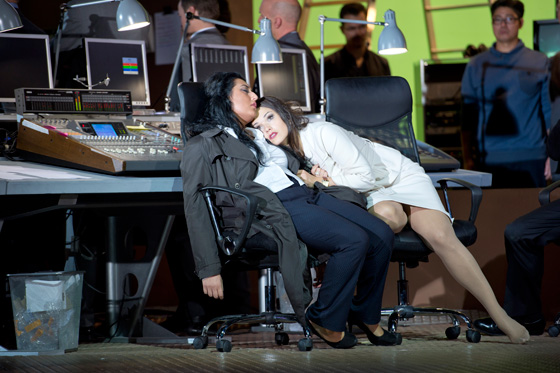
The Berlin opera public, obviously, is more familiar to do this than Moscow, so the premiere of “Tsarskoye” passed with great success and without scandals, accompanied by the Moscow Ruslan at one time - although two productions have a lot in common. Like “Ruslan”, “Tsarskoye” begins with a luxurious costume trick, as in “Ruslan”, then the collision unfolding is the result of an experiment, a dispute “weakly”. In Glinka’s opera, such experimenters were Finn and Naina, in the opera of Rimsky-Korsakov-some faceless people in office costumes who, chat on the computer, decide to cross the country's leader, a fictitious figure, which has nevertheless absolutely absolute power in the heads of ordinary citizens. It is somehow ridiculous to call these creative workers to call these creative people, but there is a modern oprichnina, according to Chernyakov, here is, here it is: mass-media technologies.
Of the IT studios and from television sets, constructed reality in the form of a male individual without any memorable properties, except for ears of ears in the background, enters the plasma screens uninterruptedly, which instead of icons stand in the most prominent place in every successful family. As always, Chernyakov’s, it is better not to look for a very simple -minded specificity. This is not about a specific country. And even the ears, as my brief survey of the audience in the intermission showed, did not prevent them from seeing after them Obama, to whom Merkel. We are talking about the technology of modern authorities and the illusions in which people allow themselves to be immersed in which they are comfortable to be for the time being, but which can have destructive consequences.
This is exactly what happened to the main character - Martha Sobakina (a new flared star of Russian origin with a western career, the winner of the fresh and accurate soprano Olga Peretyatko) was invited to this role). A dull, cozy father (Anatoly Kocherga), a promising groom, who returned from the western internship (Pavel Chernoch), and she herself is the personification of girlish touching in a vintage dress in peas and white socks, an excellent student with a portfolio, model Natasha Rostova in the window of increased comfort, where she cooles with her friend Dunyashi (Anna Lapkovskaya). Everything seems to be good. But in fact, the father is zombie a television screen, the bridegroom is a cynical, narcissistic careerist and nothing more, and she, appointed by some unknown forces of the country's first lady, is more likely from this transformation into another telefant with an ideal white-toothed smile than from some ridiculous magical potions of the Bomelia (Stefan Ryugamer) ordered by the Variere of Grigeriye. Lyubasha dirty and suffering from jealousy.
 © Monika Rittershaus
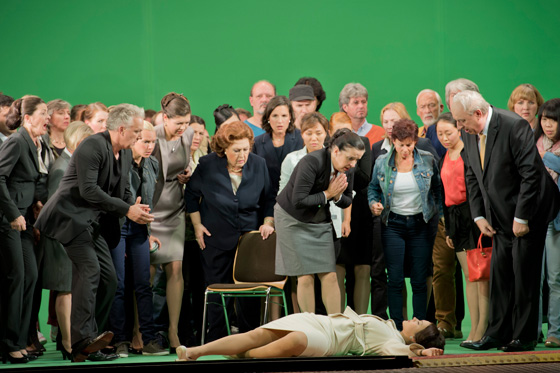
Dirty and Lyubasha is a completely different degree, these are the dramatic stories of the two living people, even outwardly breaking beyond the limits of the main, television illusory space (as usual, Chernyakov - both the director and the scenograph, the artist - Gleb Filstinsky, the costume artist - Elena Zaitseva). It is quite obvious that Chernyakov these two are much more interesting. The insidious dirty resulting in his play turns into a lyrical hero, uncertain, aged, clinging to the former romanticism, from the very beginning of the office "guardsmen" that is being knocked out of the common flock. This one of the most brutal parties of the Russian repertoire is sung as the famous German baritone Johannes Martin Krenzle as pity as possible (perhaps even too much).
Well, Lyubasha performed by the Georgian Anita Rachvvelishvili (whose glory went from the performance of Carmen to La Scala 4 years ago) was the main sensation of the production - perhaps not even planned by Chernyakov. But there is nothing to be done-the animal, dark, burning temperament and marvelous power, the voice turned the suffering of the abandoned and distraught Lyubashi (in the play, it is something like the dictator of the government television channel) into the climax of the play. For the heat, Chernyakov also added a meeting of two heroines, not planned by Rimsky-Korsakov, but very expressive-Martha from his window intersects with his eyes with Lyubasha spying behind her, takes her for the insane and goes to help her.
Unfortunately, this, the most important, the scene happens in the middle of the performance, at the end of the first action. In the second part, the overshadowing of all Lyubasha, by and large, leaves the game. And the same level and penetration of the performance no longer reaches. For the master of the great finals of Chernyakov, this is rather an unusual situation. But for the Russian opera, looking at himself without kokoshniks, this is not the biggest problem.