
Translated material
Far by the problems of contemporary art
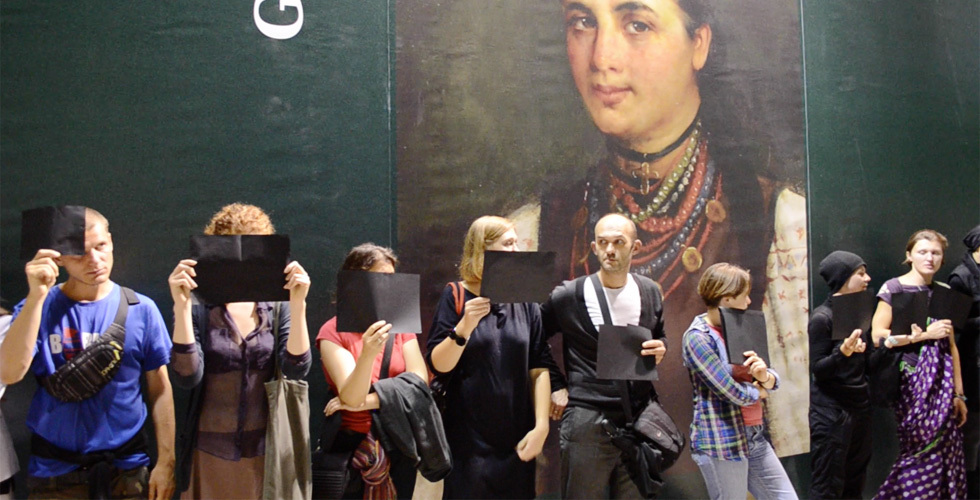
Larisa Venediktova, participant of the Ukrainian collective Tanzlaboratorium And the activist of the initiative of self -defense of working art, expressed her point of view on the situation around the “Mustytsky Arsenal” and became very relevant protest campaigns in the boycott of institutions in the field of culture.
It is not news, of course, that Madame Natalya Zabolotnaya, the director of the Museum Complex "Mystetsky Arsenal", painted Mural Vladimir Kuznetsov "Koliivshchina: The Last Judgment" in black , "punishing some artists for impudence." It is also not news that the initiative of the self-defense of working art (in Ukrainian-“Initivativist to the self-employing self-employees of mystics”, abbreviated as Istm) held a protest at the opening of the exhibition “The Great and Majestic” and from that moment boycotts “Arsenal”, putting forward a number of requirements to this institution:
- to announce the principles of the “Mystetsk Arsenal” as an institution;
- legalize institution relations with artists;
- publicly recognize the situation with the works of Tsagolov (his picture was not destroyed, but simply removed from the exposition. - Ed. ) And Kuznetsov, respectively, acts of censorship and censorship and vandalism;
- publicly guarantee the impossibility of repeating such acts of censorship in the future.
Olga Komisar, performer, member of Istm: “The paranoid fears of the sabotage, associated with the anger of the Ukrainian authorities, which in essence does not give a damn - what the artists are drawn there, the runner of the carrunctive ahead of all the steam locomotives, its ideas about how the power should react, played an angry joke with it ... This boycott was just a ripe, it is associated with the manifestation of censorship at the exhibition“ Great and the Great and the Great and Majestic ”, and with the previous history of the relations of artists with this institution. Relations not articulated, muddy and not going to be others. As for the effectiveness of the boycott, these phenomena - boycott and efficiency - are in different planes ... The announcements of the boycott articulate and clarify not only their position, but also the situation of the one who does not boycott. They take the courage to say that this place is just that and they will remain outside the boycott. ”
The news is that Boris Groys, previously known for his critical position, invited as a curator of the discussion platform “Arsenale-2014”, said in an interview with Art Ukraine magazine as follows: “The space as such is not responsible for those exhibitions that are organizing different curators in it, and accordingly cannot be the subject of the discount”, and the “problems of other exhibitions that are that the problems of other exhibitions are that the problems of other exhibitions are. By chance, they took place in the same exhibition space ” - not his problem.
Alexey Radinsky, a researcher of culture and media, editor of the journal Political Criticism (Kiev): “Or“ different curators ”godlessly deceive Grois about the arsenal and his“ space as such ”, or philosophical and financial relativism finally drove him crazy.”
His interviews progressive in the past, the almost left -wing radical curator Boris Groys told the world artistic community that he handed over the position and that everything was written (and what was said here ) can now be sent to a landfill.
The interview, in fact, was the answer to the open letter of Istm, where another name was mentioned - Maria Lind, director of Tensta Konsthall , invited to be the curator of the exhibition project of Kiev Biennale, but it seems that he had not yet given his consent. She really has something to do, instead of going to the scandalous Zabolotnaya. For example, you can recall Lind Lind about sponsorship with the Bukowskis auction house, for which it was stiffly criticized . The auction house belongs to the Swedish family of Lundin, who owns the oil company Lundin Petroleum , which is unsuccessfully accused of “genocide and crimes against humanity” in Sudan .
His interviews progressive in the past, the almost left -wing -radical curator Boris Groys told the world artistic community that he handed over the position and that everything written can now be sent to a landfill.
Sorry, but imagine that you will be raped. Group, system or stupidity - it does not matter what and how. You can assume that they have become a victim of bad people, circumstances or authorities, and for survival it is necessary for them to obey all of them, and if it suddenly succeeds, to engage in clarification, dispute, discussion or game. Resistance threatens you with death, suffering, failed career. What seems to subordinate to circumstances is, however, cooperation and consent with these rapists.
Hannah Arendt in his essay “Personal responsibility at dictatorship” claims: “Where the child obeys, the adult expresses consent; When they say about adulthood that he is obeying, he actually supports the organization, power or law requiring obedience. ” Only a child or slave become helpless if they refuse to “cooperate”. Is the fear of such helplessness drives opponents of the boycotts? Or is it scary to lose identification?
Larisa Babi, curator, culturologist, member of Istm: “Unlike other calls for solidarity, which are often based on identification, the boycott does not divide people into“ we ”against“ them ”. Everyone can potentially become “we” - “their” may not be if the institutional policy changes. The conditions of the boycott are such that they require certain actions (refusing to cooperate with Arsenal). Solidarity is carried out through a joint action, and identification retreats. The announcement of the boycott is a statement by a particular group of people, however, including all: we make a clear situation in which we are, which does not allow others (in the same situation) to remain induced. The totality of this gesture is similar to a description of the utopia, in which everyone opposes an unworthy system. At the same time, indignation, criticism, issues arising in connection with the publication of an open letter of ISTM are real manifestations of processes, cracks that exist now. The horizon as an ideal situation we strive for is at the same time under our feet. ”
Try to look at the action that at that time seemed useless and helpless - the rejection of sugar consumption by English abolitionists. You look at him from today's future, right? And this useless and helpless action already looks like an effective one? Here is what the same Wikipedia tells about this: “One of the first famous boycottes, even before the appearance of the word“ boycott ”, was organized by an abolitionist movement in England at the end of the 18th century. Members of the movement refused to consume reed sugar and other products of slave labor and in the end were able to convince a significant part of the London light that drinking tea with sugar is immoral. This served as one of the shocks to the abolition of slavery in the British Empire in 1833. ” Note: “One of the shocks”, abolitionists could not have the slightest concept of the rest of the shocks and therefore were not sure of the effectiveness of the demonstrative impregnation of sugar. They simply did not eat him, because - immoral. Morality has no reason outside of itself, a moral act cannot be effective or ineffective. It is made at its own peril and risk, to its pleasure or displeasure. And the sugar is sweet, it is unpleasant to exclude it from the diet. On the other hand, many artists and other cultural figures opposing the boycott do not understand how to boycott sugar if you produce it. They call for a dialogue with Arsenal, corporate cohesion and almost even the support of Natalia Zabolotnaya, because "it can become even worse."
Nikita Kadan, artist, curator, member of Istm: “On the one hand, the boycott violates the corporate spirit of the artistic environment and the“ consolidation ”based on it, on the other hand, makes solidarity, new in terms of quality and level of connections. Partially burning its own material base, the artistic process receives a new meaningfulness in return. Arsenal’s boycott is an adequate reaction both to the participation of this institution in the ideological maintenance of the current imperious-intricate alliance, and to the censorship of several works and the destruction of one of them, which the director Zabolotnaya called “his personal performance”. In Arsenal, everyone can be shut up without explanation - this depreciates any statement officially present on its territory. Moreover, a possible couple of months of simulative freedom of criticism during, for example, the next Kyiv Biennale will be an excuse for violence that takes place the rest of the time. ”
"A possible couple of months of simulative freedom of criticism during, for example, the next Kyiv Biennale will be an excuse for violence that is taking place the rest of the time."
“Building bridges between the West and the East, the search for a common language with a local artistic environment, and most importantly - the public. And - no policy ” - this is the position of“ manifestos ”, the answer to the call to boycott it. The “manifesto” is not recognized in these words, its specificity drowned in the river of the crisis. As for me, there is already a lot of politics. “The“ manifesto is not engaged in propaganda, does not shock and is not introduced into the country's cultural contexts, but to convince, to show, to show the need for tolerant, tolerant and conscious cultural policy - its main goal and task ”is a somewhat paternalist position. We will come to you and teach how to live - tolerant, tolerant and consciously. Hedwig Feyn, the director of Manifesto, sees in Russia only a “conservative climate” and is going to establish a “cultural dialogue”. But the “cultural dialogue” is “dialogue between America with the Balkans”, as Alexander Pyatigorsky once put it , although it is difficult to figure out who, in the case of “manifestos” and Russia, “America”, and who is “Balkans”. It is often said that Russia and the Hermitage for Manifesto are just a convenient way to solve the financial issue. In Europe, due to the crisis, the belts were tightened, and money is needed-in Russia, on the contrary, they are, although this is not voiced widely.
“The boycott of“ Manifesto ”is not a boycott of“ Manifesto ”, it is very similar to the boycott of the state,” said my colleague Alexander Lebedev in one of our many conversations about the boycottes. "Manifesto" is already whether to boycott it or not boycott, and not in what will be hung in the Hermitage. "Manifesto" has now turned into a discussion about whether - and how - artists, curators, intellectuals to resist the horror that surrounds them.
Alexander Lebedev, performer, member of I STM : “Why boycott? To note the point or barrier in the history of cultural life, to objectify the event of the default of the institution, to make it part of the story. This is a way to talk about losing confidence - or, rather, a credit of trust. Boycot is an honest way to exist in a situation where relations are more impossible. In addition, anyone who joins the boycott makes themselves visible first. Hence the accusations of selfishness and self -patient. This is a self -description of a boycotting, not wanting to be absorbed, appropriate system. ”
What, in my opinion, is the key error in considering the Boycot problem? Here , for example, it is said about the hypothetical “if we boycott the“ manifesto ”, will it do the rest of the world - whether it will cause a scandal and whether Putin and LGBT will solve the problem.” As in the case of the Kyiv Arsenal - “If we boycott the Arsenal, whether this can solve the problem of the lack of institutions, the presence of censorship and Yanukovych.” A rather infantile look at the moral problem: “If I behave well, then they will praise me, give candy, and the world will become a little better due to the fact that I may have a candy.”
Lada is TOMENTING, artist, member of I STM : “I think about words. We gave this action the name “boycott”. And one could say long: “In conditions when the institution does not respect the artist’s work, when it takes the right to unconditionally destroy the work, to deprive the artist of the voice, cooperation with it is impossible by definition.” It is easy to agree with this wording, because the facts are evident. But we uttered the word “boycott”, in response, meeting the censure of some part of the artistic community, which spoke of the rash of the gesture, which will lead to self -removal and marginalization. And if we said: “In conditions when the institution does not respect the artist’s work, when it takes the right to unconditionally destroy the work, to deprive the artist of the vote, cooperation with it is impossible by definition”? It is with the name “boycott” that it is not easy to agree. Maybe because it leaves no way for retreat? But it opens up opportunities for another action that does not look like self -removal. This becomes noticeable only when the stage of adoption of the word “boycott” has been passed. ”
There is such an expression - “respect someone else's opinion”, but the point of view is given to honor - to respect itself. Respect for oneself is, perhaps, the last refuge of desperate.
What did Mrs. Zabolotnaya do, ordering to paint the “Last Judgment” by Vladimir Kuznetsov, invited by her to participate in the exhibition? She produced Scandalon - a stumbling block - something that is not in our power to correct either forgiveness or punishment and that remains therefore an obstacle to all further actions and actions. Opponents of the Arsenal boycott claim that a dialogue with this institution is needed, that it is impossible to leave it alone with him that those who are satisfied with our place, or there will be something worse. There are those who are sure that only an annoying misunderstanding happened and you need not to be destructive and think about the future, which is apparently expected to be discussed without a boycott, and that the institution cannot be presented to the institution that it-for some reason-is not able to fulfill.
Maryana Matveychuk, the theoretician of the theater, a researcher, a member of I STM : “Boycot is needed in order to make a visible problem of institutional insanity. Everyone knows about this problem, but they don’t see it. ”
Boycot-an action that cannot be pleasant and is always exclusively forced to do something isolated object of consideration. But it so happens that other options, except for unpleasant ones, simply do not exist.
In conclusion about the point of view vs. opinion. Many confuse the point of view with the opinion, which Hercitel called the very old philosopher called the "paradus of the disease." To imagine is to measure the event with your memory, to apply your own fixed scheme to it, to measure the present with what has already been and ended-one way or another, drawing conclusions about the effectiveness of any actions by analogy with the already former, guided by their expectations of a certain result-the effect. The point of view is where you look, what is your position of look, the quality of your gaze, this is, in fact, the question - who are you, the one who looks? There is such an expression - “respect someone else's opinion”, but the point of view is given to honor - to respect itself. Respect for oneself is, perhaps, the last refuge of desperate.
Although it, of course, is not the last, but the very first refuge. Socratic, we can say. According to Socrates, when I am in disagreement with myself - it is still as if I were forced to live with the enemy. Thinking as a natural state of the human being is, according to philosophers, the key to moral behavior, in which “I choose to be myself”, as Nikolai Kuzansky said. This standard is a significant condition for thinking, and therefore morality, but cannot be established as an external order. In extreme situations (and we, it seems, are constantly in any of them), the rules of conduct and generally accepted moral standards do not work. It is often heard: "Boycot is an individual matter." The point, however, it seems that there are no non -individual cases at all.
 © Vasily Shaposhnikov / Kommersant Boris Groys
P. S. When this material was preparing for the publication, unexpected news came from Kiev: Boris Grois resigned his obligations to organize the discussion platform as part of the II Kiev Biennale and annulled the agreement concluded between him and the “Mystetsky arsenal” . In particular, he stated that he feels uncomfortable because "the Ukrainian art scene is completely concentrated on his internal problems." At the same time, the curator who thinks with such a wide, international context noted that he regrets such a decision that “does not mean” that he joins “to a call to boycott the Biennale”. Grois emphasizes: "On the contrary, I consider such a call to be wrong and harmful to the artistic system." Thus, in principle, his position did not change - this last statement by Grois did not go far from the thoughts that sounded in an interview with him. And so it's simple, to put it mildly, resourcefulness.