
Translated material
The project of another country
The fifth biennale of contemporary art takes place in Moscow
Fifth Biennale of Contemporary Art in Moscow: the path from uncertainty to the unknown
Song Dong, Zhaoo Xin Yuan. "Do not throw it away"
The main project of Biennale is held in the arena. It is called “more light”, but the connection between the name and what is presented in the exhibition hall should not be sought. The task of the curator is to choose such a thesis as the idea of Biennale, which enables artists to accommodate as many meanings as possible. And if, as a result, meanings are far from the original idea, then this is not so important.
“More Sveta” - Goethe's dying words. That is, before us is the idea of a road, a path that goes into oblivion. To varying degrees, artists were called upon to illuminate this “path”. In this context, some projects are perceived, if not superficially, then in any case curios is curious.
The history of the Aborigines
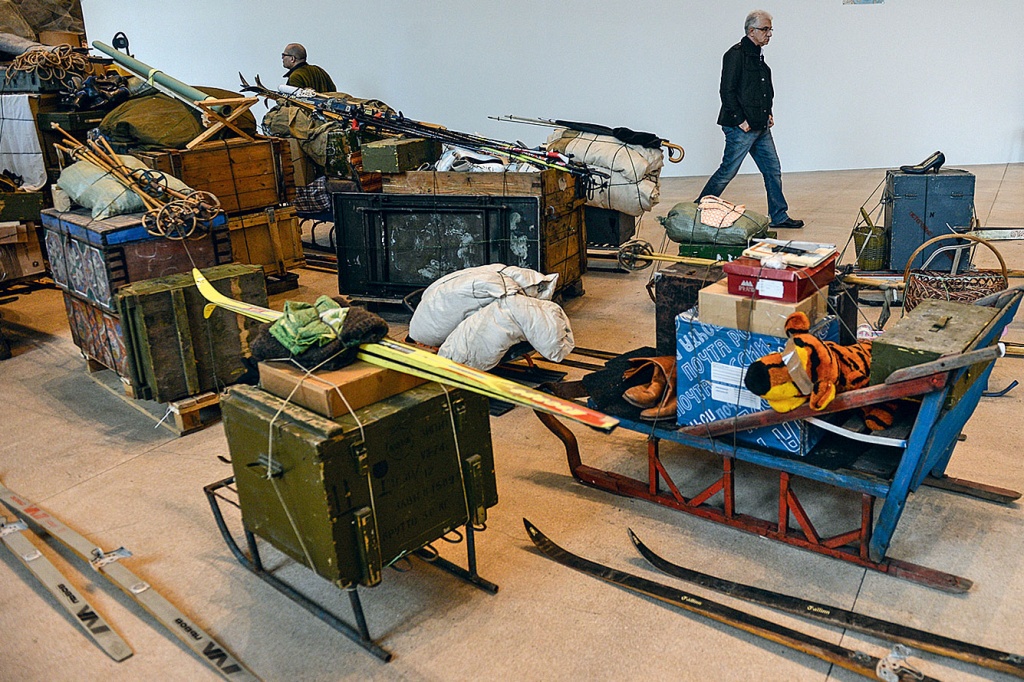
The curator of Biennale Belgian Catherine de Zegner is known for his feminist ideas, the love of the art of the Aboriginal people and the fact that he was preparing almost the first large exhibition in the west of the Russian artist Ilya Kabakov. All these three components of its curatorial handwriting were reflected in the arena. A significant number of projects are dedicated to the female topic - for example, a series of photographs of Umid Akhmedov “Mother -in -law and daughter -in -law”, on which the young Uzbeks after the wedding are captured with the mother -in -law - it was mother -in -law that chose them as their sons. In the installation of Australian artists, Alfredo and Isabelle Akilisan “Passing: Project of another country” Hundreds of sledges loaded with domestic belongings rush into the unknown (Australia is the country of immigrants, and the artists decided that this topic will be clear and close to Russian viewers). And the endless sets of small home objects, which are filled with the current space of the arena, are certainly consonant with the communal junk that Ilya Kabakov, whose exhibition also takes place in the framework of Biennale, exhibited in their installations.
"
A lifeless desert from lumps of foil in the form of eternal snow. Either hello Strugatsky, or a replica to Sorokin
"
In total, the work of 72 artists and art groups of five continents are presented in the Manege: no more than 15% of participants in such Biennale can be from the host country so that the exhibition does not lose the status of international. The main exposition is accompanied by additional - special projects dedicated to these days and deployed at the city exhibition sites. Of these, “reconstruction” can be distinguished in the Foundation “Ekaterina”-the exhibition is dedicated to the artistic life of Moscow in the 1990s; "Utopia and reality" by El Lisitsky, Ilya and Emilia Kabakov in Mamma; “1+1 = 1” John Baldessari in the “Garage” center - four cycles that offer a new reading of the classic works de Kiriko, Gauguin, Dyushan, Malevich and other authors; “Wolves and Sheep” in the Literary Museum - the reaction of contemporary artists to topical topics in the famous play by Alexander Ostrovsky.
The life of things
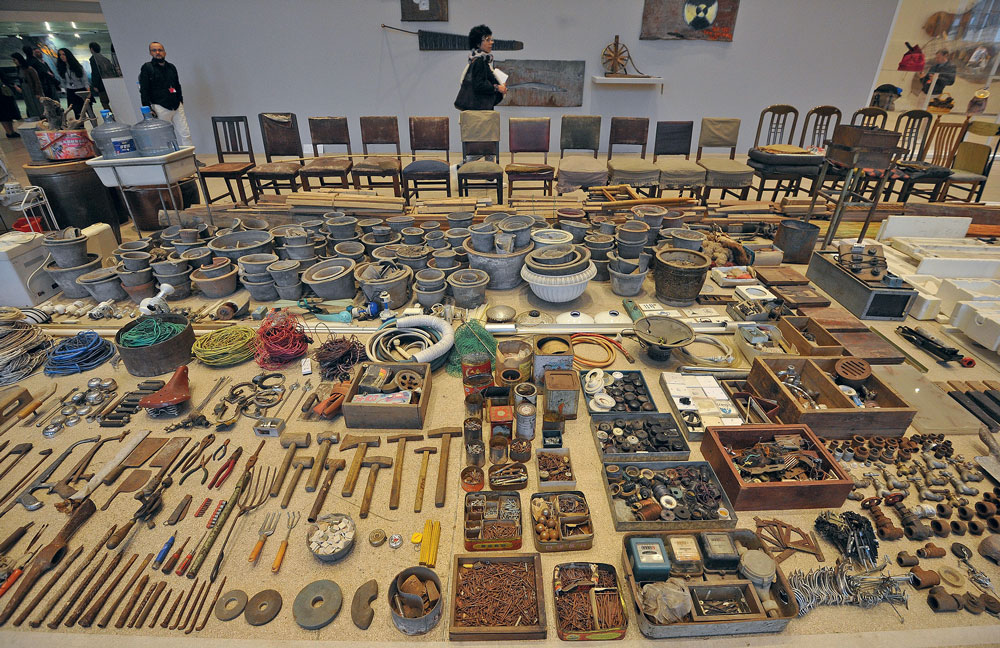
Perhaps the most impressive and simultaneously controversial project, exhibited in the arena, is called "Do not throw it away." He was created by the Chinese artist Song Dong and his sister Zhaoo Xin Yuan - 15 thousand items that their mother collected throughout her life. They are subjected thematically - shoes to shoes, used tubes from toothpaste - to tubes; The result was a giant installation, looking at which the audience plunges into the life and life of a poor Chinese family. But in fact, they plunge into themselves, begin to reflect and transfer this painful passion to old things to their own biography and their own life experience. Probably, this project can be called international in the full sense of the word: he refers us to the concept of “consumption society” by Erich Fromm, which was later philosophically comprehended in the work of the same name by the French philosopher Jean Baudrillard, he believed that consumption society is a self -deception society, in it abundance is a consequence of a carefully masked deficit.
The author of the installation says that gathering has become for his mother, who has lost her husband overnight, a means of depression. “Do not throw it away” - not only the rule of her life, but also the portrait of the whole generation of the Chinese. This character is explained as follows: everything that can be used somehow should be used as much as possible. “I remember how, in childhood, my mother brought pieces of fabrics and sewed clothes from them, which was otherwise possible to buy only according to special state coupons,” explains Song Dong. - Later, fearing that things would not be enough, she continued to collect fabrics. They are still here, neatly folded in the wardrobe. This fear of deficiency formed a special attitude to life, which did not allow throwing anything to be stored. In the end, the suffering finally broke the mother, and the habit of “not to throw away” entered the absurd stage. The objects shown at the exhibition are things that are “not thrown away” by my mother in a few decades ... ”
The road is nowhere
Actually, when you see these endless pairs of erased shoes and rows of aluminum bowls, associations with concentration camps and gas chambers involuntarily come to the head. The subject series carries deep and heavy memories, including recent ones, about our elderly women, who in the 90s dried polyethylene bags in their kitchens and then sold them on Moscow flea markets-"everything that could be used somehow should be used as much as possible."
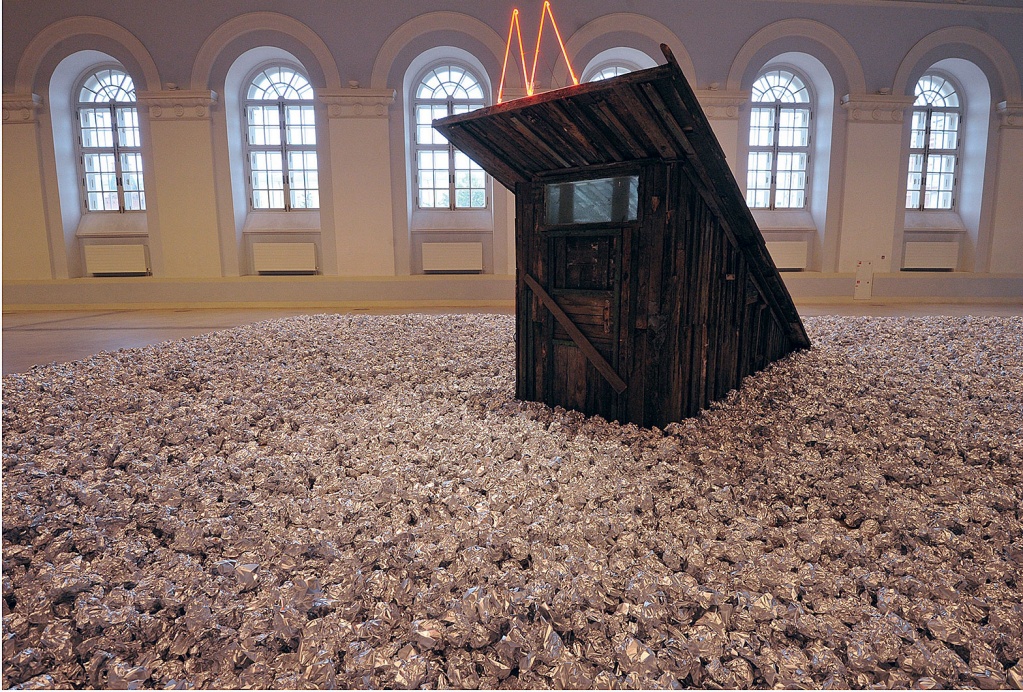
This work is supplemented at the exhibition by others, which also appeal to the material row, to the female world, being the sublimation of unspoken female destinies and it is not clear where the leading path. A chariot without a rider from adhesive tape and cardboard - the work of Valery Koshlyakov “Divine Shariton”, a great story created from unsteady material. Without a steering wheel and wales, a huge airship of the artist Panamarenko flies (the pseudonym of the Belgian sculptor Henry Van Herwegen, who creates fantastic aircraft in the real size of a model of fantastic aircraft). Muscovites disappeared underground in the installation of Alexander Brodsky “without a name”, which is a wooden cellar, over which the neon letter “m” (metro) is on, and around the lifeless desert from lumps of foil imitating eternal snow. Either hello Strugatsky, or a replica on Vladimir Sorokin.
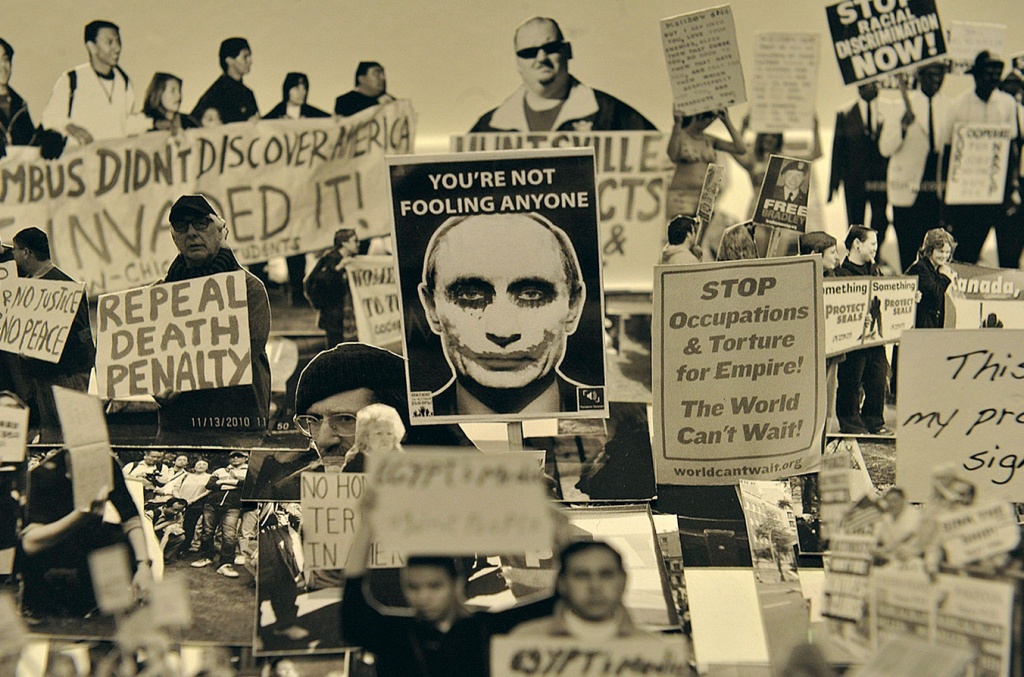
The entire space of the arena is built as a movement from the zone of darkness to the light zone. In the basement in the dark atmosphere, video installations are shown, upstairs - “in the light” - there is a random movement of objects telling about the disappeared civilization. Probably, this is how the curator of the exhibition perceives the present Russia-Atlantis, ready to go under water (or under the snow, if you turn to Brodsky’s metaphor). Catherine de Zegner declared that the fifth Moscow Biennale will be repelled from Russian realities and will focus on socio-political motives in art. But when Western artists called for the exhibition due to the laws adopted in the country, persecuting homosexuals, the curator tried to convince them, while insisting that there would be no particularly sharp projects at the exhibition. Therefore, it is not surprising that there is nothing in the exposition that would remind of the most scandalous and outstanding domestic art projects of the last time - the works of the Group “War” and Pussy Riot. More precisely, there is, but reminiscent of very indirectly: the work of the Irish artist Tom Mollya “Protest” (2012) is a long collage in the form of rally books, which includes about 1000 photographs taken over the years during protest promotions around the world. Manually carved figures of people seem to be an army of dwarfs, which remains unnoticed against the backdrop of the history of world migration directed into the non -existence of the history.
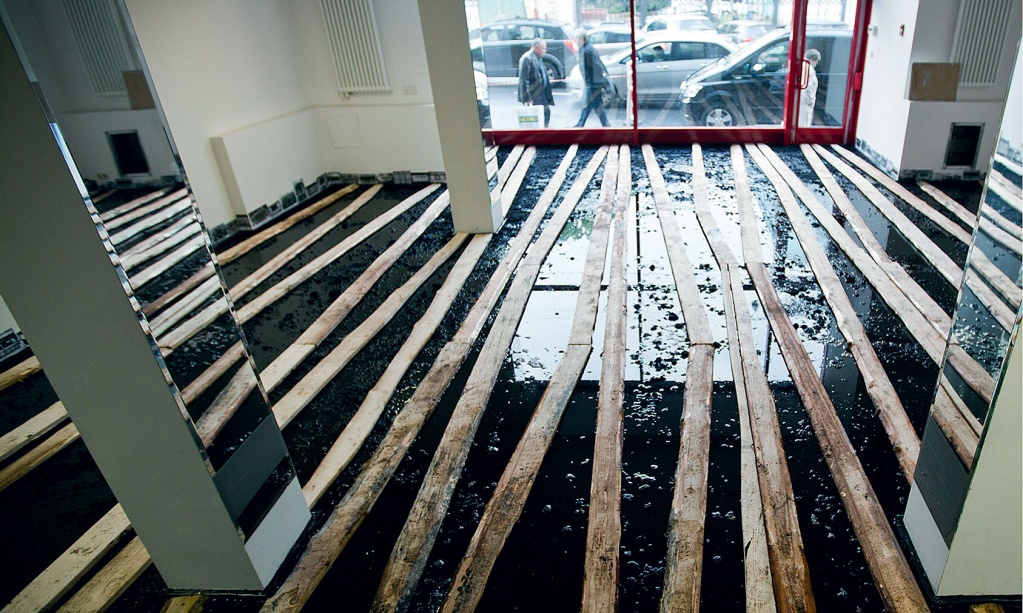
Above the mud
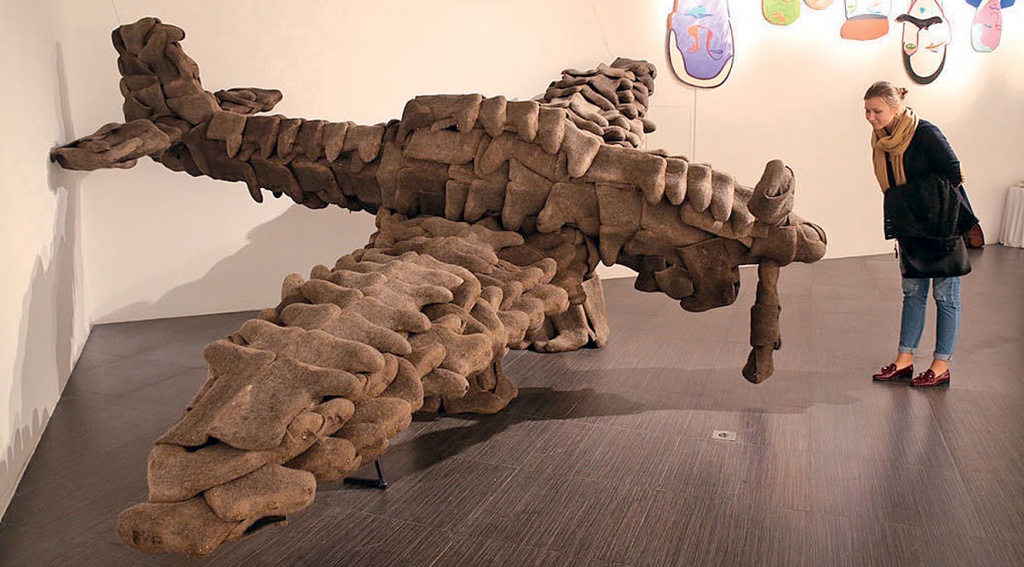
The exposition in the Ekaterina Foundation (curator Elena Selina), on which the most vivid events of the artistic life of Russia of the 90s, is documented, significantly expands the idea of contemporary art. Among the heroes of “Reconstruction” and Oleg Kulik and Vladislav Mamyshev-Monro, at the same time this is the story of the first Russian galleries and famous installations that are collected or re-recreated for this exposition. Approaching the gallery, you can already see the wooden boards laid on top of the poured ground in the window. This is the work of Dmitry Gutov “over black mud”, which was exhibited in the early 1990s in the Ridgin Gallery. 25 tons of raw land and 500 m of boards were brought into the exhibition space on Myasnitskaya in order to realize the well -known picture of Yuri Pimenov “Wedding on Tomorrow's Street” - there the bride and bride in the quarter of new buildings move through bridges over the mud. And on the second floor there is a German attack aircraft made of felt boots - the sensational sarcastic work of Alexei Belyaev and Kirill Preobrazhensky. Perhaps, if it were not for this curatorial work of Elena Selina, the fifth Biennale with the “style” motive of eternal emigration and an indefinite future would have turned out to be one -sided.
Photos: Peter Kassin/Kommersant, Sergey Karpov/ITAR-TASS, Culture Fund "Ekaterina"