
Translated material
Coonen.wav

Joint project of the magazine Theater. " And Colta.ru" Bakhrushinsky Museum Online "continues the publication of several unique audio conductors associated with the names of Alisa Konen and Alexander Tairov. These are the records of fragments from the famous performances of the Chamber Theater-“Adrienes Lekuvrer” by Eugene Scibe (the fable from which Coonen read at an evening dedicated to her 80th anniversary), “Optimistic tragedy” of Vsevolod Vishnevsky (a record made in 1951, shortly after the closing of the Chamber Theater) and the final episode The heights of the Coonen art of sounding artistic speech. Vadim Gaevsky talks about the last of these records.
In 1944, even the military, the year, Alexander Yakovlevich Tairov set-partly in the concert performance-the Chekhov "Seagull" with Alisa Georgievna Konen in the role of Nina Zarechny. In my “Book of Meetings”, in the most general words I recalled this performance, its psychological background, its aesthetic unusualness, not particularly relying on my memory. Now, after some time and almost seventy years after the premiere, but after listening to the radio recording made in 1946, I can speak more specifically. This radio monitor, of course, is a monument to the departed-apparently, forever-the theater. Not only the chamber theater, which lasted three decades, but the Russian theater in general, the drama theater of the first half of the twentieth century. In the modern theater, they no longer know how to pronounce the text. Or they do not consider it possible. All changed, speaking with Meyerhold words, the “diction” aesthetics of acting, the entire diction palette of the performance.
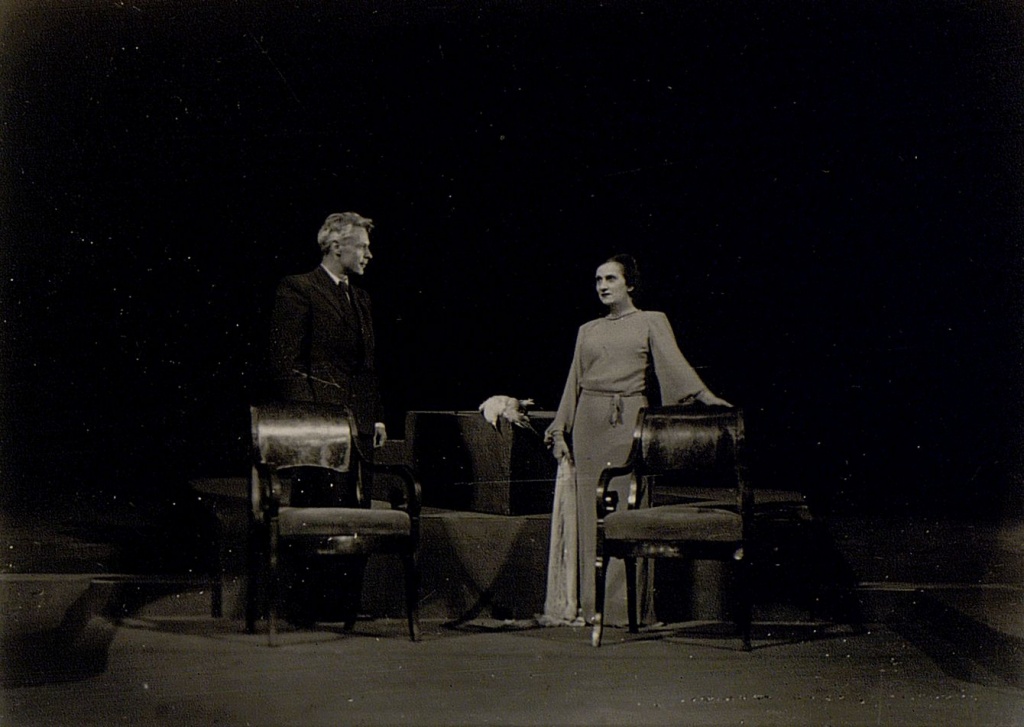 allchekhov.ru scene from the "Seagull" A. Tairov
Here, in Chekhovsky (but also Tairovsky), it is convex and bright, so it seems that some kind of connection with the past Theater, with the Bubnoy Valet and Moscow Cubism is preserved-as well as the memory of the Moscow Poetic School. And you don’t think about Bryusov (translator “Fedra”), but about Balmont - hearing a musically colored intonation, a delicately emphasized sound of vowels (to some damage to the sounds of consonants). The overall impression can be reduced to two words: acting is very energetic (almost constantly stressed the last word of replicas) and undisguised theatrical - actors, professional actors play from the same family to which their distant predecessors from the Italian Commedia Dell'Arte .
This creates a common style of execution, and this does not quite apply to only one participant in the action - Alice Coonen herself. Her style is individual. She is different. Another Alice Coonen, the other Nina Zarechny, her heroine.
“Not that ... not that ...”-in confusion and longing repeats the Zarechny-Konena, until he finds the right word: “Actress”. The actress, but one, who is just alien to the open theatricality, theatricality in the style of Arkadina, another heroine of the Seagulls. There are, it turns out, hidden, hidden theatricality - the discovery of Chekhov, the discovery of Tairov, the discovery of Alisa Georgievna. Her voice sounds in the "Seagull" not quite as it sounded in "Fedra" or her other famous performances. Both the timbre and intonation do not protect anything from anything, it is the voice of an unprotected soul open to the blow. She receives such a mortal blow at the end of the episode, but survives. The same deadly blow, without thinking about that she delivers Treplev, after which he parted with life.
This final scene is an absolute stage masterpiece, it is directed and played exemplary. Everything is traced, everything is revealed, nothing is hidden - the movement of the situation, its psychological meaning, excitement, which arises at the first moment and which dies by the end. The music sounds - first the piano plays, then the orchestra plays, the Zarechny reads the initial lines of the poetic monologue of the Treeple play: “People, lions, eagles, partridges ...” - and all this is slightly reminiscent of a melodeckamation, the favorite genre of the Chekhov era, when Turgenev’s poems in prose read the music at the summer evenings; Moreover, Turgenev’s words Nina recalls. But how is this scene far from amateur concerts: death wanders here, and only a weakening and almost perishable Zarechny-Konenin can prevent himself from destroying himself, will not allow himself to die.