
Translated material
Highlight of the regime
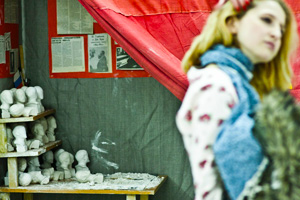
In Moscow, in the Presnya Historical and memorial museum, until November 30, the art-historical exhibition about the events of the fall of 1993, ending with the assault on the White House, abolishing the Soviet system and laying the political regime, which we still deal with it. The exhibition was organized by curators Ilya Budraitskis, Vladimir Potapov and Ilya Bezrukov with the participation of several artists: the aforementioned Vladimir Potapov, Yegor Koshelev, Diana Machulina, Alexander Vozner, Valentin Tkach, Andrei Blazhnov, Pavel Grishin and Misha Most. The exposition poses questions not only about 1993, but also about what it has now become, how it is comprehended and how it feels from today - 20 years later.
1.
At the exhibition during the viewing of leaflets and video chronicle of 1993, I was struck by the similarity of political dispositions, rhetoric and slogans with those during the protests of the last two years. The cries of “fascism will not pass”, riot police, rushing at people, imperials and red flags, leaflets of anarcho-syndicalists, in their speech pressure resembling the current ecstatic and sectarian leaflets of Cream,-all this reminded me of May 6 : a terrible historical dejaugu. It was as if in 1993 they pressed a stop frame, and recently launched a film of history again.
In 1993, there was politics in Russia: there was fermentation, there was a disagreement, it was rare that the philosopher Jacques Rancier calls a real policy, unlike consensus policy, the policy of the debugged functioning of the state machine and comfortable meetings of the parliament. After 1993, the policy disappeared for many years - it parted in the corners and home. The interrupted, not finding permission from the 1993 political disposition is psychoanalytically in the current regime. The Gater, that is, the basic configuration that still excites, still seems traumatic, unfinished and which is therefore forced to repeat - until it finds a splash and historical outcome. As if they were petrified along with the history and are waiting in the wings to come to life, the flags in the work of Alexander Poster on the entrance to the museum on Presnya. Those who say that in 1993 we escaped the civil war, involuntarily raised the question: did we put it aside for the future? The case on May 6, as well as the other judicial and legislative nightmare of recent times, is another attempt to stop and freeze a story that once again causes on the horizon the question of the inevitability of violence to break through the blockade organized by the authorities.
The policy was in 1993 on the streets-and it is impossible to avoid its exit on the streets if we want to change something. It was not without reason that an artist went out into the street, who made graffiti opposite the exit from the museum. In video chronicles, which are shown on a laptop in the middle of the exposition, there is a moment removed from the inside of the truck’s cab, when the driver, smiling, screams “we go to“ Ostankino ””, and then “do not allow bloodshed in our country” and shows the sign V - the Victory sign. In people there was a faith in politics, the hope of the possibility of changing something-faith and hope, which, after 1993, rarely meet where you will meet universal apathy.
And after that, I read on Facebook by intelligent acquaintances about “terrible people” who violated public order about “dangerous hooligans” and “cattle”, which gathered in Oktyabrskaya Square and stormed Ostankino. These “terrible people” who went out without any calls from television, which was completely in the power of Yeltsin propaganda, how can we delete their will from history? In such liberal-intellectual statements about the “cattle”, one distrust of the “people” is heard, which, meanwhile, was the basis of the Stalinist autocrat regime-for example, forced collectivization, which rightly does not cause any sympathy among the liberal intelligentsia. The hatred of a large part of the intelligentsia responsible for the production of speech and culture is logical to the old “soviet” system. But as soon as the situation lost predictability, like these people who rejected power, immediately frightened and created new explanatory idols - Boris Yeltsin and Yegor Gaidar. I remember when, at a rally in support of Navalny, out of provocative considerations, I decided to shout: “Power to millions, not millionaires” - my friend stopped me: why did you get that these “millions” be able to cope with this power? When Isabelle Magkoeva said the same slogan at the rally on Sakharov Avenue on Sakharov Avenue, the other organizers of the rally made her a private stick for “arbitrariness”. The counter question for this condemnation - and why believe that “millionaires” will be better managed with her? In the miniature of the 1993, the highlands of the 1993, even in a recent scandal with Yuri Zlotnikov : those who had control over the media, in this case, did not allow the artist who crawled out of the hall, stripping him with a malicious and retrograde old man, who is better not to trust the microphone. In addition, everyone was in a hurry for their business (for example, for a dinner with Dasha Zhukova), and they had no time to listen to boring pensioners or screamers on barricades.
I am talking about the liberal intelligentsia because it is one of the social strata closest and familiar to me. In no way, I do not think to blame the Yeltsin’s other supporters in all that happened to her and still sincerely believing at that time in the happiness of the free market, and I do not think that supporters of the Supreme Council had direct access to the truth and salvation of society. But a large role in the injury of horror in front of the supporters of the Supreme Council was played by television and the people who formed on it who formed a new consensus. As my mother told me to the question of what they thought about what was happening: “No one thought, there was complete misinformation in the media, an information vacuum and a sense of frightening uncertainty, fear of the return of the Chekists.”
Although the condensed conservative-patriotic pathos reigned mainly in the Supreme Council, it was from the point of view of trust in the “people” that the democracy of that fall was still on the side of the tips chosen from below. The political confrontation was not just a war between the White House, filled with “red-brown”, and Yeltsin’s liberal team, as is usually told by patterns of television propaganda in 1993, not a new coup, but a conflict between the Kremlin team and tips throughout the country, which were like democratically chosen, albeit dysfunctional in the existing system. This is emphasized in the exhibition, where appeals are presented, condemning Yeltsin’s actions, emanating not only from the White House, but also from local councils. For some reason, I remembered a resolution from Mordovia, apparently because of events around Nadezhda Tolokonnikova .
But in fact, the 1993 conflict was not even between the Soviets and the Yeltsin team, and not the supporters of Yeltsin won in it: the losers were the very disagreement and the basket of protests themselves. Two logic of history, mechanical and human: the first - making people with its hostages and subordinating them to the distribution of material goods, the other is the logic of human disagreements, which existed only in the form of a promise and incapable of realizing oneself in 1993. But it was precisely about the second type of history that Marx said that it could become a real history of mankind.
2.
How did people try to comprehend what was happening then and today? The exhibition is divided into two parts - into leaflets and documents of 1993 and on the works of young artists, none of whom took a direct participation in the then events.
Among the leaflets are amazing specimens - for example, a witty parody of antisocial Yeltsin decrees. A fair part of pro -Soviet leaflets was written by a condovo, archaic language in the spirit of the literature of the post -war USSR, spraced by Vladimir Sorokin. But at the same time, there are much more folk art and home -made drawings and texts - in contrast to the leaflets of Progeltsinsky, already anticipating the intelligence of new political technologies, advertising and glossy magazines. Despite the differences in the style, many slogans are repeated almost literally: the liberals still repeat the shortage of the free market, and still the left indicate the fatal cutting of social expenses ... However, the left leaflets are noticeably more: why were the Yeltsian team of leaflets, when there were “Ostankino” in their hands?
In the center of work, almost all artists are the traumatic effect of 1993, and because of this, the ability to arrange contradictions, the resolution of which is not available, is clearly displayed in its aesthetic cocoon. The structure of many works makes us recall psychoanalytic ideas about the installation of injury. Injuries in psychoanalysis is a meeting with a reality not accepted by consciousness, causing a goature of experiences and tearing any attempts to fully imagine it and reconcile with it, including retrospective attempts. In the painting of Vladimir Potapov, the inability to return to the past, to understand to the end of what happened, turns into a poster fake of personnel from 1993, emphasized by perforating of work, similar to perforating outdoor advertising. Potapov’s paintings are hypertrophied and at the same time blurry, as if you can’t make a focus on the past, you cannot record it without losses. In a similar way, in the installation of Misha Most, Lenin's faces are scraped off from gypsum busts, as if making it impossible to recall the features of such an important person and his social structure founded. An excess of painful affects is spilled out in the works of Valentin Tkach by expressionist drifts of paint on top of Soviet neo -motornote and persons of workers - symbols of those hopes that were finally rejected in 1993. A collage of leaflets and photographs that dominates the other Moscow exhibition about 1993, which is simultaneously in the Memorial exhibition hall, is also a way to show the skilings that generate nonsense, the impossibility of understanding. And this cautious rejection of conclusions, the restriction of the statement with hints, alas, characterize the entire exposition of the “memorial”.
The work of Diana Machulina, a luminous box with a disgusting melted cheese inside, planted on a stick like an outflow, and rainbow advertising of ice cream on a luminous facade, is a sarcastic metaphor for relations between expectations from the Yeltsin "democracy" and its reality. At the same time, this work seems to be an illustration of another psychoanalytic idea of injury. With injury, the fantasy covering reality is torn, and an unsightly truth is revealed behind it; But this traumatic moment of Truth is later protectively hiding behind the former renewable fantasm screen. Today, such a fadies of the current, the idea of the present, good capitalism, which exists somewhere in the West, is completely separate from our reality, serves as such a fading picture.
The obsessive return of the hyperreal and alienated picture from you, visible as if in a screen frame, pictures that you can only passively and numb from the side, deprived of the opportunity to act - this return is recorded in the work of Yegor Koshelev. In it, the scenes of the fall of 1993 are drawn inside the window frames, similar to those through which Koshelev looked at what was happening. This resembles the Freudovsky “man with wolves”, the highway of which also appeared in the window frame: in his dream on a tree, wolves sat motionlessly, fluffing their tails, and looked at him. A fair part of “New Russian Cinema” is dedicated to the poetization of apathy as a consequence of historical shock - for example, almost all Balabanov’s films, whose leitmotif was not without reason the raped girl, was a victim of circumstances. But Koshelev does not praise apathy, he has the inability to join the events only sets off their tragedy - tragedy in the dramatic sense: as a story about the fight of people with the power of capital and weapons exceeding human forces. The pathetic of this tragedy was conveyed by Koshelev, deliberately with an archaic, picturesque language, inheriting Soviet realistic painting with all its naive heroism.
The leitmotif of several works are the attributes of the Soviet, torn from context, but reminding themselves of modernity, which became the hieroglyphs of the lost and not understood social system: either a terrible empire, or hopes for democracy. For example, in the work of Andrei Blazhnova, a pregnant woman sits on the beach, losing a red banner with the profile of Lenin under herself, and looks into the distance, biting an apple. These hieroglyphs can also be interpreted in the psychoanalytic spirit as symbolic representatives of injuries after it is performed: the Schrames left on the body and psyche, traces of the meeting with the unbearable. The maximum version of such a meeting is death, and about this is the work of Pavel Grishin: the fallen blinds, similar to the Seva building flew out of the windows, on which the letters of the dead are printed with blows.
An injury is an interrupted human story, something that is impossible to just agree on: it either costs silence or causes stormy, but unsatisfactory conversations. It is significant that at the exhibition and leaflets created in the excitement and misunderstanding of what is happening, and the works of young authors may not fully find a language that should comprehend the collision with the mechanics of power, although they need to say something. The outcome of the injury - both psychoanalytic and historical - can only be an action, an act - but the act is not mechanical, like most of those actions that we do in our comfortable everyday life, but undermining the usual dominant consensus. This action seems to be hinting at graffiti opposite the museum depicting a demonstration at the White House. But this exhibition itself already has a political act, an indication of the connectivity of history.
3.
To understand the understanding of the events of 1993 by the organizers of the exhibition, I interviewed one of its curators - historian and activist Ilya Budraitkis.
- What did this exhibition mean to you?
- This exhibition is politically and socially significant, first of all, as the fact of a conversation about the events of 1993 in the space of the State Historical Museum. Today, museums of history are rapidly losing any semblance of the quality of public space , and projects located on the tip of political debate are capable of returning this social dimension to museums. In addition, the Presnya Museum is one of the two or three museums of Russia, where the 1993 theme is affected in a permanent exposition. And our exhibition is trying to somehow revive this topic, to update for people. I have repeatedly noticed that when examining the constant exposure of the events of 1993, the perception of people changes in Presnya, the alienation that we are accustomed to and which is murderous disappears to the perception of history. People begin to recall, argue, they no longer need a complete interpretation that they are used to taking from the museum, they are ready to engage in the interpretation of history.
Today, the events of 1993 are usually presented in two versions: either as a slurred silence in the spirit “such an event was, its content is not clear for us, this is one of the riddles of history”, or, conversely, through the atmosphere of pseudo-discussia, in which the clash of opinions is brought to the point of absurdity and replaces any intelligible attempt to analyze. Two sides, repeating for 20 years the same thing, is not a public discussion. 1993 takes a place among speculative disputes - such as debates about morality and LGBT, a “single textbook of history” or the role of Stalin in the Second World War. These disputes are designed to demonstrate that the discussion is endless, and attempts to find meaning in the torn chain of events are doomed to failure.
- What alternative look do you offer in your exhibition?
- 1993 is not a completed event, but part of a certain sequence, including the current state of affairs. If we want to understand why violence and authoritarian features of power have become immanent to the existing regime, we must inevitably return to the history of 1993. It is fundamental for the genealogy of today's social and political order. The attempt in our exhibition is connected with this to combine historical documents and statements of actual artists, showing interest primarily primarily in the present and through it - by 1993. It is important that most of these artists have never worked with historical material before, but for them it is necessary today. In general, the position of a socially engaged artist in his development turns out to be inevitably related to the appeal to the injury of the 1990s and by 1993, especially.
- That you would answer the arguments often put forward on Facebook and on the same Colta. Ru,-they say, if it weren’t for the shooting of the White House, then either a red-brown dictatorship would have come to power, or would a civil war have begun?
- Unfortunately, 1993 was not the moment of an alternative from either a positive or a negative point of view. Ни идея, что если бы Ельцин не принял решение о расстреле, то началась бы война и кровавая красно-коричневая диктатура, ни идея, что если бы победил Верховный Совет, то у нас было бы социально ориентированное демократическое государство, не имеют отношения к действительности. Потому что победа Ельцина была к 1993 году предопределена: это был финал трагедии, а не начало.
Вся ельцинская вертикаль исполнительной «демократической» власти наследовала партийному аппарату: несмотря на роспуск КПСС в августе 1991 года, абсолютное большинство работников партийного аппарата было трудоустроено в новые исполнительные структуры. Эти люди сознательно поддерживали курс на радикальное перераспределение советской государственной собственности. «Рыночные реформы» не были каким-то идеалистическим проектом, созданным группой реформаторов-романтиков во главе с Гайдаром, которые приняли огонь на себя и, преодолевая противодействие всей старой элиты, совершали болезненные, но необходимые шаги в будущее «свободного рынка». Нет — это был выбор большей части элиты, и приватизация была коллективным политическим решением.
И Гайдар, и его окружение не только не презентовали себя в качестве демократических политиков, но и противопоставляли себя любому виду политики, опирающейся на поддержку снизу. Они представляли себя как технократов и революционеров, которые действуют вопреки большинству, а политическое прикрытие их деятельности было задачей Ельцина. В этом отношении антидемократический элемент был изначально заложен в структуру постсоветского государства. Было изначально понятно, что если страну ждут рыночные реформы, то они должны будут проводиться жесткими, авторитарными методами. А для эффективности этих методов необходимо, чтобы этот экономический выбор был коллективным выбором элиты, поддержанным силовыми структурами.
- Можно ли говорить о более ранних роковых поворотах исторических процессов в конце 1980-х годов? Об альтернативах?
— Альтернатива как ориентир есть всегда — вопрос, кто является субъектом этой альтернативы. К 1991 году было понятно, что, несмотря на существование в стране массового политического движения за перемены, оно прочно контролируется либералами, а у несогласных с ними уже нет возможности повлиять на повестку этого движения. Было также ясно, что это движение не является доминирующим политическим фактором, а существует лишь в связке с направляющим его большинством элиты, готовым к демонтажу государства и переделу собственности. Поэтому сложно говорить даже о том, что были альтернативы в 1991 году…
Другое дело, что разговор о точках невозврата 20 лет спустя и в момент событий — это совсем разные вещи. Люди, которые участвуют в большом историческом событии, должны принимать возможность альтернативы не как прекрасную утопию, которая будет их направлять и поддерживать необходимый градус оптимизма. В каждый конкретный политический момент альтернатива продолжает существовать — на уровне человеческой субъектности, на уровне того, что идеи все-таки способны стать силой, изменяющей реальность.
— На выставке представлен целый стенд, посвященный резолюциям малых местных советов, осуждающих политику Ельцина. Какую роль для вас играла эта подборка документов? Какова была структура советов на тот момент и были ли в ней какие-то демократические потенции? Или все было окончательно зарегулировано?
- Советы образца 1993 года, конечно, не были теми, что подразумевались в 1917 году в лозунге «Вся власть Советам!» Те советы появились как орган прямого представительства классов, и именно в таком виде они были зафиксированы в первой советской конституции. В 1936 году была принята сталинская конституция, в которой функция советов была принципиально изменена: они превратились в советы по территориальному принципу. Но, согласно сталинской и затем брежневской конституциям, именно эти органы были единственными органами суверенного представительства, а председатель Президиума Верховного Совета был формально главой государства. На протяжении всего советского периода, однако, советы оставались ширмой для фактической власти бюрократической вертикали во главе с генсеком. Точно так же и в 1993 году исполнительная власть во главе с Ельциным наследовала параллельной власти партии, а местные советы и Верховный Совет оставались формально всевластными, но в реальности бесправными.
Выставляя десятки документов, мы совсем не ставили себе целью сделать сухую архивную выставку. Это видно по тому, как документы разбиты на три группы: на воззвания местных советов, на указы несостоявшегося «параллельного правительства» Белого дома и большую коллекцию листовок, представляющую позицию самых разных сил, составлявших пеструю картину уличной политики осени 1993 года. Гораздо важнее, чем просто напомнить о последовательности событий, для нас было отразить политический язык этого исторического момента. Интересно, что язык этот мало различается у приказов Александра Руцкого или призывов, накорябанных на бумажке рукой провинциального рабочего: в обоих случаях это язык, совершенно не описывающий политическую реальность, но ярко отразивший ту степень отчаяния и непонимания происходящего, которая была характерна для стороны Верховного Совета.
Также мы хотели показать, что никакой монолитной « team “Руцкой”», как сказано в одном из материалов COLTA.RU , не существовало. В отличие, кстати, от кремлевской стороны, где все работало как часы и роли были четко распределены. Центральное телевидение перло как пропагандистский танк, стальными гусеницами прокатывавшийся по всем этим ничтожным листовкам и крикам в мегафоны. Творческая интеллигенция, сгруппировавшаяся вокруг своего Бонапарта, действовала как по приказу. Интересно, что большая часть подписантов «Письма сорока двух» — казалось бы, людей, для которых слово было профессией и призванием, — оказалась удивительно нечувствительна к тексту. Это хорошо иллюстрирует недавняя подборка высказываний на COLTA.RU : одни подписали, не дочитав «Письмо» до конца, другие дочитали и подписали, несмотря на серьезные сомнения и эстетические разногласия. То есть у них, совершенно в унисон со спецназом, включился рефлекс дисциплины воюющей армии.
В архиве «Мемориала» есть интересные материалы милицейских радиоперехватов тех дней. В них, например, есть несколько моментов, когда в разговор генералов или офицеров врывается истеричный голос Руцкого, выкрикивающий, что он президент России, генерал и что он приказывает им развернуть штыки и идти на Кремль брать Ельцина под арест. Ну и прочие безумные приказы. И люди просто, не отвечая, переключали приемник на другую волну. Через какое-то время Руцкой опять находил нужный диапазон, и опять его голос воспринимался лишь как сигнал немного подкрутить ручку рации.
Никакой «красно-коричневой коалиции» не существовало. Да, были попытки объединения сталинистов и националистов на почве конспирологии и желания сильного порядка, но спектр политических сил, выступивших против Ельцина в 1993 году, был неизмеримо шире. Это были и демократы, не согласные с бряцаньем авторитарной риторикой со стороны Кремля, и националисты-антикоммунисты, и сторонники советского опыта в самых разных вариациях. Наконец, это было огромное количество людей, которые вообще не знали своих политических взглядов, но ощущали бесконечную боль и чувство потери собственной страны. Их бунт был бунтом отчаяния. Эта эмоциональная энергия защитников Белого дома никак не могла себя внятно выразить. И это видно в сбивчивых обвинениях Ельцина в нарушении законности, в попрании конституции. Но люди шли под пули и умирали не за конституцию или за законность, это были совершенно абстрактные лозунги. Мотивом было то, что люди видели, как общество распадается у них на глазах и приближается социальная катастрофа, которую они не знают, как остановить, но последствия которой будут ужасны и изменят их страну до неузнаваемости.
Сегодня мы живем в ситуации этой победившей катастрофы, которую эти люди, пусть и растерянные, но способные на героизм и жертвенность, пытались остановить. Да, через 20 лет мы можем говорить, что реальной возможности нажать на «стоп-кран» тогда уже не было. Но это не значит, что все эти люди выходили напрасно, что их участь была предопределена — ведь альтернатива существует всегда, пока существуют люди, которые в нее верят.
— Но как именно могла бы выглядеть эта альтернатива, мы сказать не можем.
— Да, такой парадокс.
— Кто вышел на Тверскую по призыву Гайдара? Понятно, что эти люди еще верили по инерции 1991 года в обновление страны, но тоже оказались обмануты.
— Да, 1991 год был совсем недавно, а пропаганда была сильна. И еще у ельцинской стороны было иное качество картинки будущего, которую они умело рисовали и могли разъяснить. Они и были людьми, говорящими от имени будущего. Но многие выходившие в 1993 году на стороне Ельцина уже понимали, что что-то идет не так, что есть основания для тревоги. Не все, кто вышел на Тверскую за Ельцина, были людьми, выигравшими от экономических реформ, — точно так же как не все люди у Белого дома от них проиграли. Но историческая дистанция была еще так мала, что социальные и политические позиции еще не совпали.
Призывы команды Ельцина выйти на Тверскую наследуют нравственному пафосу призывов 1991 года, но уже совсем в другой ситуации. Хотя тогда уже могло смутить то, что на стороне нравственности и демократии приходится шагать единым строем с армией и ментами. Интересно, что Булат Окуджава, подписавший «Письмо сорока двух», незадолго до смерти стал говорить, что сейчас он бы эту подпись не поставил и что в 1993 году он был романтиком. Ельцин и его окружение понимали, что задействуют этот советский по своему характеру и происхождению антисоветский романтизм, возможно, в последний раз. И для перестроечной «творческой интеллигенции» 1993 год действительно стал лебединой песней, после него она потеряла качество коллективного «нравственного голоса». Впрочем, и тогда Ельцин не был ей обязан своей победой.
— Сыграло ли в 1993 году свою роль недоверие либеральной интеллигенции к так называемому народу, которое часто звучит сегодня?
— Разумеется, уже тогда говорилось о «люмпенах», о «Шариковых». И поскольку социальные границы еще оставались размытыми, чтобы отличить «быдло» от «небыдла», то использовались границы политической компетентности — тот, кто поддерживал реформы, был прогрессивен, а кто отрицал, становился профаном и «быдлом». И 1993 год был последним моментом, когда возможность приобщиться к «небыдлу» была открыта: достаточно было откликнуться на призывы ельцинского телевидения, чтобы оказаться в стане интеллигентных, воспитанных людей.
— Можно ли сказать, что после 1993 года уличная политика была пресечена?
— Да, то, что произошло в 1993-м, было еще и акцией устрашения, надолго укротившей уличную политику в принципе. Рядовые участники с обеих сторон по итогам этих событий пришли к глубокому убеждению, что выходить на улицу не нужно и опасно для жизни. И этот страх, поселившийся после 1993 года, жив в огромном большинстве наших соотечественников до сих пор. Он подвел черту под тем периодом массовой политики снизу, который начался в перестройку и закончился расстрелом Белого дома.
— Можно ли сказать, что, несмотря на бессилие и общую консервативную настроенность Верховного Совета, он был более осмысленным и демократическим органом, чем будущая Госдума, например, 1993 года?
- Undoubtedly. Характерной чертой этого Верховного Совета была реальная связь с избирателями: каждый депутат был выбран от своего округа, а выборы в Совет 1990 года были самыми прозрачными выборами во всей новейшей истории России. Это был конец перестройки, сопротивление партийных консерваторов уже было слабым, а больших денег на избирательную кампанию не требовалось, так как печать газет стоила копейки и человек на зарплату инженера мог организовать себе агитацию. Округа были маленькими, и можно было выдвинуться даже с небольшой группой единомышленников. И в Верховном Совете было очень много людей, выдвинувшихся на волне перестроечной неформальной активности за счет своей гражданской позиции. Кроме того, там было просто в несколько раз больше людей, чем в Думе, и не было никаких партийных списков. Дума была абсолютным шагом назад по сравнению с Верховным Советом.
— Чем была, по-твоему, вызвана победа партии Владимира Жириновского в 1993 году?
— Голосование за Жириновского было протестным голосованием, и для этого он и был спущен сверху и раскручен телевидением — чтобы аккумулировать весь бессильный после расстрела Белого дома протест: против этих выборов, против новой конституции, против нового порядка вещей, против ощущения, что все безвозвратно проиграно. Чем отличалось и отличается до сих пор голосование за Жириновского — его избирателям свойствен большой уровень недоверия к политике в принципе, горького, отчаянного цинизма и апатии. Всем понятно, что если Жириновский призовет своих избирателей выйти на улицу, никто, конечно, никуда не выйдет, — но они придут и выразят свой пессимизм через избирательный бюллетень.
— Как ты думаешь, были ли фальсифицированы президентские выборы 1996 года, как о том обмолвился недавно Дмитрий Медведев?
— В пользу этого было много весомых доказательств. But this is not even the main thing. Главное, что, даже если бы фальсификации были раскрыты, Зюганов все равно согласился бы с любым нарисованным результатом.
— Ты имеешь в виду высокий уровень общественной апатии?
- Yes. И еще — на чем строил свою кампанию в 1996 году Ельцин? Не на том, что он лучше и что при Зюганове будет голод, это были лишь вспомогательные аргументы. Основным тезисом Ельцина был «коммунисты не придут к власти в любом случае». Этот тезис много раз повторялся в ходе кампании. Это значило одно: что либо Ельцин получит победу на выборах, либо будет введено чрезвычайное положение и на улицах снова, как в 1993-м, появятся танки. И многие люди, голосовавшие за Ельцина, именно эту возможность принимали во внимание. За этой дилеммой стояла практически открытая борьба двух группировок — Анатолия Чубайса, который политически организовал тогдашних олигархов в качестве штаба ельцинской поддержки, и силовиков, которым было выгодно, чтобы президент остался у власти с их помощью и стал заложником чрезвычайного положения. И об этом прямо говорила избирателям группировка Чубайса: вы лучше проголосуйте за него, а то вы будете иметь дело уже не с тем милым Ельциным, защищающим демократию, которого вы знали. То есть реальный выбор был не между Зюгановым и Ельциным, но между Ельциным-Джекилом или Ельциным-Хайдом.