
Translated material
The first time
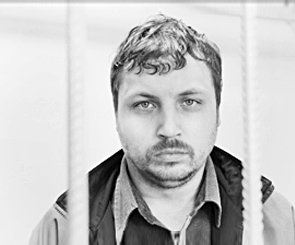
On October 8, a sentence was sentenced to the first accused in the “swamp case”, who did not conclude a deal with the investigation. Earlier, the case of Maxim Luzyanin was considered in a special order, who pleaded guilty in full (he was eventually sentenced to four and a half years in a general regime for participating in the riots and the application of violence to a representative of the authorities), and Konstantin Lebedev , who testified for other accused of organizing riots (for which he received two and a half years of deprivation of liberty). The current case, the case of Mikhail Kosenko, was also considered in a special order, but for a completely different reason.
Kosenko, a disabled person of group II, was registered in a neuropsychiatric dispensary, in 2001 he was diagnosed with “schizophrenia of sluggish, neurosis-like, with pronounced personality changes in the emotional-volitional sphere” in the wake of his head injury. Now the official name of this diagnosis is schizotypic disorder; This disease, in essence, is not with schizophrenia, since it does not include all the necessary symptoms for the diagnosis of schizophrenia. It is known that Kosenko could not continue his studies after school, hardly made contact with people, could not do any one thing for a long time. Having worked on a bushings of lead, he began to treat the surrounding world with increased caution: it seemed to him that everything was infected with lead, and even after treatment in 2001, he continued, for example, to take the door handles through a napkin or to consider that he was monitored through a telephone outlet. Nevertheless, treatment (therapy using light drugs), apparently, had fruit - it became, as psychiatrists say, “ordered”, but passivity and unwillingness to communicate with people have been preserved. There have been no exacerbations of the disease since 2001.
By order of the investigation, experts from the State Scientific Center for Social and Judicial Psychiatry named after Serbian drew up a conclusion on the mental state of Kosenko. According to the conclusion of psychiatrists, Sofia Oskolkova, Inna Ushakova and Marina Tsvetaeva, Kosenko on May 6 and later was in an insane state. At the same time, according to the document they compiled by Kosenko, not a sluggish neurosis -like, but paranoid schizophrenia, which the specialists of the state center made a diagnosis, talking with it for only an hour. As the President of the Independent Psychiatric Association of Russia Yuri Savenko, who spoke in the court in the case of Kosenko with a sharp criticism of expert opinion, if the anamnesis was stated clearly, then with regard to “studying the mental state of the sub expense and qualifications ... of these data”, “about any fullness and objectivity ... we are not talking, a whole collection of all kinds of contradictions is before us”. According to Savenko, experts through the replacement of the diagnosis and other “stretches and deceptions” (for example, nothing follows from anything that Kosenko “poses a danger to himself and others”, as well as attributing aggression to him) the court misleads. (You can not even mention the revealed professional errors identified by Savenko’s revealed professional errors with the names of drugs.) However, it was the expert’s conclusion that the investigation was that the investigation, and the prosecution part of the charge demanded for Kosenko forced psychiatric treatment, and therefore his case was considered separately from the rest. Carrying out a re-psychiatric examination, Kosenko’s defense failed to achieve.
Kosenko was actually charged with Luzyanin: in Bolotnaya Square they were nearby, and both of them, in addition to participating in the alleged riots, attributed violent actions in relation to the same OMON employee Alexander KazMin. According to the investigation, Kosenko inflicted one blow with his hand and one blow with his foot. In the case there are two evidence of Kosenko’s guilt - this is a video, where he simply stands next to people who are pushing the police, and the testimony of one of the OMON employees, who allegedly saw Kazinko hit Kazmin. Kosenko did not admit his guilt. At the same time, when the Kosenko case was considered in court, the charge of the use of violence was re -qualified from part 1 of Article 318 to Part 2 - that is, from violence that is not dangerous for life or health, to a dangerous one. Thus, Kosenko turned out to be the only one of all the accused in the “swamp case”, which is charged with the use of violence that is dangerous to life or health - despite the fact that the conclusion of the forensic expert says that Kazmin’s health was caused by slight harm. Kosenko also filed a lawsuit to damage Moscow property, once: asphalt, toilet cabins, etc. (in the case, Kosenko’s involvement in the infliction of this was not mentioned), but later it was recalled.
On suspicion of participating in the riots, Kosenko was taken into custody on June 8, 2012. The court rejected his petition for house arrest - Kosenko explained that he often feels bad. During the investigation of Kosenko, he was kept in pre -trial detention center No. 4, known as the “bear”, later he was transferred to the Psychiatric Department of Butyrki. The Basmanny Court has repeatedly extended the term of Kosenko’s detention in custody, agreeing with the arguments of the investigation that, being free, he could destroy evidence of the crime, hide or put pressure on witnesses, and ignoring any arguments of the protection and guarantee of human rights defenders. At the same time, in the pre -trial detention center, Kosenko at first did not give the medicines prescribed by the doctor, the local doctor did not examine him, the psychiatrist came only once. Lawyer Vladimir Ryanov filed a number of complaints about the violation of the rights of the client, after which Kosenko allowed to transfer the medicine, and the doctor also visited him. While in Butyrka, Kosenko complained about unsanitary conditions.
It should be emphasized here that the authors of the aforementioned forensic psychiatric expert opinion asked the investigator a direct question: “If to [Autsenko] suffered and suffers from a mental illness, dementia or other painful state of the psyche, whether the content of the investigative insulator is reflected in its condition, is there a threat of exacerbation of the disease or another threat of his health?” Answer: They say, this question "is not within the competence of forensic psychiatric experts." We quote Yuri Savenko: “The fact that the content of such a patient in a pre -trial detention center, in the conditions of isolation from the external world and the habitual habitat, conducting investigative actions and the sensation of the upcoming threat to his life and health, will significantly worsen his mental state, is undoubted and already confirmed by specific facts. Experts themselves write that the sub expigurations felt a deterioration in his mental state and began to engage in auto -training in order to "do not fall into madness." The evasion of experts from the answer to this question characterizes them themselves and throws another shadow to the institution that raises such experts. ” (It can be added that one of the authors of the examination, Sofya Oskolkova, was already pretty much from the Independent Psychiatric Association headed by Savenko for the book “Medical and Social consequences of the destructive activity of totalitarian sects”.) Experts of the Center of Serbsky removed responsibility for the consequences of Kosenko’s stay in the pre-trial detention center, actually blessing the investigation and the court then in order not to release it.
The trial in the case of Kosenko was eleven months, since November 2012. Moreover, it is quite leisurely - sometimes one meeting per month, or even in several months. Representatives of the prosecution read the results of medical examinations of police officers: the conclusions said that reliable conclusions about the cause and time of injuries could not be made, nevertheless, it was concluded that "injuries were received in the performance of official duties on May 6." At the same time, it remained unclear, with Kosenko. Witnesses of the prosecution for a long time were not at meetings. Finally, at the end of July 2013, riot police and Maxim Sanaev appeared, who were actually interrogated behind closed doors , and it was not made a special official decision on this subject: the judge Lyudmila Moskalenko simply ordered to close the doors after lawyers and relatives entered the hall. At the same time, Kazmin did not see Sanaev at all, and Lukyanov, who at first uncertainly confirmed that he saw Kasenko beat Kazmin, then, answering the questions of the defense, said that he saw how the defendant “made movements of Kazmin”, but added that he knew that he had beaten him.
One of the victims in the case of Kosenko was a member of the procession on May 6 Valentin Yastrubinetsky, next to which a bottle of incendiary mixture broke. Kosenko’s involvement in this event was not discussed at all, and Yastrubinetsky did not appear in court, his testimony recorded by the investigator was announced in court. As for the victim Alexander Kazmin, he did not confirm at the trial that it was Kosenko who inflicted blows to him. Later, another witness to the prosecution, riot police, Roman Puzikov, told the court that he could not identify the defendant, and he did not see how Kazmin was beaten. The last chord in the presentation of evidence of the charge was a demonstration of the video, but in such a way that not only the audience in the hall did not see it, but even the judge.
The judge at first refused to attach video evidence to the defense to the case, but at the next meeting she unexpectedly agreed . The video, as well as the defense witnesses - the co -chair of the Moscow Society Memorial Jan Rachinsky, the journalist Alexander Podrabinek and the member of the Council of the Memorial Human Rights Office Oleg Orlov - showed that Kosenko simply stood with riot police, and at some distance from the fight, and did not accept participation in it.
Most of this time, the judge did not allow Kosenko a date. In addition, letters did not go to Butyrka, and the sister and representative of the accused Ksenia Kosenko could not even inform him of his mother’s serious illness. She died on September 5-her son learned about it from the air "Ren-TV". The judge did not let him go to the funeral, citing the lack of such a practice in relation to the pre -trial detention center, as well as the fact that he is socially dangerous. The Public Verdict Foundation, which defended Kosenko, made a statement in which, in particular, it was noted that Kosenko was “kept together with other prisoners in a regular cell, already recognized by the experts of the Institute. Serbian socially dangerous. At the same time, there were no conflicts or facts of aggression confirming the social danger of Kosenko for the entire period of being in a regular cell, ”and security at the funeral, if it was necessary to maintain it, could be provided at the expense of the convoy.
On October 2, a debate took place on which the accusation repeated all the already sounding arguments: Kosenko “succumbed to illegal calls”, taking part in the riots and in the beating of Kazmin. In some cases, the prosecutor considered the testimony of defense witnesses in some cases, in others he invited the court to interpret critically, as well as the photo and video signatures presented by the protection. And already the fact that KazMin and defense witnesses identified Kosenko, according to the prosecutor, is sufficient evidence of his guilt.
A day later, Amnesty International recognized Kosenko as a prisoner of conscience, because, according to the organization, he “was not involved in violent or any other illegal actions during mass protests in Moscow on May 6, 2012, but nevertheless appeared before the court” and “has been in cadre of the peaceful exercise for freedom of speech and meetings” (earlier Kosenko, like all the rest The arrested participants in the action on Bolotnaya recognized the human rights center "Memorial" and the Union of Solidarity with political prisoners ). The court turned out to be deaf: on October 8, in some points, literally reproducing the text of the indictment, found Kosenko guilty of participating in the riots and the use of violence that is dangerous for the life and health of the government representative, and decided to direct it to a compulsory psychiatric treatment in the hospital (this decision of Amnesty International has already condemned ).
The united group of public observation (light), even before the verdict of Kosenko, presented its own assessment of how the right of the accused to a fair court was observed in the framework of this case. Among other things, a regular removal of protection issues to witnesses, the content of the accused in the cage were recorded, which “creates a prejudice in the guilt of the defendant, can be considered as humiliating human dignity”, the interference of the escort in the process of transferring documents from the defendant and vice versa, refusal to satisfy the presence of the mother’s funeral, which is interpreted as a violation of the right to family life.
This is not the first verdict, which states that there were mass riots on Bolotnaya Square on May 6, 2012 (the protection of all today's accused is categorically opposed to this situation, since there were no pogroms, arson, nor the use of weapons, which usually characterizes mass riots, if this term is understood in a strict legal sense) - in their participation, Maxim Luzyanin was found in their organization, in their organization - Konstantin - Constantine Lebedev. However, in this sentence, we see both an undisguised evidence of the indictment in the consideration of the “swamp case”, and a demonstrative appeal to the notorious punitive psychiatry, which has recently been increasingly applied in relation to the opponents of the current government. The political use of psychiatry is also mentioned in the above statement by Yuri Savenko.
It is assumed that Kosenko will be treated in psychiatric hospital No. 5 in the village of Troitskoye-Antropovo near the Stolbovaya railway station. In 1968, in this hospital, for a month, one of the first Soviet human rights defenders Alexander Yesenin-Volpin was located (this was the first loud violent hospitalization for political reasons-however, committed without the appointment of a court and after several hospitalizations for almost ten years). Yuri Savenko, however, expressed the confidence that psychiatrists working in this hospital differ from those who constituted an expert opinion on the state of Kosenko. He also recalled that six months after the person’s placement for compulsory treatment, the commission examines him. But only the court can still make the decision to terminate the compulsory treatment. On the other hand, lawyer Dmitry Dinze says that “people who are prescribed for a forced measure of a medical nature are being prescribed ... at least three years” (he also dispels doubts about whether access to the people contained there is possible: “No matter how much I went to my customers, I have always been let go, there were no contraindications”). Lawyer Irina Khrunova adds that, as a rule, “quiet”, that is, unpolish patients in hospitals “hold as long as possible”. Finally, Kosenko’s lawyer Dmitry Ayvazyan notes that even if an amnesty will be announced to the defendants in the “swamp case”, which was spoke after Putin’s statement at a meeting of the Valdai International Club, it will not affect its person who is recognized as insane and sent for compulsory treatment.