
Translated material
"Stalingrad": for and against
For: Vasily Koretsky
According to the official Soviet version (stated with all the cynicism of historical necessity in Ermler’s film “The Great Fracture”), the plan of the Supreme Command relative to Stalingrad was this: by all means to restrain the onslaught of the German offensive to winter colds, drawing the enemy into the bag. Then - hit from the flanks with reserve divisions and close the encirclement. They decided not to evacuate the civilian population - the army would not defend an empty city with such persistence.
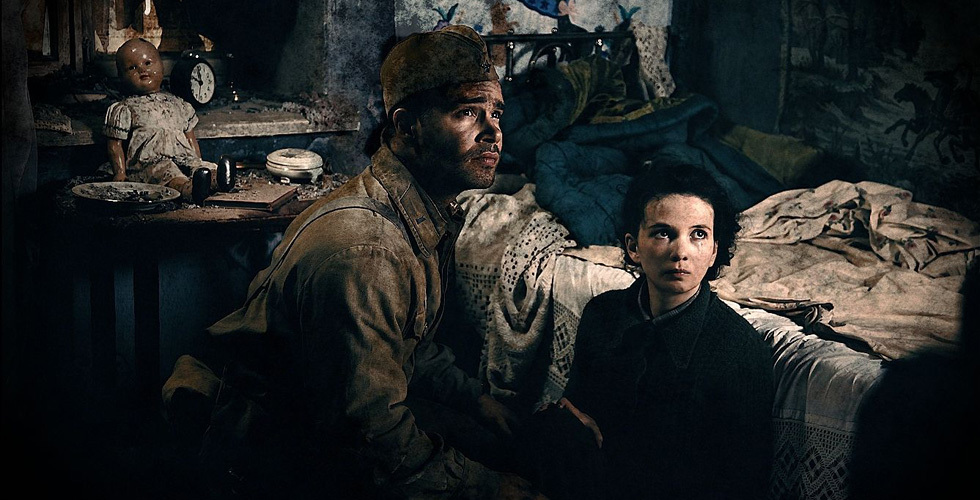
That is how - and not at all from the pathological attachment to the place of registration - and the girl Katya, who was met by the Soviet intelligence group, who crossed the right bank of the Volga, was in house No. 34 in order to cut the enemy’s telephone communications in house. Neither Katya, nor scouts, nor their commanders, nor commanders were aware of the genius plan of the Generalissimo, and therefore simply tried not to die in the very first 40 minutes (the average life expectancy of a fighter in Stalingrad) and lay more Germans. The audience of Stalingrad does not know this, which the great battle opens up not by a huge panorama - but with its smallest, meaningless fragment outside the big context. Sometimes the field of view is covered with red brick dust or ashes, which constantly sprinkles in front of the camera for aggravation of the 3D effect.
This 3D, by and large, seems artistic excess, bravado director of the winning, similar to the bombing of Dresden and Hiroshima. “Stalingrad” is quite effective and so - to evaluate the intra -gas installation, it is not necessary to put glasses. But the stereo gives a completely unexpected effect corrected by “under the old” picture-something elusively doubles along the edges of the contours, exactly like on the color illustrations of the Stalinist Talmudes about a delicious and happy life among portraits of Pushkin and Gorky, cyclopean bushes of aloe and stucco molding on the ceiling.
Two women, two houses, two dictators, the images of which converge like the faces of Alma and Elizabeth.
In the same way, the microcosmos is double (despite the thousandth mass, Bondarchuk’s film, in fact, a chamber drama played by eight to nine people), which the scriptwriters Tilkin and Snezhkin create on a patch around the Barmaley fountain. An amazing symmetry is observed on both sides of the conditional front: two women, two houses, two dictators, the images of which converge like the faces of Alma and Elizabeth in a short scene of the German construction against the backdrop of a giant Stalin bas -relief. True, there are five Soviet heroes for one antagonist-nine, Captain Kan-but this ratio just approximately corresponds to the proportions of their and our military losses.
At first, such an outcome of numbers really suggests that the hero of Stalingrad, like the Ninth Company, is not a person, but a group of fighters - yes, yes, a proven recipe. But as the number of synchronics on the screen grows, you understand that everything is not so simple that they are all one. The German officer, Russian soldiers, the blonde who is under the German, and the brunette who, with ours, are parts of the same two -year history of the war, who appeared at the same time at the same time. Each of them shot on civilian and his own, saved, raped, observed a military honor code and discarded it, like a machine -free in a city battle, surrendered for a stew and ate the land, took revenge for those who died in the rear, believed his face from a poster and hated a political officer.
However, you should not consider “Stalingrad” by the front, undermining the canons of Soviet patriotic cinema, which still gravitate over any film about the Great Patriotic War. Bondarchuk is a very Soviet director: in the sense that he hides his revisionist figure in the pocket of conservative bureaucratic trousers. His statements are always ambivalent - recall the “inhabited island”, which was read as critic as one, and others as an apology of the state of things in the Russian Federation.
So for every reason to doubt a large myth of a great victory here there is a reinforced concrete argument in favor of this victory. The comparison with the parade suggests itself-two hours before the viewer, all the best that has accumulated in Russia by 2013: Grossman, Netrebko, Tsoi and Zemfira, the legacy of the "fighting tag" and the access to the Pacific line in the prologue, the production of the Ministry of Emergencies, the nomination to the Oscar; All one to one. “Stalingrad” is a large exhibition of the achievements of the national economy like Sochi, only better: the fire here is always uninterruptedly delivered for its intended purpose.
 © WDSSPR
Again: Igor Gulin (Commersant- Weekend Combater)
Presenting the plot and a rhetorical aura hanging over the film “Stalingrad”, from the picture of Fedor Bondarchuk you expect, first of all, new knowledge about official patriotism, about what is now, from the point of view of the conditional “Channel One”, “War”, “Feat”, “Homeland” - well, and so on. The same meaning of the ritual proclamation of updated values, the need to consolidate them hints at the WWII veterans to watch the film for free at any session: the presence of these spectators should be ritualized, to assure a new project of patriotism.
This expectation is partly justified. “Stalingrad” is very valuable in the sense of intonation, it demonstrates a two -part formula for official patriotism: effectiveness + piercing. Airplanes, tanks and other technology are dramatically sinking on the screen with such a triumphant clang that Michael Bay bites his lips, the detachments rush into the attack with frantic crowds, and every soldier demonstrates miracles of martial art. In the background, a melancholy-mountain and very homely voice tells about the homeland, the heroes who determined the fate of millions at the cost of their own life, as well as a turning point in the history of mankind, almost the main figure in which the narrator's mother turned out to be.
The move to the side: in fact, all these speeches about the salvation of mankind are extremely abstract, and their clumsy metaphysics is curiously consistent with the visual series. In Stalingrad, the painstaking reconstruction of Soviet life (up to the ugly underpants of the luxurious heroine Yana Studilina) is combined with absolute fantasy. This city is with eternal twilight, with monstrous burning people, with a beautifully fluttering 3D ash-Soviet Silent Hill, at best-Mordor. In the manner of the same Tolkien (although the screenwriter seemed to relied on another military epic), the horrors of the latest history are condensed here in a muffled fairy tale, and the main action of the Tolkien book - throwing the ring into the vent - would also be necessary here.
Here we return to the mother of the narrator. The fact is that Stalingrad is the history of conception. This conception, firstly, is a collective, secondly, immaculate, thirdly, let’s say, compensatory, it is a magnificent session of sympathetic magic, to become aged like that.
At the beginning of the film, the narrator reports that he had five fathers, and in response to the bewilderment of the interlocutor, he takes on the story of his birth. Stalingrad battle. Russians repel an apartment building from the Germans, behind which is a passage to the Volga. In this house, a native of a resident is found - the frightened girl Katya. Now about her - no less than a strategic passage - six men care about. With the number of fathers here, as you can see, a light inconsistent. Among the military, one is played by the director of the director - Sergey Bondarchuk, the other - the director himself, whose character is obviously considered to be a grandfather - from a certain metacolomedia, so as not to create an incest -based partnership with his son. So, five: a courageous captain, a shy radio operator, a cynical sniper, a good-natured artilleryman and an impressive singer, who lost his voice and turned into a reconnaissance of a bormier.
Russian eroticism is a kind of heroic impotence.
“You had five husbands,” as Jesus Samaritanka noted, but not one of them was the biological father of the narrator - the son of Katya. He was a German soldier from a detachment standing in the house before the start of action, which is not reported directly to us, but hints with all possible clarity. Heroes do not know about this, but nevertheless they have a double feat - not only the defense of the house, but also the mystical replacement of enemy seed. (The collectiveness of this action refers to another gospel story about seven brothers, who took in turn the wife of the first for the sake of the continuation of the genus.)
And in this sense, the whole film is a thunderbing sexual intercourse. It is full of sexual symbols. Here Sniper Chanov, as a seemingly impossible angle, plants the only rocket in the house in the enemy tank and receives long compliments to its masculine qualities. Here Katya stretches to the belt of Captain Gromov and begins to unfasten his holster, but he nervously removes the girl’s hand, pointing to her age too young for weapons. You should not talk about the spirituality bathing of a girl in the bathroom in the middle of a destroyed house. So, in general, the whole film. At the same time, the relations of the five (six) military and their ward are desperately chaste.
Russian eroticism is a kind of heroic impotence, especially in comparison with what is happening on the other side of the street - in the building where the German headquarters is located. The captain of Peter Kan, sitting there, has two goals: take a house and take a woman - a blond beauty Masha living in the basement. Both that and the other the captain manages, but neither one nor the other ends with anything good for him. The external erotic success of the Nazi captain turns into his loss.
“Stalingrad” is generally arranged as an erotic competition, competitive group sex, in which Katya/Masha’s strategic house and generalized woman are indistinguishable metaphors of each other. In the final battle, Kan finally captures the house by monstrous efforts, but the radio operator Sergei manages to transfer the request to his own - to deliver a missile blow to the building. The one with whom the final penetration wins. The ritual conception of the hero, and with him and future victory, happened.
The pornographic intensity of action by this time reaches such shamelessness that the audience erection is inevitable, like tears at the end of the "mermaid", even if the work of Fedor Bondarchuk is extremely unsympathetic to you. After the explosion, the next portion of words about heroism, the Fatherland, the happiness of the descendants follows, and the ideological message becomes crystal clear: patriotism is an orgasm.