
Translated material
"My site scared me"
In addition to the main project, the Moscow Biennale traditionally includes a large program of parallel and special projects. Participants and organizers of four such projects told COLTA . Ru about those relationships that arise in the process of working on exhibitions.
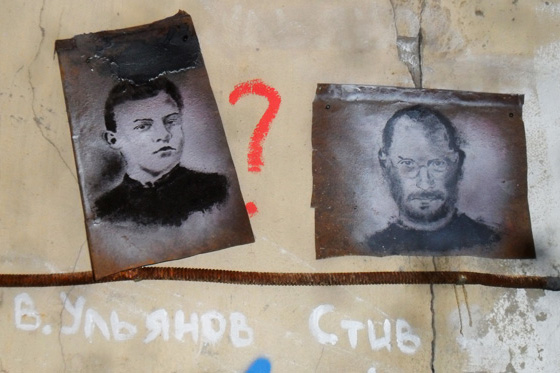 © Chaim Sokol Chaim Sokol, "Wall of Solidarity", 2013
Chaim Falcon
Member of the Mediadvor project , which was held from September 24 to October 15 in one of the buildings of the Higher School of Economics and organized together with the State Center for Contemporary Art
- Why did you decide to do the work of the "wall of solidarity"?
-I had time to reflect in detail what public art is, during the year of teaching at the Rodchenko school, where I headed about public art, which, in fact, became for me the opportunity to analyze this area.
I thought it was not just a yard, not just some place. This is a university where students study, they are taught by teachers. To do something without them, without any of their participation, it makes no sense. Even a year was not necessary to understand this obvious thing. I thought that we should somehow try to use students, organize them just as students. Then, already along the way, this idea was transformed from the wall newspaper into the "Wall of Solidarity". I wanted to arouse their student spirit, collective consciousness.
- It turned out?
- No, not a drop at all. I’ll tell you even more: then, when I already did everything, there was a meeting with the artists, and some of the very students I met before drawing something on the wall. And they said: "Yes, we realized, this is a provocation on your part, and we will draw, correct." I was even delighted, I thought that something still woke up in them. The only thing I regretted: it was necessary to shoot this wall in dynamics. And finally, I got out there to see how everything changed - and nothing changed, no one did anything, do not care about everyone.
- Not a negative reaction?
-There, someone carefully wrote some graffiti with a balloon, something so incomprehensible, but did it, trying not to hurt my inscriptions and drawings. That is, it did not even work as a provocation. Only the nails fell in some places.
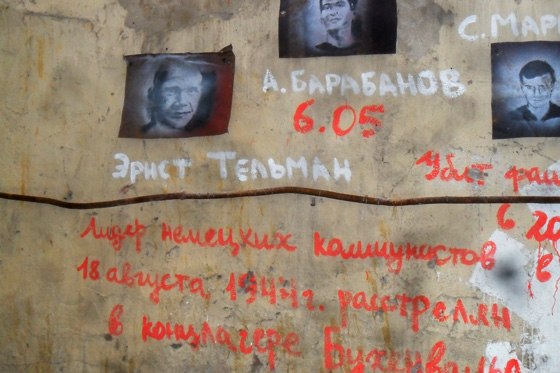 © Chaim Sokol Chaim Sokol, "Wall of Solidarity", 2013
This is an interesting conclusion. It was such an experiment with a predictable result, but nevertheless. I met with a group of volunteer students, even in a sense of activists, but activists are not in our, but rather in such a Komsomol sense. We talked for more than three hours what solidarity is, what is it in history. I tried not to offer them ready-made solutions, but to simply bring them to some thoughts, thoughts. It was very interesting in itself, because it turned out that these guys do not have any collective identity. That is, personal, personal - quite, with the social, national, religious, everything is in order, completely educated, well -read guys, they know Foucault, Agamben, they all know, they studied everything. But they do not possess collective identity, for them it is not just alien, but hostile. They immediately renounced the students when I began to briefly tell them that students have always been a kind of avant -garde of society: the end of the XIX - the beginning of the twentieth century in Russia, 1968 in Europe and America, students in China. They told me: "We do not feel like a certain group." I tried to find out who they feel themselves: no one. And, of course, they do not have only critical - no view of society, at modern problems. I don’t know, maybe I demand too much from them, they still are 20 years old.
We seemed to be a little close to the understanding that education is becoming more and more inaccessible. This problem somehow worried them, but also so passively. They told me that a law came out that allows universities to assign prices for a hostel. The state no longer regulates pricing in this area. If earlier a student paid 5 or 10 percent of the scholarship - this is a meager amount, now each university can determine the price of himself.
- That is, they knew that they were directly concerned?
- At least they knew that, of course, it does not concern them personally, but rather their comrades, because there were all Muscovites or more or less arranged. In general, they do not face this problem.
In short, when we started talking about migrants, about the problems of gender, racial, labor discrimination, it all sounded in an incomprehensible and strange language.
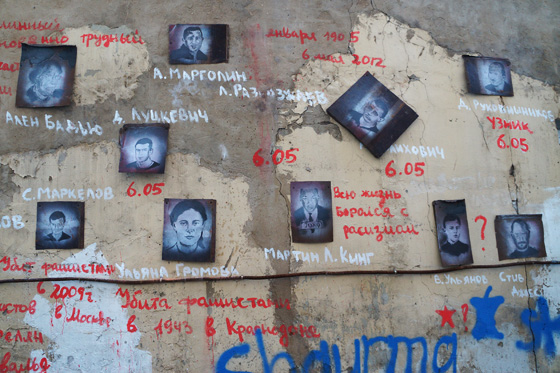 © colta.ru Chaim Sokol, "Wall of Solidarity", 2013
- And how did you choose those heroes that you ended up?
- I repeat, maybe I demand a lot from them, although the young Guards, for example, were no more than years. According to the results of our very long conversation, I asked them to send them separately to me the names of the people with whom they are in solidarity. Moreover, initially I did not limit them in any way - it could be a person either from history, or from their personal environment, or from our present. As a result, I get Steve Jobs, Nagarjunu, Lars von Trier. It was, however, Agamben, but it is also not clear what it means to be jointly with Agamben. The man who sent Agamben, as far as I know, did not actively participate in the anti -fascist movement, does not defend the rights of migrants. I was terribly angry and decided not to draw all these characters, because there are much closer and more serious problems, I drew prisoners on May 6 - not all, because I would have to draw a lot - and mixed them with other characters: Ulyana Gromova, Ernst Telman. He painted young Lenin with Jobs and put a question mark between them so that, looking at this wall, they at least think about something. I am sure that most of them will say Jobs, but at least it will already be a more meaningful choice. Initially, I wanted to provoke them, or maybe teach them, to force them to think.
- Are these future journalists?
- No, journalists are in another wing, and the “wall of solidarity” is located at the faculty of cultural studies. Even worse: these are future culturalists who perceive the culture completely distant, do not understand what it means to be in culture. You can study Foucault, but together with students from the Rodchenko school we began to say: if you offer some name for the “wall of solidarity”, this is a kind of political gesture, your political choice. To be solidarity with Foucault, you need not only to study it, but to share his views, personal positions. I told students: do you know that Foucault was left -handed, gay? It was somehow strange for them. I think to do this a project about this, we - during the discussion - said a fairly wide circle, I don’t know how much my recorder caught everything. But it would be interesting to decipher this conversation.
- But it is the culturalists who often write expert conclusions for the courts, including such as such as Samodurov and Erofeev.
- Here you go...
I hoped that some reaction would follow-either from the university side or from the students themselves. There are many ways to interact with this wall. In the end, all these portraits can be quite easily ripped off. My main omission is that I drew one still alone. We agreed to do this in the form of graffiti, but there were endless rains, so I drew everything myself in the workshop, and already under the monstrous spillful rain, we attached all this. Students did not participate in the direct process of creating work, but it would be interesting to see what they would do - draw or what?
Such an experiment with a rather sad end, but, on the other hand, if you return to art, I believe that public art should be like that. Not in the sense of aesthetics of interaction-I would even call it anti-interaction: to do something not with the group, but contrary to this group. We need to think less what pieces to put in the city.
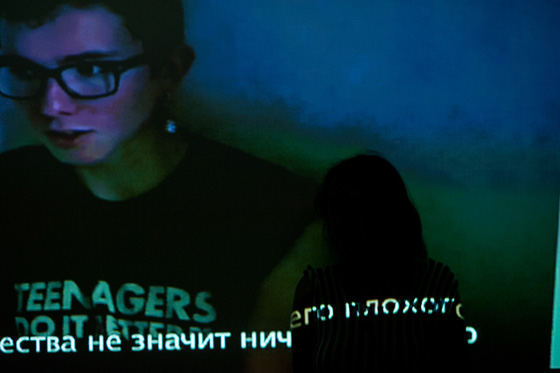 © Victoria Ushkanova Lyubov Matyunina, "Alec", 2012. HD video projection. Provided by the artist
Ekaterina Krupennikova
The curator of the project " Playing with nature" , which is held from September 23 to October 30 at the Sokol CSI
- As you told me yourself, you assumed that there would be a failure. Why? What confused you?
- My site scared me. I saw her, thought about her and was horrified. And I was also embarrassed, of course, the lack of money for the repair of this site. Plus, you see, because I do not hang out in Moscow, no one considers it necessary to come to me. It’s not that in the end it happened in the end, but I had such a fear that since no one knows me here, no one will be interested in my exhibition either.
- Do you think that the Moscow scene is strictly tied to dating?
- It seems to me that yes.
- You have experience in life and work in other countries. Is such a situation different from what is happening, for example, in Holland or Poland?
- Absolutely the same. The point is not in the Moscow situation, but the fact that there are so many exhibitions and events that you come only to those people that you really want to come to. Or it should be some extraordinary event.
- And different organizational moments did not embarrass you in Moscow? Moscow is famous for the fact that many exhibitions are crookedly made, and not because the curator is bad or artists not very, but because the institutions have no understanding how and why make exhibitions.
-I was somehow not afraid. It seemed to me that everything would be all right. As a result, it happened, because I had a very professional team of builders, on which, I think, you can rely in any situation. I was incredibly lucky with them. I had thoughts that I would not find them, that no one would help me, that I would not find money, that I will not have equipment and, moreover, that I will not be able to do several works, and most of them were carried out in Moscow. Four days before the exhibition, I was not sure that they would work out.
-Most of the artists-from abroad, before that they had no experience in Russia. How were they configured?
- They were scared. Even before the arrival, they asked me the question of whether they needed protection. They got me in every possible way, tried to drag their equipment from abroad. Someone tried to rent it somewhere abroad, someone tried to buy it, send it. And not only equipment - even flowers. I told them: "Guys, we can find all this in Moscow." Of course, I was not sure of everything, but in the end it turned out perfectly. But here they were just afraid that everything would be unprofessional here, that they would not find what they usually need. They were absolutely not protected psychologically, did not understand where they were going.
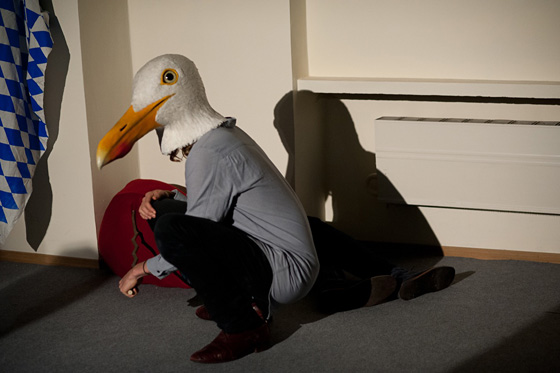 © Victoria Ushkanova Roderik Khitbrink, “Hyperbdity (or what is known to the elephant)”, 2013. Performance, dimensions and duration vary
- Why did it happen? Why did they create such an impression? It was a kind of myth about Russia or they knew something, did someone tell them that everything was so here?
- This is a good question. I think that both. On the one hand, there is a certain myth that we have absolute chaos and darkness here - this is what is broadcast to the West: our excellent political situation, censorship. On the other hand, there is the experience of their colleagues in working with our institutions. Someone did not do something somewhere, did not. All this is overgrown with rumors. As a result, we get a situation where artists are simply afraid to go to Russia.
- After this trip, did their opinion change or not?
- It turned out very interesting. They were all in a panic. Arriving two weeks before the exhibition, they saw that the installation did not start, it never began the first days while they were in Moscow. Installation began five days before the exhibition. And the artists are not used to this. They wanted to see the list of equipment, generally many things in advance in advance, but this was not all, because I was also only two weeks in place and I needed time. The artists were horrified, in shock, terribly panicked - exactly until the moment they realized that everything would work out anyway.
There are some particular cases: one artist arrived, spent a casting-in three minutes she chose the actress, who perfectly suited her for performance. There were people who suffered for a long time, because I lacked the budget and I could not give them everything they want. But the Europeans do not compromise: I want this equipment, and at least you crack - give me it, otherwise I will not show the video, and the existing projector is absolute shit, I will not work with it. In no way, rested with horns - and that’s all. And at first they arrived, but they have nothing, and then they look - one has everything crystallized, the other, for the third ... In the end, they become calmer. They see that their colleagues succeed, and then they begin to hang out. And this was another risk. It seemed to me that everything would fail, because at some point they relaxed so much that they began to hang out too actively. I just could not collect them. They found friends, girlfriends and went along the bars.
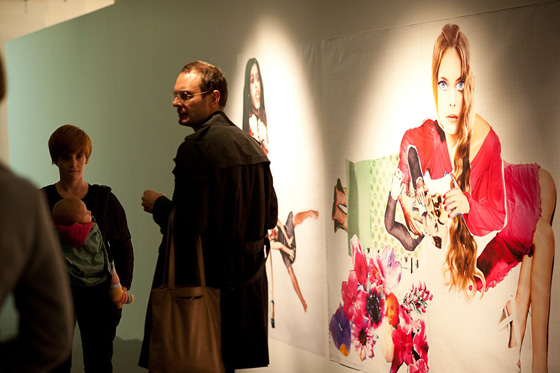 © Victoria Ushkanova View of the Exposure. Ekaterina Chernysheva, "Merry Naps", 2010 - continues. Collage, printing with an increase, dimensions vary
But I would like to say something else: we had some problematic installations. There was a moment when we mounted a video projection with the artist at two in the morning and realized that we could not screw the projector manually, we need a professional bracket. And our main builder says: “Well, jump in a taxi and go to a round -the -clock store, we will buy everything there.” And then the artist realized that it would work - and precisely because we are in Moscow. Nowhere in Europe on the night of Sunday to Monday you can not buy equipment at such a time of day. He went to the store in the middle of the night, bought what he needed, and we all mounted. In general, there were many adventures. The artists were, of course, in shock, but in the end they really liked everything, including the discovery. Everyone was very pleased.
- Was everything good with Russian artists?
- It was very interesting with them. Foreigners asked the same. They could not understand where the Russian artists were. They did not see anyone. It was calmer with the Russians - they knew that everything would work out, they used to work in any circumstances, I think. Valya Fetisov came at the last moment, when everything was already done with them, almost on the opening day, and mounted the light. Naturally, he checked everything in advance, we agreed on everything. Olya Zovskaya also arrived with work on the opening day (although before that she went to see the space several times). Well, Albert Soldatov - also.
The Russians treated everything calmly. At first, foreigners had no confidence, and they ran after the builders, stood over their souls, waited for them to pay attention to them. With Russian artists, we agreed on the location of the work, discussed some details, they calmly came on the opening day for installation. And foreigners did not crawl out of the room, followed everything that was happening. Foreigners have no trust in us. There were situations when foreign artists annoyingly and boring explained to me what I should do as a curator, tried to teach me my profession. Or they tried to teach builders, but it did not work out there, since the builders do not speak English. I had to be a psychologist and serve as a buffer between artists and builders, so that the former would not really get the second.
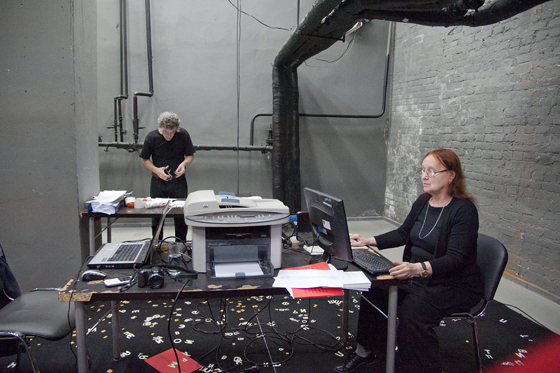 © Tanya Sushenkova Totart: Natalya Abalakova and Anatoly Zhigalov, Underground Printing House, 2013 - continues
Natalia Abalakova and Anatoly Zhigalov
Participants in the project " Zoo of Artists" , held from September 18 to November 17 in the exhibition hall "Solyanka Slot"
- A large project in which you take part is called the "Zoo of Artists." Recently, the feeling appeared that the artists were locked inside the “official” exhibition spaces - and a comparison with the zoo is very accurate: you can’t get out, they show the artists with a finger, they must entertain onlookers. But in this situation, you decided to create a kind of place of disagreement inside the prison for entertainment, which is inherently any zoo. Is your project a critical replica addressed to “political art”, which is provided in such zoos, or is it really a direct statement about the possibility of working inside such closed systems?
-In fact, the project “Zoo of Artists” was conceived by the curator Fedor Pavlov-Andreevich as an Ommage Taiwanian performer Taychin Sier , who became famous for his Live Performance in the gallery, where he spent 365 days behind bars. With this performance, Sier brought the performance to the logical end. Each of the inhabitants of the Zoo had to sit in his cage for 28 hours (4 hours a day). A prerequisite for participation in the project was the physical presence of the artist, as well as the ignorance of the project participants regarding the work of other artists. Our task was to offer, without violating the basic conditions of the project and, moreover, taking it as a certainty, a completely different, alternative model of Live Performance , which overcomes the existing performance scheme and a “suffering” form of performance. Thus, we created, or rather, initiated the creation of an intangible product of communication through the Internet and then material, printing leaflets and projecting the texts and video images of the multi -made participants onto the screens of plasma panels. In the process of performance, within seven days, our cell is filled with the collective energy of the statements of dozens of participants. Пространство социальной сети ( Facebook ), в которой мы общались с участниками нашего проекта, ощутимо присутствует в ограниченном решеткой пространстве камеры или клетки, преодолевая нашу насильственную изоляцию. И вообще, что такое решетка, какие ассоциации возникают, когда мы ее видим? Значение самого слова так и не удается уловить, сформулировать, словно «прутья разделяющей нас решетки», перефразируя образную речь Пауля Целана, отделяют нас, затерянных в лабиринтах «решетки языка», от тех, с кем мы хотим и — более того — ДОЛЖНЫ говорить об этом. На самом деле предложенная метафора клетки как нельзя лучше соответствует реальному состоянию современного художника, чья деятельность попадает во все более явную зависимость от культурных институций, которые, с одной стороны, способствуют созданию культурной ситуации, а с другой, жестко регламентируют каждый шаг художника, навязывая собственное представление о том, каким должно быть современное искусство. В рамках институционального пространства и кураторского диктата любой самый трансгрессивный и критический жест превращается в зрелище среди прочих зрелищ. И самый «крутой» художник неизбежно становится ярмарочным персонажем. Нередко то же самое происходит с активистским и политизированным искусством. Естественно, художники ищут выход из такого положения. Что касается нас, то в данном случае мы обратились к еще мало исследованным возможностям социальных cетей, к WWW , Всемирной паутине, телекоммуникационной сети, представляющей собой своего рода модель, некое подобие жизни и, более того, человеческого тела, многих тел (сколь бы кощунственной такая мысль ни казалась). Эта невидимая, но неоспоримо существующая сеть в определенном смысле является произведением искусства, так как в ее существовании соединяются природное и культурное. И мы (в данном проекте как художники-перформеры) хотели и хотим участвовать в ее жизни и способствовать ее развитию, делегировав свои тела как некоего номадического «кентавра», который выступает то как символ, то как миф. Это — к проблеме телесности (в перформансе) и ее перекодировок. А также не менее важна для нас тема сохранения живой энергетики перформанса, его неповторимого «здесь и сейчас», что есть одновременно и утопия, и реальность. И не через повторение перформанса ( reactment ), а обращаясь к современным технологиям, тем более что основная тема нашего live -перформанса — СВОБОДА и вся амбивалентность и противоречивость мифологий, с этой темой связанных.
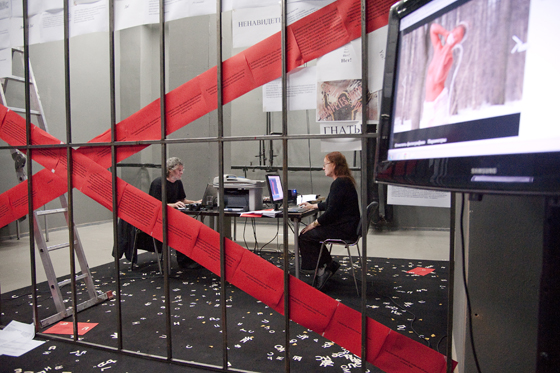 © Таня Сушенкова ТОТАРТ: Наталья Абалакова и Анатолий Жигалов, «Подпольная типография», 2013 - продолжается
— Почему именно типография? И почему ваш проект так сильно связан с социальными сетями и интернетом?
— От наскальной живописи до Гутенберга и от Гутенберга до современных цифровых технологий человечество пыталось и пытается найти средство сохранения живого жеста и слова. Типография и есть метафора этой человеческой, слишком человеческой страсти остановить мгновение. Подпольной же она становится в борьбе с неизменным овладением инструментами высказывания, осуществляемым властью и ее институтами. Социальные сети являются одним из пока еще вневластных пространств взаимодействия.
— На этой биеннале много внимания уделено перформансу. Несколько спецпроектов и мероприятий параллельной программы посвящено подобным художественным практикам — полностью или в большей мере. Отчего так, как вы думаете?
— В современном глобализированном мире культуры (а V Московская биеннале производит впечатление именно события такого рода) перформанс — уже установившийся жанр современного искусства. Различные виды перформанса (политизированный активистский перформанс, перформанс как арт-терапия, перформанс как мини-театр, перформанс перед видео- или фотокамерой, перформанс как флешмоб, мультимедиа-перформанс, сетевой перформанс и проч.) непротиворечиво существуют и диалогически взаимодействуют друг с другом. Очевидно, художники (а возможно, и зрители) сознательно или бессознательно обращаются к этим формам, не требующим громоздкого институционального вмешательства, для быстрого и оперативного ответа на запросы времени. К слову, во время одной скайп-конференции нам был задан вопрос: «Были ли у вас случаи, когда институции отказывали вам в проведении перформанса?» Этот вопрос несколько нас озадачил: до самого недавнего времени, создав около 100 перформансов, мы никогда и ни у кого не спрашивали разрешения. Может быть, в этом жанре искусства есть какая-то особая притягательность, если не сказать неожиданность, непредсказуемость и загадочность — потому к нему и обращаются участники параллельных программ, кстати, всегда привлекающих к себе большое внимание.
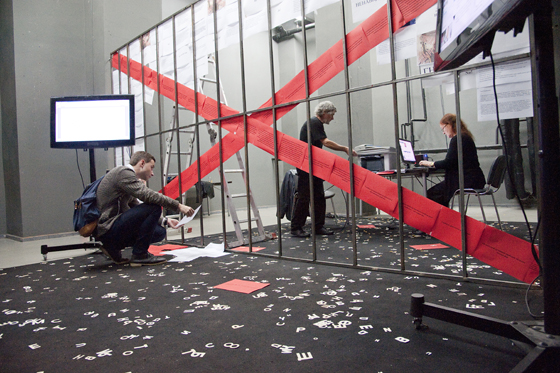 © Таня Сушенкова ТОТАРТ: Наталья Абалакова и Анатолий Жигалов, «Подпольная типография», 2013 - продолжается
— За последние годы, как мне кажется, перформанс в России был сильно обесценен действиями разных институций, особенно галерей, которые использовали его как своего рода маркетинговую уловку, чтобы раскрутить тот или иной проект — например, выставки, где большую часть произведений составляют живопись или инсталляции. Создавалось впечатление, что перформанс идеально подходит для этих целей. Неожиданное, динамичное, иногда шокирующее, заставляющее удивиться действие — одна из опций в арсенале рекламщиков. Художники, иногда довольно известные, соглашались на это, и их можно понять. Как с такой ситуацией быть? Даст ли вот эта новая волна, замеченная на биеннале, — возвращение к более осмысленному применению этого медиума — результаты, благодаря которым будут не только «маркетинговые» перформансы?
— Несмотря на то что перформанс как жанр давно уже апроприирован культурными институциями и во многом используется в качестве пикантной приправы ко многим зрелищным блюдам, суть перформанса, его ядро, — неповторимый жест, знак присутствия, трансгрессивность, свобода, необузданность, способность в игровой форме высказывать то, что невозможно высказать иным способом, умение заглядывать в глаза смерти — все это остается неизменным и неподвластно полному приручению. К перформативным действиям прибегали с древнейших времен, от символического жеста библейских пророков и средневековых юродивых до художников нового и новейшего времени. Рынок переваривает и превращает в товар и зрелище все. У него не бывает несварения желудка. И все же художник всегда будет пытаться создать непривлекательный и непотребляемый продукт. Перформанс жив.
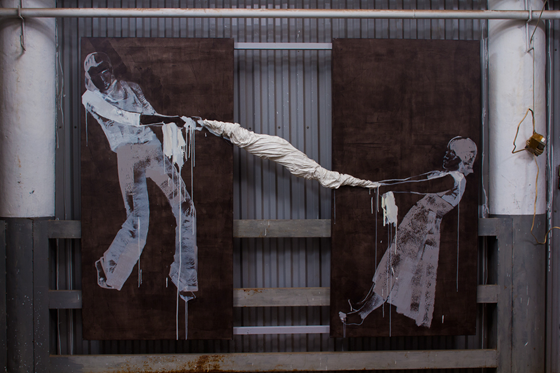 © Пресс-служба ЦТИ «Фабрика» Полина Москвина, Виктория Малкова, Выжимаем и вешаем, 2013, выставка «Облако» на «Фабрике»
Ольга Широкоступ
участник и координатор проекта « “Облако” на “Фабрике” » , проходившего с 10 сентября по 1 октября в ЦТИ «Фабрика»
— В какой роли ты участвовала в проекте «Облако»?
— Я участвовала как художник, мы делали работу вместе с Аней Ходорковской. А помимо этого — как координатор «Фабрики».
— То есть ты занималась всем проектом, все знаешь и все видела?
- Yes. Это был мой последний проект в качестве менеджера, мне было очень важно и интересно поработать с Витей (Виктором Скерсисом. — Ред .) над его проектом. Я буду и дальше сотрудничать — уже не в штате — с «Фабрикой», например, буду координатором на ретроспективе группы «Что делать?» In February.
— А в чем, по-твоему, важность выставки, сделанной Скерсисом?
— Самое главное — это его общение с художниками, не конечные работы, а система работы. Со всеми, кто там выставляется, он находится в постоянном контакте, постоянно общается и помогает.
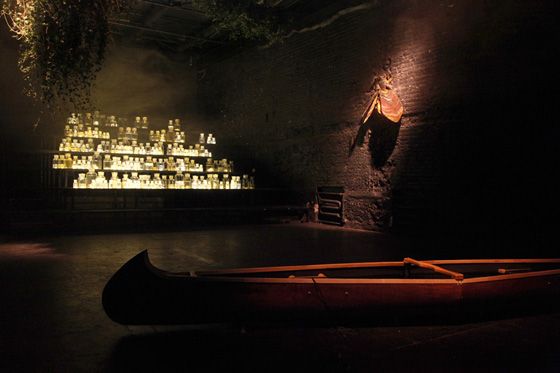 © Пресс-служба ЦТИ «Фабрика» Арт-группа Бестиарий, Ароморфоз, выставка «Облако» на «Фабрике»
— Мне интересно собственно про «облако». В тексте для выставки высказана занятная идея про состояние современной художественной среды: что такие формы, как группы, уходят, но появляются временные объединения, которые Скерсис сравнивает с облаками. Поскольку ты в этом участвуешь, ты, видимо, согласна, что все там изложенное соответствует действительности, но все же что ты об этом думаешь?
— Да, я согласна с этим. Это такой тип организации — свободные коллаборации. На моем примере — так и работает. С Аней мы не работаем как в группе. Мы собираемся, чтобы реализовать какой-то проект, а потом работаем отдельно. Вот есть «Периметр» и «Бестиарий», но это группы без четких границ. Это тип организации труда.
— А тебе кажется, что такой тип коллективности продуктивен?
— В первую очередь мне кажется, что он интересен. Это такое наблюдение из сегодняшней ситуации, достаточно точное, а не Витино изобретение. Скерсис просто показывает, что это очень подвижные структуры.
— А, на твой взгляд, с чем это связано?
— Эти формы мне кажутся совершенно естественными сегодня — так же как удаленная работа или фриланс. Это вытекает из реалий нашей жизни. Совершенно нормально, что художники начинают таким образом сотрудничать. Скерсис просто видит, как ребята работают, и описывает это.
— Виктор до этого неоднократно делал похожие выставки — на «Фабрике» и на «Электрозаводе». Собственно, даже не делал, а участвовал в этом, и не как куратор, а как такой дискуссионный модератор. Он приглашал людей к разговору, а они уже делали какой-то проект.
— Ну да, Витя везде подчеркивает, что он не куратор, что он вообще к этой роли относится критически. Всегда подчеркивает, что он художник, как и все. И у него совершенно не деспотическая манера работы над выставками. У него есть такое слово — «оркестровка», как мне кажется, очень важное для него. Даже с уже готовыми работами он занимается такой вот оркестровкой. По-моему, в этом он блестящ. Создает атмосферу, находит связи между работами, которые кажутся на первый взгляд неочевидными. Это он умеет делать и делает очень хорошо. Он никогда не давит на художников, у него не может быть такого понятия, как «тема выставки», или определенной проблематики, которую нам навязывают. Он скорее расспрашивает тебя — с чем ты сейчас работаешь, что для тебя сейчас важно или болезненно. И, выявляя это, немножко обобщает ситуацию.
 © Пресс-служба ЦТИ «Фабрика» Игорь Баранчук, Яша Веткин, Фотомусор, выставка «Облако» на «Фабрике»
— Достаточно давно — скажем сейчас только про московскую ситуацию — есть очень сильная аллергия на фигуру куратора. Многие художники достаточно резко об этом говорят, некоторые — помягче, но по факту такое неприятие фигуры куратора есть.
- Yes, I have.
— И ведь это связано с тем, что Скерсис отказывается называть себя куратором и заявляет, что он оркестрирует. Or not?
— Мне кажется, что Витя уже долго так работает, и для него это единственно возможная форма работы. Это ему свойственно, для него это совершенно естественная позиция, а не ответ на кураторство. Он никогда и не стремился быть куратором. Хотя это может быть предложением — чтобы ситуация менялась. Такой личный пример: взрослый, состоявшийся человек, мэтр, может быть неавторитарным и очень деликатным. Ведь аллергия на кураторство связана со стилем работы, а Витя просто еще очень мягкий, для него было бы просто неорганично учинять над нами какое-то насилие, начиная с экспозиционного решения и заканчивая внутренним обсуждением.
— А ты как художник сталкивалась когда-нибудь с экспозиционным или концептуальным насилием со стороны кураторов?
— Нет, как художник и участник выставок не сталкивалась, но как менеджер, конечно, наблюдала такую форму работы, когда куратор заранее точно знает, что он хочет сказать, как все должно выглядеть. Это очень давняя проблема, мы все читали книжку Обриста (имеется в виду «Краткая история кураторства» Ханс-Ульриха Обриста. — Ред .). Это просто совсем разная деятельность — то, что делает Витя, и то, что делает авторитарный куратор.