
Translated material
Alive, how few people succeeded
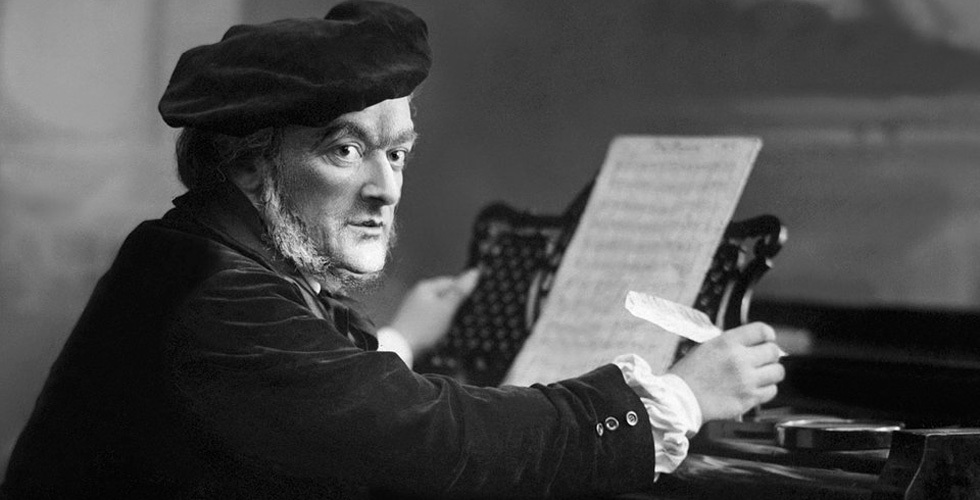
The Wagnerian year dedicated to the 200th anniversary of the German genius rolled around the world without going around our country. Today, for example, the Bolshoi Theater is released by the “Flying Dutchman”, the renewed performance of Peter of the Concavor. But it seems more of interest in Wagner than the productions of his operas, which can offer Russian opera platforms. Therefore, COLTA . RU decided to remind her readers with the main points of Wagnerian mythology.
Even if Apocalyptica undertakes to celebrate Wagner's two hundredth anniversary of the loud mass show, this means only one thing - Wagner is alive, as few people have succeeded. From a stunted, with magnificent bucks of a very but not athletes, the composer today has turned into a crazy crazy genius of the Gothic-Chibankannaya appearance, and this thysh Kitch from the Finnish group is funny and in itself, and as an act of appropriation of the figure of a long-deceased, the transformation of Wagner into its own, from a dead man who wagged endlessly along the avenues.
Wagner of the sample is two thousand thirteenth years - a container of polar views. Wagner for neo -Nazis, musicians of all stripes, whether it is an authoritative barrenboe or Therion , elites and lower classes, for war, love, genocide, humility, racial hatred, aging snobs in Victorian interiors, for rebels and quiet haters of the dull world surrounding them.
The life of Richard Wagner himself sometimes resembles a cheap weekend melodrama at Russia: a talented margin with a great idea in his head is experiencing a storm and fed and comes to the long -awaited honor and success. In this melodrama, details are important. Despite the instability of Wagner himself, his biography is whole and indivisible. Wagner's story is the construction of a cult named after himself.
First
Wagner is the embodiment of totalitarianism. He, like Verdi, turned out to be the only great opera composer in his monastery. But Wagner, unlike Verdi, crushed reality for himself. He created his own history of the world in articles, art and life. He acted hardly looking at history. Each of his opera was written on his own libretto, in which sometimes there was a little more from the original than nothing. The German epic on the “Nibelung Ring” is clearly not worth studying.
He created his temple with his blackjack and everything else. Wagner turned the conductor with his back to the public, turned off the light in the hall, turned music into religion. Only not music at all, but your music. For him, one was built a theater where the music leaves the sarcophagus, he invented his traction time, with one “ring” you can completely score the ether of any television channel for a day or entertain yourself during a flight to another continent.
He created a musical epic, turning Homeric epithets such as a “helmet hector” into musical epithets of lieutmotives, he remade the opera as a fact. His musical dramas are long, because he needs to explain and explain everything, his story about what was in the last series, stretches for his watch, for the same reason it is boring.
Wagner was an amateur. Wagner was self -taught. Music to him, perhaps, was too restrained. And the self-study of restraint was spitting, he did not care about the rules-he did everything in his own way, he created a new art (ignoring everyone around), he believed that there was no art in his days and everything was very bad.
He invented an antique example of genuine, long -gone art, where everything was subordinated to a single goal. He formulated his art: G ESAMTKUNSTWERK - a synthesis of everything. But first of all - words and music, drama and opera.
Wagner converted the singing technique, he created a new type of singers - he demanded over the overwhelming, new intonation, his revolution is a change of gaze.
There was nothing more serious than his music for Wagner, he sat through it with a feeling, breaking a clear structure. He abandoned the overture and came up with the introduction - partly because he could not create an overture under all laws. But he ignored laws.
He showed the conductors their place and purpose, under him the orchestra mutated to the scale of the troops. He did what Napoleon failed - he captured the European world. And he, perhaps, is the only one who managed to create an ideal work of art. Ideal in the sense that it can only be represented. Romanticism through Wagner turned to Fin de Siècle .
Money
All my life Wagner lacked money. If you take the Rhine gold for literality, that is, for currency, then Wagner is the same Nibeling Alberich - of the money, he sculs his endless ring. Life in poverty taught Wagner to waste. He wanted to write music and not engage in anything else, but without capital it was impossible, but Wagner did not know how to save money. He loved to be luxurious-and, in order to live in comfort, he conducted, wrote articles, wore things in a pawnshop, got into his debts and suddenly forgot about what he owed to someone.
Wagner had a bad mood without money, and in a bad mood he could not create great works. “I am differently arranged, I have sensitive nerves, I need beauty, brilliance, light! The world is obliged to provide me with everything I need. I can’t live in a miserable position of an organist, like your favorite bang! ” He said one lady.
Or in a letter to Ferenca, he gives the sheet: “God is gracious, and those amounts that I could“ earn ”in America, their people should give me, not demanding anything decisively in return, except that I do it, because this is the best that I am capable of. In addition, I was not created in order to “earn” 60,000 francs, but rather in order to smear them. I can’t “earn” at all: “earn” is not my business, but the work of my admirers is to give me as much as I need to create something sensible in a good mood. ”
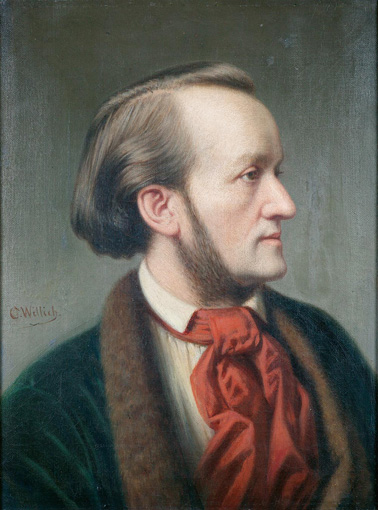
Because of the debts, Wagner ran away from the cities, lied, climbed into new debts and once thundered for a month in a debt prison in Paris. He preferred to keep silent about this. There, in the debt pit, he began the "flying Dutchman."
Money from a rescue circle once grew into a pathological dependence: a couple of days before his death, Wagner in a letter asks Impresario Neumann to send him money-and this is when for him alone and his operas the theater was rebuilt in Bayroit, his own estate stands nearby, a profit pours from all over the world.
True, the more money was becoming Wagner, the more it was necessary, for example, to hold the festival in Bayroit and finally put the entire “ring”, which it is hardly possible to put on the stage (“sulfuricular couples are darkened and turn into completely black clouds, which rise from the bottom up; then these clouds, in turn, turn into dense, dark masses of the rocks that move all the time, so the scene as a scene, so the scene as a scene, is like a scene as a scene. It is as if deeper and deeper sinking into the ground ” - similar remarks at Wagner everywhere).
There is even a simple addiction: the more Wagner has fans and glory, the more magnificent it is. The larger Wagner has greatness, the more the gap, which needs to be poured with money. And greatness directly depends on his works, and the index of their coolness from the score to the score rose steadily. And in order for steepness to grow, you need more money.
In this closed circle in the 19th century, the world had to spin so that Wagner was fine. And in the 21st century, the circle is not broken: the ideal work of Wagner’s art is still another of the most difficult challenges to directors, conductors and singers, and the call should be accepted and won, and won on the stage, not in the cinema.
Women
At twenty, Wagner was at the dance evening. By this moment, he finally reached Napoleonic growth, but self -esteem was still constrained. At this evening there was a engaged couple: in the orchestra there was a groom, a bride in the hall. Wagner was next to the bride. It seems that the weddings did not work out: “Everyone was too flared up, forgetting about personal thoughts,” the official groom played dances, and we involuntarily began to hug and kiss. The groom noticed these signs of tender feelings, but ... reconciled with his fate, ”Wagner writes about the first acquisition of self -esteem.
Further, the injured husbands became more and more. Neither his own wife, nor other people's marriages at all interfered with him. It would be strange if they interfered. And everything would go wherever it went, but Wagner's benefactors turned out to be husbands - the composer in this regard was either completely headless or very prudent. Or headless, but lucky. Or all together at once.
The first of the two wives of Wagner was not lucky, perhaps the most. The beauty Minna Wagner was married to a young composer to quietly and calmly ate days, and not to run around Paris, saving her husband from a debt pit and pulling out of other very entertaining situations. Yes, and to live with an eternally incorrect husband, perhaps, is not the best fate. So from year to year, beauty and health left her.
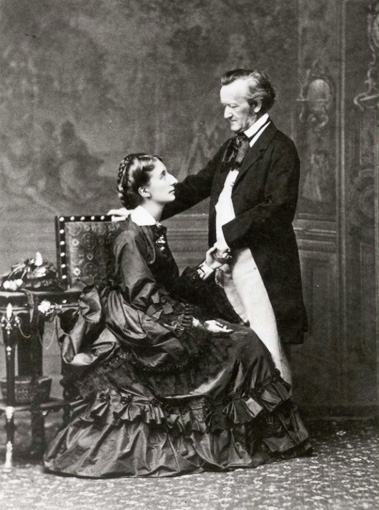 © Richard Wagner Museum Bayreuth with Kosima Wagner
In 1850, Wagner ended up in Bordeaux in the house of wine merchant Losso, where he was engaged in his wife Jesse with his wife playing the piano for three weeks. Three weeks later, Wagner informs Minnah that everything is the end and it's time to escape from the world. Run along with Jesse, run away, to Greece, to where the only true art of drama was born. But the mother of Jesse, who issued Wagner an annual pension, turned out to be more cunning, and it was all over - neither flights nor a pension. And the divorce was postponed.
In Switzerland, Wagner lived in the estate of the wealthy family of Voyendonk. Near Wagner his wife. And someone else's wife. And again, the lightning of love amaze the composer. Matilda Voyendonka and Wagner send fiercishes to each other, she writes poetry, he puts them on music. In this love, “Tristan and Isolde” accelerates, the drama, which deprived the reason of one performer of the Tristan party (and a lot of listeners) and killed another, as well as two conductors (right behind the remote control), in general, a great work.
The premiere of Tristan in 1865 was conducted by Hans von Bulov, a passionate fan of music of the future, a student of Liszt, the husband of the daughter of Liszt Kozima and the propagandist of Vagner's music. Wagner is the leader of the music of the future, the old friend of the sheet, the second husband of the daughter of Liszt Kozima and the propagandist of his own music.
Kozima became the main acquisition of Richard Wagner in 1863, the acquisition, happy for them two and hardly joyful for others - even the king of Bavaria Ludwig was drawn into the history of their love. As a result, Hans Bulov, one of the main associates of Wagner, divorced Kozima in 1870 and took up other matters, no longer contacting Wagner. And Richard and Kozima connected themselves with strong bonds and became as if we were one, sharing anti -Semitism, nationalism and love of Wagner's music.
After the death of the composer, Kozim Wagner became a severe and jealous guardian of heritage. She created the canonical repertoire of Bayroit and generally arranged a lot of all interesting, albeit conservative. The Karet and horses born in the era and saw cars, planes and a world war, she remained her views in the era that gave rise to her. Modern was carefully selected to Bayroit, but Kozima carefully protected her husband's works from everything that could harm them.
Ludwig
The Bavarian king Ludwig II fell on Wagner's head. But in the way and on time. As a young man, Ludwig heard “LoEngrin”, Wagnerianity's disease firmly settled in him, and until his death he did not get rid of it. When Wagner published the text “Ring”, burdened with good old monetary problems, in the afterword he settled in the discussion of where to get him the funds for the production of “Rings”, and invited some king to give all this money. He himself was unlikely to then believe that among his fans there is a future king who is unevenly breathing in art. However, only Ludwig acquired power and the first thing he called Wagner, he did not miss his chance.
From an anarchist and political criminal, the sample of Dresden 1849, a friend of Bakunin, a fighter for the revolution Wagner turns into a friend of the monarch. Relations “King-Data”, “Fan-Comboser”, “The owner-toy” ensued. And it was so that Wagner was the king and master, but Ludwig won more often, only his super -egoistic toy brought more pain.
In general, the relationship was complicated. King Wagner respected, but respect himself more. The king loved Wagner, and Wagner used this, of course, it was reasonable on his part. But Ludwig was sophisticatedly organized, and the further his life led away, the more sad everything became, and Wagner contributed to this.
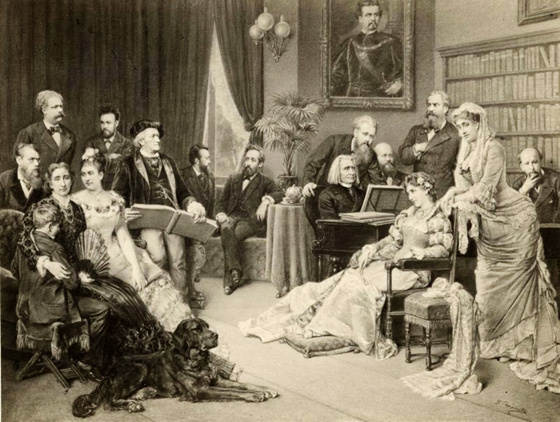 © Richard Wagner Museum Bayreuth
It all started as in a fairy tale: they met daily, both admired each other, talked endlessly (and Wagner loved to talk). Ludwig dealt with the debts of the composer, began to support him. In Munich, he arranged the premieres of four Wagnerian works, and the “Rhine Gold” and “Valkyrie” - ignoring the composer's ban.
Wagner, a man without a measure, almost immediately went too far, climbed into political affairs and began to weave intrigues against the gentlemen who did not like him in the government. As a result, Wagner was expelled from the glorious city of Munich, but the friendship did not end. Ludwig had an endless amount of money, and Wagner helpfully helped the king spend it on Wagner and his venture.
And the king spent a lot - he built locks and furnished them (the interiors of the Noyshwanstein castle were stuffed with plots of Wagnerian operas), got a wedding carriage that had not been needed, and paid the indemnity after the war with the Prussy. After this war, Ludwig did not go to people and for himself arranged opera productions, which was a little expensive. And when Wagner needed money for his recreation center, Ludwig helped him. He is the only one who was allowed to sit at rehearsals in a brand new Bayroita was built for him a special royal staircase, but it came out with her like a carriage.
When the first Bayroit festival ended, Wagner again turned for money, Ludwig could not refuse. In the last letter to his king, Wagner forbade Ludwig to put Parsifal in Munich, as he did not allow anyone to take this shrine from Bayroit thirty years after his death. And all. From year to year, Ludwig was mentally thinner, and in the end he was deprived of legal capacity. The king went to the next world with the doctor, dragging him under the water.
Wagner
It is customary to call the great Wagner, speaking of his music. But one music cannot be done here. People who had a happy misfortune to meet him and be friends or just hear his music, were transformed (in a twofold sense).
His friend, composer Peter Cornelius, could not overcome Wagner’s pressure and remained part of his time without going into eternity. Ludwig Bavarian and Adolf Hitler, meeting with his music, have changed. Hitler Wagner penetrated before the First World War, Wagner’s anti -Semitism and his philosophical views were weighed into the Fuhrer’s soul, Wagner became the chief composer of the Third Reich. After the Second World War, Wagner began to look with squint, caution and distrust.
 © Richard Wagner Museum Bayreuth
After meeting with the composer, another person changed, but the first meeting was in absentia. At fourteen, Nietzsche heard “Tristan and Isolde” and, as it usually happened in those days, sat down on this music. The young philologist Nietzsche finds himself in Tribshen, in the house of Wagner, and immediately the composer entangles him with nets. They talk endlessly about art and all sorts of things, Nietzsche is instructed to engage in Wagner's texts. He completely includes in the composer’s affairs, he is even given a room called a shelter of thoughts.
How often happened to Wagner's friends, for some time Frederick almost lost himself. Wagner captured him, Wagner praised his play on the piano and encouraged him in every possible way in composer undertakings. Wagner turned Nietzsche from a philologist into a philosopher.
But every person for Wagner is only a tool. Gradually, from the Wagner in which Nietzsche found so much joyful for himself, the biliary essence of the composer is increasingly more distinctly. Wagner's totalitarian egoism depreciates the existence of other people if these people are not all given to him. This is Nietzsche notes more and more. The atheist Wagner, moving to Parsifal and Bayroit, comes to Christian ideas. And here everything is the end. Nietzsche is burdened by Wagner, and Wagner sees that Nietzsche will not bring benefits. The philosopher through love and respect came to criticism and, if not the first to closely examine Wagner, then one of the first to indicate the danger of his interpretation of art - which Wagner adjusts over the life into which he turns life.
Wagner himself becomes a work of romantic art. Richard Wagner from beginning to end is the finished world in itself. He ignores the external world, and everything around it is people, philosophy, money - just an instrument for the ultimate goal - its music. Schopenhauer with his “world as will and representation”, with which Wagner from the fifties and until the end of his life was worn, was, of course, not a teacher. Wagner assigned Schopenhauer to himself, as he appropriated everything else (Nietzsche’s labors he considered it almost his labors). Although Schopenhauer was so -so to Wagner and gave him that it would be necessary to tie up with music.
Wagner-philosopher is a house of cards: it is worth it, but to the known time. Each time he sorting out his philosophy: he does not leave a living place on Christianity and supports the revolution, then the whole European elite flows into his theater much later, and relations are established with God. Возвышенные идеи чистой любви, сострадания и смирения перетекают из оперы в оперу. Он декларирует их в искусстве, но в жизни едва ли им следует. В «Кольце» чистота безбожна — наивный Зигфрид борется с богом. А уже в «Парсифале» наивный Парсифаль с богом в одной компании, и нехорошая Кундри исправляется.
То, что принято величать «Вагнером-мыслителем», заключено в раз и навсегда усвоенном — есть лишь абсолютная необходимость Вагнера, и все поставлено на эту лошадку. Обычный такой солипсизм.
Во времена Вагнера время шло неспешно. Во времена нынешние Вагнера можно ускорить, можно превратить в китч или пошлость. В общем, сегодня с ним можно делать все что угодно. Хуже не станет.