
Translated material
Why do children translations?
One of the most acute topics of today's children's and especially teenage literature is a fairly large number of translated books. For the Russian reader, this situation, it would seem, is familiar - the names of Andersen, Lindgren, Milna, Jansson, Darrell and many others have become relatives for us. This is a special, amazing tradition of reading in our country - it is, in my opinion, a unique character: we sensitively, subtly perceive a variety of texts. We can work with them. We completely accept in our culture. But uniqueness is determined not only by this: this ability to accept and consider almost its literature of other countries is combined with an incessant confrontation - irritation, anxiety, which is caused by children and teenage foreign literature among parents and teachers. They try to contrast her domestic, she is accused of planting alien values.
How it takes place, how it takes root, how the translation book lives in Russia and not only, two wonderful translators told me - Olga Bukhina and Olga Warsaver.
- Where do the translations of certain books come from?
Olga Bukhina: In all these situations, an incredibly many accidents. First of all, the book should catch someone in the eye and like it-to the translator, the publisher, to one who accidentally told about it to the translator or publisher, at least the employee of the Agency for the Sales of Rights that offers its publisher. As this happened in the Soviet years, it was best described by Lilianna Lungina in the “Settail”, when she literally dug up “Carlson” in a pile of beautiful ones, but empty (for her) books. The value of this discovery for children's literature in Russia is not necessary to explain. Many wonderful American books were translated in Soviet times because their authors or themes were “progressive”: “over the abyss in rye”, “kill the mockingbird”, the wonderful book of Howard Fast “Tony and the Magic Drive”, which I would really like to open it.
Great luck, when the translator himself becomes the “discoverer” of the book, I had such good luck. The translator is already immersed in the tongue, sometimes it’s easier for him to see a standing book. This does not always mean that the same translator will eventually translate it. Sometimes your “discoveries” come to someone else. Another person with a “sensitive nose” on a good book is an editor or publisher. He listens all the time and looks at who mentioned something, that it was there a pretty lies. The children's book primarily lures with a beautiful cover. Of course, the last twenty -odd years is completely different than the Soviet years. But even in the post -Soviet time, one can clearly distinguish two different periods - in the early perestroika years, when it was possible not to pay attention to the rights (for books published before 1973), I often brought the book to the publisher, now the publisher often offers a book to me, since everything ultimately rests on the purchase of rights. Nevertheless, this is still the process of happy accidents. The main thing for me is not to take on a children's book that does not like at all. With some books that I translated, I just had "love at first sight." But this is only the very beginning of the process, so to speak, a prelude.
- How does the decision come that this book is very necessary/I want to translate: what influences? How does the translator argue, taking on such a task?
Olga Warsaver: In the standard case, he does not reason, he simply takes and rejoices at the order. But in this sense, I am terribly whimsical and a long time ago I gave myself a vow not to earn money by an artistic translation. This gives freedom to translate exclusively what you want. I try not to change this principle. I often choose books myself and come to publishers with my ideas and projects, I am looking for like -minded people among publishers, not customers. So our relationship is being built. Sometimes you have to persuade, but recently they trust me, and - I hope - not in vain.
However, there are generally amazing stories. Once, a file with a book was sent from my favorite friendly publisher: help me decide whether to publish it. I read overnight, excitedly, in the morning I write: “Yes, yes, yes! Need to! A wonderful book. I will be happy to translate it, postponing all other things! ” But the publishing house for a number of reasons reasoned differently. The book went nowhere, I was upset, tried to find the one who eventually bought rights, but did not find it. And she slowly persuaded herself that it means not fate ... However, four months later, when I forgot to think about this book, they call me from a completely different publishing house, with which I had practically no relations, and they say: “We recently bought the rights to one book, and it seems to us that you should translate it.” And pronounce the very name. I will also say it now, because I am sure that this is a completely wonderful book for younger teenagers: “On the Blue Combet”, the author is Rosemary Wells. Events take place in America against the backdrop of great depression, in the late twenties - early thirties of the last century. The main character, a lover of toy trains, on one adamant day jumps into a huge layout with fear, on which his trains are running, and, without breaking the cardboard, is inside, sits down in that very “blue comet” - and goes through the whole country to California, because it was his father to work there. Moving west, he also makes a trip in time and arrives in California in 1941, not 1931. There, he, sharply matured, almost falls into the army. And then, already in New York, it turns out to be a teddy baby in 1926, among bankers and industrialists, who do not suspect that a terrible economic depression awaits them in a few years ... In general, read, you will not regret it.
The teenagers did not hear about the process of Sinyavsky-Daniel, about the entry of troops into Czechoslovakia in 1968, about the psychiatric hospitals where Soviet dissidents sat.
In general, I really respect children's books, where the historical background is well spelled out. Following the "comet" I translated the "battles on Wednesdays" Gary Schmidt. There, the action takes place in 1967-1968, against the backdrop of the Cold War between the USA and the USSR, hot in Vietnam, and there were still student unrest, the murder of Bobby Kennedy and Martin Luther King ... And all this is in the book, and there is also a completely life -giving Shakespeare ... The book is so good that I could not resist and made a staging for the theater ...
And then a pathos question arises of the purpose of books in our life. Theaters would be happy to put this play, but you can’t lure adolescents in the theater, but here is a story, and even overseas. Teenagers know too little about those times. In general, about any previous times in any country. They are great depression, that Stalin's repressions or the Holodomor - everything is one. They did not hear about the process of Sinyavsky-Daniel, about the entry of troops into Czechoslovakia in the same 1968, about the psychiatric hospitals where the Soviet dissidents sat. Now let's see from the other end of the very “cross-cultural bridge”, which is entrusted to translators. Last year I gave several lectures in America for students of junior courses of the university. Showed them an excerpt from the diary of the girl Nina Lugovskaya, who was discovered in the nineties in the archives of Lubyanka. For this diary, the whole family was imprisoned at one time. I did not tell anything of this to American young men and girls. I just read them aloud the passage completely innocent: how the girl went to the theater. She showed a photo and asked to determine when and where this girl lived. They identified the era from the photograph quite accurately. They said: 1920-1930s. But with geography it turned out interesting. They calculated that since schoolchildren go to the theater - a civilized country. And then it turned out that it could not be America. Why? Well, we had depression, students answer, theaters were closed. Their professors were dumbfounded from such knowledge of their own history.
So literature, and translated literature, including now, now leads bridges between eras, and not between cultures. It is she who gives the children the opportunity not to learn from the textbook, but to feel how people lived once, how they live, how they live somewhere. My decisions on the translation of books are often a sort of missionary in nature.
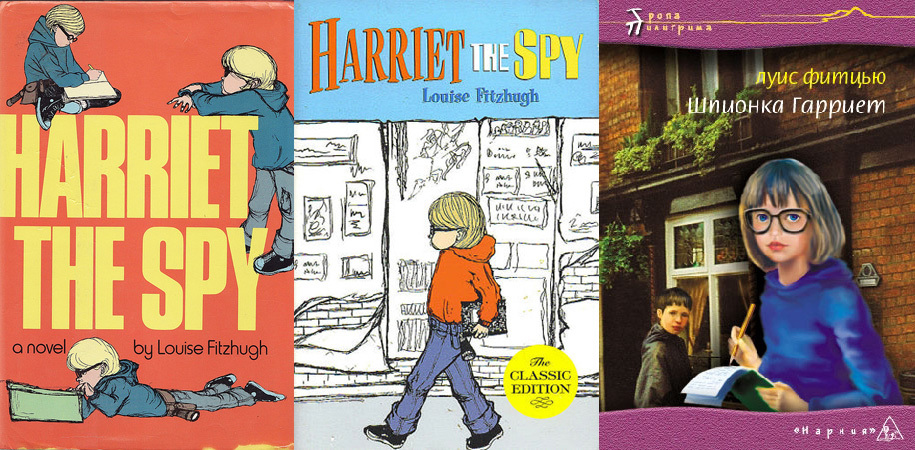
Bukhina: When I just moved to New York, Anna Godiner and I stumbled upon Louis Fitzu's book “Spy Harriet” (Narnia Center). For me, the decisive moment was the fact that the book takes place almost next to my new house - in several bus stops. I went to this area several times, as they say, “studied the area”, photographed for the artist. This is a very city book about the life of a big city, so I wanted it to be read in another big city. Something like my gift from New York Moscow.
My second New York book was quite recently. "Masterpiece" Elis Brochu (Publishing House "Pink Giraffe"). We transferred her with my sister Galina Gimon. It was a hot summer, and huge beetles crawled around my bathroom, which in New York is not uncommon. And then an e-mail comes from the editor with a proposal to make a translation. On the cover of the book is a huge beetle, he is the main character. The book is wonderful, the beetle made friends with the boy, and together they (without a tongue, but surprisingly well understanding each other) make a bunch of feats. I considered it a sign. And now I endure beetles in the bathroom quietly and dutifully and call everyone Marvins - by the name of the protagonist.
A small child does not care - a translation book or written in his native language, he does not think about it, his parents think about it.
If more serious, you are trying to imagine which children it can be interesting if it would be interesting to you at the appropriate age. Sometimes you simply fall in love with the first page, as it was with the book of Philippi Pierce “Tom and Midnight Garden” (Self -Cat Publishing House). Once this book was terribly famous, but then they somehow forgot about it. Now they are actively remembered both in England and in other countries. As soon as I began to read, it immediately became clear: it is necessary to translate, the topic of loneliness of the child is absolutely universal, alas, not obsolete. And, as you yourself showed in the previous report, modern children are absolutely necessary to leave the world of fantasy. And in this book is just both. This is such an interesting combination of everyday life and time travel - a peaceful coexistence of realism and fantasy, real magical realism. Only when the book was already published, did she learn that literary scholars write long articles about it. This is just an example of a book in which there is something for both children and adults.
- How does the Russian reading public meet translated literature?
Warsaver: Yes, differently! Previously, forty or five years ago, translated books were a sip of freedom. You read - how I went abroad. Another life and the shore is distant. You can write dissertations about what the magazine "Foreign Literature" meant in the cultural life of that time, for example. Now the situation is completely different. There was a devaluation of the printed word as such, and the poet in Russia has long been "more than a poet." The same story with translators. They are no longer heralds of freedom, not a horn of another life, but simply people who are covered with painstaking and, as many believe, purely craft work. Moreover, in the 1990s, the profession was pretty discredited, since the publishers wanted to make up for the missed, drove circulations, and people who knew foreign languages rushed to translate everything in a row. The quality of the texts was out of hand ... in short, unequal. Now the generation is just in the age, whose parents did not really complain of translated literature for low quality. And now they fundamentally do not buy and do not read translations to their children. Fortunately, there are other examples. Many “Mama” forums discuss books, and experienced mothers advise their virtual interlocutors to translate books, they know the names of translators who symbolize a quality mark: these people will not take nonsense, and the text will be good.
Bukhina: A small child does not care - a translation book or written in his native language, he does not think about it, his parents are conceived about this. For a child, English children's rhymes, in general, are no different from Agnia Barto or Fly Renates. It would be very interesting to understand at what age the child really begins to realize that the book is translated from some other language. Eight? Ten?
Irritation about the very idea of translation or irritation causes this or that translation book is rather an adult reaction. Of course, irritation causes a new translation that you are used to. Each of us has his own favorite translation of Alice. It is not necessarily the best (however, who determines - which one is the best?), Just your beloved, which you remember by heart. But there is a point of view that completely (almost completely) rejects translations. The very idea that children need to read only books written in their native language, and not translated ones, in my opinion, does not make the slightest sense. Not only is the child to lose a bunch of wonderful books. The point also is that translated books give a child/teenager invaluable material - regional studies, an understanding that in other places people are the same and the problems are the same. And at the same time, they are completely different. Learning the culture of another country through a children's book is invaluable knowledge for the child. It will not be filled with any other ways in any other ways. Of course, every country has its own books that are written about children of other countries. In Soviet childhood, N. Kalma performed such a function. For example, I terribly loved her book “Bookstore near Etual Square”. But still, when I got to the translation books, they were much better. During my childhood, the translation book was, in general, a rarity and therefore very highly appreciated. And mostly good books were translated, as they translated little.
In Russia, incredibly many are translated in comparison with other countries. But the question is not only how much it translates, but also in how much it reads later.
There is also an idea of distrust to the language that arises from bad translations. Parents think that children need to read well -written books, which means non -transient. But this is rather from ignorance of how many good, but excellent translations written by a wonderful Russian language.
Irritation about the very idea of translation is not only a Russian problem, in Russia it is small enough compared to the American, for example, a situation where children's books are practically not translated, unless these are fairy tales: Russians, say, fairy tales are quite popular, but for the most part in transfers, and not in translations. The rest, if it is translated, then few people read. So the whole marvelous Scandinavian children's literature practically passes past a little American, and only “little prince” and “Babar” come from the French ordinary reader.
- Is it possible to correlate the birth of the book and its fate? The ideologically necessary translations, apparently, are accepted better?
Bukhina: Ideology is probably too broad the concept at the moment, when such different ideologies are adjacent. But, of course, the book should "come to the court." In children's literature, ideology is not only that which is planted from above: here you wrote about the desire of children to read about fantastic worlds, it seems to me that every generation passes through this, I bored read science fiction, there was practically no fantasy translations. The ideology partially dictated the choice, the sixties - the time when they believed that science would turn everything over, solve all problems. And this determined the choice of what to translate, in favor of science fiction, fantasy seemed too lightweight. Over time, in science as a universal decision in general, they lost faith, began to pay attention to psychology and spiritual issues, and here fantasy is indispensable.
- How much is the development of translation literature in the world (who translates little, and who is a lot - especially in comparison with Russia, of course)?
Warsaver: The English -speaking world translates negligently, and not only from Russian, but from other languages too. It is very difficult to break into their market literature, including children's. And for them even Andersen award, that is, “Malaya Nobel Detlelite”, is not an argument.
Bukhina: In Russia, incredibly many are translated in comparison with other countries. But the question is not only how much it translates, but also in how much it reads later.
Unfortunately, Americans translate extremely few, only about three percent of all books published - translations. There is even such a term “problem of three percent”. In the center of literary translation at the University of Rochester, a magazine with the same name is “three percent”. Moreover, three percent are any books, for literature itself it is 0.7%, I don’t know statistics on children's literature, I’m not sure that it exists, but there should be even less offhand. In Europe, the situation is much better. The United States is very closed in their relations with the literature and culture of other countries. Даже «Гарри Поттера» пришлось «переводить» с английского на американский: когда в американском издании вышла первая книга «Гарри Поттер и философский камень», ее назвали «Гарри Поттер и волшебный камень», опасаясь, что философия — слишком сложное слово для хорошей продажи книжки.
The editors thanks the All -Russian competition for the best literary work for children and youth "Booker" for support when working on this material.