
Translated material
And instead of a dog you have a hippo?
• Let's start this time with the Urals (No. 9, 2013), publishing among other things Julia Kokoshko : “Birds carrying irreparable pediment, / white caps and the burden of the embezzlement, / such golden, / black pupils and a feather of comma, / ruling the volatile race - / in a gap, / bush the capital, prickly prone flowering: / blowing himself off with urban illustrations / sprayed in vain, / and over the passing of the highway / messenger, anfas - in the reasoning of the bent veranda, / fired in pauses in the sieve, / accordion, stretching half -elevation - / muses of the cuts and a cheese cardboard, / wanderers, carrying the library, / excavating their page by say Nuts, / suddenly scattered. " In the same issue, Natalia Sannikova talks with Oleg Dozmorov, who, answering the question of whether it is possible to write on the table all his life and remain happy, says that “fortunately, the poem cannot imagine the absence of the listener. We can grumble at the lack of recognition, the reader, but the poem does not give a damn about it. ” In the critical part, Boris Kutenkov writes about the book of Maria Stepanova “Kireevsky”. In Zvezda (No. 10, 2013), Elena Nevzglyadova reflects on “gardens in Russian poetry”, and Irina Surat in the article “Clear guess” analyzes in detail the poem of Osip Mandelstam “To empty land involuntarily falling ...”. “Friendship of the Peoples” (No. 10, 2013) publishes the text of Alexander Timofeevsky “The case that occurred in the university botanical garden of Balchik on the day: the power of the Botanical Poem” .
• September number “October” (No. 9, 2013), entirely dedicated to children's literature, offers the reader to the poems of Andrei Usachev’s poems, Galina Dyadina and Anna Matasova : “The girl met the girl in the forest, / The girl nodded with a smile:“ Hello! // What are the cannibals chewing in the Berlog? You have a hippo instead of a dog? // Are you ancient as a mummy? “Jerusalem Journal” (No. 46, 2013) publishes poems by Semen Kraitman , unpublished texts from the archive of Alexander Mezhirov , a selection of Marina Boroditskaya and Inna Lisnyanskaya . Here is the article by Elena Korkina ““ Belarusian Jews ”Marina Tsvetaeva :“ The last notebooks of Tsvetaeva have retained the texts of her translations from Jewish poets, natives of Poland. Most of these texts are not published, not attributed and not deciphered. ”
• in the New Journal (No. 272, 2013)-the verses of Mark Kharitonov and Andrei Gritzman : “Somewhere, behind the collapse of houses, firewalls, wastelands and squares, / in a brick house on the edge of the city- / at a dark table with fragments of letters, dry leaves, / she sits for a long time, alone, finally, / even for a long time, / even a long time All deadlines have passed. // reads a longtime; air, exhaling, turning into stone; / Halzedon Koktebelsky, New York grenade, / Transparent amber from the time of overseas, / from the shores, where the covered with a bumped torpedo boat. " “Foreign Notes” (No. 22, 2013) publish verses by Marina Kudimova and Boris Kherson .
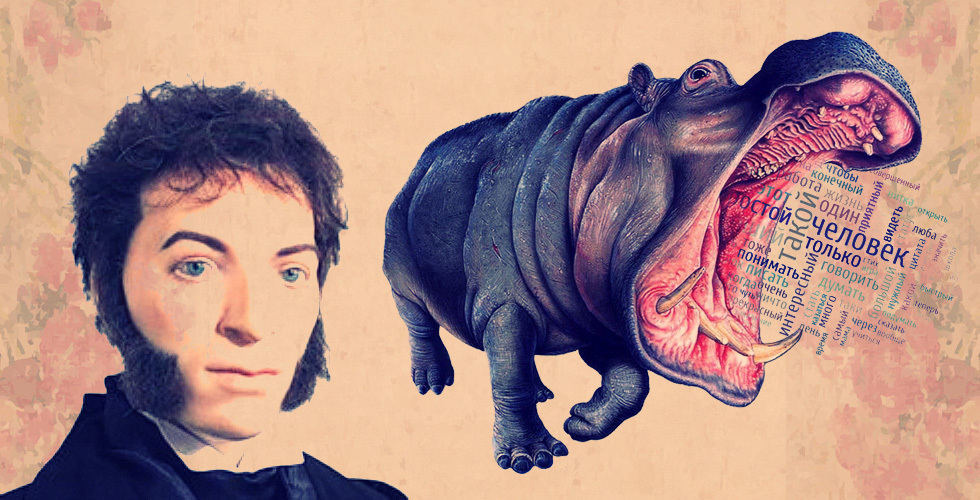
The developers of the Russian company Madscale have created a valid model of a lyrical poet in life.
• The “Highways” for the reporting period published verses by Viktor Lisin , Denis Kryukov and Igor Bobyrev , as well as the “Mystery in six paintings” by Oleg Asinovsky , here are the collections of Gala Uzryutova and Sergey Danyushin : “But if Brodsky / Born, say in 81 / Shabashil with a freelancer / in the agency, let's say in the agency PR-rileshnes / I would have been led to say ryzhiy / readers would affectionately / call it autumn // writer D Woke up / in cold sweat / in an unfriendly bachelor bed / drank water from a plastic bottle / and again forgot a disturbing sleep // But if Vaginov / Zavid, until 1984 / I hate a bitch. " Here - the essay of Peter Razumov “Contemporary Art and the Method of Production of Beautiful in Poetry” , as well as a new selection of Catherine Comerine “Bird Latitudes ” : “Sepaled in two / throws back / invisible goal / and again closes / screamed into the cloud // Matient / Movement of the flocks output / Emergency thought / tightened thought / fastened stitches / loops of take -off / and falls // In the half -air air / The outlines of the primary can / scratched through / to eternal permafrost. ”
• Separate publications. In the "Emigrant Lyra" (No. 3, 2013) - verses by Svetlana Kekova and the conversation of Alexander Radashkevich with Natalia Gorbanevskaya. In the journal “Seven Arts” (No. 9-10 (46), 2013) - Dmitry Bobyshev’s poems and “Alexander Book” Vladimir Gandelsman : “She turns around and thinks:“ If he / sees the shadows / loved ones that are inhabited by me / Hades ... ”turns into a new topic. // “He will see that I’m going through, / that I am devoted to the dead, that more miracle, / what to stay with them ... - He will not overpower the one that was prescribed to him, and will tear from here.” // Then he reduces a step, feeling his back, / his back, and the back of his head, and entirely - the whole heaviness / dreary. She says: “Native”,- / someone, and he turns around, daring. ”
In the magazine "Homo Legens" (No. 7, 2013) - verses byNatalia Chernykh , Ekaterina Simonova , Kirill Zakharov and Vera Pavlova : "Pigeons, why are they letters? / Because the pigeons are nozzles. / Neither gu-gu-nor friends, nor enemies, nor wives. / So, it will remain uninfilled, / How the heart with a forehead breaks through the wall, / How the death of love prescribes a price, / How a bullet flies by, / How sick is your favorite beloved. ” In the critical part of the same number, Evgeny Suslov writes about the book of Alexander Ulanov, and Arsen Mirzaev - about Tikhon Churilin .
• The section “Texts and authors” on “Babylon” was updated - the pages of Natalia Azarova , Nastya Denisova and Anna Glazova appeared there. In addition, Irina of the Machine Ophelia and Turnokoks was posted on the Ailusos publishing house. Polina Barskova in the preface writes about the verses of Masha, in particular that “the technical apparatus here is virtuosen and extremely curious, if you reflect on how the Machinsky’s location in an alien language environment and its translated classes influenced the fabric of her Russian verse. Constant negotiations with someone else's language and its poetic tradition and features here lead to natural and productive compromises - the sound nature of the verse from a strict law is turned into a constantly changing, whimsical design of the scene, into a whim, that we must be able to and want to feel. The sound in this verse is spilled and bewildered and frenzied and unexpected and mocking. ”
• Premium plots. Firstly, a long “debut” list has been announced. The most famous names in the poetic nomination are Andrei Grishaev and Ruslan Komade, but many others are familiar to regular readers of this section. Dmitry Vedenyapin is responsible for poetry in the jury of this year. The second long list for the reporting period was announced by the Moscow Observer Prize, which, recall, was “established in March 2013 by the site“ Cultural Initiative ”to encourage journalists and critics who actively respond to the current events of the current literary life of Moscow and Russia as a whole and analyzing the development of modern poetry and prose,” and is awarded “for bright and substantial publications” on the site everything on the site all on the site. the same "cultural initiative." The jury of the award includes poets and critics Kirill Kovalji, Leonid Kostyukov, Dmitry Kuzmin and Kirill Korchagin. The latter writes about the prize as follows: “The report on the literary evening - the genre, of course, is also not perfect: it is always a renegade on a living thread and involves a quick reaction that does not leave a lot of time to reflections about what he saw or heard. <...> Nevertheless, the report plays an important role - it can be considered a kind of laboratory, in the bowels of which the schemes of understanding of the current literature are invented. This genre-Bastard, located on the periphery of the literary world, can still be the basis for more thorough statements about certain phenomena of current literature. ” The short list of premiums is promised to announce on November 1, and the final decision to be made by the middle of the same month. The laureate by the care of Komus will receive 50,000 rubles, and the authors who are included in the short list are 5,000 rubles each.
• On the Radio Liberty website - an interview with the American poet and translator Yevgeny Ostashevsky, which we did not catch in time, whose book of Vvedensky translations recently published at the New York Review of Books . “There is an absolutely brilliant book called Leningrad, it was written by Lin Hedzhinian, Barrett Watten, Michael Davidson and Ron Sillman about how they went to Leningrad in 89 at the invitation of Arkady. There are many curious moments: in particular, it is described from the angles of several American poets at the same time the performance of Arkady, who acts with more traditional Russian -speaking poets. Those go on full shamanism, and then Dragomoshchenko begins to read. For American poets, a ridiculous triumphal note includes here, and they give him poems in their own translations, as if it was all completely transparent, as if they had gone to this country, in which nothing was clear to a person from California in the 89th year. And suddenly something of his own and dear. This is very comical. I really like to read the notes of old European travelers about how they first meet with the Indians. The British in 1553 get to Kholmogory, communicate with the Russians for the first time, describe absolutely as a meeting with the Indians. Something from this description suddenly swims in this book “Leningrad”, ”says, in particular, Ostashevsky. Here, at “Freedom”, Vladimir Gandelsman and Alexander Genis are talking about Sheimas Khini, and Tatyana Voltskaya and Andrei Sharry take an interview with Igor Pomerantsev in connection with the publication of his new book “Late Collection”. In addition, Pomerantsev was awarded this year the Tsarskoye Selo Art Prize (in the nomination "For contribution to poetry"). Among the laureates of past years are Sergey Stratanovsky, Vladimir Ufland, Evgeny Rhine, Anatoly Nayman and many others.
• “Kommersant- Weekend ” publishes an article by Yuri Saprykin about Galich: ““ Lines were lined with themselves, as if someone was dictated, ”Galich recalled his first“ anti-Soviet ”songs; The feeling that a certain highest power is written through you, not news for a great poet; But here this force can be given a name - it seems that Galich is captured by the elements of genuine Russian speech of the XX century, the language of crushed, sunk, pursued into nothing, this language dictates to him and the subjects, and themes, and the ethics of behavior; On it, you just can’t write about something else, you can’t behave differently with him. ” Polit. RU offers the interested professional audience a report by the teacher of Isaa MSU and the Center for the Eastern Philosophy of the Institute of Philosophy of the Russian Academy of Sciences Yu.A. Draisis "Classical Chinese Luisha Verse." In the current China, meanwhile, according to Amnesty International , the poet and journalist Shi Tao were ahead of schedule .
• The latter for today is that the developers of the Russian company Madscale have created a valid model of a lyrical poet in full size, i.e. A robot capable of clapping his eyes, move the jaw and select rhyme in 16 languages to any spoken word. They called it inventively: Idapushkin (photography and technical characteristics - here ). This same Aidasukinsyn looks rather frightening, but you can do with upp - however, so far only for Android .