
Translated material
Vasily Tsereteli: "We are for education"
- The traditional question: what are the plans of the Museum of Modern Art?
- We have big plans, huge. In the Moscow Museum of Contemporary Art, as in any other large museum, the plan is formed for the next three to five years. Our museum makes approximately 80 exhibitions per year at its own and at other sites. Together with the GCC, we will organize the Biennale of young art, which will be held at the Moscow Museum next year. In addition, this year we presented two projects as part of a parallel program of the Venice Biennale and plan to continue to participate in it, we plan international projects. One of the important events of the next year is the 15th anniversary of the museum. In this regard, we make a new thematic exposition. Once we decided: instead of a chronological exposition that lasts several years, to make small versions of a constant exposition more effectively, to change them every six months-with different curators, with different topics-and thus, our entire vast collection, which does not fit into the framework of one exhibition, each time to show the viewer to look at it in a new way, and specialists who are engaged in a new way the study of contemporary art, to give the opportunity to delve into it and feel what it is.
- With this kind of practice of showing the main collection, it turns out that in Moscow you were pioneers. Then something similar began to do the department of the latest trends of the Tretyakov Gallery. You go ahead of many in this matter.
- We do not compete with anyone, we have our own policy: we collect, show, study, publish, teach, study the art of Russia and the countries of the former socialist camp. International art in our collection is present, but there are few of it. Of course, I go a lot to different museums and saw, in particular, to Tate and not only that museums depart from the practice of showing a constant, unchanging exhibition, instead hold temporary thematic exhibitions of the main collection, which make it possible to see the work of artists in a new way. I believe that this practice has shown that it is more interesting and better. You give the opportunity to both your curators and the scientific department to develop, work with different professionals, delegate responsibility to your employees, who in this way also develop. Both of our current exhibitions of this format - “Dreams for those who are awake” and “Expansion of the subject” - showed how the press, experts and visitors appreciated the new high level of dialogue. On our anniversary, we plan to invite an international curator. We listened to critics, many of whom expressed such a wish: why don't you try to work with someone from abroad, who has a different look? And we will do this on our 15th anniversary next year, uniting three of our buildings with one large exposition. I hope this will be a successful project.
In Russia there is fashion - curators, specialists, etc. - Any peak of foreign discussion immediately to try to apply to our reality under a copy. But this, in my opinion, does not work.
We also have a practice to show our honored artists who had no exhibitions or were at all, but small. We make large retrospectives and new projects in which the museum becomes a white canvas, removes and completely provides space for an artist or curator. We allow the artist to maximize all our ideas, our desires, our vision and try that it is not just an exhibition, but a scientific study of his work, a total installation, where you fall into the world of this artist. We do not just bring and hang the paintings, but make exactly a whole project. All exhibitions that are held with us in Ermolaevsky Lane, in Gogol and Tver Boulevards, are built on this principle.
- Very often, in the case of retrospective exhibitions, the museum works with a fund or gallery with which the artist cooperates. Accordingly, the question arises: what is the influence of these organizations?
- In Russia there is fashion - curators, specialists, etc. - Any peak of foreign discussion immediately to try to apply to our reality under a copy. But this, in my opinion, does not work. Until now, the international community has discussions whether the galleries have the right to participate in exhibitions, whether they can be indicated as partners, etc. These debates have been conducted for years. We see: the Los Angeles Museum was recently appointed the director of the former gallerist , and there was a kind of attitude to this. At the same time, we see a wonderful example of Biennale Whitney, who is considered one of the most respectable exhibitions in New York, and there you can often find inscriptions that "such and such a gallery is provided." For example, there were discussions within the framework of Turner Prize , why from a certain gallery the most finalists. In Russia, the situation is different. In the 90s, when there was no art market and in fact nothing was bought, the galleries were curators, and performed work, and supported artists. Many of the most important works of art are now in galleries, which sometimes work as funds.
Glory to God, we have never had such that the authorities or the Department of Culture intervene in the policy of the museum in the sense of which the picture is hanging. And that's right.
We do not work on the principle of some European museums, where you come with the exhibition, and they say: very well, we accept the project, you will pay so much for rent and do what you want. We are interested in every project that we do, because we, as a museum, believe that this is important, it fits into our concept. And we believe in the importance and significance of this artist. We do not take a rent for rent, we become partners, provide the room depending on the project and the concept. Either the artist works with the curator, or it is a gallery, which, together with the museum, hires the curator. There are either the partners of the fund, or sponsors, or some grants from the ministry, etc. That is, each case is individual. We develop that mechanism of relationship and work that is optimal for this particular exhibition. Naturally, we cannot finance everything, we do not have such funds. Therefore, each time certain opportunities are selected for the museum to carry out scientific work, make the highest quality project, from which there would be benefits to the society, the artist and the viewer. In my practice - how much we worked with galleries, with curators, and in general, in general, with each exhibition project - there were no conflicts. Each galleryman understands that there is a gallery space and there is an exhibition in the gallery, but there is a large -scale museum retrospective of the artist. Of course, the artist’s works cannot be divided into gallery and museum, it is necessary to show his work as a whole.
- In the name of your museum is the word "Moscow". How do you perceive yourself-as a Moscow museum or still Russian, in a wider way?
- In general, our full name is the state budgetary institution of culture "Moscow Museum of Modern Art." We have been in Moscow, and the collection with us - from the end of the 19th century until today. As for modern art, we are comparable to the concept and principle of development with museums such as Pompidu, the Whitney Museum, MOMA in New York or the London Tate Modern . And, of course, you need to choose your specialization, what you will represent most fully, where you can make the right platform. We have a good collection of the Russian avant-garde (this is the base with which it all began), the 1920-1930s, non-conformists, painting of the eighties, relevant Russian art, etc. Of course, our museum, being in Moscow, is called Moscow, but the significance of what we are doing, and the collection that we have, go beyond the framework of one city, they are all -Russian. In addition, we do many joint projects with regional museums. Each exhibition is not just we took and hung several pictures, this is a scientific work, preparation. Therefore, for example, our museum made the first museum exhibition of Alexandra exter. This is also work with partners, such as the Tretyakov Gallery, the Russian Museum, the Hermitage, etc. So an important analytical scientific work is formed, which is good for everyone. For example, the project “History of the Russian Video Art” is, one might say, the first educational manual for the analysis of this medium. It was a three -year project ( 2007-2010, curator Antonio Jeuza. - Ed . ), Which became a certain basis in its study. During the year, in addition to the constant exposition, we have a number of theoretically important, analytical exhibitions, also international expositions related to the display of international art stars. Now we are trying to make less small personal exhibitions of international authors, and more group, such as, for example, the exhibition "Masterpieces of the XX century" from the collection of the Institute of Contemporary Art of Valencia. We showed a collection of young Spanish artists, made an exhibition of Boyce, preparing an exhibition of German art together with the Goethe-Institute. The exhibition of Miro, organized in conjunction with Boszo, was very important. We do not think that our collection is limited by any framework. This, of course, is the whole country and the state of the former socialist camp, our collection presents art from Azerbaijan, Armenia, Georgia, Ukraine, Belarus, Baltic countries, etc. We take as the basis a single school, close relationships and mutual influence of artists and historical events.
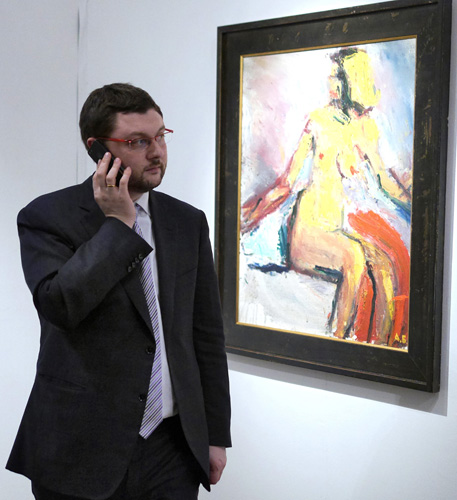 © Vasily Shaposhnikov / Kommersant Vasily Tsereteli at the opening ceremony of the exhibition “Aron Bukh. To the 90th anniversary of the master "in MMSI, 2013
- How is your budget formed? Is this the money of the Department of Culture of the city of Moscow or is there funds from the federal budget, the money of sponsors?
- How was the museum based? They said for a long time that it was necessary to create a museum of contemporary art. The debate was conducted, some collections were created, and something was already at that time. But in fact, the decision to create such a museum was made in 1994, when the mayor signed the corresponding resolution. At the same time, Zurab Tsereteli acquired and handed the city the building on Petrovka. For many years, he collected the work of both artists of avant -garde and naive art, as well as the sixties and much more. He handed the city a collection of more than thousands of work, and the Moscow Museum of Modern Art appeared on this base. The collection has gradually grew, in which now more than ten thousand works, including all directions since the beginning of the 20th century. We have a scientific laboratory that conducts research, studies the safety of paintings, participates in conferences devoted to the preservation of contemporary art, restoration, analysis. That is, it is such a scientific laboratory that can work in these areas with any other institutions. We have a school “Free Workshops” , which is as many years as the museum. Each summer, school exhibitions are held, showing the result of training and giving the opportunity to young artists to show their work for the first time as part of the Debut program. And for a young artist it is important to appear for the first time. There is a drawing school for very small ones - children from 4 to 14 years old. There is a separate library that now has more than eight thousand books. In her fund, both foreign literature and what is published by us, plus something is bought, is given something to us. In the near future we will make the library open. This will be a new space to which all schools, students, anyone will have access. We have published the magazine "Dialogue of the Arts", covering not only our exhibitions, but also life in Moscow and regions, international projects. In publishing, we try to make maximum coverage, we publish catalogs, scientific books. Now we have launched the new Internet project "Contemporaries" , which is supervised by Irina Kulik. The museum has a bookstore where we try to present in all directions the products published by us and our colleagues. The museum cooperates with many institutions, tries to conduct more regional and international projects.
We see how, due to misunderstanding, people make incorrect decisions: we saw the trial of Erofeev and how people incorrectly interpret work from his exhibition.
We are very actively negotiating with the city, so that in the future we are built a new building or give us some of the existing industrial buildings that could be adapted for the needs of today. The new building is also a plus to the tourist attractiveness of the city. In addition, the museum will work much more efficiently if it is in one building adapted for its needs.
The Moscow Museum of Contemporary Art - a municipal institution, belongs to the Department of Culture of Moscow and is funded from the municipal budget. There are also different partnerships. So, the exhibition of the Miro was financed, including by the Ministry of Culture and the company "Bosos". There are annual cooperation, interstate programs, some grants in which funds and federal ministries participate. And each time it is a difficult job on the search for partners, friends, those people who can support the museum. We are looking for additional funds to do more quality projects, so work on the search for partners is very important. For example, the exhibition “Difficulties of Translation” in Venice was partially paid by the Department of Culture, and partially Andrei Cheglakov and the Ukraine hotel. There are people who see that art must be supported.
- International and Russian practice shows that the presence of its own large collection is an argument in a conversation about support, not only financial. For example, in the Warsaw Museum of Contemporary Art, which they have been trying to evict for a long time, there is a show of their collections - the exhibition “ In the heart of the country ” , it is an argument that they are needed, that the museum cannot be transferred from the city center. Similar arguments sounded in history around the museum, which wants to create a GTSIA.
- Of course, the collection is important. This is one of the subjects of discussion on all kinds of debate and round tables. These discussions have been going on since the 1950s and 60s-whether the museum is needed, whether the collection is needed by the museum. So, in Germany there are many wonderful institutions that work as Kunsthalle, they do not collect collections, but are engaged only in research and analytical work. My approach is still different: the museum should have its own collection, because if you are a museum, one of your tasks is analytical work, preserving the culture and passing it to the future generation. A large gap arose due to the fact that in Soviet times, museums were not replenished with collections of actual art. In the regions, a picture of the development of Russian art of the XX -XXI centuries is practically not presented. For example, more than a thousand museums were built in China, all artists were represented, exhibitions are demonstrated in all regions. And thus, the inhabitants of the whole country see art, they are developing. Therefore, of course, the collection of the museum is needed.
But we do not have enough rooms. Our collection, if you try to hang it all, will not fit in any of our spaces.
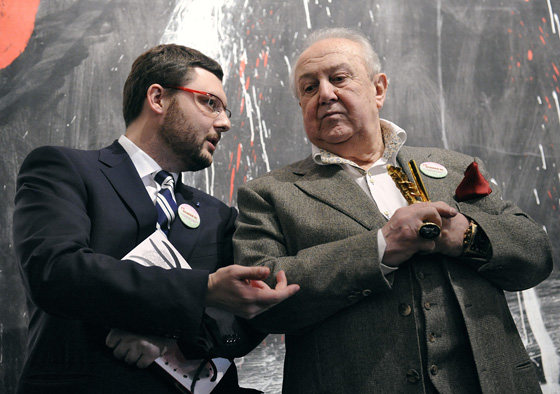 © Gleb Shchelkunov / Kommersant Vasily Tsereteli and Zurab Tsereteli during the opening of the exhibition “Juan Miro. Images "in MMSI, 2013
- Do you have enough storage facilities?
- No. As in any museum, this is the biggest problem. Now many museums are building new storage facilities, such as the second storage of the Hermitage, which is designed by Kolhaas. Of course, the storage must be made open and affordable. Now we rarely see the building was built precisely under the museum. Usually, some existing buildings are reprofiled for museum needs, and each time it leads to difficulties with storage facilities. This is the problem of any museum, but it is wrong to completely abandon the storage in the museum. The museum itself needs a space for storing temporary projects and exhibitions. Large open storages can be done somewhere remotely, even in sleeping areas, as the Hermitage did, for example. This enables residents to be interested in art, see it, somehow develop.
- Do you, as a state institution, affect the authorities? There was a story when they removed the work of the IRWIN group , hanging on the facade of the museum.
- Not quite so. Glory to God, we have never had such that the authorities or the Department of Culture intervene in the policy of the museum in the sense of which the picture is hanging. And that's right. They finance culture, support, develop and trust those people who are sitting in the field. And with Irwin there was a slightly different situation. Four days on the facade of the museum hung a large banner. Initially, he was supposed to be in English and another size. The curator decided to increase it, and we went to meet him. It is not a matter of power, there is a law that forbids to hang banners that cover more than three windows on the architectural monument, we did not know about this restriction at that time. The decision on a large banner was made at the last moment, and I decided to hang it. We proposed placing a banner in the courtyard of the museum, but the artists did not agree. Someone wanted a big scandal, resonance. The scandal did not work. Кто-то ждал, что будет что-то, какая-то реакция. А реакции не случилось, просто нам сказали: «Снимите либо согласуйте». That's all. Никто ничего не запрещал, скандала не было.
Очень важно создавать как можно больше филиалов или независимых музеев, и государство должно пополнять фонды всех музеев таким образом, чтобы человек уже с детского возраста понимал, из чего вообще состоит искусство.
Очень опасно вытаскивать работу художника из контекста, можно этим ввести в заблуждение зрителя и исказить месседж художника. Мы видим, как из-за непонимания люди принимают неверные решения: мы видели суд над Ерофеевым и как люди неправильно трактуют работы с его выставки. Или вот ситуация: у нас во дворе висит работа «Распятие» Юрия Орехова, выдающегося российского художника. Он преподавал в Суриковском институте, работал над храмом Христа Спасителя, его скульптуры стоят по всему миру. Работа была подарена художником городу, городом — музею. Несколько лет она у нас выставлялась во дворе. Внезапно два года назад приходит какой-то человек и говорит: «Снимите эту работу». Why? «Ущемляет права верующих». Why? «Обнаженное распятие». Если говорить о реалистической скульптуре, то в Риме в то время было распятие людей в обнаженном виде. С реалистической точки зрения, с художественной, да с любой — это классический художник. Такое случается от непонимания и незнания контекста и истории. Нет понимания, что это музей, что это высочайшая культурная институция. Это невежественно — идти в Эрмитаж и пытаться запрещать Чепменов. А у нас сплошь и рядом такое отношение. И в результате пришло несколько десятков человек, которые провели молебен у этой скульптуры. What is this talking about? О незнании, необразованности людей. Поэтому так важно привлекать специалистов, которые трактовали бы произведения искусства. Поэтому мы — за образование. Очень важно создавать как можно больше филиалов или независимых музеев, и государство должно пополнять фонды всех музеев таким образом, чтобы человек уже с детского возраста понимал, из чего вообще состоит искусство. И тогда уже, придя в музей, он не задает себе вопроса, можно ли тут этому произведению быть или нельзя.
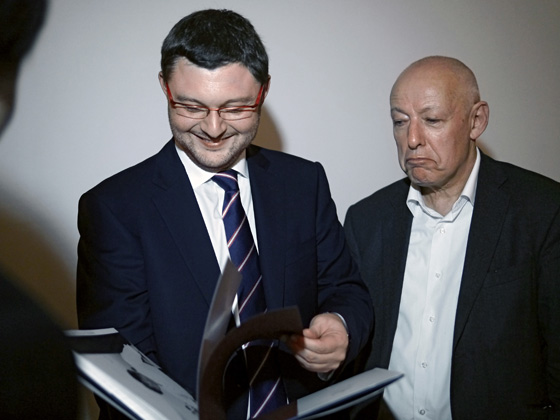 © Василий Шапошников / Коммерсантъ Василий Церетели и директор Института проблем современного искусства Иосиф Бакштейн на открытии выставки «Молодое искусство Китая» в ММСИ, 2012
— Какая у вас сейчас посещаемость?
— В прошлом году было больше 300 тысяч человек. Конечно, мы хотим больше. Здесь много факторов. Это и пиар, и популяризация, и количество туристов. Очень хорошо на посещаемость работает «Ночь музеев», когда за одну ночь к нам приходят 14 тысяч человек. Выставку Миро за один месяц посетило больше 30 тысяч человек. Думаю, популярной будет и акция «Ночь искусств». Если сравнивать с международными музеями, то, например, в Бруклинский музей искусств приходит примерно 300 тысяч человек в год. Я считаю, что нам надо стремиться к большему. Если брать наши международные выставки, такие, как в Венеции, то посещаемость будет зашкаливать за полмиллиона. Но посещаемость — это всего лишь один из показателей успешности выставки и музея в целом.
— Последнее время очень остро стоит вопрос трудовых прав художников , которые работают с тем или иным музеем. Как заключается трудовой договор?
— Я не знаю, у нас не было таких проблем. Если художник делает персональную выставку, то он не получает за нее гонорар, но получает саму выставку, каталог и т.д. А куратор, который осмысляет или создает этот продукт, получает гонорар. Если это художник-экспозиционер и он монтирует экспозицию или если он выступает как куратор, то тогда с ним заключается договор, обсуждаются средства, на которые он рассчитывает, и мы работаем. Все опять же зависит от суммы. Если она превышает определенную регламентом, прописанным 94-м законом, то мы уже должны объявлять тендер. На сегодняшний день это одна из самых больших проблем в работе, с чем приходится сталкиваться каждому государственному музею, каждому государственному театру, — этот 94-й закон, который, конечно, имеет в основе благое намерение противостоять коррупции, но при этом абсолютно неприменим к сфере культуры, где низкая цена не может быть основным критерием.
Если художник делает персональную выставку, то он не получает за нее гонорар, но получает саму выставку, каталог и т.д. А куратор, который осмысляет или создает этот продукт, получает гонорар.
Вот есть директор. Если это любящий свое дело и свою институцию руководитель, он никогда ничего в ущерб ей делать не будет. Он будет стремиться к соотношению цены и качества. Но по 94-му закону мы, например, при издании книги не имеем права указать подходящую типографию, не можем указать необходимые требования к качеству. Каждая книга, готовящаяся для выставки, — как произведение искусства. А в итоге любое издательство может подать заявку на участие в конкурсе и выиграть, мы с ними будем обязаны заключить договор, а они напечатают в плохом качестве, и мы будем вынуждены с ними судиться.
— У вас уже было такое?
- Was. И мы будем судиться или расторгать договор, объявлять новый конкурс, и будет вся эта волокита. А бывает, кто-то конкурс выигрывает, приходит и говорит: дайте нам денег, мы уйдем. Мы сразу передаем эти дела в соответствующие инстанции. Поэтому этот закон не работает. А каждый конкурс — это время наших сотрудников, время, которое должно тратиться на решение других задач. Каталог не выходит вовремя — страдает выставка. Недавно у нас была история с транспортной компанией, которая также просто выиграла тендер. Прислала художнику машины, перевозящие фрукты и овощи. Художник в ужасе, страховая компания в ужасе, все в ужасе. Опять расторгается договор, снова с кем-то заключается, выставка передвигается. Все это — время, деньги, масса усилий. И плюс к тому, если ты расторгаешь договор с фирмой, ее название вносится в реестр недобросовестных компаний, а это означает лишь то, что ее владелец берет и регистрирует новую компанию за две секунды и повторно участвует во всех конкурсах. То же самое с застройкой выставки. Делается проект, делается экспозиция. Выставка — это результат творческой, художественной и научной работы. И бывает так, что в последний момент художник решает: здесь надо стенку немного повернуть или покрасить красненьким. Ведь это же творческий процесс! А конкурс уже проведен, компания уже выиграла тендер, и у них уже написано, что «стенка такая-то, столько-то краски». And all. Что страдает? Страдает выставка! И так сплошь и рядом. Это касается всего. Например, библиотеки: оптимально книга стоит такую-то сумму денег — не самая дорогая, но качественная — и продержится в библиотеке от 5 до 10 лет. 94-й закон вынуждает покупать эту книгу по самой низкой цене и самого плохого качества. Через год ее надо будет выбросить, потому что она склеена, а не сшита. И библиотека повторно обратится в закупку, а им скажут: да вы только что покупали. И так везде и во всем. Этот механизм не работает. Работать можно более эффективно или менее эффективно, и этот закон вынуждает людей работать менее эффективно.
— В такой ситуации музею удобно было бы иметь собственную типографию...
— Это тупик, мы не можем заниматься всем и сразу. Типография — отдельный большой проект, на который нужно потратить массу времени и сил.
А что касается художников, у нас, слава богу, не было никогда проблем. Если это производство выставки, то с художником заключается договор. Есть юридический отдел музея, который этим занимается. Сложностей и нерешаемых проблем не было. Любая проблема решаема. Главное — у тебя должно быть желание сделать так, как художник хочет, как куратор хочет и как хорошо для музея. Музей должен быть мобильным и любить тех, для кого он создан, — и посетителей, и тех, кого он показывает.