
Translated material
“A man is incorrigible. But he was given hope "
Mikhail Arkadyev - about homosexuality, human choice and love
Conductor, pianist, philosopher Mikhail Arkadyev* - About love, sin, freedom of choice and the phenomenon of homosexuality
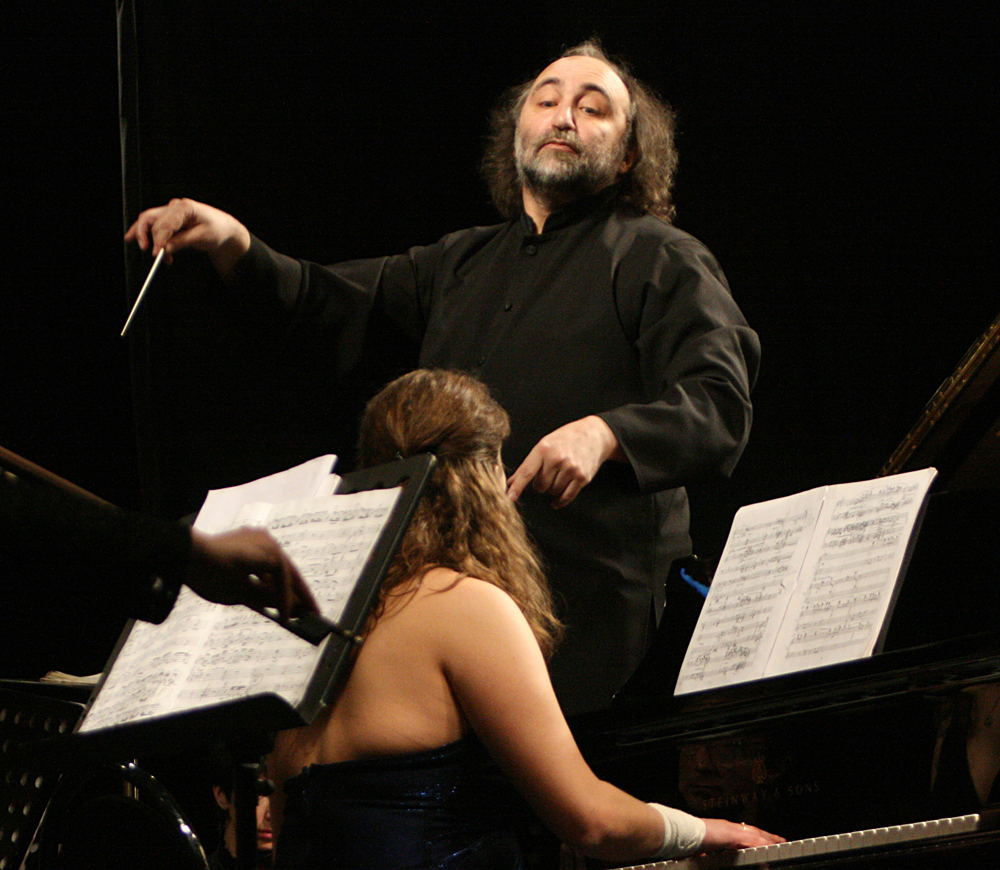
Mikhail Arkadyev for the conductor's remote control. 2010
About chastity and shamelessness
| *Mikhail Arkadyev is the author of the philosophical book "Linguistic Disaster", which is published in St. Petersburg. In the summer of 2011, he published an open letter against the accession of the Union of Composers to the Podputinsky All -Russian Popular Front, for which he was dismissed from Gnesinka and was removed from working with the Pacific Symphony Orchestra (The New Times No. 35 of October 24, 2011). |
Any relationship, painted with tenderness, trust, friendship, desire, is a kind of love. In love, which is always worried about the freedom of the one he loves, a perversion is impossible. Perversion is a desire, crippled by power and fear (often with fear acquired in childhood) and turned from joy and mutual pleasure into a desire to own and humiliate. The very desire, libido - is chastely; Although it is a paradoxical, but an invaluable gift and our possible gift to another person and people in general, no matter how sad it may sound.
Usually the concepts of “shamelessly” and “chastely” are opposed. But only then “non-essential”, which is chaste, and vice versa. Chastity does not know false shame, as Adam and Eve did not know him in the biblical myth in paradise (before the “forbidden fruit”, before the “fall”). In the ancient category of sin, the ability of a person is unconsciously encrypted to be just a person, to use, and hence to abuse freedom. But this abuse is not at all disobedience to God. The abuse of freedom is a violation of freedom and humiliation of another person. Therefore, the moral who puts a person in a position of guilt before God (that is, “cosmic”, original, metaphysical guilt) is at the basis of his own immoral. It allows the abuse of power over the body and soul of another person, which we see in the real history of Christianity, including in the history of Christian families, not only states.
About the majority and minority
| ** This is how the fifth commandment in the “Ten Commandments of the Parents” of the great teacher Janusz Korchak is formulated: “5. Do not humiliate. " |
The most important ethical commandment does not humiliate ** not included in the Old Testament or the New Testament Canon. Meanwhile, it is ethically stronger and independent even by the commandments of “not killing” (recall the problem of self -defense, murder in battle for the homeland or to save the family, child, other person), not to mention others, including “do not adulte”.
Sexuality is the desire for pleasure laid down by nature, instinctive seeson in animals, free from calendar cycles and burdened with language and culture-in people. The so -called instinct of reproduction, the continuation of the genus - the concept of a new European person. I believe that bisexuality is also a concept. It is quite a paradoxical assumption that the “norm” for humans is a pansexuality (and bisexuality as its form), and heterosexuality and homosexuality are “deviations” (given the conventionality of such a separation).
"
Perversion is a desire, crippled by power and fear and turned from joy and mutual pleasure into a desire to own and humiliate
"
Using this paradoxical hypothesis and rethinking the jargon of gays, “natural” (that is, natural) in this case, the absolute minority - bisexuals should be called. It would be political correct in relation to “sexual minorities” to change rhetoric and formulate the principle: the heterosexual majority is the same deviation from the norm as the homosexual minority. The causes of deviations are specific cultural and historical. Primary social deviation - the ban on incest - formed the social history of man.
A person is a deviation by definition, and the deviation is catastrophic and dangerous. But this deviation cannot be corrected, since all attempts by radical correction always lead and will lead to human victims. A person is incorrigible. But he was given hope and will to reduce to a possible minimum the consequences of his own non -rights.
About homosexuality
Propagation can be considered in a sense by a side effect of a sexual act. At the very dawn of history, long before the Neolithic revolution, a person was most likely not quite sure that the act is a direct cause of the birth of a child. Bisexuality in all morally non -centralized, that is, not claiming total power over the souls of people of cultures (for example, in European antiquity and later, up to the Italian Renaissance, or in ancient India, Egypt, Iran), was the norm. Homosexuality was not marked as a deviation. As a special marginal phenomenon of homosexuality, which was allocated in public consciousness, could arise only against the background of strict state-social condemnation and prohibition. That we are observing for the first time seriously only in the postrenceanese, that is, the “Protestant” (in the broad sense, including counter -reformation) to European culture.
All attempts by radical correction of a person always lead and will lead to human victims
"
I say this with the greater conviction that I myself, like most of my contemporaries, are not inclined to homo- or bisexuality for family and cultural reasons. The fundamental conclusion follows from this: we must not forget that our follow -up by the norms is a consequence of our choice and is supported exclusively by our choice, and not the absolutability of the norms themselves. The only set of ethically “absolute” norms: do not do with another what you would not want to do with you; Do not consider the other as a means, but only as a goal.
In Russia, until 1917, as far as I know, there was a fairly tolerant attitude to homosexuality. Only the Stalinist post -Bolshevism (state Soviet “Protestantism” - in the sense of ethical rigorism) led to a total prohibition of homosexuality, that is, to state homophobia. In this “prohibitive” direction there is now legislation in Russia.
About the choice
Morality is a concern for not violating, if possible, the freedom and dignity of another, and it (unlike morality) is associated with a constant choice. That is, morality is not vertical and not static, like morality, but horizontal and dynamic, which was well understood by the Russian philosopher Nikolai Berdyaev. Was Berdyaev ready to nominate the following moral thesis: do what you want, but do not break and take care of the freedom of the one who is next to you?
With such a principle, with its consistent observance, it is impossible to abuse: he corrects himself, is built as a form of interaction, and not as a moral dogma. But what if you really want to break the freedom of another? No one and nothing can interfere with this desire. But it is possible to regulate actions based on such a desire - and for this the legal system of the liberal state has been created. Why liberal? Because the basis of the most difficult and branched system of liberal law is the aforementioned principle: “Do what you want if you do not violate freedom and do not humiliate the one who is next to you.” This principle, mindful of Rabelais, will call the "principle of Telemic Abbey."
This position, in turn, is expressed in the fundamental, only apparently purely legal, but in fact - the moral principle of the presumption of innocence. Many would like to think this principle as soon as external, purely legal. But if we are looking for the deep foundations of post -Christian morality, we are forced to perceive the presumption of innocence (a person is innocent until his guilt is proved) as an internal regulator of our moral life.
The question of conscience, that is, a sense of guilt in the face of an internal court, should probably (if the rhetoric of obligation is applicable here), regulate the principle: do not break freedom and do not humiliate the other - with all the difficult meanings of the concept of “other”. This "other" is inside us. That is, we must distinguish between false (conscience-censure) and genuine (free) conscience-they are often mixed.
Photo: Andrey Gorbosos/RIA Novosti