
Translated material
Xenophobia as a control method
A hundred years ago, the jury court in Kyiv issued an acquittal of the clerk of Menachem Mendel Bailis, accused by the authorities of ritual murder. The charge was completely fabricated. A century later, the authorities are trying to play the same map
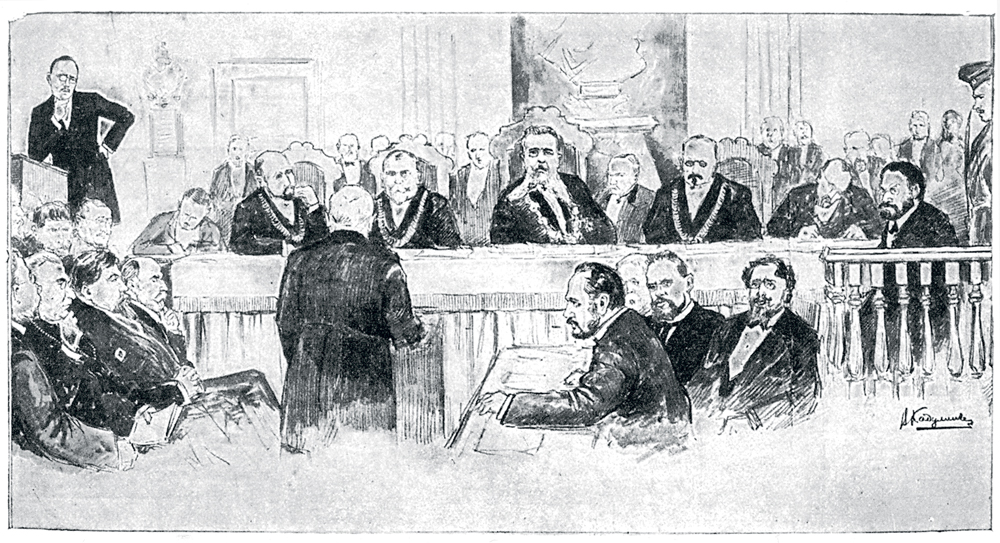
At the hearing in the case of Bailis (in the figure - the extreme on the right, sits under guard). October 1913
Many books, documentary and artistic literature, and journalistic reports about each of the days of this very resonant trial in Russian history have been written about this terrible and tragic story with a conditionally happy ending in the world.
Today it seems important to me to say about those lessons of the Bailis case that the current government could extract from him if she could learn from other people's mistakes.
It is no secret to anyone that the investigation of the murder in Kyiv, Andrei of the Yushchinsky comedy of this court, had nothing to do. The names of the actual killers were known to the authorities at a very early stage of the investigation, like the motives of the crime. Participants in the gang that committed the murder were soon caught, and this happened two and a half years before the start of the process.
However, the actual side of the story of the murder in the preparation of the trial was not accepted at all. The directing of the process had nothing to do with the norms of criminal law: political technologies acted in its pure form. The initiative to condemn the Jew on charges of a ritual murder of a Christian child belonged to the leader of the pro -government of the two -headed eagle. For a long time he tried to convince the Kyiv authorities, secular and spiritual, but neither the governor nor the bishop found his support. But the Black -Holded Petersburg press became interested in his venture, then the deputies of the State Duma, and through them - the Minister of Justice, who caught fire and took the matter, as they would now say, "to control." An investigation group was sent to Kyiv with clear instructions who and what should be exposed to it. Judge Boldyrev was put the chairman in the process, specially for this transferred to Kyiv from Uman, with a promise after the successful completion of the case to appoint him the chairman of the district court. Boldyrev brilliantly coped with the selection of jury for the process: five of them were members of the Black Hundred, the rest - sympathetic. The prosecutor was also sent to the process specially trained from St. Petersburg. As experts, the authorities attracted a number of specialists associated with the “black hundred”, and some of them (for example, the physician Kosorotov) for participation in the process from the secret funds of the police department paid a large amount of black cash.
"
Putting on "strangers" is an attempt to combine society under the banners of enmity
"
After such a capital preparation for the trial, one can understand why the authorities did not doubt the victory of the state prosecution at all contrary to the well -known facts in the case. And it is worth noting that over 100 years, the methods with which the Russian government guarantees the necessary verdicts in resonant political processes have not changed at all. And in the “Yukos case”, and in the “Kirovles” case, and in the Tomsk process “Bhagavad Gita”, and in the posthumous trial of Sergey Magnitsky, we stumble upon all the same tricks - writing out from the hinterland of “correct” judges, investigators and government officials, connecting the “necessary” experts, an extraordinary increase in the order of the process participants, etc. By the way, exactly, on the 100th anniversary of the Bailis case and the 10th anniversary of Khodorkovsky’s landing, Vladimir Putin signed a decree that raised the judge of Alisov, who had passed the posthumous sentence of Magnitsky to the Moscow City Court.
And the main thing is that it is worth remembering the case of Bailis is the goal for which the whole complex combination has been hidden. Having accused the Jews of drinking Christian blood, the government hoped to send popular anger in their direction. The tsarist government needed an enemy around which society could be rallying in order to take dissatisfaction from the first persons growing in the country. And in this sense, all political technological exercises of the current government are a direct continuation of the 1913 policy. Daily setting up viewers on migrants and foreigners, gays and Muscovites, the “creative class” and the non-profit sector, for human rights defenders and environmentalists, for cubes of abstracts and “blasphemy people”, on American adoptive parents and Dutch diplomats, opposition and enemy “Internet” are an obvious attempt to unite society under banners comprehensive xenophobia. And it's time to remember how this attempt ended a hundred years ago.
About xenophobia in its modern form - read in the main topic of the number