
Translated material
Deputy of the Baltic
On October 23, Latvia President Andris Berzins opposed the initiative of the right to demolish the monument to the Soviet soldiers-liberators in Riga-this idea aroused a sharp rebuke of the Russian Foreign Ministry. But the statements of Berzins Moscow seemed to have not heard ...
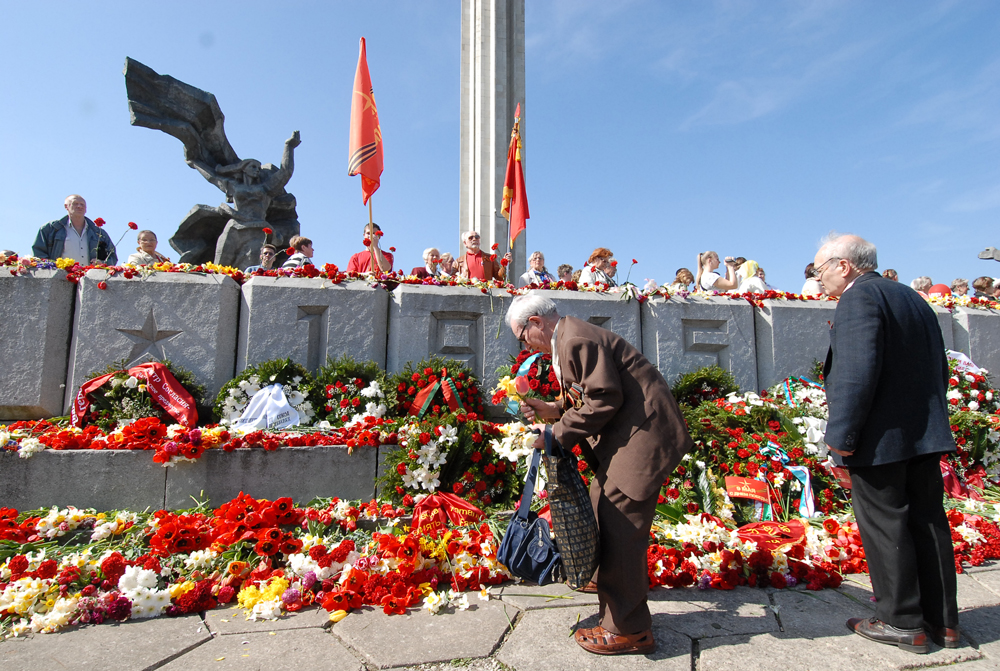
Veterans at the monument to Soviet soldiers in Riga
As a proposal for the dismantling of the monument, in May, the party “Fatherland and Freedom”, which is part of the ruling cabinet, made the party in May. In October, the initiative was supported by the Minister of Justice, Janis Bordans, he proposed to build up to 200 thousand people, a stadium on the site of a monument on the site of a monument, near on the site of the monument. Berzins believes that Bordans "uses an administrative resource for election purposes." 10 thousand people who put signatures in support of demolition (this amount is enough to consider the petition in parliament), apparently, they think otherwise. However, according to polls, the vast majority of Riga - for the monument, and they also collect signatures. In a word, there is an acute discussion in Latvia, and she is an occasion to talk a little about something else.
In the British House of Commons, the left deputy George Galloway has been sitting for a quarter of a century. For many years, colleagues called him a “deputy from the Baghdad constituency” - Galloway was known as a passionate defender of the Iraqi dictator Saddam Hussein. In 1994, he personally visited Saddam and in front of the television cameras admitted that he admires his "courage, strength and tirelessness." After the overthrow of Saddam, documents allegedly confirmed in the Iraqi Foreign Ministry building: Galloway annually received £ 375 thousand from the Iraqi regime. The Daily Telegraph newspaper published, Galloway filed a lawsuit against it - and won a full victory: the judge decided that the allegations of receiving money were unproven and slanderous. The British deputy defended the Iraqi dictator from a pure heart.
So, there are defenders of dictators not only in the Westminster Palace, but also in the European Parliament. In October, there were hearings on the situation with human rights in Russia at the end of the 13th year of the reign of Vladimir Putin. Representatives of the Russian opposition, including the author of these lines, performed at the hearings. Russian diplomats were also present, but they did not ask for words. As it turned out, this was not necessary - the difficult task of defending the Kremlin’s policy was taken by the deputy of the European Parliament from Latvia, Alexander Mirsky.
"
Mirsky deputy in an interview promised to “personally throw” Russian opposition from the European Parliament
"
From his speech it was possible to find out, for example, that Mikhail Khodorkovsky was not at all political prisoner, that the current Russian State Duma is a legitimately elected parliament, and in the mayor of the capital, all Muscovites voted for Sergey Sobyanin, which confirm him (worldly) conversations with passers-by in the Moscow region of Vykhino. The arguments based on facts, for example, was officially recognized as the “international amnesty” as a prisoner of conscience that the State Duma, according to its own former speaker, has been a place for discussions for ten years and that, according to official figures, almost 30% of Muscovites voted for Alexei Navalny, the deputy was not impressed. In any case, Mirsky was clearly not tuned to the discussion: after reading his workpiece, he ran away from the hall. And a few days later he published a note and gave an interview in which he promised to “personally throw” Russian opposition from the European Parliament if they still appear there, and called his colleagues - deputies from the Baltic countries of Karlis Shadurskis and Vitautas Landsbergis - “Russophobes”. Judging by the quality of the article, the “Russophobes” speak the Russian language much better than the worldly itself. “Understand that he is used to protecting the Russians from Latvia, and here he has to protect Putin from Russians. This is much more complicated, ”one European Parliamentary explained to the author of these lines.
The case of the worldly is not exceptional. Of the nine deputies from Latvia in the current composition of the European Parliament, three have very specific relations with the state that they represent. In addition to Mirsky, this is Tatyana Zhdanok - the founder of the international front of the workers of the Latvian SSR and Alfred Rubix, the first secretary of the KPL Central Committee, who headed the local GKChP during the couch of 1991. According to the European Parliamentary delegation, one can judge the moods of a significant part of the Russian -speaking citizens of Latvia, many of them are nostalgic for the times when the country in which they live was forcibly devoid of independence.
However, it is not a fact that this nostalgia is sincere: the market of the Russian -speaking media of Latvia (like two other Baltic countries) is almost monopolized by the Kremlin television channels that carefully conduct the line of official Moscow. The fact that this line is, one could once again verify during the last verbal conflict between Moscow and Riga: the statement of the head of the Ministry of Justice of Latvia in support of the dismantling of the monument caused the “deep indignation” of the speaker of the Ministry of Foreign Affairs of the Russian Federation Alexander Lukashevich (the stylistics of his statements quite organically fit into the era of Molotov, Vyshinsky and Gromyko), which once again accused Latvia. In "Falsification of History".
Of course, the issue of the monument should be resolved by the Latvian society itself. But the perseverance with which the Russian authorities pretend that they do not understand how people may not like a monument to the army, which spoke for half a century in the role of occupation power.
The market of Russian -language media of Latvia is almost monopolized by the Kremlin television channels
"
Those who continue to repeat the Soviet lie about the “voluntary” accession of the Baltic countries to the USSR are engaged in this falsification of history, forgetting about the secret additional protocol to the Molotov -Ribbentrop Pact, the Ultimatum of Molotov by the Baltic governments, the introduction of units of the Red Army, Lithuania and Estonia in June 1940, about massive deportations of 1941 and 1941 and about mass departments of 1941 and 1941 and 1949. In their revisionist fuse, the current authorities even ignore the official documents of the USSR and Russia, including the Decree of the Congress of People's Deputies of the USSR of December 24, 1989, condemning a secret additional protocol to the Molotov -Ribbentrop Pact. In 1989, our deputies announced the pact invalid “from the moment of signing” and stated that his provisions “were from a legal point of view in contradiction with the sovereignty and independence of a number of third countries”. But there was also a Russian-Lithuanian agreement of July 29, 1991, in which joining the USSR in 1940 was officially recognized as annexation.
However, what is surprised if in United Russia they again started talking about returning to the former place of the monument to Felix Dzerzhinsky ...
By the way, the Kremlin propaganda in the Russian -speaking media space of the Baltic countries is aimed not only at maintaining Soviet nostalgia, but also at quite practical goals. In the State Duma elections in December 2011, United Russia received 54% of Russian citizens in Lithuania, 67% in Estonia and 77% (!) In Latvia. Despite the fact that Russian citizens living in other countries of the European Union voted mainly for Yabloko, and in Russia itself, even according to official figures, they could not gain 50%.
In May 2014, the next elections in the European Parliament will be held. There is no doubt: fans of Vladimir Putin will again be in the Baltic delegations in Brussels. Maybe this is not bad. In the end, the European Parliament, unlike today's Russian State Duma, is still a “place for discussions”.
Photo: Timur Subkhankulov/ITAR-TASS