
Translated material
Will underground rivers come out of the shores?
On September 24, the Smart Moscow lecture at the Turgenev library named after Turgenev, a lecture by Maxim Deputatov, a specialist in the history of the Moscow metro. The expert spoke about the underground rivers of the capital, as well as about the very principle of the construction of collectors and the history of such communications. We all know that the pipe area is named after the pipe in which the Neglink River flows, but do you know that the real pipe appeared there under Catherine II? Slon gives an abbreviated version of the lecture.
In Moscow, about 170 small rivers, streams. The city has been standing at this place for many centuries, it is growing, developing, and with it the hydraulic system changes. Why did people build all kinds of hydraulic structures in the city (in the city, we do not consider agriculture)? The answer is simple: in order to solve the problem of stocks - where to put them? Personnel are not only impurity, but also any liquid waste of human life. How did the ancient person solve the indicated problem? Yes, he didn’t solve in any way, he just poured everything behind the wander and calmed down on that. But gradually engineering thought came to dig some channels, fix them with boards, stones. Better yet, to give it to top. Thus, the first drainage tunnels appeared. The famous Roman cloak Maxim ( Cloaca Maxima, Big Cloka) is one of the first drainage systems in the world, it was built in the VI century BC and has survived to the present.
The level of development of underground structures is an important criterion for assessing the civilization of society. On the territory of Africa, for example, there are no underground structures of this kind at all.
So, a person came up with where to drain the sewage, used water, and the problem with underground structures was solved. Somewhere in the 19th century, however, a new one arose: the cities developed, and the location of the buildings became so tight that the rivers flowing within the city suddenly began to interfere. The next stage came in the development of drainage underground structures, namely, people began to build collectors for rivers and streams. The first was London, where in the 19th century one of the earliest underground manifolds was built for the Fleet River.
I will say a few words about construction methods. Drainage and river collectors are simpler than those that are needed for the subway. They are located at a lower depth, they do not require complex electrical systems. On the Fleet River, the open method of underground insurance was used: the Earth was unloaded, at that moment the water was diverted along a wooden tray to the side. After the construction was completed, the tray was cleaned, and the river flowed into a new stone direction. Further, the ceiling was put on top, it was covered with earth. The pavement is ready!
There is another method, formwork. At the beginning of the 20th century, the collector was built in Vienna as follows: wooden boards, then concrete or bricks were laid. And most collectors of the late XIX of the beginning of the XX century were made in this way.
Neglinka was once clean
In Moscow, all these structures began to be built much later than in Europe. First, the most primitive drainage systems appeared, wooden: they were found in the Kremlin.
When we talk about hydraulic engineering in Moscow, we need to recall the Neglinnaya River. On a fragment of the map of 1739, it is visible in all its glory. As you know, Moscow was founded in the confluence of the Moscow River and Neglinnaya on the Borovitsky Hill. On the map on the right side, the tributary is visible, it is crude, and on the left of Neglinka, which begins in the area of the Riga Railway.
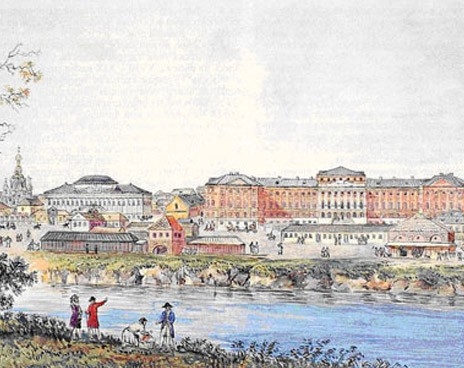
On the watercolors of Matvey Kazakov, dating from 1790, Neglinka is depicted in a natural channel. She was a pure river, fish was caught in it, even navigation was.
But by the end of the 18th century, Neglinnaya began to be polluted. Moscow grew, developed, became more and more people, and they did not really think where to put the slop, they were simply merged into the river. The first project for the arrangement of Neglinka appeared under Catherine II, but then they limited themselves to minimal measures: they simply made an artificial channel, strengthened the boards of the coast, ennobled what can be conditionally called embankments, and the first underground site was made on the tube area.
As you know, the area received its name because of the pipe, but it was a very conditional pipe in the wall of the White City, and through it Neglinka flowed out. And already under Catherine, the square received a real pipe when a small section of the river was removed underground.
Once again, Neglinka was equipped after a fire of 1812. A commission was created to determine the degree of seriousness of destruction, developed a plan to restore the city and reconstruction of Neglinka in particular. Most of the river, approximately from a gravity to the water of the Moscow River, was completely removed underground. Of course, from the point of view of modern hydraulic structures, that first collector was very primitive, wooden. Its detailed description was not preserved, but there is a historical evidence of the period of the 1880s, then Neglink was again planned to reconstruct. The famous journalist, writer Vladimir Gilyarovsky took part in the assessment of her condition. His report was preserved, which was then published:
“The pipe set is quite well preserved, but in some places there are longitudinal cracks, especially large under the theatrical passage and near the Sandunovsky fountain, for 60 fathoms. In some places, the arch is donkey and narrowed the channel. <...> The walls of the canal have a thickness of 4 bricks, and the set - 2 bricks. The floor consists of a double row of boards, embedded along the canal. The walls of the canal lie in their base on three rows of piles, and the floor is strengthened on transverse logs, cut into these piles. The floor was in places in places; Its boards break off the current and clutter up the channel. The height of the canal has not yet been the same. ”
Another passage from the book “Moscow and Muscovites” Gilyarovsky, where Neglinka is devoted to a whole chapter. He inspired me extremely when I first got into the underground world:
“A stench steam fell from the hole. Fedya-water conductor climbed the first; The hole, raw and dirty, was narrow, the staircase stood steeply, his back shuffled against the wall.
There was a squelching of water and a voice, like from a crypt:
- Climb, or something!
I pulled my hunting boots higher, fastened a leather jacket on all the buttons and began to go down. The elbows and shoulders touched the walls of the pipe. My hands had to hold tightly at the dirty steps of the steeply stood staircase, which, however, was supported by the workers who remained upstairs. With each step down, the stench became stronger and stronger. ”
There are beautiful lines-a writer with a worker goes, stumbled upon some objects with his feet, and Fedya says: “I tell you exactly, we walk around people.” Perhaps this is really so, because in the same chapter Gilyarovsky describes how he met people who robbed a certain master and wanted to throw his body into one of the hatches leading to Neglinka.
In 1886-1887, under the leadership of engineer Nikolai Levachev, a major overhaul was carried out. The tunnel was expanded, the walls were plastered, the bottom was deepened and laid out with a white stone. The valves were also installed that allowed the stream of water. This is a serious hydraulic structure, a collector of almost a London level, where people built for centuries, the engineering solution was made almost perfectly.
The collector in the form of a brick pipe built by the formwork method has been preserved so far. But he could not do what not even impurity contributed to, but storm rains, which in Moscow occurred quite often.Flooding in the area of the Neblin River was commonplace. |
After the famous flood of 1908, in 1910-1914, according to the project of engineer Peter Shchekotov, a reservoir of 120 meters long was built next to the Small Theater and the Metropol Hotel. The construction from an engineering point of view deserves the highest praise. His section, form, and how the paths on the sides are arranged, was the top engineering thought of his time.
In 1965, Neglinnaya Street was again flooded with water, and it was decided to build another collector. If the old dudes was located where Neglinka fell into Moscow-River, then the new collector rushed the Kremlin from the eastern side, stretched under the charge and went to the Moscow River. It was built by the shield method. A passing shield is an unit that leaves a finished tunnel. In its head, there is a working mechanism that chooses the soil, followed by the prefabricated elements of the finish, the so -called tubing, they are either concrete or cast -iron. The construction of the collector saved the situation for some time, but the shower continued, he could not cope, so they made another duplicate, from the Durov Theater to Theater Square. It was built by a semi -chisel method and copes with flows to this day.
Presnya and Ceshera - episodic characters of the play
The next hydraulic system, which I will tell you about, is the Presnya River. The source is located in the area of the civilian platform, then it goes through the ponds in the former Petrovsky Park (now it does not exist), along the Moscow Hippodrome and through Presnensky ponds, partially preserved; Presnya flows into Moscow-River. They decided to remove it underground only at the beginning of the 20th century, because the district began to grow, built many factories and factories. The collector is quite simple.
This is how Presny's water is looks like now.
On the right - rudimentary cleaning structures of the Soviet era. This collector only during the construction of the Government House was a little redid, one plot was killed, they made it concrete. But in general, this is a brick pipe, which looks the same throughout its entire length.
Another river system is the Cher - Black -Gorgyazka -Olkhovets in the east of the central part of Moscow. On the map of the Moscow sewage system of 1912, then the word “sewage” had a wider meaning, not only impurity, but also drainage hydraulic structures, there are these rivers. In red, it was noted where underground sections are built, and blue are open. On the right, where is the cascade of Ponds, there is Cher with his drain, on the right, in the area of the pharmacist lane, a stream of Kukui flows into it, and the left of the Black Eggle River is visible to the left of the Razumovsky estate. And, finally, in the left side, - the system is still not fully studied - the source of Olkhovts. Now all this is underground.
To date, the collector of the Ceshera River looks like this: on the right is the river itself, Olkhovets on the left. These rivers are mentioned in sources in connection with the 1934 accident. The Olkhovets stream was assigned on a wooden tray to the side for the construction of a metro foundation pit. Because of the storm, the tray collapsed, the river began to fill the pit, but everyone quickly restored.
“Indoor” experts scare us, they say that underground rivers will emerge from the banks and flood all of Moscow. Before that, it is still far away, but one cannot but admit that the collectors suffered during the reign of Soviet people, although they were originally built at a high engineering level. |
Under the ways of the Kursk Railway there is an unusual section for Moscow, in fact, where the Black Eggy collector crosses the railway tracks. Here, a solution was used for Moscow: not a brick or concrete was used, but a stone, and the shape of the collector is double. Technically, this is due to the need to keep the upper pressure as much as possible, which is enhanced by passing trains. The collector was built at the beginning of the 20th century and from an engineering point of view is of serious interest.