
Translated material
Russia should press on all buttons
Around Russia
 Russia should press on all buttons
October 30, 2013 Alexey Makarkin
It is clear that in fact we are talking about politics, that at the end of the next month, Ukraine should sign an agreement on the association and the creation of a free trade zone with the European Union. It is clear that Russia does not have many pressure tools for Ukraine. And it is clear that one of these tools is already a long -tested, so to speak, “gas weapon”. There was just a meeting of Russian and Ukrainian presidents, and according to the results, it can be assumed that they once again have not agreed. What can this bring to?
I think that the Ukrainian authorities, when she went to such steps to rapprochement with the European Union, had in mind the possibility of nominating such requirements on our part. Therefore, Ukraine has several possible answers, which, in turn, can be combined. Firstly, this is a strategic course towards a significant reduction in gas dependence on Russia. Indeed, the volumes of the purchased gas are already significantly less than they were before and than they are provided under an agreement that was signed under Tymoshenko in 2009. The second point is if Russia requires compliance with this agreement, that is, the purchase of such a amount of gas as Ukraine is no longer needed, Kyiv may threaten an appeal to international courts that can recognize the condition of these agreements with bonded and allowed Ukraine to unilaterally reduce the volume of procurement. There is such an opportunity. Thirdly, Ukraine is now making a fairly large rate on the development of shale gas deposits with the participation of American companies. True, nothing is guaranteed there, the project is rather risky, but there are a chance of success. Fourth, cheaper reverse deliveries from Europe are already being made. That is, Ukrainians seek to diversify gas flows and, apparently, the volume of supplies on this channel will increase. And finally, if Ukraine is in a critical situation, I think that its authorities, as usual, expect that someone will give them a loan, for example, in the same West that is politically interested in Ukraine signing this agreement. This, I think, is also included in the plans of the Ukrainian side-if all of the above will not be enough, then you can grab something else in the West. Therefore, I doubt that these actions of Gazprom will be effective in the political sense.
An important problem here is that when they transfer “pros and against” the agreement with the Customs or European Union, they very often do not take into account such a key concept as trust. The Ukrainian elites experience strong fear of Russia, they do not trust her. At one time, Yanukovych made a large political rate on the well -known agreement “Fleet in exchange for gas”, which was concluded immediately after his victory in the elections in 2010. But then it turned out that the Ukrainian side very much missed this agreement. Because the Russian fleet in Sevastopol remains until 2042, and the discount on the gas that the Ukrainians received in exchange in a very short time was safely “eaten” with a serious increase in prices. As a result, now Ukrainians purchase our gas more expensive than they purchased when this agreement was signed, while they do not have such an argument of pressure on the Russian side as the presence of the fleet in Sevastopol. Here they signed everything.
This agreement turned out to be a great tactical success of Russia, we achieved our fleet at its main military base in the long run, and this was essentially nothing worth it. But in fact, there are not only material assets, material interests, but also such an intangible, but very important concept as trust. And here, apparently, as a result of this whole story, it has gone from the Ukrainian side. It seems that Kyiv frankly believes that Russia then used negotiations with Ukraine for a second time in its interests. The first time was in 2009, when Tymoshenko needed to sign an unprofitable agreement with Russia at all costs, and she signed. And the second time - this, “fleet in exchange for gas”, which was also unprofitable for Ukraine. And for the third time they would not want to experiment. So it seems that the Ukrainians here have already prepared for possible Russian actions, and somehow it will be very difficult to turn their mood.
At one time, “gas diplomacy” was effective until the Ukrainian side was adapted and has provided alternative decisions. We are just used to the fact that in our gas relations with Ukraine the game goes into the same gate. We press, click, click on Ukraine, and it is ultimately forced to retreat, to meet us. But now it turned out that this objectively could not last forever. Anyway, the player that you constantly play is in the end adapts. It’s like in chess, when a losing and weaker enemy studies on his many defeats.
There is a second point - Ukraine in this situation began to really negotiate with Europe. After all, what really always bothered us? Russia very seriously protested against the defense integration of Ukraine into Europe, the entry of Ukraine into the North Atlantic Alliance. Here everything was always serious, in 2008, at the summit in Bucharest, very sharp statements by the Russian president were made in this regard. But at the same time, Russia was quite calm about other integration projects, for example, to the Eastern Partnership. Assuming that they will never be realized, that it is all not serious, this is all nonsense, conversations, signing protocols about intentions that mean nothing. But the Ukrainian and European parties managed to find that format of agreement, which, firstly, will be binding, that is, it is not just a declaration, and secondly, it is beneficial for both participants.
And it turns out that now Russia must press all buttons in order to prevent this outcome. And with a whip, and gingerbread, and Glazyev comes there, and Gazprom threatens, in general, all resources are mobilized. Our power underestimated the Ukrainian integration potential, was not ready for the fact that some formula, an association agreement meaning a free trade zone and in a foreseeable perspective - a visa -free regime. The format that at the same time does not guarantee anything to Ukraine in the sense of joining the European Union. It is clear that many European Union countries are extremely careful about further expansion to the east, especially after the extremely contradictory experience of Bulgaria and Romania. With difficulty and with great problems, after very careful selection, Croatia was accepted. With other applicants, everything is much more complicated. The Association Treaty does not give Ukraine any promises. And at the same time, this agreement includes this country in the sphere of influence and interests of the European Union, through the zone of freedom of trade, through a potential visa -free regime, through a number of other instruments contained in the agreement. Therefore, these factors, that Ukraine adapts itself, and agrees with the European Union bypassing Russia, we can say against the political interests of Russia - this is the reality in which Moscow and Kyiv have now encountered.
It is also important that upon closer examination it turns out that we have practically no serious supporters there. It is clear that the West of Ukraine and the intelligentsia from Kyiv have always looked towards the European Union. But the elites of the East also try to distance themselves as much as possible from Russia in connection with the circumstances that I spoke about. They do not trust us, we are considered too unpredictable and dangerous. As a result, when the question arose of who will promote the ideas of the Customs Union, it turned out that it was either Medvechuk, who was frankly unpopular in Ukraine, or who went to Rada from the “Party of Regions” around the district of Odessa Markov. But Medvechuk is not a serious figure now, and on the example of Markov, Yanukovych showed everyone hesitating and thinking about how to make friends with Russia that it was prohibitively risky. I mean all those who went to parliament with the support of the Party of Regions. Markov’s decision was selected by deputy powers, he was arrested on charges of criminal offenses, and he was accused of involvement in events that were almost in 2007. That is, in this way, President Yanukovych showed that he controls the situation in the “Party of Regions” and will not allow Russia to actively play on its site, and there are no other sites on which Russia can play there.
Author - Deputy Director of the Center for Political Technology
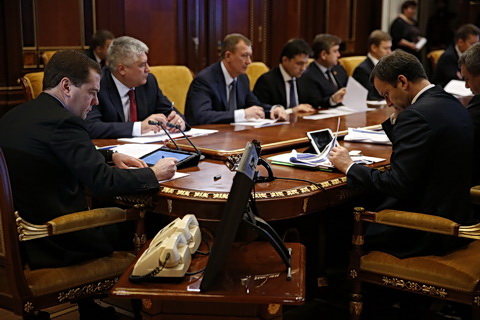
In the photo: Russia. Moscow region. October 29. Russian Prime Minister Dmitry Medvedev, Minister of Internal Affairs of the Russian Federation Vladimir Kolokoltsev (left to right) and Deputy Prime Minister of the Russian Federation Arkady Dvorkovich (right) during the selective meeting "On urgent measures to strengthen payment discipline in the field of natural gas supply", which took place in the Gorki residence.
Photo by ITAR-TASS/ Dmitry Astakhov