Date
Author
Source

Preserved copy
Translated material
Verdict or case (about one interview with D.S. Likhachev)
Historical determinism is especially attracted to those for whom the case is only a mistake of the observer. There is no random in history, they believe: if you look at the world as a deliberate creation, the case still turns out to be a regularity. For us, observing the history of the last decades of Russia, these reasoning are almost devoid of theoretical boring. It is difficult to disagree that in Russian history, including that began after perestroika, there is too much grief, and such that has already happened (and more than once) in Russian expanses. And our disappointment (which - and so it is clear, you should not go into details here) is too easy to explain to some black rock, which, together with owl wings, hovers over Russia and does not give it a room for gaining, I would say, normality, although I understand how subjective this “normality” is subjective.
But I'm talking about something else. I'm talking about determinism. Is there a difference in how religious people look at history, which, it would seem, historical determinism should be close, and non -religious, based only on their knowledge and intelligence? Oddly enough, it is not necessary. That is, it is clear that there are also completely naive observers, who and the tsunami in Japan are a sign of discontent of the Creator, but the level (I don’t even know what - self -awareness, cultural sane, experience, just mind or vigilance) also affects here; What will my story be about.
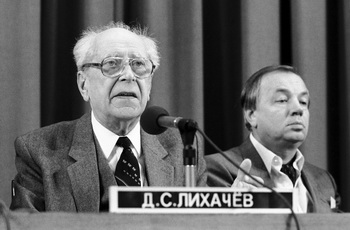
It so happened that I was one of the last to whom Dmitry Sergeyevich Likhachev shortly before his death gave an extensive, lengthy interview. He was weak by age, but completely distinct and, I would say, intellectually adamant, recently coping his 92nd birth. I then worked on the Radio “Freedom” and made a program about the affairs of Bakhtin, Meyer and the younger Dmitry Likhachev, by the way, thundered in camps after a report on the old spelling, which the twenty -eater researcher called “ the violated and distorted by the enemy of the Church of Christ and the Russian people” . It sounds menacingly and almost in the spirit of Shifarevich or late Solzhenitsyn, but you can’t say in the youthful neophyte fuse.
One way or another, Likhachev was convicted and received 5 years of concentration camps, his parents were busy with a reduction in the deadline, naturally, believing him unfair (the boy in the circle of friends read the report on spelling), but the deadline was not reduced, which was actually Likhachev and saved. It turned out that if he had been chopped up to 3 years (which his parents sought), then Likhachev would have landed just at the height of the next campaign against the “enemies of the people” and, undoubtedly, would quickly return to the camp. And so he managed to survive, get into the gap, get lost, count (unlike Shalamov) that the camp was a school of life (like the unique people whom he met there) and even write the first scientific work on card games.
But those who want to read the text of the program will be able to do this themselves, but I want to talk about their last question to Likhachev and what preceded him. And what was not completely included in the program. But first about the historical retrospective. The end of 1998, the economic crisis has just erupted, Putin has already appeared on the horizon, but he is only the director of the FSB. Russia, as they write in bad articles, chooses the future. And after a long conversation about history, about the life of 70 years ago and Likhachev that time I ask the last question: what do you, Dmitry Sergeyevich, think about the historical prospects of Russia? What awaits us, in your opinion? An even greater darkness or joyful dawn? To which Likhachev answers with some young readiness: it may be different. It may be bad. Or maybe not - it all depends on the case. Since the three of us talked, our interlocutor, a believer, is not very, obvious, pleased with this answer, as if Likhachev tells his version, correcting his words: "How will God give, yes, Dmitry Sergeyevich?" To which Likhachev suddenly simply answers: no, God has nothing to do with it. It's all about. “I believe in case, I do not believe in the laws of history as immutable. That is, the laws act, and historical life goes on its own, and sometimes case, accident, and so on bursting there. This cannot fail to see, you must be a very blind person, so as not to see the role of the case. And now a lot can depend on the case. Now it is impossible to predict our future, because it is all illegitimate, there are laws, but history does not pay attention to them. How many cases were, well, at least the fact that I received five years, and not three years that my parents were bothering. If my parents achieved that I would have been given three years, and not five years, I would no longer be, I would have been somewhere in exile, in terrible conditions, I would have undergone a second arrest and so on. Pure case. "
I must say, I was surprised: I was warned in advance that I was careful with the religious feelings of Likhachev, and I myself knew that he was an Orthodox person. Therefore, probably, he expected a completely different answer to his more than on -duty question, although my expectations, rather, the characteristic of me, not Likhachev. One way or another, he replied: a case, nothing predetermined, maybe anything.
Now, 15 years after this interview, we have the opportunity to more clearly imagine this case because it has a name, and you, as they say, know this name. But I want to say about something else: that Likhachev, from the height of his age and his difficultly repeated experience, did not think, as we believe today, that Putin was predetermined. That Russia, humiliated by the failure of perestroika, by the fact that it unexpectedly turned out to be the last in the civilizational queue, was looking for rehabilitation, rehabilitation and found them in the person of Putin, who, as it turned out, was the worst properties of Russian society - envy of the more successful, hatred for the West, xenophobia in relation to strangers, cruelty to the weak, dullness of the Rab. Zoological patriotism.
However, Likhachev did not consider this option a predestination, but believed Putin and his parish (which Likhachev, I must say, found) a game of chance. But what could be different, today we ask ourselves this difficult question? If not Putin, then what? Could there be a revanchist fundamentalist obscurantism, attempts to fencing from the world, supports on the weakest sides of Russian society in the form of its imperial complex and self -embezzlement of nationalism? Could Likhachev were sure; Although our view today, so to speak, is blurred by the rough reality of already accomplished history and perfectionism seems to be inappropriate. As they say banal in such cases, history does not know the subjunctive mood. Although the late Lotman wrote about unfulfilled scenarios of history that they live, are carried out in consciousness even when the story itself chooses another option. So for these 15 years I have no, no, and I will remember the “case of Likhachev”: could he be, could everything turn out differently, could everything be better than it seems today? And, frankly, I don't know the answer.
Photo by Peter Nosov /Photo Chronicle TASS /