
Translated material
Colta.ru
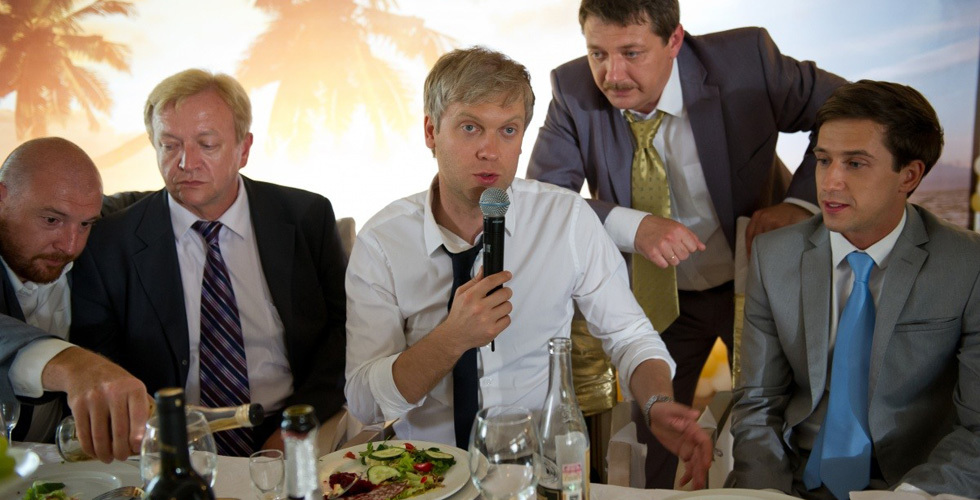
Delicate sunset. The quiet rustle of coastal waves. Candles. One, in the gazebo by the very shore, the mermaid peeps at the horizon. Beautiful and serious, he is already floating towards her in a small boat under a scarlet sail ...
Such and only this was a future wedding. Hoping. I dreamed, Dureha. Even this idiotic plastic tail was trying on (turned out to be heavy). It was necessary to intervene dad and, as always, ruin everything! No sea to you (and it is two steps - after all, Gelendzhik!). No mermaid. No scarlet sail. But everything has already been agreed! Thank you, the guys helped from work (and Natasha does not work somewhere, but "in the gas industry, draws up the contract"). The coastal yacht club at them with Romka is a complete disposal, only pay. But no! Everyone again decided Boris Ivanovich. He says, I’ll do everything, "if only it was not ashamed to look in the eyes." The restaurant "Golden" (in it the head of the city administration, Papin chief, did his birthday!). Instead of the sea - murals. Rings from a pawnshop, a terrible white dress from a wedding salon. Duet "Kapuccino", ensemble of paratroopers "Sineva", Cossack choir. And, of course, a crowd of drunken relatives, where without them! Thank you, even though there will be no gypsies: in return they promise a belly dance ... And the worst thing: she, Natasha, will, according to Boris Ivanovich, will sing with all the song of Grigory Leps “Natalie”! To sing chanson at your own wedding!
What to do? And the dress, and the rings, and the artist Svetlakov discharged from Moscow - all of him, Boris Ivanovich. And you can’t refuse, and agree - the wedding is one! Although why? .. Roma perfectly came up with: we will arrange two weddings! One for the stepfather, the other for yourself. And everyone will be happy. And everything will work out.
It didn't work out. Neither Roma with Natasha (two weddings predictably merged into one, and then the worst thing began). Neither we all. It is easy to notice that in the plot "Bitter!" The whole history of Russia of the last twenty years was reflected - including the only moment of happiness, the flight from one wedding to another.
Not everything came out even with the director of Zhora Kryzhovnikov, who decided to remove the spiritual and funny folk comedy-but in the genre of “Wolf”. No, of course, "bitterly!" - Bright and accurate cinema, the film is exceptional. Its advantages can be listed for a long time and with pleasure (starting from carefully thought -out motivations of characters to the game of absolutely all actors, including even episodic). But why in a crowded hall instead of friendly laughter - tense silence, from time to time the bitterness rolls to the throat, and in the final, if they sob, then not with joy, but from complete despair? Going out into the street, you suddenly notice that from all sides you are surrounded by the same faces of the guests of the wedding chanson and iPhone. Here is a small, but already mustachioed official with his shoulders like Van Damma leaves the official foreign car. Drunk gopniks on Moscow Boulevard tear off their jackets, shirts, T-shirts and yell, tattooed that there is urine in unison with Tamada-Svetlakov: “Ra-a-a-S-Ssia!” Here are a gloomy, before time, who are stubborn and somehow ridiculously painted women strictly look at passers-by, shake their heads and hurry home, to the recently “thrown up” husbands or sons. The desire from horror as soon as possible to get drunk by leaving the cinema; The feeling that you suddenly fell into the film (or he burst out); The desire to run rather, to hell, just not to see all this. Such a power of emotion, such a cruel misanthropy is inspired by the paintings of only one director - the Danes of Danes, infinitely distant from the genre of the comedy of the Danish.
Of course, the similarity of impressions from such different films could be attributed to a simple coincidence or a formal technique - a pseudo -documentary, almost “dogma”, a camera that was shot “bitterly!”. But Kryzhnikov himself does not hide from the journalists at all that Lars von Trier is his favorite director, it was his films (as well as the Manifesto of Dogma 95) that were samples for the director “Bitter!” For the director. And then it becomes clear why not everyone is drawn to laugh at all, looking at the drunken bride of the Romine, who was dancing under the “loneliness-lip”, on the face of Svetlakov’s salad or on the ensemble of the paratroopers of the “blue”.
Pseudodic hyperrealism is good for drama, thriller, horror film, but not for comedies. The best of them are always implausible. Sometimes comical and really arises from recognition, sometimes - from recognition in the not -so -pretty character of the caricature on themselves (so intellectuals make fun of the weak -lecharactic and petty lyrical hero Woody Allen). But what was conceived by Kryzhovnikov and his co -author Aleksey Kazakov as a hypertrophied image, a grotesque, being multiplied by a stylistically impeccable pseudo -amateur survey and an accurate selection of actors, is only a ruthless reflection of reality. The very one, in which two weddings, two parts of Russia have been striving for centuries in different directions for centuries, at best - with contempt ignoring each other, in the worst - converging in the next bacchanalia, which is possible except for riot police, and even then for a short time.
The parallel here is quite conscious (the final scene of reconciliation, where Natasha through the tears draws the song of Leps in the car carrier, was written by Kazakov just at the height of Moscow rallies), the diagnosis is deadly accurate. And the truth: over the past twenty years, it has become clear that it was not going to celebrate separately or together. Perhaps more humane than this forced prolonged cohabitation, there would be an honest divorce that relieves the torment of at least descendants. But no, this should not be; And someday, the daughter of Roma and Natasha, getting married, will burst out in the same way between the imaginary world of her dreams-and a crowd of drunken, stupid, evil, but still relatives, from childhood familiar guests.