
Translated material
14 words about "Russian march"
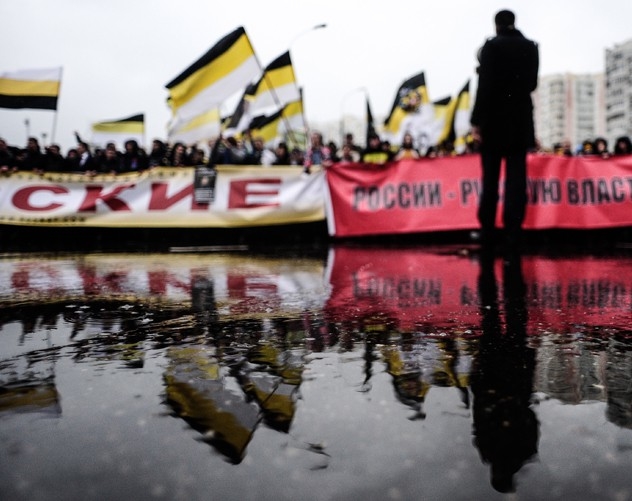
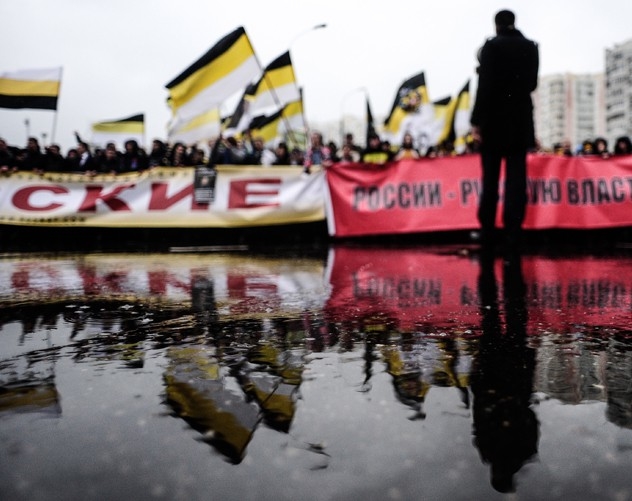
Photo: Sergey Bobylev / ITAR-TASS
The march is the only political tradition associated with the Day of National Unity. The original name is the Right Marsh, in 2005 supporters of several nationalist movements, including the Loyal Kremlin (Eurasian Youth Union, the Russian National Union, etc.) passed the march from the Pure Pond metro station to Slavic Square. Most likely, allowing the first march, the authorities hoped that it would become one of the elements of the quick rooting of the new holiday in the mass consciousness, but the idea of a joint march of different nationalist organizations almost immediately healed its own life, and all the further attempts of the Kremlin or prohibit the march (in 2006, after refusing to agree on the procession, the organizers even offered their supporters to gather in the metro and drive it on the ring line), or to grab it on the ring line) (In 2009 and 2010, parallel to the procession of nationalists, its “Russian marches” took the movement “ours” under the slogans of the friendship of peoples and counteract the “enemies of Russia”) did not affect the main tradition of nationalists in Russia - every year on November 4 to enter the “Russian march”.In 2009, when, after the defeat of the Cherkizovsky market, some of the merchants moved from there to the Moscow shopping center in Lublin, in this Moscow district, clashes of local residents with foreign merchants began. After several thematic protests, which lasted from August to October, the nationalists decided to hold the Russian March in the same area. The mass procession through the streets of the Moscow outskirts seemed successful to the organizers, since then Lublino has been a traditional venue for “Russian marches”.
Nationalism is one of the existing political movements in the world along with liberalism, social democracy and others. Nationalist rhetoric is equally used by all the systemic parties existing in Russia, even Vladimir Putin called himself and Dmitry Medvedev Russian nationalists. In the last elections of the Moscow Mayor, politician Alexei Navalny, who also calling himself a nationalist, gained 27 percent of votes. Russian - titular nation (that is, a nation, the name of which is called the state) in the Russian Federation; people whose representatives, according to various estimates, make up 80 to 85 percent of the population of Russia; The state language of the Russian Federation. At the same time, the word “Russian” is used as a marker for discussions on the topic of nationalism - it is believed that the very use of this term is a sign of the most radical nationalist views, unacceptable in a multinational country that defeated fascism. Consensus - uniting the power and opposition that unites in Russia, according to which nationalism is deadly for the country and its supporters do not have the right to political mission. The power and its propaganda most often pay attention to the fact that Russian nationalism, if not stopped, can lead to the collapse of Russia. The liberal opposition is more afraid of pogroms. Both those and others agree that if honest elections were suddenly held in Russia, nationalists would certainly defeat them, who "we will be the first to hang on the lanterns." Fear is a feeling experienced by part of Russian society in relation to nationalists. The nature of fear is unknown, but most likely, it is he who forces supporters of freedom of speech to demand criminal prosecution for nationalist statements, opponents of Vladimir Putin - to vote against Alexei Navalny, the authorities - to arrange demonstrations of the Minister of the Interior with an illegal taxi driver. In the context of the consensus of power and a significant part of the opposition about the fact that the nationalists have no place in public policy, fear becomes an important domestic political factor that is effectively used by the acting government (“Yes, do we have churov, but do you really want the victories of nationalists in the elections?”). Hypocrisy - probably a mandatory feature of all critics of nationalism and “Russian march” of the Kremlin. In fact, how to avoid hypocrisy to prove that you support the Kremlin in his fight against nationalism, not to mention that you support the Kremlin? As a result, the rhetoric of the liberal critics of the “Russian march” is indistinguishable from the rhetoric of state television channels that criticize rallies in Bolotnaya. The same emphasis on marginals (one person in a bear skin for several thousand demonstrators will certainly fall into all photo reports from the march), the same words about extremism and the inadmissibility of such shares for “decent people”. If in the comments about the “Russian march” the actress Liya Akhedzhakov appeared with the question “Where is our army?”, No one would be surprised-the entire anti-nationalist rhetoric of Russia of the 21st century comes from the beginning of the nineties, when they scared red-brown as they are now scared by nationalists. Navalny - a politician who, having refused to participate in the “Russian march”, immediatelyestablished himself as the most radical nationalist, about which the mayor’s election in 2013 should be regretted immediately. It is considered in a good tone to declare that by his refusal to reach the “Russian march” Navalny buried itself as a politician - while most often the same statements are made by those who buried it earlier. Kolovrat -the name of stylized swastika adopted in radical nationalist circles, as well as the name of a bad rock band, compensating for the quality of his music by the political radicalism of texts. The concert of the Kolovrat group ended in the “Russian March” of 2013. “Imperial flag in your hands. And Kolovrat on the sleeve, ”the observer of Novaya Gazeta, the supporter of Navalny’s supporters, teases . The pogrom is a completely typical phenomenon of street policy in the Central Asian and Transcaucasian republics of the USSR in 1988-1991. The pogroms ended either in the introduction of Soviet troops (Baku, 1990), or a full -fledged war (Nagorny Karabakh, 1988–1992). There were no pogroms in Moscow and areas of the Russian Federation, but rumors that they were about to begin, circulated over the past last years of perestroika: the confidence of the Soviet inhabitants in the fact that the pogroms would be, based on the historical literature on the pogroms in the Russian Empire at the beginning of the 20th century, partly on the aggressive rhetoric of the Society “Memory”, which was considered 25 years ago the most considered the most radical nationalist movement. Many years have passed since then, the forecasts of pogroms have not come true, but many people are still waiting for them, peering with fear at a broken machine with drinks in the Biryulevsky shopping center-maybe this is a pogrom? Blood is that which can spill as a result of the pogrom, as well as the criterion of ethnic its viability according to the version of critics of nationalism. "I have a quarter of Tatar blood, what will you do with me?" - asks the opponent of the nationalist, and his face acquires a triumphant expression, because he knows very well that the nationalist, most likely, will simply have nothing to answer. There are no ethnic blood groups, among the leaders of nationalists there is no one who would seriously talk about “Russian blood”, but this argument will probably sound in any disputes on a national theme for a long time. People - according to Article 3 of the Constitution of the Russian Federation - the only source of power in the country. In practice, the article does not work, and the presidential administration remains the only source of power in Russia. The people are usually called the rally participants in Biryulev - it is assumed that such a source of power will cause fear even with the most convinced supporter of democracy. Most often, the assumption is true - the people and the opposition are equally afraid of the people. Akunin -the pseudonym of the Russian writer and translator Grigory Chkhartishvili, under which action-packed novels have been published since the late 90s of the last century. The writer Akunin is also known as an active participant in rallies in Bolotnaya Square and the sequential critic of the Kremlin. On the eve of the “Russian march” of 2013, Akuninsaid that it was impossible to be at the same time as a liberal and a nationalist, nationalism leads to the pogroms and the collapse of Russia, and participation in the “Russian march” is a sign of security for the political leader. The last thesis, as well as everyone else, was addressed to Alexei Navalny. Biryulyovo is a district in the south of Moscow, which became a symbol of Russian nationalism after unauthorized rallies of the local population provoked by the murder of a local resident. It is customary to contrast the aggressive element of the urban outskirts with the intelligent peaceful protest of the Bolotnaya Square, which is Boris Akunin, - it was this contrast that forced the activist Ilya Gushchin, who has been in prison in the “swamp business” for a year and a half, to say that he is “not a swamp, but a Biryulevets”. However, since no one particularly monitors the fate of those arrested in the “swamp business”, Gushchin’s letter did not affect public opinion. Fascism - according to the popular Comintern definition, terrorist dictatorship of large capital. In the fascist corporate state, all political, economic and power power is concentrated in the hands of a small group of people who are ready to maintain power for any crime. In the fascist state, people are put in prisons for participating in demonstrations and even for statements, the political system is pronounced as a pronounced leadership in nature, and formal state institutions, primarily parliament and courts, perform a decorative function. Unfortunately, in the Soviet Union and post-Soviet Russia, thanks to the works of mass culture about the Second World War, a stereotype about fascism has developed: the Soviet man is sure that the Hitler’s portraits were hanging around in the fascist state and the Gestapo constantly chases someone. In fact, ordinary peaceful people live in a fascist state, like in any other, who go to work and in the cinema, go on vacation, have dinner in restaurants, drink beer, take consumer loans, give birth to children. In the fascist state, you can live calmly and joyfully, and this is at least 140 million living witnesses.