
Translated material
Stop-steady | Colta.ru
The reason for this article was the discussion around the exhibition “The Feminist Pencil - 2” , caused by a small, but noticeable intervention carried out by the artist Alexandra Galkina. The second, markedly expanded, release of the exhibition of women's graphics was organized by the curator-artist Victoria Lomasco and the curator-art of the Plungyan on horizontal principles: artists from different regions were exhibited, whose works were primarily united by social feminist themes. The curators deliberately abandoned the aesthetic selection criteria, trying to “give a voice” to those who, as a rule, have no voice in the institutional artistic system. The exhibition took place at the festival of the Media Activist art festival, and the feminist problems are plots, for the most part related to the detailed, realistic description of the experience of oppressed women-sex workers (work of Victoria Lomasco), women who were subjected to violence (Comic of Masha Ivanova), patients of the female department of the psychiatric hospital (drawings by Yana Smetanina), migrants (street art Ghandi ), etc., was in close neighborhood with the works of the so-called artivism. Conditionally, left -wing trends - anarchism, anti -fascism, neositualism and just civil activism in their “artivian” manifestations - were collected together, being a colorful picture of a certain positive protest activity on the principle of “for everything good against all the bad”.
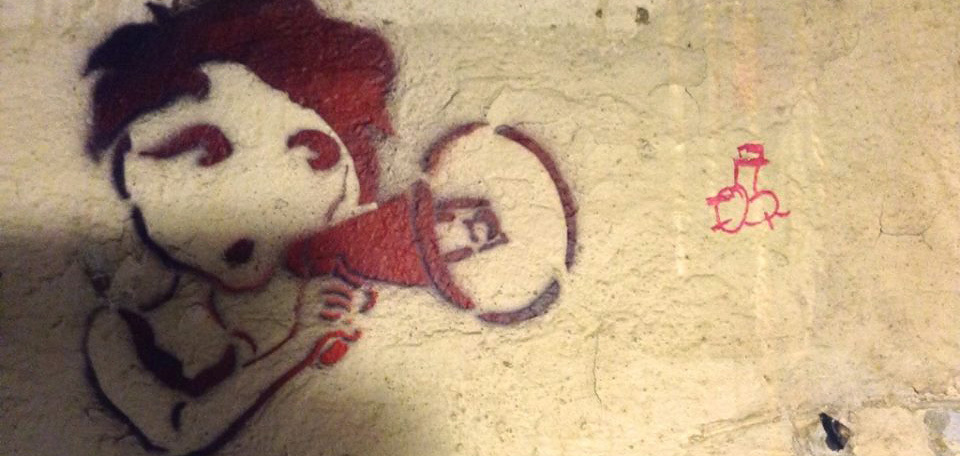
Galkina, an artist, who came out of the circle of the “School of Avangardism” ( 1 , 2 ) Avdeya Ter-Ogagany and Anatoly Osmolovsky, invaded this art festival with her unexpectedly unfriendly statement: next to several works of the “feminist pencil”, she reconnaissance on the wall of the little X ** ki. The gesture, obviously referring to the neo -vanger practices of the Radek group, caused an active discussion in the range from the sharp condemnation of arrogant vandalism to the “successful” artist to the approval of a subversive well -aimed statement.
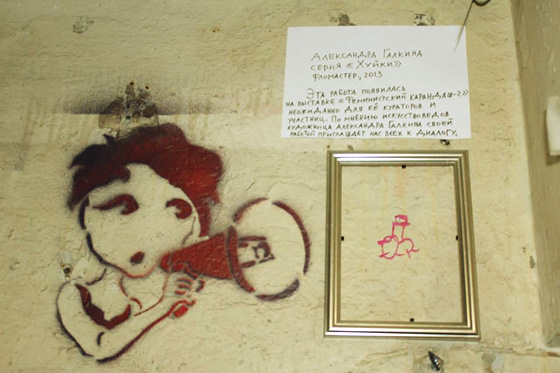 Facebook Victoria Lomasco “X ** K” Alexandra Galkina in a frame and with explication written by the curators of the exhibition “Feminist Pencil-2”
This story could be considered a provocation, which only distracts those to whom the exhibition is addressed from an unconditionally important social agenda put forward by it. But we want to do not so much as critics, affectively occupying one or the other side, how, firstly, to trace the history of one artistic technique, the variation of which was the intervention of Galkina, and, secondly, to mapping the cut of the left artistic currents that function today in Russia. This does not mean that we are eliminated from political judgment, but when it comes to conflict within the environment with common (left) political values, sometimes political meaning is no longer in hasty identification on one of the conflicting parties, but in the analysis of disagreements.
* * *
Artists and curators that will be discussed, converge in their most general premises: they produce critical art, ideologically contrasting themselves with some total of the existing order - be it patriarchy, capitalism or their intersection. But there is a fundamental difference in the positions that they occupy in the institutional system of art production, in what place in their practice theoretical prerequisites occupy, and in how they strive to interact with the consumer of art - what place they prepare him.
“Young” and “left” is heterogeneous and does not exist in a single single -controlled stream: its different components coexist in different registers, and the disagreements born of this multi -registration and overlap can become the most interesting content of this cut.
To understand the contradictions of leftist art, we will use the scheme of three registers - symbolic, imaginary and real - proposed by the French psychoanalyst Jacques Lacan to describe different modalities of the human psyche, which are also involved in collective, social processes, in culture and art. Our goal here is not to give a universal explanation with the help of these registers, not to stand over the material, passing it through a simplifying explanatory scheme, but indicate that dialogs and conflicts often arise between types of critical art acting in different modalities, and that these modality can be tried to reflect and distinguish.
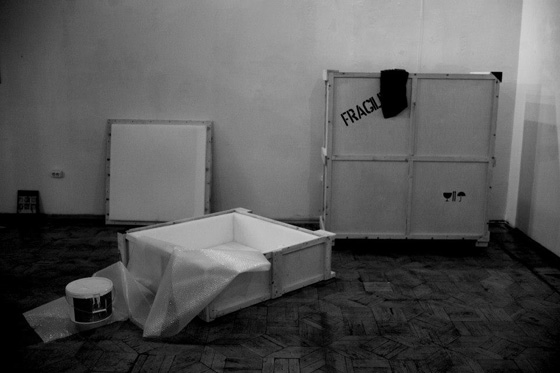 © Sergey Savenkov, Random Gallery Exhibition Arseniy Zhilyaev "Save the Light!"
The political meaning of the statement is not reduced to its literary content, which can be extracted and retold is an understandable thesis of institutional criticism. But it is psychoanalytic tools that sometimes allows you to achieve a special nuance. The conflict that arose between the parasitic gesture of Galkina and the socially responsible narrative approach of the “feminist pencil” can be described as a conflict of art acting in real (Galkina) and imaginary (feminists of “pencil”) registers. The third, symbolic one can add to these two types of art, which is most clearly expressed in the works of Arseny Zhilyaev, whose recent exhibition “Save Light!” It opened in parallel with the “pencil”.
* * *
The intervention on the “pencil” is the next point in the history of the reception, which has developed since 2005 in the works of David Ter-Oganyan and Alexandra Galkina, which they made separately and as co-authors.
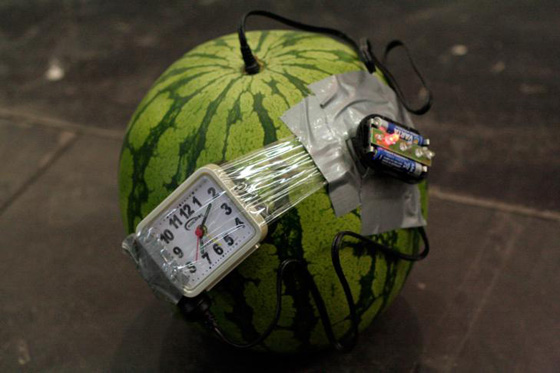 One of the versions of David Ter-Ogaganyan not a Bomb. 2011
The first one can be considered the work of Ter-Oganan-Ml in this series. “This is not a bomb” of 2005: it appeared on the wave of a terrorist phobia, which overwhelmed Moscow after the explosions of 2004 in the subway, which also became a reminder of the earlier series of explosions of residential buildings that occurred before the first term of Putin, as well as on the explosions of September 11, 2001 in New York. Three-liter banks with something uncertain (in subsequent versions of work, objects changed to melon, watermelon and other items.- Ed .), Wrapped in wiring and tape, on the one hand, on the one hand, a witty joke and the most media-sought-after work of the artist. On the other hand, they gave rise to anxiety in the viewer, recalling the feasible fears, about what no one wanted to remember. The terrorist act is that which cannot be explained based on the humanistic ethics. Unimaginable, but irrefutably reliable, which suddenly occurs at any point in time and space. There are no reasons why these random people become its victims. And the anxiety that the viewer arises when meeting with the fake bombs of Ter-Ogagan in the safe space of the gallery is the memory of something always present, that it is impossible to completely explain in the words, nor imagine in the form of a holistic image: this is something and calls Lacan real. At the level of the object, the real one is in the image of the Freudian das ding - “things”, endowed with a special, exceeding all discursive justification with the status. And this, as it seems to us, is an ideal definition for a fake bomb. The viewer takes as a bomb that a bomb can only seem if a person already lives a fear of a terrorist attack as something, which will terribly exposure the inside of the usual one. The everyday life for the viewer by default is comfortable and devoid of surprises, and therefore Ter-Oganyan makes his work an attack on bourgeois calm-he never put bombs outside of art institutions. The pseudo -bomb denotes the limit of humanistic discourse based on bourgeois values. It functions as institutional criticism, pure unproductive negative, based on the law épater le borgeois , and is fundamentally unfriendly to the very bourgeois viewer, whom the artist is witty frightening with a toy bomb, but does it not jokingly.
The political meaning of the statement is not reduced to its literary content, which can be extracted and retold.
On the same principle, the joint work of Ter-Ogaganyan and Galkina of 2006 was “arrested”: at the address indicated in a stylishly reputable invitation to the action, the audience unexpectedly came to the exhibition, but to the police department, where, of course, they were not expected-but in general they were ready to accept. So consumers of art were harshly and cynically put face to face with the border of the art system, with naked state violence, framing all the debugged functioning of modern society. In relation to the cozy existence of art lovers, the work “you are arrested”, as “this is not a bomb”, discovered the proximity of the Lakanovsky real, in this case, a real indifferent law and police lawlessness.
When Galkina painted her “x ** ki” on the “feminist pencil”, she almost correctly reproduced the reception, in her monotonous efficiency that has not changed since 2005-only contexts, that is, discourse, in which he intervened, denoting their boundaries and pointing to the displaced from them.
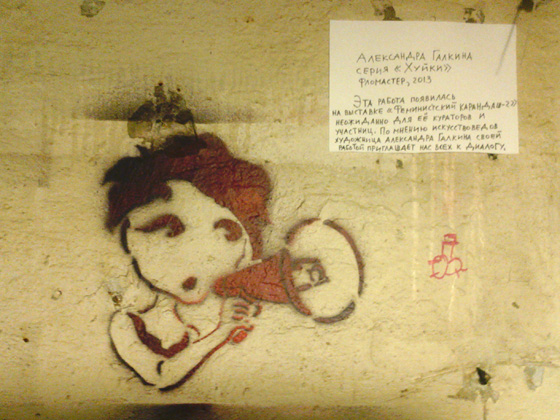 “X ** K” after Alexander Galkin tore off the frame
Many after this intervention condemned Galkin for arrogance, and indeed, their artistic arrogance is obvious in the practitioners practiced by Galkina and Ter-Ogaganyan. They always hold aside and retain the privilege to indicate the shocking real and have the key to discourse, which exposes the inhabitants who have forgotten in the comfort. This elitist position is the sparoded position of the modernist, based on the idea that in art there is something unprincipled, mysterious, elevated, using the tongue of Kant, or the real one, using Lacan jargon: something that is able to generate complex meanings without expressing them directly.
* * *
Until now, artists have turned this technique against the thoughtlessness of artistic being. At the “feminist pencil”, Galkina attacked an art that in itself claims to be critical.
In the described works of Galkina and Ter-Ogagan, there is no positive subject, they are always parasitic-that is, they indicate the limits of someone else's discourse, from which they themselves hold aside. The “feminist pencil” is arranged in the opposite way: in its center there is a positive subject, an oppressed woman who should be released. Artists are identified with her, and it is proposed to be identified with her. There are a lot of “documentary” graphics - and such documentary, as a rule, works precisely on the fuel of empathy, that is, identification with the image of the viewer.
For such structured art, it seems to us appropriate to introduce the Lakanovsky register of the imaginary: this is the level of representation, literally - the image of another person, including the image of a visual - realistic, holistic.
The exhibition selected in this way does an important work: in addition to the fact that it gives a voice oppressed, introduces a certain public agenda, it simultaneously sets the matter so that the viewer is identified with the subject, thrown out by the dominant discourse. Actually, this is how any “left” position is built. At the same time, members of the Moscow feminist group (MFG) are not limited to the deconstruction of fixed binary oppositions of the patriarchal order (male/female, active/passive, etc.). The feminists of this circle clearly outline their identity as opposed to identical to the patriarchal.
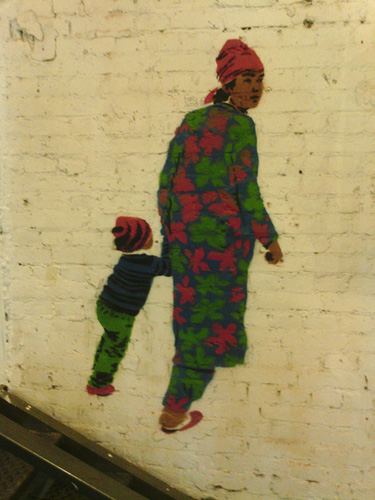 Gandhi's stencil graffiti at the Feminist Pencil-2 exhibition
The problem is that, having closed in the safe space of their exhibition, empathy and nursing themselves turn into a ruling discourse, repressively acting in relation to strangers. This inevitably occurs when you have to fence off your own space in an aggressive environment. But then there is an urgent need for reflection of their own discourse, which is impossible if remained at the level of the Lakanovsky imaginary. Otherwise, the dominance of the imaginary is fraught with a constant reproduction of characterizing the right -wing policy of “their/alien”, the logic of exclusion and “party purges”, when, with the aim of consolidating the core of the community, abstracts are subjected to ideologically close, but still not sufficiently their own.
Sometimes MFG makes antidiscurs in its software tool. And it is precisely to the imaginary level that the requirement voiced by the faith of Akulova, close to the MFG circle, to speak from the first person as a member of a generality, and not on behalf of discursive reasons. According to this logic, in order to speak on behalf of women or LGBT, you yourself must belong to these groups, otherwise you are not marked with the necessary, clearly separated from others and cannot protect the rights of these minorities.
Turning this to the usual art history jargon, one could say this: purely social criticism suddenly came across an institutional criticism.
Galkina's work indicates the implicit boundaries of the ghetto established at the exhibition-although the modality of this instruction is really arrogant, it can be read as a rejection of dialogue and, in a sense, non-discursive. Such is the real attack on the imaginary.
Ultimately, x ** ki is exactly what is replaced from the pencil discourse. Das Ding arises at the very moment when no one expects its appearance, violating the established mechanism of warm empathic identifications, comfortable imaginary relations.
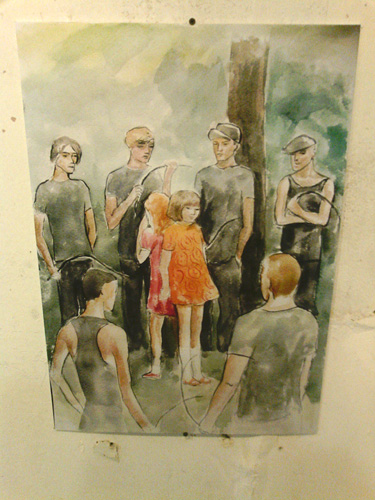 Alina Copeca, “Games”, exhibition “Feminist pencil-2”
Turning this to the usual art history jargon, one could say this: purely social criticism suddenly came across an institutional criticism. An important property of an imaginary register is reproducibility and stability of the images in it. The fact that this second release of the “feminist pencil” is perceived as a more successful precisely because it was second to develop and strengthen the successes of the first is natural for the logic of media activism, because it exists mainly in the imaginary register of repeated identities, and does not into question the space or institutional frame where it manages to be.
This is a well -known idea that it is only worth it - to the limit - to capture the first channel, and the dominant ideology will fall, giving way to a new and fair order. And here the border between contemporary art as a specific reflective, laboratory practice and striving for the tactical effect by media activism passes. Critical art builds its practice as if the utopian capture of the main ideological devices has already occurred - and now you need to think about how not to get into the old traps.
* * *
But what has been said does not mean that critical art always acts on the side of the real and does not try to construct a positive program. Here we move to the third Lakanovsky register-the symbolic register, and if we talk about the Russian stage, then of all artists working at this level, it is difficult to find someone more characteristic than Arseny Zhilyaev. Unlike Galkina, or artists and curators of the “feminist pencil” (it seems for the first and for the latter it is rather an antagonistic figure), he frankly, defiantly discursive. His exhibitions with their complexity resemble program political texts and are built as dry multi -level allegories. The engine of its enterprises is an obsessive desire to create a universal, closed descriptive system, which covers all the total and artistic reality in their interaction - and does this so that all conflicting lines are neatly reduced in it. If in life a politicized artist must constantly resolve the conflict arising between the autonomy of art and political reality, then in the ideal artistic constructions of Zhilyaev each time an attempt to abstract and link in one logical supervision system, which would subordinate the effects of the imaginary and the effects of the real. And it is in this sense that he acts in a symbolic register. The call for solidarization with the Museum of Proletarian Culture (2012, the State Tretyakov Gallery) is clothed by Zhilyaev in the form of assembly from different historical and theoretical references. This type of art, on the one hand (like the artists of the “pencil”), seems to be called to solidarity with the designated subject, and on the other (like Galkina) - seeks to probe the boundaries of the exhibition utterance. And at the same time, he is deprived of the empathy of the first and severity of the second. Zhilyaev’s relationship with theory is also built differently: he does not cut it off, but does not use it “inspired” for expressive design of witty, clever, but unproductive gesture. Instead, he studies it sequentially, then to be reproduced in his solution in his overwhelmed critical hybrid.
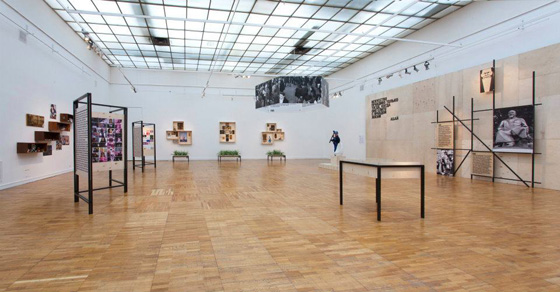 Facebook Gallery "Rigina" Exhibition Arseny Zhilyaev "Museum of Proletarian Culture"
При этом позитивный утопический пафос его проекта, грезящего будущей революцией, как если бы это было дело свершившееся, и посвященного поиску нового политического субъекта, оказывался неотделим от «демиургической» роли художника, который в своих работах наслаждается символической властью над материалом — но эта власть всегда остается властью компилятора.
И в своей последней выставке «Спаси свет!» Жиляев осуществляет рефлексию своего метода и всей художественной системы как автономной машины по производству смыслов, в которой реальное политики может быть дано лишь мистификацией, намеком, зиянием. Он как будто обнаруживает, что подлинно политическое находится не в его сложносочиненной дискурсивной машине, а в ее брешах и что участь художника, действующего в символическом регистре, — подглядывать за политикой из выстроенного им замка.
***
Зачем нам понадобилось увязать все эти разные типы критического искусства, один за счет другого, и заодно всех тех, кто его в текущий момент практикует, с риском навлечь на себя неудовольствие участников этой не без натяжек сконструированной истории? Может показаться, что вся затея была устроена ради того, чтобы, переименовав все на новый лад с помощью некоего потустороннего дискурса, примирить и деполитизировать то, что спорит, сопротивляется и находится в состоянии скрытого или явного антагонизма. Но мы не ввязались бы в это неблагодарное предприятие, если бы не считали, что вопрос о том, как именно эти типы искусства взаимодействуют, — политический.
Ни один из этих типов искусства не заменяет другой, и ни один из них не полноценнее, не точнее остальных. Но каждый из них можно использовать для того, чтобы лучше понять специфику другого, что мы и попытались проделать. Описывая их, мы выхватили их из исторического контекста и в заключение хотим их в него снова поместить. Очищенные от него, они являются не более чем приемами, параллели которым можно обнаруживать в разных точках истории искусства, отечественной и особенно западной, что само по себе лишено смысла. Но эта конкретная их конфигурация и взаимное развитие принципиально историчны, они соответствуют разным волнам и источникам политизации последних полутора десятилетий.
Ни один из этих типов искусства не заменяет другой, и ни один из них не полноценнее, не точнее остальных.
В конце 1990-х — начале 2000-х была еще свежа память о советской идеологической машине и продуцируемых ею ложно-положительных идентичностях, опрокинуть которые долгое время мечтали художники. И потому в 2000-х речи о том, чтобы начать конструирование новой идеологии, среди них не шло. Левое искусство могло существовать только в форме радикального маргинального жеста, изобличающего изнанку жизни. Ему было сложно оформиться в какой-либо позитивный дискурс, призвать к (утопическому) моделированию новых форм жизни или начать рассказывать понятные истории о социальном. Но ситуация изменилась: в 2010-х левый феминистский и марксистский дискурсы все больше интегрировались в культурное производство, с одной стороны, давая место последовательным интеллектуальным построениям, с другой — прямым активистским практикам. Однако эта вторая волна политизации художников не смыла первой: это было бы и странно, поскольку речь идет об авторах одного поколения. Нормализуясь и нормализуя, то есть завоевывая пространство в выставочной и общественной повестке, художники и кураторы, пришедшие в конце 2000-х — начале 2010-х, укрепляясь в своих позициях, рискуют начать воспроизводить свою этику механически, выхолащивая ее содержание. Именно поэтому старый прием, который, казалось бы, был уже не нужен — ведь появилось новое, как будто бы более развитое критическое искусство, — напоминает о том, что такая прямолинейная идея прогресса (от старых приемов к новым) сегодня к области искусства неприменима. Переходя по мере изменения ситуации в другие регистры, искусство не становится более полным. И если оно само не будет помнить о своих границах, то неизбежно найдется кто-то, кто на них укажет.
Авторы благодарят Анастасию Власик и Александра Бронникова за помощь в подготовке статьи.