
Translated material
Alien leader
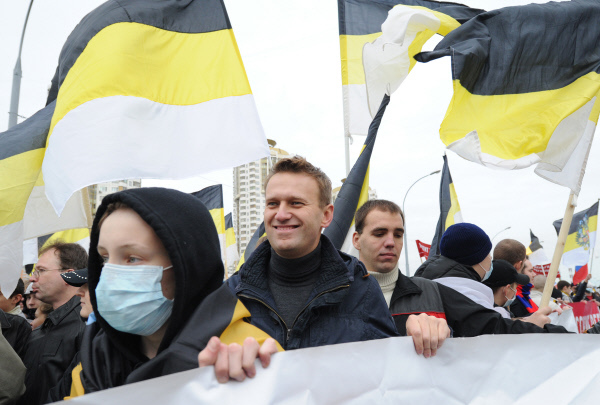
Many intellectuals have a problem with Alexei Navalny. This is their problem, not Navalny.
He is, as it were, “their candidate”, because the liberal and the fighter with corruption, they invested in his promotion - who could: PR in conscience and soul, and not necessarily for money, support, ideas, abilities, abilities, sympathy in a clash with power/courts, votes, finally.
And at the same time, he is not “their candidate”, because he, for example, has his own idea of who the nationalists are, and he does not shy away from them. Without a long excursion into the history of a promising politician, I recall: in 2011, he was the last time at the “Russian march” and participated in the rally under the slogan “Enough to feed the Caucasus”. It is said that when he was first or once again put him in Kutuzka, funny Caucasians handed him food. This, of course, is such a smile about: let it not feed, but we will feed him.
After 2011, Alexei did not go to the Russian March. Last year, he was sick with influenza and did not particularly comment on his absence on the RM, this year was not ill, was not and commented. Everything can be found in his LiveJournal , I will only quote this: “I still support the Russian march as an idea and as an event, I am ready to help officially or somehow ...”
Aleksey, I am sure, did not twist the soul and shared the slogan "Stop feeding the Caucasus." And he does not shout in the soul that supports the “Russian march” as an idea and event. He does not lie, does not encrypt and does not try to be what he is not. This is exactly the same Alexei Navalny, on whom a significant part of the liberal intelligentsia relied on. And it does not seem to me that his choice to support the “Russian march”, but not to go to it is the result of the benign influence of that part of the liberals, which next to him does not refuse to support him under any circumstances. This is the choice of a policy that is suspended by real and future court decisions, and any provocation for him is fraught with complications. And the politics, who reasonably decided that the photographs next to the ziging youths are unprofitable for him. Well, as a politician Putin decided that he was unprofitable to pronounce the name of Navalny.
The liberal intelligentsia really wanted to believe that they found their leader. And this is a leader, but not them.
Where does such a disappointment come from? Navalny did nothing that he did not do before. He could not deceive his expectations, because his views are well known. He believes that if people take to the streets with a nationalist program, then there is a problem and a reason. And yes, it is impossible to ignore these people and the problems that excite them. And it’s better to talk and look for a way out than pogroms. And there are nationalist sentiments not only with us, but also in Europe, where their leaders and candidates are gaining more and more votes. And better the nationalist party, which participates in the elections than spontaneous discontent on the streets. He sees the problem like that, this is his position - was and is.
It seems that the disappointed in Navalny had previously fascinated by someone else. From him all the time they require some words and answers: “Tell us directly, are you going to create an analogue of the Lepenovsky party? Just tell me straight. "
Yes, much more straight. Alexey Navalny is a moderate nationalist. This is the name of his views, which he never refused. And a significant part of its electorate goes to the “Russian March”. (In a bad bunch with the Nazis, therefore, to support the “Russian march” in all its diversity for a serious politician, unpromitable.) If we talk about the French National Front himself, then it is worth noting that Marine Le Pen was distinguished by his own strength from the uncontrollable of his father, who headed the party for many years and in vain dumped the word of Jews. The daughter does not do this, she seriously changes the image of the party to a more restrained, pragmatic, modern and acceptable, or something, for a wider electorate. Hence, including the take -off of the ratings. In Russia, Navalny is able to occupy this niche, which, in my opinion, is and is still free. And this is exactly the electorate that he is capable of by virtue of his own beliefs and the right charisma to lead. Because he does not need to flirt with him. He shares the views of the moderate part of the marching. And it is with this electorate behind Navalny’s back that is promising as a politician.
These intellectuals - purebums, eternal dreamers - remain the only counterweight, without which not to balance the wheel of our history.
That's all that you need to understand. Navalny is not the leader of the "gentlemen of intellectuals" , as one of my colleagues put it. And to be offended by him is stupid. His views are quite stable, he does not need to “rule” him, he did not slip, he was not mistaken. As a politician, he can change accents depending on the situation, listen to different groups, but he is what it is. And so it must be accepted - one. Or not accept - others.
Do not humiliate Navalny with public interrogations. It was not he who tried to deceive someone. It was someone who was glad to be deceived.
The liberal intelligentsia really wanted to believe that they found their leader. And this is a leader, but not them. And in their delusion, Navalny is definitely not to blame. I am sure that he will preserve his fans in this environment, who will somehow agree with himself and combine the love of a fighter with corruption and man courageous in the face of a repressive state with his moderate nationalism. And even more or less clear how you can persuade yourself: "There are nationalists, this is a fact, they did not fall off the moon, which means that we must learn to talk with them, and someone must do it." Is liberalism with nationalism compatible in one person? Until a certain point, this is probably possible. But then you have to make a choice. In fact, it is much more interesting whether the first and second is compatible inside the same electoral group. In my opinion, it is quite difficult. I know people who refuse to trust Navalny because he was liberal. And I know those who will not be able to support him, because the nationalist. These are still different groups of support, and those who are not scared away by nationalism, more. Pure pragmatist makes the policy take this into account.
The same part of the intelligentsia, for which nationalism is unacceptable, will have to form their agenda and put forward his leader. His chances will be much lower than that of Navalny in the event that he managed, say, to create his own moderate nationalist party. Thirty -five percent, as polls show, such a party would have gained, that is, I would go to the Duma with a bang. The natural change of tedious and rather meaningless communists and the LDPR.
And this, by the way, is a significant difference with France, which Navalny recalled. He, as it were, pulled out the national front from the context of its existence in a democratic country, where there are two other leading democratic parties. There, despite the relative success of Marin Le Pen, today both in the 2012 presidential elections and the party received only two places in the National Assembly, while Madame Le Pen itself lost to a socialist in its district. The system in France and in other European countries is balanced much better than a much longer history of free elections. Even in those countries of Europe, where nationalists are lucky than Le Pen in France, there are democratic frames that protect society from too retreating politicians of all directions. We have not built such a system, we have other introductory data, other proportions between political forces, a different structure of the country, a different degree of immunity and other risks. This is what worries the thinking part of society, and one can only rejoice that there are people whom it bothers. Just in France, 80 percent worried, who did not give Pope Le Pen to win in 2002, and so far we have this percentage of electorally insignificant. But this percentage of intellectuals uninteresting from the point of view of political prospects - name them, if you like, puishers, divorced from reality, eternal dreamers - remains the only counterweight, thereby the weight in the wheel of our history, without which this wheel cannot be balanced.