
Translated material
Firstly, it's beautiful
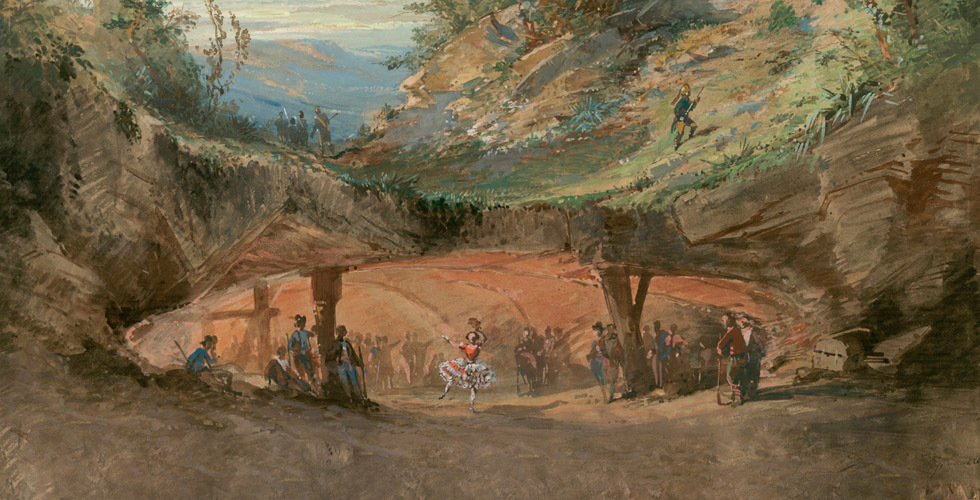
Tomorrow at the Bolshoi Theater begins a series of premiere shows of the ballet Pierre Lakott "Marco Spade." It is clear that universal thoughts, anxiety and aspirations are now associated with one single subject: the appointment of Nikolai Tsiscaridze at the St. Petersburg Academy of Ballet, or rather, by slow extrusion of Tsiscaridze from the Ballet Academy back to good ministerial hands. Nevertheless, life is going on - and Marco Savor cannot be missed. According to the well -known expression, “there are horror what fools and the charm of what fools”, and “Marco of the Spade” - this is just a halite rare, but completely charming.
What is it, in fact, such
This is a new version of the 1982 performance. There will be no doubt that the choreographer will change much, almost everything: that last ballet was composed for the heavy and fading Rudolf Nuriev, and in the big role of the noble robber Marco, the recesses were given to the easy -minded David Holberg. This is first. Secondly, that ballet was placed in the Roman opera, the troupe of a small, dull and provincial, and the current large one is one of the largest ballet players in the world. That is, Pierre Lakott finally got a chance to truly do what he was planning in 1982: a free retelling of the disappeared Parisian performance of the same name, born in 1857.
Who is Pierre Lakott
This French choreographer is sometimes mistakenly called the "restorer" of ballets of the 19th century. Sometimes - a stylizer, which is also not true: his style is his own and quite recognizable. From the ballets of the 19th century, he takes only a libretto - just what was the worst in them. It is impossible to retell the plot “Marco Savor”, it is so weak, confused and says that even such famous artists of the pen as Eugene Skibe, super -successful at one time, did not shy away from hacks.
And Bunin, as you know, scratched his hands to rewrite “how to” the “Anna Karenina” itself. What is pretty in Lakotta is adequate; Tea, not a “sleeping beauty” of Petipa climbs to rearrange, as the impudent and ignorant Soviet choreographers did. The ballet of the XIX century gives him a huge choice: on this segment of the history of summer, he is teeming with deceased performances. Lakott modestly pulls out the little things from her waters pretty, quite mediocre and writes the washed text again with its beautiful (what to say) with French handwriting - clear, dense, small.
Why is he doing it
His case, of course, is still waiting for his psychoanalyst. Lakott runs in the ballets of the 19th century, as some run to Thailand: from the flowering complexity of modern European life. From the responsibility of something to "say by your work." From the debt "have a concept." Moreover, “relevant” and not the same as that of a neighbor. The nonsense of the ballet libretto of the XIX century immediately acquires meaning and value. "Stupid" means better. Lakotta for many years, and he himself saw, as in choreographers-titans burst in his head an iron vein from a constant strangle to give out “conceptual” (at Begra, for example). The ballets of the 19th century demanded only one thing from choreographers: for the ballerina to be satisfied with her solo and that everything ends with a cheerful mass dance. And here, be calm: the entire cordel of the Bolshoi is busy in Marco Decade, and two ballerinas at once (by the way, both are graduates of the Vaganova Ballet Academy, which, you see, worked so badly that only Tsiscaridze was not enough).
Why is this a big
At the moment, very few choreographers live in the world, who can compose dances for a large number of classic dancers, with pointe, variations, and cordeal ensembles. There are fewer such choreographers than pandas and even white tigers. There are almost no them. Trumps with a large number of classic dancers, let's put it too much. But there are more than choreographers, and they need to feed new performances regularly. Most survive a diet from the golden clip of the XIX century (“sleeping” - “swan” - “bayater” - “Don Quixote”), but you will not be fed with canned food. And dancers need to be kept in uniform. And even more: with loaded work (rested, they immediately begin to weave intrigues, this is the law of the genre).
Spectators should be kept in shape too. And in a situation where the soul asks to go somewhere in a new dress from Prada , and “my husband and I have already seen the“ swan lake ”, Pierre Lakott holds out a saving hand. And he drags you to a big performance with a stupid libretto, mass dances, pointe and duel ballerin. Go bad! Come to Bolshoi. See the chandelier, curtain. Drown the ass in a real theater chair. Drink champagne in the buffet. To see people and show yourself in a large foyer. No, of course, on some modern ballet you can also be champagne, and a chandelier, and Prada . It's just that this is not the same (on the modern ballet, in addition, they can be thrown from the stage from the scene, then the naked ass is shown, then the concept of the head of the chlobe - this requires their mood, not to mention the dress). And with a large pointe, well -dented, luxuriously dressed, stupid, but at all stupid things that are not burdened (and how contagious!) All of the above -mentioned performance merges into a harmonious chord.
Sometimes they go to ballet just for pleasure. And the “Marco of the Spade” in Bolshoi is exactly such a case.