
Translated material
Why I'm not Servokin
Inna Denisova: Let me start. The film, according to the creators, was shot "based on" Roman Ivanov, written in the late 90s, when at one time it was replaced by another. In the film version, the action takes place 10 years later, and we see the hero not 28-year-olds, what is Ivanov’s service, but 40 years old, which rather refers us to “flights in a dream and in reality”.
Vasily Koretsky: And to the entire corps of a seven -year cinema about how empty and hopeless life is in the Soviet Union.
Denisova: But the problem of timelessness is replaced in the “geographer” the problem of middle -aged crisis. Plus, the hero inherits the literary tradition - he is like Hamlet, and at the same time “extra man”.
Koretsky: And this is the main question for the film. After all, it is not clear, in relation to which Service is superfluous, that there is one whole that does not let him into himself. In the 1970s, it was clear in the Soviet Union what it was expelled from: from the Soviet team, from the utopia, which was covered-and everyone understands that it was covered. Then there is a disposition typical of Russian culture: a hero who wants to live not by lies cannot be socialized in a society that, as he believes, lives untrue. The nuances of this layout can be different: in the “duck hunt”, we see that this is a oburih, a Chaldean society is not so scary, but in “flights in a dream and in reality” we see that the hero is actually an idiot. In the "Autumn Marathon", everything is good at all. But in the heroes of these films, which, of course, the roads of both Khabensky and the director of Veledinsky, their era is still reflected. The era of stop. And here I do not understand what public agreement the hero refuses to sign. He just sticks out like a nail, and that’s all.
Denisova: Yes, but returning to your words that the hero of Yankovsky was an idiot: in fact, the same reproach is pronounced in the “geographer” in modern terminology. The wife tells Slovekin that he is a loser. A very characteristic word for our time, Ivanov does not have it. And, for example, in “flights in a dream and in reality” several times in relation to the hero the word “bastard” is used.
But still, the fundamental difference between the hero played by Khabensky and the hero Ivanov (and Yankovsky) is that the latter go a way. Ivanov is described in the second part of the book, when the teacher and students go on a hike. Slovikin has a huge internal work, he makes the path from dislike to gain true love ... In fact, there, in the book, a lot of things are happening. During this hood, they pass the church, and there are a lot of sensations of the hero in connection with a visit to the church. They pass the zone ...
At the writer Ivanov, this is all spent in open text: I went a long way for this campaign, during these few days - and in the book he was fixed from point A to point B, and then still meaningful by the hero. Servoikin Ivanova is looking for love in himself, and he finds it. Even the hero of Yankovsky in “flights in a dream and in reality” goes his own way. Like Grebenshchikov: "He went out to go to the beginning, but he drank and fell - that’s the whole fairytale."
But this hero is striking in the fact that here it is not that he himself does not go any way-but even neither the director nor the screenwriter came to mind that the hero should actually move somewhere.
Koretsky: This is phenomenal, of course, that a person with whom nothing happens is an absolutely static figure, made by a hero. Why watch him?
Denis Ruzaev: A static hero, in fact, fits well with one cinematic tradition - into the tradition of “New Hollywood”. There, too, most of the heroes had one important line, the property - inability to act. The hero of the "New Hollywood" was determined by the fact that he did not commit acts, fled from them. But he was obliged to disappear in the final, this is his essence. Like Jack Nicholson in the Five Light plays-he sits down in a trucker cabin and leaves somewhere. And it is clear that this road is into oblivion. The “geographer” would be five times more powerful-with all its shortcomings-if this scene was decided in the finale in the final when he went to the balcony-and suddenly he was not there. "Mom, where is dad?" It is such a finale, it seems to me that it is dictated by the logic of the plot.
By the way, in the film there is still one moment of transformation, the moment when the hero has something turns on in his head. Remember, Servkin with a student in love with him, during the campaign, get to the thresholds and see how the rest of the guys cross them. And so he sits on the ground and says: "How long I have not called my mother."
Denisova: This is a pure quote from “flights in a dream and in reality”! This is not in the book, so the artist Khabensky handed over hello to the artist Yankovsky. Only if a whole motive is connected there, here it is just a phrase without meaning and context.
Ruzaev: And what did Khabensky say to you in an interview, what did he play?
Denisova: He simplifies, it seems to me, just as the director simplifies. He somehow very painfully took my question, what is the tragedy of the hero. He repeated everything: "There is no tragedy ..."
Koretsky: Yes, the point is that there is no tragedy. There is just a constant stasis. And it is not clear what kind of movie we are watching then. Is this a comedy? Is this a melodrama? If there is no tragedy.
Ruzaev: If there is no tragedy of the hero, and the hero is tangibly unhappy, then the world around the hero should be traged.
Denisova: But he, you know, significantly unhappy with phrases from the writer Ivanov. Because the writer Ivanov described the misfortune of his service. Service in the film is not unhappy at all. But sometimes he suddenly pronounces the phrases of another, the book Service, which he - as boots are not his size.
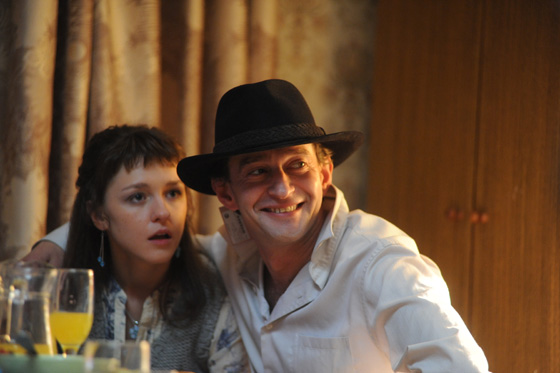
And the viewer finds himself in complete bewilderment, when the hero-play suddenly begins to pronounce book monologues: they do not lie in this drawing, fall out. And, I agree with you, the finale is very important there. Here in “Flights in a dream and in reality” a very cool finale, in the same place Yankovsky dies metaphorically - he literally throws himself with earth, lays in grass. In the book, Slovikin looks from the balcony, and in front of him “the radiant desert of loneliness is spread” - this is the last phrase of the novel. But now try the kinematographically Osil phrase about the "radiant desert of loneliness"!
 © Our cinema
Koretsky: I wonder why, despite everything that we have said here, the audience likes this movie so much?
Ruzaev: It seems to me that it brings comfort ...
Koretsky: That is, the main contingent of the audience of this film is women 40 plus? By the way, you noticed what an important emphasis in the film is placed either by impotence, or the frigidity of Slovekin - as I understand it, is this quality appeared in the film? He does not want anything in every sense. He has no internal throwing, bustle, he is absolutely calm in his decline, insensitive, and comfortable to him. He has no internal unrest, he does not pull anywhere, he does not rush inside. This is like a rebel - a drunkard, but harmless. This is such a character of the film “Twilight” - it seems like a vampire, but does not drink blood, like a womanizer, but does not fuck anyone, and if it fucks, it is selflessly, solely for a woman to be good. It seems to me that this impresses the audience who see in it the perfect type of Russian man. There is such a couple in the Russian mass consciousness - a mother -in -law woman and drinking gouging, Olukh, who needs to be looked after.
Denisova: But in “Flights in a dream and in reality” the hero of Yankovsky is essentially the same.
Koretsky: No! He, unlike the hero of Khabensky, is a dangerous, destructive person, he destroys everything that he touches. This is a person who is able to hurt people around, you can cut about him. And you cannot cut about the hero of Khabensky, he is not capable of any act. This is not Makarov, and this is its ideal. He has everything except this black inside.
Denisova: In an interview with Novaya Gazeta, Velensky says that they created the Prince Myshkin-this, by the way, about Hero-idiot. And the feature that you are talking about is the Myshkinsky line. He loves everyone, he forgives everyone. At the same time, the creators of the film deliberately erase some touching features of Slovekin. In the book, when the class goes on an excursion and everyone is scattering, and Service remains with Masha, he very enthusiastically tells her about what really excites him. He says: "I have an attitude to the rivers as women." And in the film, Masha tells him: "What are you, Victor ... Yes, you yourself are not interested." That is, all the good, for some reason they deliberately clean the fullness of the hero. One of the touching moments of the book turns into the fact that this is just some kind of teacher-in-house, who himself is not interested in anything.
Koretsky: So he is in the film an absolute teacher-in-house from the very beginning. Maybe this is such a deliberate sabotage against the intelligentsia?
Denisova: I also wanted to say that I was surprised by the choice of book replicas of the hero. The screenwriters had a very fertile material, because they did not need to come up with dialogs: Ivanov’s abundance of all kinds of jokes and sayings, and this helps a lot of the entertainment of the film. The audience laughs, very funny, really. But at the same time, Ivanov has exactly the same number of very serious statements, the character endlessly reveals himself, constantly articulates his states, well, this is how this idea of a modern saint. He says: “I would like such absolute love that I would not be the key to anyone happiness and my happiness to be no one.” And this phrase meets the misunderstanding of the hall. Organic to the book hero, she is unnatural Slovekin, whom we see on the screen. The viewer really does not understand - what was it? Why does the clown, cattle and infantile egoist philosophize?
 © Our cinema
Koretsky: Well, because the authors of the film clearly wanted to save the hero from a constant internal monologue.
Denisova: Yes, they do not load him at all, so that the viewer does not overwork, God forbid. Well, why? Let him joke further. He succeeds in this tragicomic irony.
Koretsky: It’s not that the hero was simplified here, he looks simply exaggerated, a parody.
Denisova: In the book of the hero, a rich dictionary and erudition, he speaks with phrases: “They attacked me as the first equestrian on the blue -worships ...” The hero of the film does not leave such phrases, obviously, regretting the spectator who will say: what, in kind, are noble?
Koretsky: That is, it turns out that the film was shot from the point of view of the students of Service? Is the target audience a mass of mediocrity that they hate it? That is, we see the story of this hero through the eyes of the Devochnik from the back desk.
In general, I am very interested in this issue with the target audience. I am not quite clear who can associate himself with this hero.
Ruzaev: When I looked, I tried to calculate how many years Servicin. It seems to me that he has no forty yet.
Denisova: Well, how much Khabensky, so much. And in the book Soldykin 28.
Ruzaev: But he does not fit into any age, he does not look like either 32-year-old or 40-year-old. This is a person between generations.
Denisova: I think they were afraid to screw up here. They were afraid to shoot the 90s so that they were still cluttered for inaccuracy. Because it is very easy to screw up, in fact. And so there are a lot of problems, still go to the historical era, so it was easier for them. But, in my opinion, this can be forgiven if you explain this time today, except for the position of this Budkin, who ... Who is he playing, Kapkova plays, Perm Kapkov? In addition to these inscriptions “Happiness is not around the corner” and other iPhones of students.
Ruzaev: Yes, only signs of time, but without a spirit of time.
Koretsky: As a result, the hero of the same era was placed in another - and while he was shoved there, the whole texture was squeezed out of it, the whole skin got off, and just a stamp remained. There were jokes, Okudzhavka remained, roughly speaking, but nothing is worth it. We cannot now listen to Vizbor and Okudzhava as contemporaries listened to them. Now all this looks comical, because these songs today are deprived of the socio-cultural aura on which they relied and which they themselves created. They do not cause nostalgia, because behind them are not our memories, but strangers - parents, for example. Also, Servkin in the film is a memory of something that was, but the memory, obviously, is not directorial, but strangers, and therefore only external gestures are reproduced, and then inaccurately.
 © Our cinema
Denisova: But after all, Danila Bagrov, the hero of his time, was also a stamp man, a hero-formula, but he was so whole!
Koretsky: Danila Bagrov is ambivalent, he is a character that very different people can easily project their experiences. Apparently, there was approximately the same calculation: this lack of clear positions and motivations suggested that Slovikin would also serve as a vessel that each viewer himself would fill with his experiences or memories. But the problem is that instead of serving as a kind of gutta -percha form that everyone is wrinkling for himself, it turned out to be a vessel ringing the void. And somehow I do not want to fill it at all. You can’t put yourself there, because you immediately stumble about something, as a result, some kind of cast is moving along the screen, a golem-he walks, breathes, everything is fine, but he has nothing inside him.
Denisova: And once again: Ivanov has the whole introduction of the hero formulated, you can read everything that he thinks, the internal monologues are all articulated. Or the hero of Yankovsky in the film Balayan-he does the same, but with cinematic means ... Remember the main episode of the film when Yankovsky takes a tarzanka, turns and just looks from under his hand, looks so that everything sinks inside. A person does nothing, just his gaze - this is all his distorted, unhappy life. You understand what the scale of the tragedy here is. And in the "Geograph", in general, there is not a single episode that would try to somehow explain this hero.
At the same time, the film begins promisingly: an unfortunate person enters the carriage of the train and sings Kipelov’s song “I am free”. This is a very good move, it works. Kipelov is a dude from the Soviet era, on the one hand, and on the other, he wrote this song at a turning point, this song sounded when someone else could take it seriously, and it is still singing in Karaoke in the provinces, and they sing in trains. That is, it is such a song that combined three eras. This is a good moment in the film. And then, if we talk about music, then this singer Pelagia with Russian folk songs ... This is inconvenient, you directly experience a painful sense of awkwardness for the Russian folk song. Still, the “steppe and steppe around” sang.
Koretsky: And when the heroes have fun under the “Vladimir Central” - is it convenient?
Ruzaev: But there the whole scene is designed to cause disgust.
Denisova: “Vladimir Central” is for the same purpose that Pushkin, who is always read by his women, Service, for the same purpose, with whom an interested teacher is turned into a teacher who does not need anything. This is a deliberate reduction in the image of the character.
Koretsky: To some extent, there is even harmony here in all this. The hero is such a lumpen-intelgent, and the film is such a lumpen arthouse. There is a lumpenization of everything: language, expressive means, hero. At the same time, despite this peculiar integrity, you simply make you from the fact that there is no poetics in the film. That is, there is a unity of artistic means and a hero, but in fact there is not poetics. This is some kind of hellish world of the singer of the circle and Vaengi ...
Ruzaev: No, you are wrong now! The world of the singer of the circle and Elena Vaengi is not just not devoid of poetics - she is even with excess. I have no aesthetic complaints about chanson or such music, but she tears me too much, I can’t listen to her (laugh) . If the film "Geographer drank" was the same ...
Koretsky: Nevertheless, this film is obviously spectator, I am sure that there will be hellish Andlages ... Or maybe this is a matter of Khabensky? Maybe Khabensky is really capable of gathering the halls?
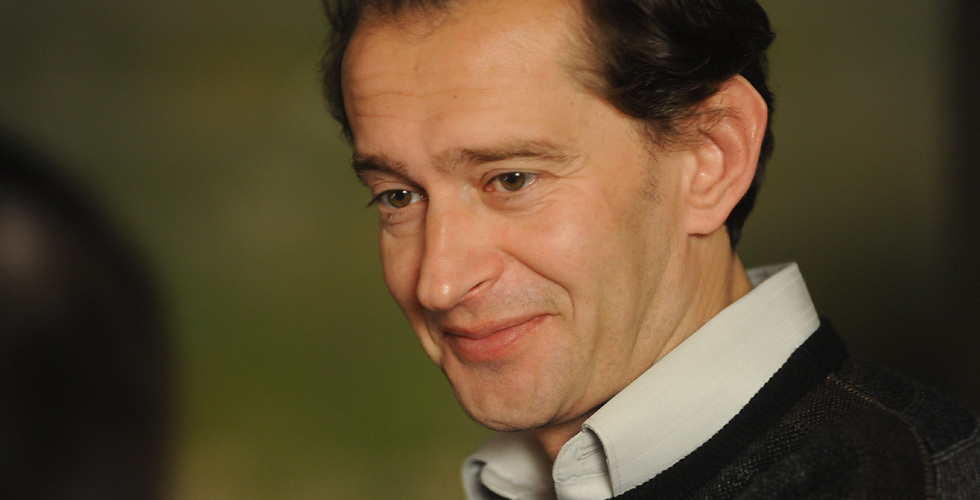
Denisova: Khabensky is certainly very charming.