
Translated material
Reform on demand
Another concept of restructuring the law enforcement system
By order of the Committee of Civil Initiatives Alexei Kudrin, experts of the Right Management Institute (IPP) at the European University of St. Petersburg have developed a concept for law enforcement reform 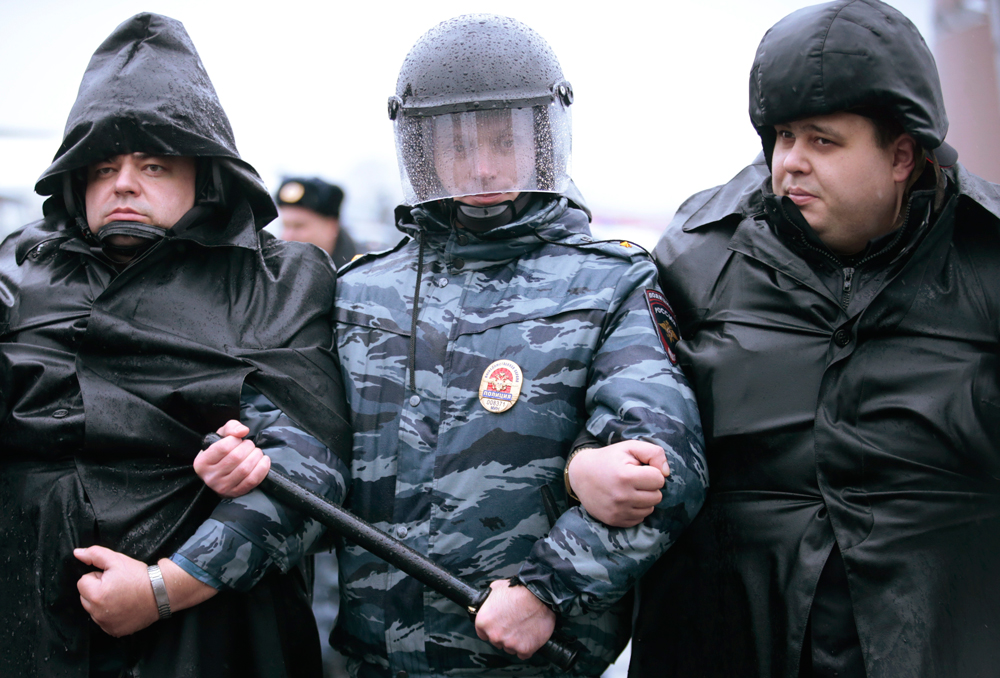
The first reaction of police officers, to whom the developers of the Concept of Complex Organizational and Management Reform of Law Enforcement Agencies showed this document, was a rejection. “No one will ever do it anyway,” they said. “And then we told them: imagine that it does not depend on you, but it has already done it inside. How will it work? And after some time we heard from them: I don’t know what will come of it, but it may be interesting. ” The author of these words, one of the developers of the concept, Maria Shklyaruk, herself worked for more than ten years as an operative, investigator, deputy head of the investigation department in the city of Sosnovy Bor of the Leningrad Region. After a month of work on the document, she said to herself: “I can imagine how this system functions in my area.”
Three levels of new police
The concept of reform proposes to create a three -level police: federal, regional and municipal with a clear distinction between functions. Municipalities are engaged in public order, prevention of crimes and registration of offenses, which they then transfer to the investigation up. The regional police investigate the low and average gravity of the crime, protects the buildings of regional authorities, regulates the road traffic in the territory of the subject of the Federation. The jurisdiction of federal police officers is investigated by serious and especially serious crimes, the fight against organized crime and terrorism. FSKN and SK are abolished as individual departments, investigators of the UK make up the backbone of the federal police, drug police are part of the Federal Police and the police of the region.
The municipal police will be accountable for local authorities - whether it be the mayor or municipal meeting of deputies, the regional - the governor or the Legislative Assembly of the region, the federal to the president. At the same time, the federal police units at the regional level will not lead the regional police, and those, in turn, will have representative offices at the local level, but will not be the heads of the municipal police.
The concept deprives the new police of non -core functions: the issuance of licenses for security and detective activities is transferred to the Ministry of Justice, internal troops are transferred to the Ministry of Defense, the driver’s license will issue civil offices. The developers of the concept explain the abolition of the OEP by the fact that "the damage caused by the" struggle "with economic crimes exceeds the damage that is caused by such crime." The functions of the OEP will go to the Federal Police and the Federal Service for the Investigation of Official Crimes - if there is a statement by the victim. If the state considers himself to be the victims, the counting chamber, Rosfinmonitoring, the Federal Tax Service and Rosfinnadzor will be engaged.
But two new units independent of the system of the Ministry of Internal Affairs will appear: the Federal Service for the Investigation of Official Crimes and the Criminal Statistics Agency. The first will deal with the fight against corruption and other crimes within the system and will obey - as an option - to parliament. The second will lead its statistics, based on an improved system of indicators. The investigator and the prosecutor is given the right to error: the case closed by the investigator’s decision will not be guilty if he did not violate the law during the investigation. As well as the matter lost in court, it will not be considered a shortage of the prosecutor, unless, of course, he ruined him, collecting unacceptable evidence. 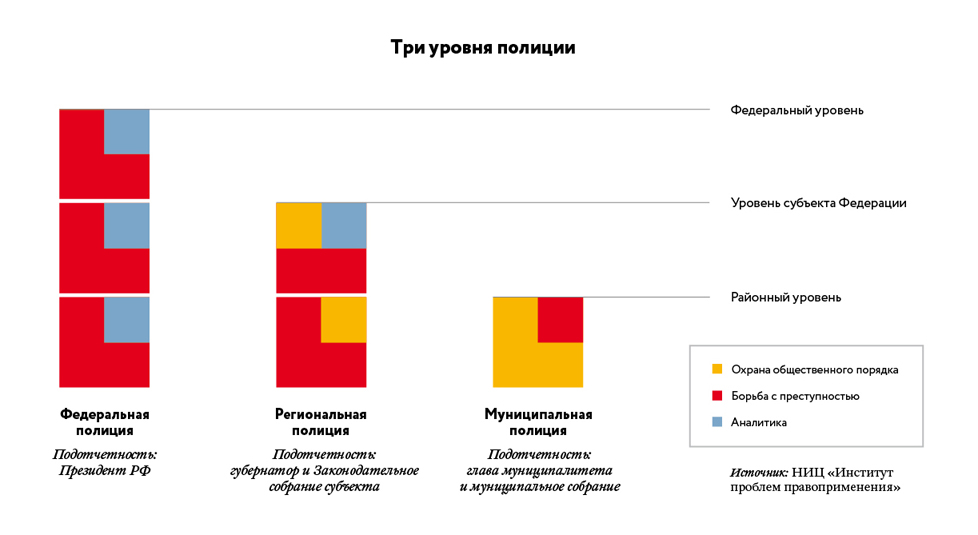
The Ministry of Internal Affairs is obliged to resist
The reaction of the former and existing police officers with whom the New Times correspondent spoke to the theses of the concept is different, although Shklyaruk is right: at first everyone says that no one will realize anything now. “What the police share is good and correct,” said Roman Khabarov, a former district police officer from Voronezh. - As for the personnel, that is, the formal reasons for all take out to the staff and recruit, and if it is as with certification, you will get the same garbage. And one more thing: I would still choose district police officers. Let the municipal police obey the mayor, but the district police officer can say: people were elected. ”
“We must, of course, leave the possibility of investigating crimes at the local level,” says Yuri Pakhotin, a district police officer from Verkhnyaya Pyshma, who recently responsible for the interethnic conflict in Sagre. -It will not work differently: the district police officer knows people, knows who can commit a crime, and helps to disclose. And a stranger will come to whom I conveyed what he registered: with whom he will communicate, how? "
“The investigator has a“ termination of the case ”stick is a bad stick. If it is removed - on the one hand, it will be good, says lawyer Vadim Kobzev, the former investigator for especially important cases of the corruption crime investigation department. “And on the other hand, they will take more money for termination.”
The Ministry of the Interior knows about the concept - they themselves requested the text. “Officially, they did not say anything, they simply asked to familiarize themselves,” says Vadim Volkov, the project manager managers, the project developers project. - Well, unofficially ... I can’t say. We have no illusions: in its current structure, the Ministry of Internal Affairs is obliged to resist this concept. They are still not ready for organizational and structural changes, they are only ready to increase control, discipline and financing: this is their standard position. ” "

"We have no illusions: in its current structure, the Ministry of Internal Affairs is obliged to resist this concept"
“The concept can only be implemented from the outside, the developers say, immediately adding that the definition of the responsible for reform is a political issue and not in their competence. In addition, a number of related reforms are required to carry out the intended reorganization: budget, tax, amendments to the Criminal Code and the Code of Criminal Procedure. And of course, the ideas of which at the Institute of Law Problems also work, its basic provisions are also working, its main provisions They can be represented by society in a few months.
“It doesn’t matter if there will be an attempt to immediately implement this project, two other things are important. Firstly, we show that there is no hopeless situation, there are understandable, simple, technological things that can be done right now, and do without ruin everything, says one of the authors of the concept, sociologist Ella Paneyei. -The second: all the same, someday the moment will come when the law enforcement agencies will have to be put in order, and it is good that at that moment there is some kind of plan. This is much better than at the moment of sharp changes to write reform on the knee. ”
Political moment
Experts of the European University in cooperation with the Moscow Foundation Indem began work in mid -2012, in the wake of mass rallies of protest. As the project manager Vadim Volkov said, it was a counter movement: “We accumulated materials on the topic, but the request came from the Committee of Civil Initiatives Kudrin.” By that time, the experts of the institute were known for their reports on the topic that they made in the context of the preparation of Medvedev reform. “Then we were asked to express our opinion, but nothing of our opinion was taken into account,” Volkov recalls. “Now the position is this: while Alexei Leonidovich (Kudrin) has a pause in a political career, while he is engaged in civil initiatives, it would be logical to attract expert powers and make a project in case the political situation changes.” The political situation since mid -2012 has changed, albeit not as it seemed at the peak of protest activity. But new factors appeared: the events in Biryulev once again showed that dissatisfaction with the work of the police and its inability to respond to criminal challenges are fraught with pogroms.
Vadim Volkov does not exclude that everything can happen earlier than it seems. “A few more crises like Biryulyovo - and the program will become a public fact that they will begin to take seriously. Yes, I believe in the pressure of society. "
Photos: Tatyana Makeeva/Reuters