
Translated material
But we make rockets
Museum of the USSR in the homeland of Lenin: a project without a concept
Last week, the national project “The USSR Museum in Ulyanovsk” was presented in Moscow. What image of the Soviet Union is going to create in the homeland of Vladimir Lenin and how much it corresponds to historical realities - the New Times found out
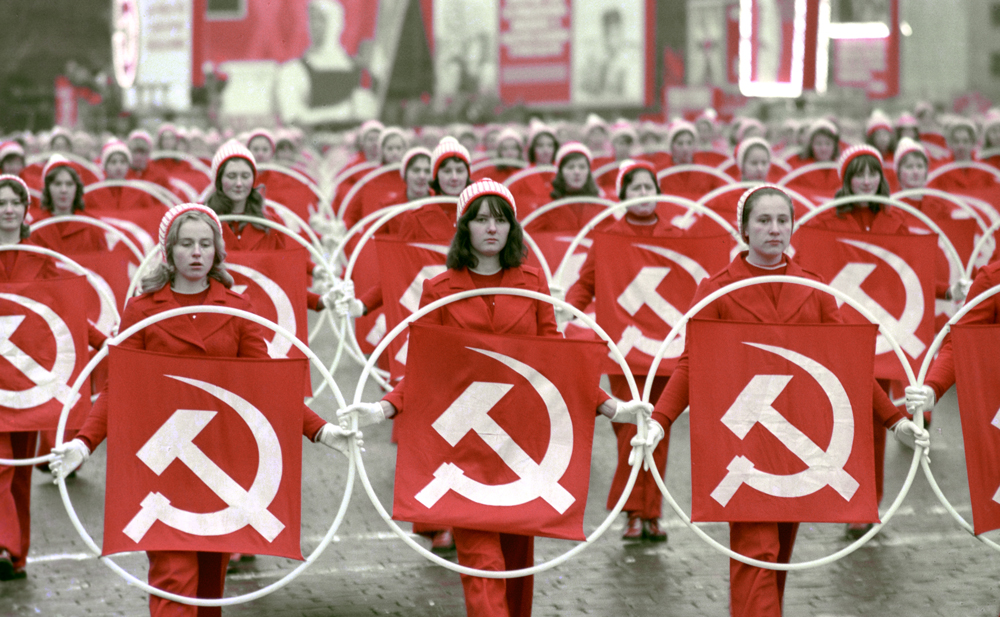
The celebration of the 58th anniversary of the Great October Socialist Revolution. Moscow, November 7, 1975
“We slide in the USSR at the level of some symbolic things. Here is the Soviet anthem, for example, Lenin in the Mausoleum, and these conversations are endless about the restoration of the monument to Dzerzhinsky - these are all symbolic things, ”says the sociologist and museum expert Anatoly Golubovsky. - And I have a serious suspicion that the USSR Museum in Ulyanovsk will also be a museum of symbolic values that need to be falling to be saturated with the energy that supposedly existed when we were all uniform, indivisible and there were no interethnic problems ... "
Stakhanov pace
The authors of the project are accurately experiencing a certain weakness for symbols, at least symbolic dates. The idea of the USSR Museum as a national project was announced in Ulyanovsk at the end of December 2012, on the eve of the 90th anniversary of the formation of the Union. April 25, 2013, shortly after the 143rd birthday of Ulyanov-Lenin, Governor Sergei Morozov presented the project at a meeting of the regional parliament. On June 12, on the Day of Russia, in Ulyanovsk, they presented the urban planning concept of the “Cultural and Tourist Cluser of the USSR Museum”, developed by local architect Oleg Vladimirov: a territory of 120 hectares, two dozen industry museums, a grocery store of “Gastrona” and the Friendship Park of Peoples. Finally, the presentation in Moscow was arranged on November 7, thereby closing the symbolic ring of commemorative dates.
The Ulyanovsk museums and their other weakness are not particularly hidden - to money from the federal budget. As the project was developed, its estimated cost grew up directly by the Stakhanov pace. It began all a year ago with a relatively modest figure of 2 billion rubles. In April 2013, Sergei Lakovsky, director of the Ulyanovsk Regional Resource Center for Tourism Development (head developer), already spoke about the amounts comparable to expenses on the Universiade in Kazan (42 billion rubles) and the celebration of the 450th anniversary of the entry of Chuvashia in Russia (25 billion). And in early October, a new estimate appeared - 61 billion rubles, including 33.5 billion from the federal and regional budgets.
"
"A person must leave the museum with a sense of pride in the past of his country"
"
True, the Ulyanovites are no longer responsible for the last numbers: this is the result of a financial and economic examination conducted by specialists of the Higher School of Economics (HSE) by order of the Ulyanovsk regional administration. As part of this study, both financial and investment and purely business aspects of the future museum complex were studied. In particular, as Ilya Kuzminov, director of the Center for Territorial and City Planning of the HSE, explained The New Times, experts were interested in the state of the tourism industry and the service sector in the region, historical prerequisites for the development of a new project and the possibility of “structuring a tourist product”. The conclusions came out for a sight for sore eyes: the payback of the project over ten years, an increase in tourist flow from the current 200 thousand to 1 million people a year and 4 billion rubles of net profit annually.
However, experts in the field of museum business are not so optimistic.
“I believe that the USSR Museum in this form is an erroneous decision. In order for the museum to work on the city, it should be someone, there must be people who consider this museum their own, ”says the galleryman and art manager Marat Gelman. “But for this, people should be given some look ahead, and then everything is built on the past.” This can work in Venice, for example, but in Ulyanovsk it does not work. ”
According to Gelman, he proposed another idea - to make the Museum of Cinema on the basis of the Lenin Memorial, where the materials of the USSR era would take their place: “For actors, directors, producers, this museum would become their own. There is a place of application of forces: after filming, the museum is given scenery and costumes, master classes come there, that is, life begins around this museum. ” But the Ulyanovtsev did not carry this idea. As for the Museum of the USSR, he, according to Gelman, is already: “This is Ulyanovsk himself, who has phantom pains and ambitions of the federal city. Indeed, in Soviet times, albeit on one day on April 22, he actually became the capital of the USSR. ”
A steam locomotive or life
 |
| The project manager Sergei Lakovsky believes in the bright future of the USSR Museum. November 7, 2013 |
The fact that the Ulyanovsk people want to quench their nostalgia for the former greatness due to the federal budget is their local problems. But the development of the ideological concept of the USSR Museum could well become the task of an all -Russian scale. What is the "Soviet style"? What image of the USSR should visit the visitors of this museum? What, in the end, could be the main idea of the whole exposition? Convincing answers to these questions would be interesting to hear many Russians.
However, for some reason, its authors are in no hurry to develop this side of the project. “Yes, there is no historical and ideological concept of the USSR Museum yet,” admits Sergei Lakovsky, who, incidentally, at the Moscow presentation on November 7, was not at all in advance as the “frontman of the project”. - But we are in the homeland of Lenin and we must take an example from Lenin. He made a revolution, too, without a concept developed to the end, also far from everything was clear. ”
At the same time, people who officially have not involved in the project, but ardently supporting him, have some ideas. For example, the deputy director of the Lenin Memorial Valery Perfilov defines the main idea of the future exposition as a “museum of the Great Idea”, the USSR represents in the image of a steam locomotive flying into a bright future and proposes to form the historical consciousness of visitors on the basis of extremely positive events: “A person must leave the museum with a sense of pride in the past of his country.” And Alexander Dugin, the philosopher, the Eurasian and a member of the Izborsk Club of Political Sciences, which carries out the ideological support of the project, promotes the idea of the “museum of two myths” and suggests for clarity to place exhibits on two floors: “At the top is a positive myth, as enthusiasts have seen the story. On the lower floor there is a “red terror”, a gulag, dissidents ... It's like on icons: on top - heaven, from below - hell. ”
Those who do not experience their ideas about the image of the USSR and those who do not experience special pride in the future by the steam locomotive. Say, politician and historian, HSE professor Vladimir Ryzhkov characterizes the Soviet style as “imperial, communist, very boring and very frozen”, highlighting as the main Soviet line “boredom and gray”. And the art critic and curator of the famous exhibition “Forbidden Art” Andrei Erofeev defines the through idea of Soviet history as “the militaristic culture of the despotic suppression of man”.
“This will be another attempt by the apologetics of the Soviet past -“ Svinar and Shepherd ”or“ Kuban Cossacks ”
"
At the same time, many experts believe that the history of the USSR is too complicated and diverse to isolate some single “Soviet style” in it. Within the framework of “socialist realism”, the architect Eugene Ass recalls, a certain unity was: for example, architecture was “national in form and socialist in content”. But even in it there were completely different styles and trends-it is enough to compare the Stalinist skyscrapers of Moscow with the new Arbat, which, according to Assa, is “some kind of different story that it would probably be better not to remember.”
“The existence of the state for 70 years is such a complex thing that it is impossible to describe this idea,” the art critic and culturalist Vladimir Paperny is sure. - If we look at the architecture of constructivism and high Stalinism, then we will see that these are just different biological creatures, there is nothing in common between them. And many historians spoke of the Lenin Revolution and the Stalinist counterrevolution: what Stalin did was direct destruction of everything that Lenin did. ”
The conclusion about the impossibility of creating a single image of the USSR and sociologists agree. “The Soviet Union is a certain abstraction that we are now building and which will be built in this hypothetical museum,” explains Boris Dubin, former head of the Levada Center socio-political research department. - Because the Soviet Union of the 1930 model is one, the 1960 model is another, 1990 is the third, and there were also a lot of changes between them. As Yuri Levada said, the history of the twentieth century in Russia moved by short dashes and long traditions do not exist here: there were several very strong fractures inside these 70 years. ”
Bargaining is appropriate
The development of a common idea for the USSR Museum clearly interferes with the lack of consent on many key issues of domestic history.
“The country is split in relation to its own history, everything is too politicized, the bunch between the historical approach and the current ideology is too direct and strong,” says historian and TV presenter Nikolai Svanidze. “Therefore, now there is no need to wait for historical objectivity at all - neither at the level of the Ulyanovsk Museum, nor at the level of the history textbook, nor at the level of a state approach to history in general.”
True, objectivity in a museum business, as his experts are recognized, is a very subjective concept. “Every exhibition and every museum is always someone's statement,” Paperny explains. - There is no such abstract concept of "it really was." There is no “actually” at all - there are points of view, interpretation. Therefore, for the exhibition, it is not enough to collect some objects-this will not have any value. Value will arise only if there is someone’s look, someone's concept and someone's analysis. ”
Since the authors of the Ulyanovsk project have not yet done such an analysis, The New Times invited experts to formulate their own concept of the USSR Museum.
Andrei Erofeev believes that the USSR should be considered as "deviation that has generated completely special forms of material and spiritual artistic culture." Accordingly, in the artistic part of the exposition, in his opinion, only “official Soviet art, the so -called socialist realism, its modifications and variations, its metastases,” which “are directly related to Soviet context and outside this context, are meaningless”. After all, let's say, Kazimir Malevich "It is not necessary to have any revolutionary songs, marches or tank columns to have a background-but the director Sergey Gerasimov needs it, otherwise his films do not represent any value at all."
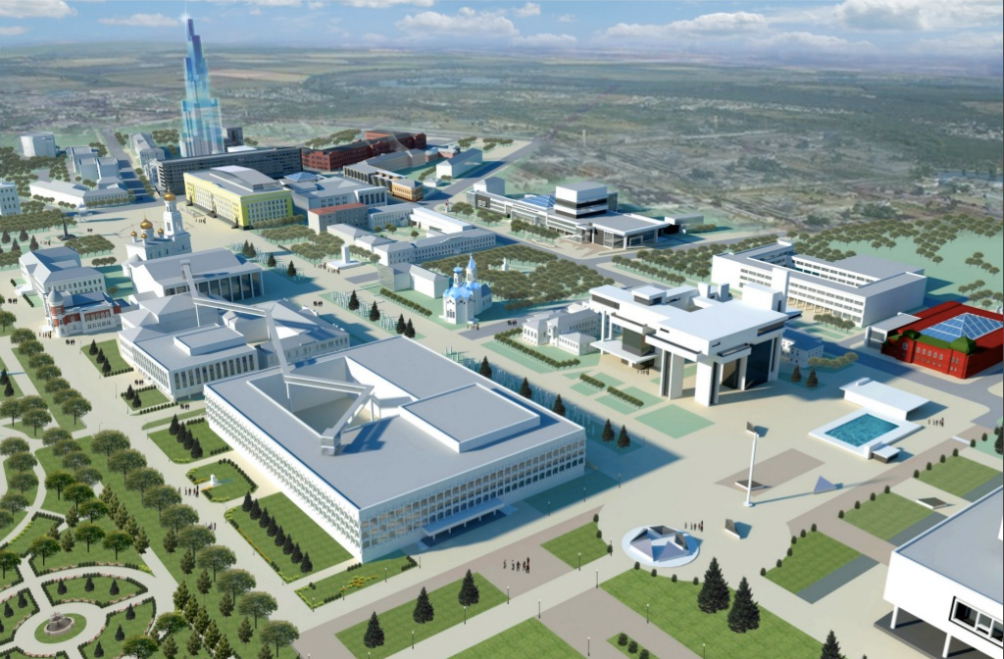
This will look like in 2022 The Cultural and Tourist Closure of the “Museum of the USSR”. Slide from the presentation of the project on the website of the Museum-SSSR.rf
The chairman of the board of the international memorial, historian Arseniy Roginsky offers a different approach: visitors to the USSR Museum should form a “complex memory”, which consists “not only of what we should be proud of, but also from what we should be ashamed.” After all, "a great story is a shameful story at the same time."
Vladimir Paperny believes that the conflict of historical interpretations can be shown through the conflict of expositions: so that “different pavilions or rooms in this museum completely contradict each other when a person sees some room that is built on one interpretation, and then moves to another-and sees something directly opposite.” And Anatoly Golubovsky is confident that the “nerve and conceptual rod” of any project related to the awareness of Soviet experience should become the antithesis “Contrary to or thanks”: “The greatness of Russia is that all its achievements occurred contrary to power-state pressure. And the guardians believe that these achievements were thanks to the state. Therefore, I am not opposed to appreciate these achievements - you just need to clearly represent, contrary to them or thanks. ”
Finally, the concept of the museum could be built on the basis of the image of the USSR that has developed in the minds of most Russians. VTsIOM, and then the Levada Center examined the phenomenon of Homo Soveticus for almost 25 years. True, Boris Dubin, who was one of the leaders of this project, believes that such a museum concept is akin to "the average temperature in the hospital, including cooled." But the sociologist nevertheless agreed to simulate such a “People’s Museum of the USSR” specifically for The New Times.
So, the central place in the exposition should be occupied by victory in the Great Patriotic War and the flight into space of Yuri Gagarin. At the same time, the average Russian does not want to know about the price that I had to pay for the victory. You can talk about repressions and collectivization, but something like this: well, yes, all this was, but did not stop the victorious act of a powerful power. Brezhnev time should be given in the brightest colors. “It is reminded and painted so that it is a paradise of history,” explains Dubin. Although personally, the dear Leonid Ilyich does not cause particularly positive feelings. Well, the 90s, starting with Gorbachev and Yeltsin, is, of course, one continuous black color.
“This is a Soviet picture of history, and strongly shifted by the 70s-the beginning of the 80s,” the sociologist summarizes. “Because it is precisely this time, firstly, it seems the most“ pink ”, and secondly, it seems relatively real-unlike the 30s, when most of the current population was not in the bud.”
The past is returning
However, almost all independent experts are sure that no complex concepts are needed by the authors of the project and everything will be much easier. “I suspect that this will be another attempt by the apologetics of the Soviet past instead of its reasonable and sober assessment. In general, such a “pig and shepherd” or “Kuban Cossacks,” says Eugene Ass. “The Ulyanovsk leadership wants to make the Sugar and chocolate museum of the USSR, where they will show how it was good, how equality was, how everything was free and how the Yenisei was blocked,” Nikolai Svanidze agrees.
True, another question arises in this situation: is it possible to create a museum at all that the past is not yet? After all, well-recognized signs of Soviet life appear in modern Russia more and more, which means that the USSR is still “more lively than all the living”, and not in the Leninsky figurative, but in the very literal sense.
The museum workers have the answer to this question is unequivocal. “The museum is what has somehow left our lives,” explains Anatoly Golubovsky. “And if it does not leave or returns, then it is pointless and premature to museum in it.”
However, the authors of the project “Museum of the USSR”, carefully following the general line of the Kremlin, apparently think differently.
Photos: Yuri Abramochkin/RIA Novosti, Artem Sizov