
Translated material
It is difficult without our help of history
An amnesty is a way for the authorities to get out of an unconditionally idiotic position, not too losing his face. But can she use it?
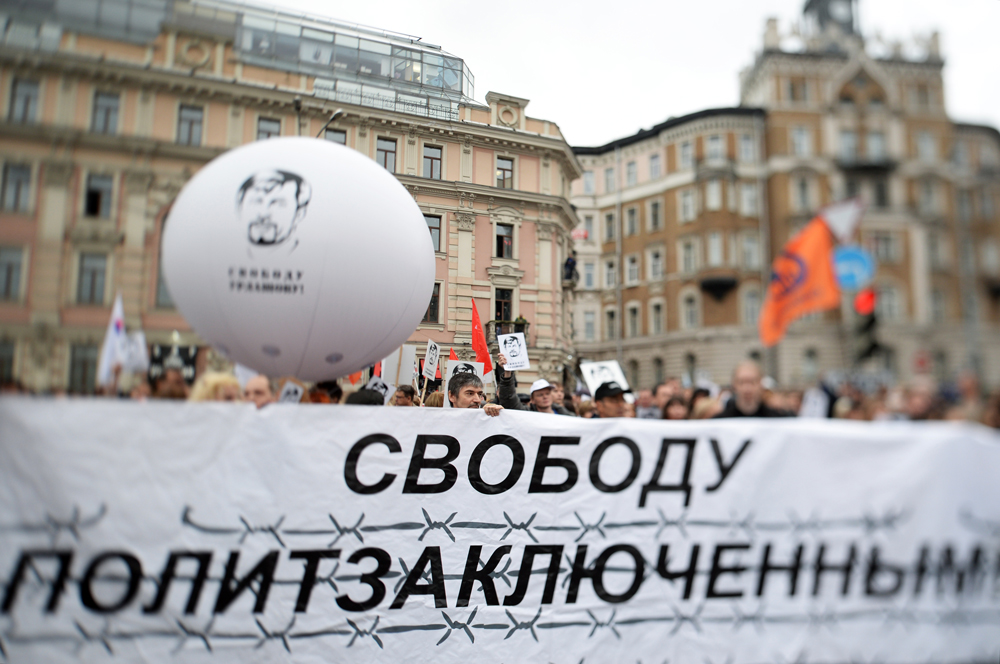
Participants in the procession in support of political prisoners. Moscow, Boulevard Ring, October 27, 2013
They call, call. They call from different periodicals, from some radio channels and ask more or less. “We,” they say, “we know that you have signed a letter, appeal, petition in defense of those and these.” "Well, yes, I say, signed." - "And tell me, why did you do this?"
A strange question. So simple that you don’t even know how to answer so that it doesn’t work out completely lapidarously. No, it does not work out non -lapidarously. What can you really say? That I subscribe to all these documents, because I want to at least help the beautiful girls Masha and Nadia, the teacher Farber, environmental activists from Greenpis, the Swamp prisoners, the defendants in Kirovles, all the rest who were detained, judged, have already been dried by the ridiculous, unquenchable logic of the normal person of the accusations?
Well, yes. So I answer. And I also answer in the spirit that in our country to punish, condemn, dry and plant, alas, significantly more than those who want to intercede, regret, sympathize. And in this case, the need to join the minority works at the level of the reflex.
And I also say that when I read about the progress of trials or from time to time I visit the court hearings, I am not left by the feeling of a painful sleep in which you are not able to move my hand in order to drive a fly crawling around your face.
The second question is also quite expected. About whether I believe in a positive result. Oh, and this question is definitely not easy.
Today they also called and asked about amnesty.
Why signed? Why did you record a video on this topic? Because it seems to me, and not only to me, that this amnesty, if the decision on it is made, would not only give the opportunity to be released to all the already navigable people, but also allowed the authorities to be appropriately out of the unconditionally idiotic situation, not too losing her face too much. We already know that they are not to blame for anything. But “they” do not recognize this, but people will still be released. And it seems to everyone good.
Do I believe that this amnesty will still be? And if it will, will it affect politically motivated processes? Honestly? To be honest, not very.
No, I'm afraid that they will not want to not lose their face. They, as it seems to them, will live well without a face. They will live with the fact that they have long been instead of a face. And in general - the matter is not in the person, but in compliance with the kids.
"
Each time in the depths of the sober seemingly consciousness lurks a small “what if”. And I am not ashamed of this naivety
"
In the register of their kids virtues, no mercy is affected by God. And they do not know what it is. This, as it seems to them, is something from children's books. And they do not play the rank in the tracks. They are serious, clear, concrete, unwinding people. State people, what.
They know only two mental states - either “bent” or “bent”. Either humiliate or humiliate. Any concessions, any manifestation of goodwill, any will to compromise in their boy categories, is usually indicated by the expressive word “sink”.
To show at least some mercy means to bend, bend, give in, lose. Close, in short.
It is unknown to them that condescension to other people's weaknesses or nonsense, that mercy to the fallen is a sign of calm power. But they are weak, that's the matter. They are not confident in themselves, in their own legitimacy, that they are in their own, and not in a foreign place. And after all, they are not true of this.
Their game is not a chess game. In chess sometimes they go back, sometimes sideways, sometimes a horse, sometimes diagonally. Their heads do not turn, they know how to walk only forward, even if they go towards their own disaster. And this disaster will certainly come, because no one has managed to deceive history yet. And to be honest, their inevitable disaster does not upset me very much - they themselves chose their way. But at the same time, I firmly know that if I live before the trial of them, I will again sign different letters and petitions, calling for justice, for law, for mercy. They can count on this firmly.
However, their disaster is their disaster. And today I don’t care about them. I am about the fact that so far, in prisons, in prisons, zones, and psychiatric hospitals, innocent people are contained-their fate excites me quite real.
Do I expect when I sign what I sign, or when I write my own texts, for a specific success? Rather, no, I don’t count. But I continue to do this, risking, along with other subscription colleagues, to seem ridiculous. It seems funny - okay, this is not a problem. And this is not the main thing.
And the main thing is that every time in the depths of the sober seemingly consciousness lurks small, almost inaudible and almost invisible to the eyes of “what if”. And I am not ashamed of this naivety. Not only because without hope or at least without its simulation, life becomes almost unbearable. But the point is that the truth is-what if ...
Once, in the 60-70s in the dissident environment, it was customary to raise a toast during friendly feasts "for the success of our hopeless work." This paradox was not such a paradox, because everyone internally understood that there were no completely hopeless things. Even court cases.
Let us believe that our aggregate efforts and efforts of each of us are fixed not only, more precisely, not so much on success as on history, which, of course, is an omnipotent lady, but without our help it is difficult.
Photo: Ilya Palev/RIA Novosti