Date
Author
Шекспировский сезон Алексея Бартошевича
Source

Preserved copy
Translated material
Chaos picture
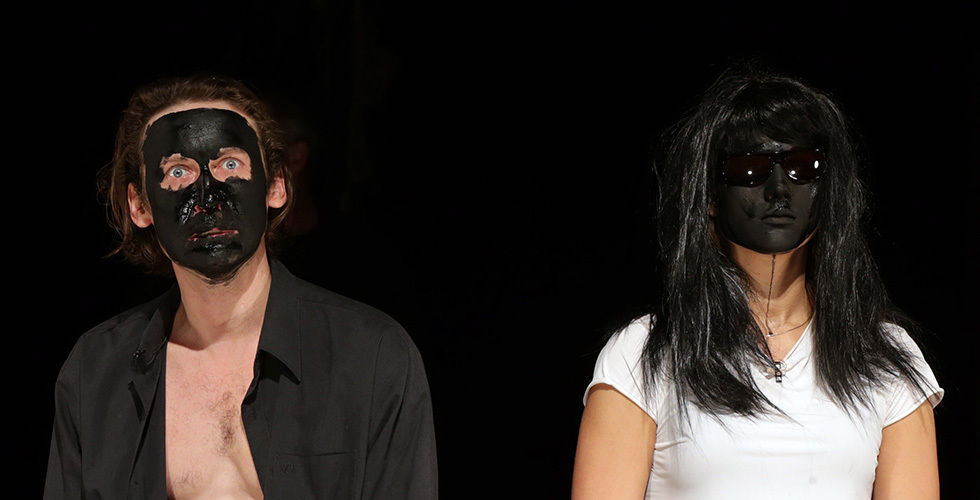
The premiere of Shakespearean “Othello” in the capital's “satyricon” predictably became one of the most discussed events in the Moscow Theater Autumn. At the request of Colta.ru, Yuri Butusova, the country's chief Shakespeare, shared his opinion, the berry of domestic theater studies Alexei Bartoshevich shared his opinion.
This is not a review - let theatrical observers write (and have already written ) reviews - but rather a brief commentary on the general meaning of the production of Yuri Butusov - like me, this meaning, understood.
In Shakespeare's work on the Tragedy of Othello, it has long been noticed that in this play, any of its main characters not only exists on its own, what it is, but at the same time lives in many mirror reflections, composed of how others perceive it. These reflections rarely converge, since each at each moment sees the other differently. The character in its unity is created not only by its immanent essence; It also grows out of the totality of views and reflections, judgments and visions of other characters. Or is not created when the concept of the whole, like the very idea of a dramatic nature, is perceived as imagination. In the play, the unity of characters is more likely to form, in the play by Butusov - rather not. And this is not a mistake, but a conscious choice of the director. We do not know which of the desadnam is real: a golden -haired doll, like two drops of water similar to Barbie; The imperious lady of the Great Light, who treats Moor contemptuously-firing; Sexually preoccupied beauty, ready at any moment to surrender to the one who wants it, and her romance with Moor is nothing more than a minute erotic whim (which, by the way, directly says: “When she is fed up, she will need another”); Or, finally, a frightened girl in the scene of death.
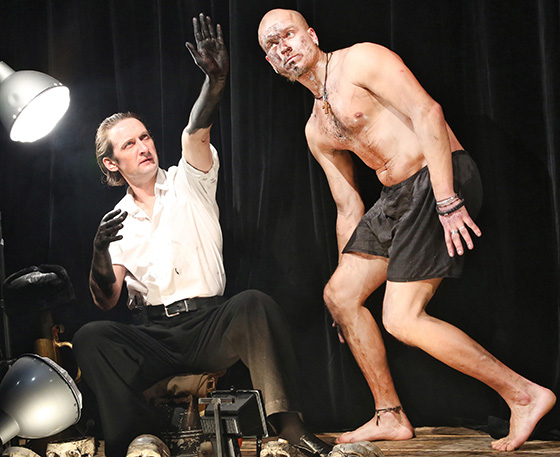 © Mikhail Gutherman / Kommersant
The same - with Emilia. Who is she is the faithful friend of her mistress or the one who, without hesitation, betrays her to please her husband for a minute: there is no answer, by the way, there is no in the play. Where is the truth, which of the Emilia or Desdemon is the true, neither the heroes of the tragedy, nor to us, its viewers, are given to know. Iago sees his wife Emilia, a lustful female who was sleeping with Moor, but he is unlikely to have at least some reason for this.
However, the line between reality and painful dreams in the world of the performance is extremely fragile. In the play “The Lieutenant of His Mauritanism” he himself invents a nonexistent connection of his wife with Othello in order to retroactively justify his intrigue, here he really seems to be cheating: we see with our own eyes an erotic scene between Emilia and Mavra. It is clear that this scene exists only in the inflamed imagination of Iago. But we are witnessed his hallucinations, which in the theater means: all this was actually. The theater is by its very nature - isn't it a factory of illusions dressed in the blood and flesh (what is said in another play by the same author: “Imagination gives invisible things and abode and shape”)? To failure, filled with complexes of male inferiority and therefore torn apart by hatred for the whole female family, he only expects treason from Emilia to make sure that all women are animals, and the whole world is no better, and immediately convince the boss, and this becomes an impetus to the whole intrigue.
However, the word “intrigue” is not very suitable for this: after all, he wants to open his eyes to the general to what he is really convinced of. Othello believes him almost immediately. It seems that he has long and well knows what betrayal is, and waits for him in advance, almost himself is glitting him. The reason is not that, they say, "I am black." On the contrary, only believing the slander, he becomes black: the actor on the stage smears his face with black paint, and this is the color of death. This moment is preceded by a long painful silence when Othello takes a firm step towards non -existence.
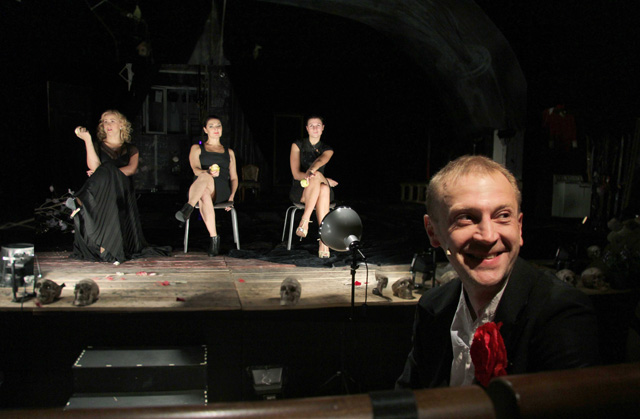 © "Satyricon"
What is actually more than real in the performance and that in the end tells him (the performance, and not to the world) inner wholeness - this is the spiritual and physical suffering of the heroes - both Othello and Yago (remarkably the strong work of Denis Sukhanov and Timofei Tribuntsev) who fell into a trap of universal heartlessness. They now and then are lying down, the earth goes under them with a stilt, there is nothing to rely on: everything they touch, begins to immediately crawl at the seams, crumble to dust, plunge into black fog. They with a painful aimlessness are wandered among the world flea markets reigning on the stage or a warehouse of cluttering the scumbags of unnecessary things-all these empty boxes, dusty ficuses, old suitcases, abandoned furniture and other dumps of dirty civilization, among the deafening noise of cabaret music, which must be shouted so that you need to be heard at least somehow, among all things, among all, at least it is heard. This provincial Cyprus mess with seductively wriggling girls, that is, among the Universe, who turned into a garbage dump or, expressing himself, more appropriate for the tragedy, a language plunged into chaos.
(It is impossible, however, not to notice that the picture of chaos in the directing of Butusov and in the scenography of A. Shishkin could be somewhat less chaotic.)
In the program, the director offers his translation of the author’s name: not “amazing with a spear”, but “oscillating spear”. There is no place to argue about the reliability of the translation, but since Butusov prefers this word, it means that he needs it for some reason. Let us leave aside the Freudian associations associated with the word "spear". Let's say about another and more significant - about the meaning of the word “oscillating”, which determines a lot in the philosophy of the performance, where people are immersed in the world of universal uncertainty, where all the concepts and all the boundaries are blurred, that is, the same funny and terrible postmodern world in which we all live. However, and this, perhaps, is the whole thing - the director does not receive masochistic pleasure from being in world aimlessness, but hates her, is tired of her to death. Therefore, on the stage, the postmodern grotesque is not lightly cynical and comfortable in the illegal space, and the tragedy is a rare guest on modern stage.