
Translated material
Construction on bones

In the city of Korolev, a house is destroyed, which could become a museum. Candidate of Art History, senior researcher at the State Institute of Art of Plungyan and candidate of architecture, senior researcher at theory of theory and history of architecture and urban planning, director of the Center for Vanguard at the Jewish Museum Alexander Selivanov, visited the queen and tried to understand the situation.
On the morning of November 8, the next arson took place in the city of Korolev, Moscow Region, and at night the first stage of the illegal demolition of the house number 34/2 on Ordzhonikidze Street, one of the world's first houses, was known to historians as the house of Stroyburo (architects A.Ya. Langman and L.Z. Cyrikover), was launched. The house of Stroyburo is included in the impressive constructivist ensemble of the Bolshevskaya labor commune (1928-1935), almost completely preserved to this day.
The territory of the commune in the mid-1930s was an interesting complex , which today gives a complete picture of the early-Soviet socio-pedagogical experiment of the organization of collective life. It included a kitchen factory, a hospital complex, a shopping center (“house-ship”), dormitory buildings, a kindergarten, a working club, the house of communal assemblies (“house-sarkelet”) and a residential building, which will be discussed in this article. In the history of our art, Bolshevskaya labor entered, among other things, through the famous film by Nikolai Ecka “Tulfet in the Life” of 1931-the first sound tape of Soviet production dedicated to the re-education of a teenager-communal.
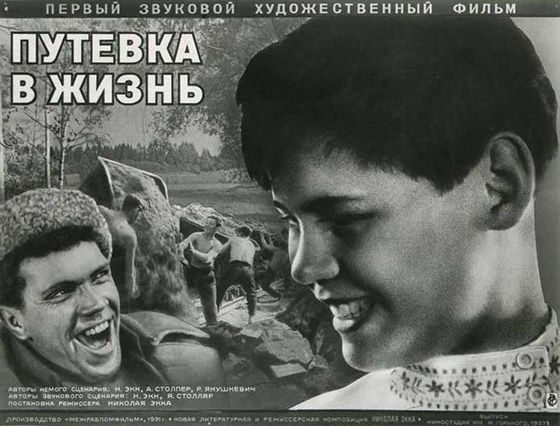 The poster of the film "Tulfet in Life"
According to the project of the General Plan for the development of the city, Korolev, the whole complex of labor community, with the exception of the shopping center, is planned to be demolished with subsequent construction in the liberated sections of multi -storey buildings. Activists of the Royal Branch of VOOPIIK are currently doing everything possible in order to save the complex as a whole and the building of Stroyburo as part of it.
The question of the demolition of the house was raised about six months ago. According to the city defender Maria Mironova, the chairman of the Obopiyik of the city of Korolev, as a result of many letters to different instances, it was possible to achieve a decision to put the entire complex on the queue for the adoption of the status of an object of cultural heritage, but the house after resettlement was not under guard, and municipal papers for unknown reasons limit the ban on any work on the territory of the monument today - November 11, 2013. During this time, the evicted house set fire to seven times.
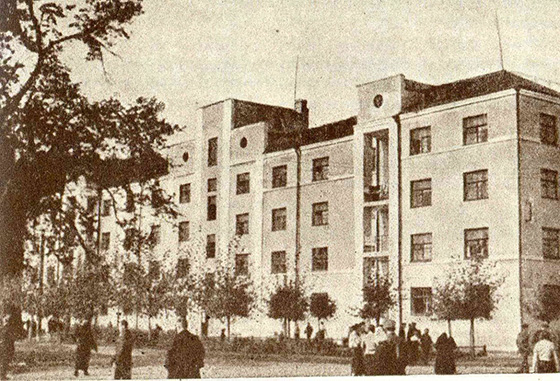 Complex of the Bolshevskaya labor commune, houses Stroyburo. 1930s
Now, while the house is actively collapsing with excavators and fire, the Ministry of Culture is being voted or against the demolition of the house. Many locals support demolition. Based on their words, the developer (CJSC “Development-XXI”) set them before the condition: if a historical house is not demolished, the inhabitants will be evicted from new municipal apartments. The practice of such construction “on the bones” in the city is not new: the neighboring high-rise building occupied the territory of the cemetery of the 18th-19th centuries, which the representatives of the “development-XXI” turned around, throwing and destroying the tombstones. It seems that the manipulative rhetoric of the developer has been so established that a meaningless requirement to make a choice between the history of the city and its improvement, the townspeople have long been perceived for granted and obediently support the destruction of their own memory.
In these catastrophic conditions a week ago, on November 2, the activists-amenders in two rooms inside the house during the next inspection found wall painting of the early 1930s.
“The second day Zhenya Rybak called me,” says the local historian and history lover Vladimir Kultin, the head of the club “Podlipka-Kaliningrad-Korolev”. - He was in the house with his little son. You know the layout itself - on the right along the corridor are two rooms, then the kitchen. If you notice, there is not a single window in the house now, a terrible draft, because of which the wallpaper has moved away from the walls. So he discovered painting. Of course, we opened our mouths. We searched and watered, but here you have an amber room. I even called him Shliman. And the son was just in the second room. He says: Dad, and then uncles. We look - indeed, this is Maslov, a portrait of three workers. There is no doubt that this is he: part of the painting with the bridge is known in other copyright repetitions. They began to examine further - they found geometric shapes, a bright raspberry triangle, a circle in which we later recognized the steam locomotive.
Tailing the wall between the rooms, we realized that it was made later: the skirting board was different, and the doors leave the impression of late gem (it is evident how the cuts are smeared at the top of the opening). All these partitions are already on the BTI plan of 1947. But if you mentally remove the wall and doors, we will see a large hall with two identical windows, which was painted around the perimeter. ”
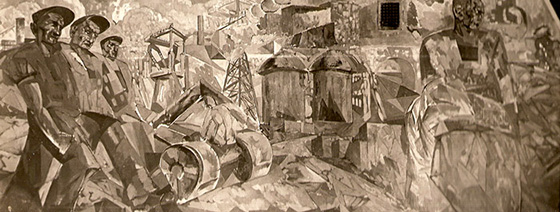 © V. Kultin Freska in the house of Stroyburo, former
 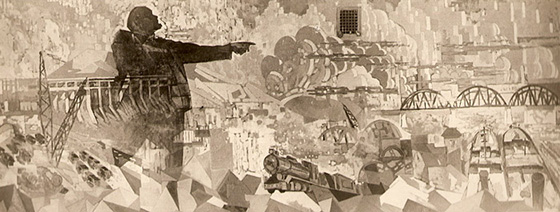 © V. Kultin Freska in the house of Stroyburo, former
 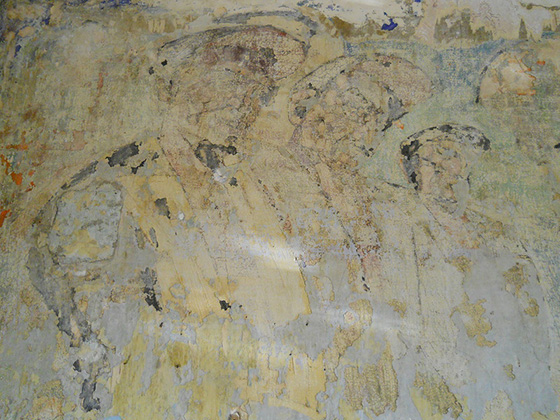 © V. Kultin Freska in the house of Stroyburo, the current look
The find in the house of Stroyburo can be fully considered sensational. Not only because very little wall painting has been preserved, and not only because of the evidence of authorship: pre-war photographs of the mural were preserved among the daughter of one of the communities, artist Vasily Maslov (1905-1938, shot). It is sensational because the found monument is known by archival materials and was previously considered lost, since, according to inaccurate information, the signature was made inside another building of the complex-the Iskra Kommunarsky club, which burned down in 1943.
The very personality of Vasily Maslov, the Yekaterinburg artist, who left the house, earning painting, then studied at the mid -twenties at the art universities of Gorky and Baku, and then went to Moscow, where on the recommendation of the People's Commissar of Education A.V. Lunacharsky received a hostel and got a job as a candidate for the Rabfak of the Arts. In 1928, Maslov, through Maxim Gorky, met with the organizer of the BTK Matvey Pogrebinsky and so became one of the Bolshevskiyskihsky community. Maslov’s murals can already be put on a par with the works of many contemporary painters to him, such as Vladimir Malagis, Israel Lizak, Vasily Kuptsov and others.
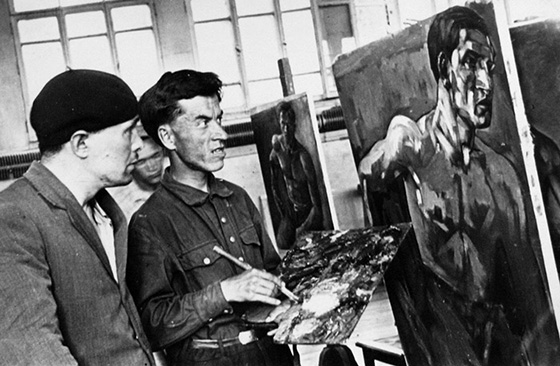 Vasily Maslov in the Bolshevskiye Commune Bolshevsk
They decided to temporarily not give information about the murals before the arrival of experts in order to prevent targeted vandalism: threats from supporters of the developer had already begun to act at the address of activists. However, on November 8, the house broke out for the eighth time. According to the city defender Olga Melnikova, everything pointed out to a professional arson: the roof was destroyed, the building burned at once from several sides over the entire height. Firefighters privately confirmed that the house was pushed by a combustible mixture, but refused comments when the recorder turned on.
Pyotr Shubin, chairman of the Council of Deputies of the city of Korolev, who managed to suspend vandalism in relation to the house of Stroyburo from Friday to Saturday, says that the general plan of the city, according to which the demolition of buildings is planned, has not yet been consistent with either the Ministry of Culture or the Ministry of Nature Management. However, the development of territories continues to go.
“This“ defeat ”will go down in the history of the city and the Moscow region, and the names of its participants will be there on a par with those who repressed Kommunarov in the 1930s.”
Almost immediately after the liquidation of the fire, the building of Stroyburo again began to be accelerated. On the night of November 8, a tractor with a bucket was brought to him and began the collapse of the left wing. On November 9, the second bucket was already driven, much larger in size. In the presence of the police and the fire department, the building continued to smolder: it was created that there was a constant re -arson - now under the enhanced control of the authorities. In the interval between these stages of collapse, the authors of this article managed to penetrate the house and partially shoot a very wet painting in both rooms, as well as distribute information about it on social networks. It is very likely that the paintings similar to this can be found under layers of wallpaper and in the remaining rooms of the house, but this can be installed only when they completely stop any work on its territory. Now access to the premises is blocked: the ban is connected with the desire to prevent art history and architectural examination, until the building is finally ruined.
In order to distract the attention of activists from the house of Stroyburo, on Saturday another criminal offense was committed: the arson of the first floor of the so-called 38th store-the neighboring constructivist monument, the shopping center of the Bolshevskaya commune, known as the "house-ship". The demolition of this house was not expected even by the general plan, but the silent support of the police and the Ministry of Emergencies looked like an encouragement of further unlawful actions.
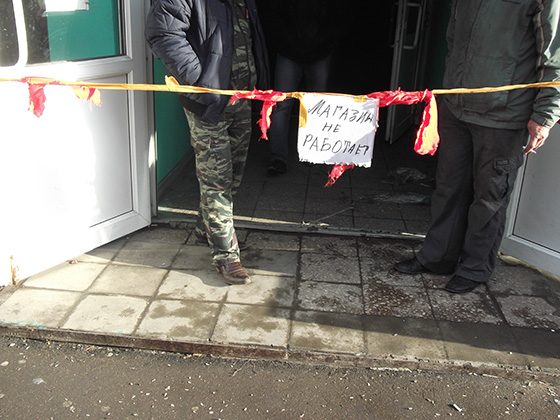
Over the weekend, vandalism reached the absurd apogee. Evgeny Vyniyov, Chairman of the Council in the Moscow Regional Department of VOOPIIK, held negotiations with the MO, the city police, the city’s police, the head of the fire garrison and the representative of the developer of CJSC “Development-XXI”. On his Facebook, Neighbors writes about the obviousness of conspiracy between local authorities, firefighters, police, the Ministry of Emergencies and the developer:
“Under the guise of extinguishing a fire (which is not for almost a day), it was decided to cause maximum, irreversible damage to the building of Stroyburo. Allegedly, in order to extinguish smoldering floors (although there is not even smoke), it is necessary to break another wall (this is done by a tap) and break the walls of the house between the windows of the first and second floors in six to eight places (this is done using an excavator). Nobody makes responsibility for such a decision, everyone refers to a certain commission decision on the results of the morning meeting in the administration.
At the same time, the firefighters did not consider it necessary to extinguish smoldering floors last night and this afternoon, and for some reason it was necessary to break half of the walls of the house for some reason tonight. They tried to start a break today earlier, but the large excavator broke down, and it was necessary to find a new one. Almost all of the house is already flooded with water, what else to stew there (and why you can’t do this through the windows - it is incomprehensible). And what kind of new method of extinguishing fires in historical buildings using a breakdown of half -meter brick walls?! Residents say that through the windows of the first floor in some apartments, chopped trees and branches are visible, which, apparently, are placed to continue burning and the appearance of smoke. Work on the breaks of the walls is carried out by the developer, interested in the destruction of the house. It leads them allegedly on behalf of an emergency commission. Representatives of the developer and the police at the same time unanimously assure that they will not allow the demolition of the house, since they were “forbidden by the governor”. ”
 © Facebook of the Royal Branch Vopiikik state of the house for November 10
The house destroyed now is not only the first house of labor communum, the most significant part of the complex from the point of view of history, not only a successful example of residential architecture of the era of constructivism created by famous architects. This is the semantic center of the complex, connecting the daily life of yesterday's street children and the artistic experiments of Kommunars with the memory of their tragic fate, arrests, and repressions. The corps of personal things, photographs, archives, memoirs and arts that has survived to date would have created a magnificent innovative museum here, creating a clear idea of the history of social and architectural experiments of the avant -garde era and showing great importance to the queen as the flagship of the early -Soviet communal culture.
The story destroyed at these minutes in the queen is not an abstraction at all. We are talking about the material evidence of the life of the generation of the 1920-1930s: about the people who built this city and created production in it-taking into account the fact that the commune existed not with state money, but only for earned. Among the communities and educators were famous scientists, musicians, athletes, artists. The house could well be hung with memorial boards. The preservation of this memory was not allowed by a wave of repressions in 1937-1938, which destroyed most of the communities. It will not allow him and CJSC “Development-XXI”.
Meanwhile, the entire complex of Bolshevsk buildings is an undoubted resource for attracting tourists, since there are still completely different constructivist buildings, stripped on a single axis - alley of Kommunarov (now - Ordzhonikidze Street), each of which could contain minimal museum elements and draw up tourist infrastructure. The Kukhnya factory, a kindergarten, a hospital, a department store, a training building, residential buildings could accommodate a cafe, a children's center, a pharmacy, commercial zones, open lectures and educational spaces, hostels, which consistently revealed not only the history of the Bolshevskaya labor community, but also the aesthetics and concept of a new organization of the life of the 1920s. The house of Stroyburo, which closes the complex on the right side, could accommodate a hotel on the upper floors, galleries and art workshops, studios on the middle, the Museum of Labor Complex in the first and become a new cultural center of this whole part of the city. Needless to say, there is no such complex in the country, just as there is still no USSR Museum.
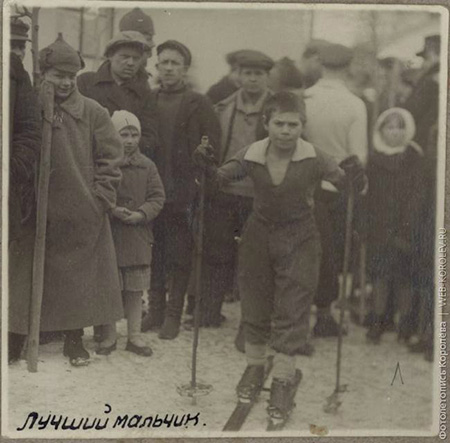 Museum.web-korolev.ru Bolshevskiyski Kommunars. Competitions among juniors. The best boy. Kostino, 1937
In the context of the “red tourism” actively developing in the world and even domestic attempts in this direction (Ulyanovsk Region), the Korolev suburbs had every chance to take a leading position. Foreign tourists who came to watch this “re-education plant” in the 1930s could well return here again and in more numbers today. The commercial attractiveness and social demand for this cluster is obvious. With the thoughtful and high -quality use of this complex, Korolev could gain economic self -sufficiency and get new development vectors, abandoning the participation of the next faceless appendage of the capital filled with new buildings.
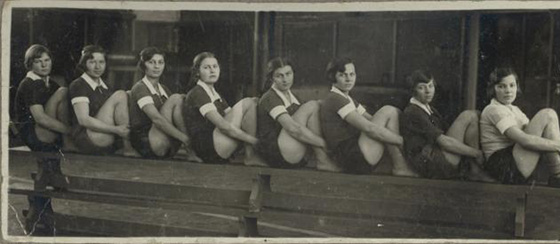 museum.web-korolev.ru athletes of the Bolshevskaya labor commune No. 1. Women's team. Metalist stadium, 1934
“I don’t know whether we will save the house of Stroyburo or not,” writes Evgeny Neighbor. -But I know for sure-this “defeat” will go down in the history of the city and the Moscow region, and the names of its participants will be there on a par with those who repressed Kommunarov in the 1930s. They destroyed people, and these destroy the last memory of them, but the same methods. ”