
Translated material
"We have not contacted you anymore"
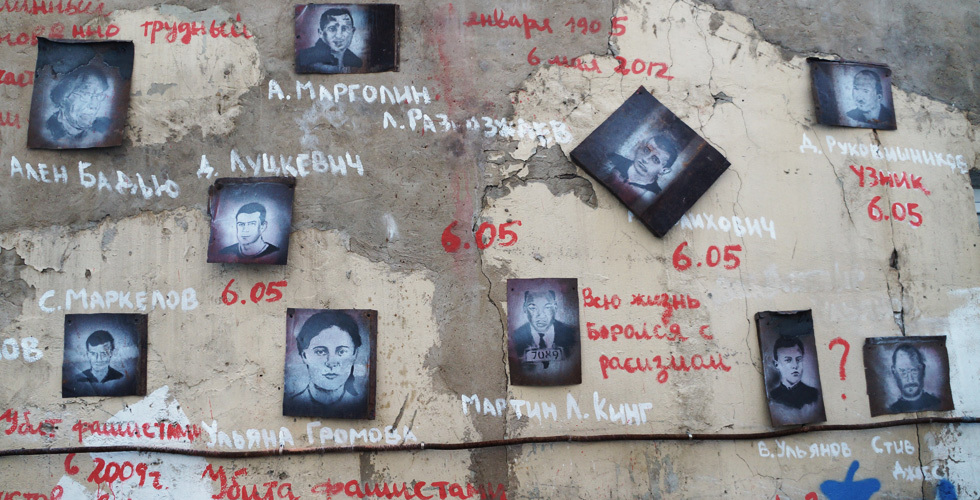
Dear Chaim Falcon!
In this letter, we would like to respond to an interview that you gave Sergey Guskov for Colta.ru, dedicated to your work experience at the projects of the parallel program of the fifth Moscow Biennale. It seems to us impossible to keep silent when you are trying to voice only your position and not hear others, in addition, we would like to answer how you interpret our cooperation with you.
First of all, we would like to state our point of view on the interaction that took place between you and us in the preparation of work. Short background: in early June, the curator of the Mediadvor site Marina Zvyagintseva informed us of the readiness of one of the artists participating in the project, working with students - this event laid the foundation for our (running forward - largely failed) communication. It was about working on the wall of one of the buildings of the courtyard and its artistic transformation. As you remember, in June we contacted you and the first meeting took place, where you talked about your idea of the “walls of solidarity”. We agreed on the next meeting, in which, among other things, your students from School Rodchenko had to take part. A pause was taken, during which we had to think about possible heroes of the project.
The meeting took place in September. Three students of the School of Rodchenko, six students of the Department of Culturology and you were present. At the very beginning of the meeting, you reported your left -oriented artistic activity. Further, the conversation was built in such a way that you asked leading questions: what we are unhappy at the university, in the country, etc.; Whether we are worried about corruption, education reforms, the last laws that have entered into force ... Each of these issues led to demagogy without any discussion of the discussion. You also called (but did not determine) a certain category of “students”, to which they attributed participants in the 1968 uprisings, appealed to the age of partisans of various wars and to the assertion that the people of our age - or rather, “student” - have always been an avant -garde of society with advanced ideas and active activities. Your replicas were read by us as a provocation. A firm feeling was created that you provoke us on a political statement that you want slogans from us to the anger of the day, evaluative judgments, and not a critical position. In this connection, we said that we do not have such a collective identity and we do not define ourselves through students in your understanding. We tried to talk about a specific task - about creating a work related to the wall, but with your help we were again drowned in demagogy.
When we talked about the image of specific people on the “wall of solidarity”, everyone agreed with the portrait of Walter Benjamin. We claimed that we could not speak out for everyone with whom we are learning, in connection with which we proposed to launch voting at the faculty (Faculty of Philosophy of the Higher School of Economics, consists of departments of oriental studies, philosophy and cultural studies) and make empty frames with the ability to enter new people. It was about M. Foucault. (Is it possible to clarify: in an interview you say that for the students your statement about Foucault’s sexual orientation was strange - you mean everyone who participated in the conversation, or specifically us, or what follows from previous proposals - students of the School of Rodchenko?) And we completely did not understand your “surrender” in a possible solidarity with the philosopher. In the end, we managed to agree that each of those present chooses his “hero” and “antihero” with a brief explanation of his position. Over the weekend, we all discussed and sent you a list of people with portraits (Steve Jobs, Lars von Trier, Charles Bodler, Susan Umbrelor, Nagarjun, Georgio Agamben, Adolf Eichmann and Anders Bering Bvik), despite the fact that most of us were not very impressed by the idea of “antiheroes”. You called this list "supercultural and safe."
Your work and we are in the university, within the walls of which we are students, that is, “free in our solitude” individuals.
There was also an agreement on our participation in the installation of work. At the appointed time, it was difficult to do, it was impossible to do anything. In this connection, you have completely taken responsibility for the materialization of work.
Some time later, a round table dedicated to the results of the Mediadvor project was held at the faculty of media communications. That evening we informed you that we took work exclusively as a provocation in our direction, which angered us, and, perhaps, we will do something with it. I remember that after in a conversation with us you were indignant and argued about what it means to be solidarity with Lars von Trier.
We have not contacted you anymore.
Now we would like to explain our position regarding everything that happened and has a place to be.
Initially, our goal was to beat the space of the courtyard, we wanted to revive it more or less conceptually. Therefore, we expected a meeting with you with great hope. In our opinion, the problem is that both sides did not talk their views on specific things and goals of work. Our conversation recorded by you on the recorder is really curious to decipher. From our point of view, you were looking for - in a particular group of students - an active action, protest against the existing order of things and the desire to change everything for the better. If so, then, alas, our aspirations coincided only in the latter. You are outraged by the lack of response in your direction regarding work. Understand that the lack of radical gestures is not ignoring what you tried to convey. (We would still argue with the conceptual part.) The fact is that your work and we are at the university, in the walls of which we are students, that is, “free in our solitude” individuals. You are surprised by the characters whose candidates we proposed for the "wall of solidarity." For us to be solidarity, this does not mean completely and completely sharing and continue the views or position of a person. For us, this means maintaining a healthy critical position in relation to any phenomena and have the right to choose a reasonable interpretation. The university is a space of understanding the outside world, free from politics. That is, no matter how we (including each separately) ourselves are self -determined outside the university, inside we get the opportunity and freedom of reasonable independent judgments and academic actions. Which are possible only on condition of complete individual solitude. In the framework of this situation, the key concept is “the validity of judgments”. The “Wall of Solidarity” for the most part looks like your personal statement as part of the program of the parallel project V of the Moscow Biennale. And this statement is almost contrary to the initial prerequisites for our communication with you. The publication of the interview with you really has somewhat clarified your intentions in this work. Which caused such a long textual explanation on our part.
If you are interested in activities within the university regarding recent events related to law or mass riots, you can almost easily find the appropriate research and work. Also, perhaps, you will be interested in the NIU HSE there are research groups involved in the problems of street art, urban space, labor in modern society ...
Do not consider our position too conservative. We would very much like to provide a wider vision of the region with which you had to work, and, possibly, clarify some principles of the device of this mechanism.
The distance between the researcher and the object of study, which is guaranteed by the academic, university environment, helps us reveal the possible meanings and causes of phenomena, lay them out into components, look at different angles into certain phenomena, ask new frames and questions. The university is not a place where we are stamped by specialists of a narrow profile who are unable to look at the situation wider, this is the space of our personal development and learning to one or another skills that go beyond the limits of competencies indicated in the educational standards, including communication skills.
Sincerely,
Students of the Department of Culturology
F-Tee Philosophy NIU HSE