
Translated material
Short course: Bibop
Colta.ru continues the encyclopedic series about the history of jazz : famous jazzmen intelligibly explain key concepts and phenomena from the 130-year history of the musical direction that changed the 20th century. This time we will talk about the period from 1940 to the 1970s-about jazz, which is customary to be called "modern", or M Odern Jazz. Let's start with Bibop, from where he came out.
Since the mid-1930s, a reflection arises in the American press about the significance of jazz for American culture: how to evaluate a technically developed, but in its function, entertaining modern jazz in terms of “serious” academic music? Can jazz be considered a truly national American phenomenon? Critics-Tradealists condemned the withdrawal of some swing musicians from the "genuine" hot jazz towards the Europeanized complicated technique. Others argued that, only approaching modern academic music, jazz would gain its true meaning.
To perceive jazz, one must have such an organization that acutely feels the movement of time.
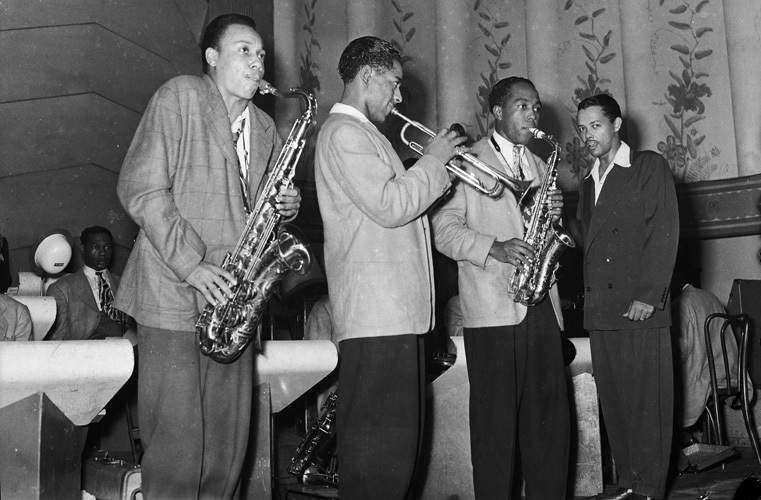
Against this background, in the early 1940s, the Minton ' S Playhouse club forms a community of relatively unknown experimental musicians-Charlie Krishen, Teleonius Monk, Kenny Clark, Dizzy Gillespi, Charlie Parker and others. As a result of their joint jam sessions, a new style is produced, which is strongly contrasting with the swing of that time: the swing beig bands preferred small ensembles of four to five people called “combo”, instead of dance rhythms and bright melodies-long improvisations at high speeds and based on complicated harmonies. As in the case of the New Orleans style, the early Bibop was not documented on records, largely due to the strike of the American Federation of musicians of 1942-1944, directed against large American grames, demanding the regulation of copyright deductions (another consequence of this event, according to some researchers, was the extinction of instrumental beagennas and their extraction from them and displacement from them mainstream vocal popular music). The first bibop notes appear only in 1944, when this style has already gained relative fame. This fame was not least contributed to a significant part of his audience, called “hipsters” (fans of Bibop, who consisted mainly of white students and college graduates, representatives of the middle class, who were impressed by certain features of the lifestyle of bope - for example, the style of Dizji Gillespi or heroine dependence of Charlie Parker). The romanticized image of the marginal musician-bover was largely associated with the riot of the Negro population of the United States against the commercial exploitation of their unique culture, with a reaction to segregation and even with progressive political views. The consequence of the aspirations of the bopers to ensure that their music is perceived primarily as a serious art, to be the birth of modern jazz.
Charlie Parker and Dizzzy Gillespie - "Hot House"
German Lukyanov
Trubach, flogelhornist, ensemble "Cadans"
Parker and Gillespi created a language that people have used for many years. If you have created a manner by which you can find out through two or three tacts, is already excellent. If you have created your own style, you are already a genius. Such a musician becomes a commander who indicates the road, leads hundreds of musicians, he has a clear plan of how to develop this art. Parker and Gillespi gave such a direction - Bibop. Later, many musicians, reluctantly, carefully, began to follow this. If you compare with a swing , this is a more virtuoso improvisation, a more mobile melodic, the use of some politicalNar movements, when the melody is displaced with respect to the main harmony, say, half -ton. At first, they were very modest. They took ordinary songs. Many musicians did not even know notes. Education gradually became jazz. The musicians composed complex topics in the mature Bibep - it would not be possible for an illiterate person. The element of competitiveness is always present in art. When jazzmen want to show themselves in the best way, the pursuit of speed begins. If we talk about aesthetics, then, of course, it cannot be said "the faster, the better." Rimsky-Korsakov did not write the “Boemel Flight” to play faster and faster. When Tchaikovsky wrote the 1st piano concert, everyone said that it was impossible to play. Now second-year students play-technology has grown.
Beethoven, Bach, Schubert, Scriabin - they were all jazz musicians of their time.
Jazz is an inspired sense of rhythm. Jazz loves fewer people than symphonic music, opera, ballet, he requires a certain rhythmic talent among the listener, the need to enjoy the freedom of rhythm. To perceive jazz, one must have such an organization that acutely feels the movement of time.
Charlie Parker - " Koko "
Yuri Chugunov
Composer, arranger, teacher
Why can Parker be called a composer? He laid a new language for improvisation. For the first time, the really boors began to engage in harmony, they began to be interested in modern academic music, attended concerts of Stravinsky, Bartok, and began to study European harmony in textbooks. Improvisation was significantly complicated in all parameters - rhythmic, harmonic and melodic. Harmonic time was compacted in Bibep - in one tact could be from two to four chords (detailed harmonization). The concept of harmonic replacement came into use - tonic and dominant chords could be built not only on the main steps. The role of chromatism intensified. The use of harmonic add -ons made it possible to use political -based techniques.
Thelonious Monk-"Ba-Lue Bolivar Ba-Lues-Era"
Roswell Radd
trombonist
At this time, new styles appeared. You can listen to the notes of Charlie Parker and other musicians of the late 1930s-early 1940s-it was a very sophisticated style. But if you listen to what they did, it becomes clear how they interact, and this is the most important. In music, there can be as many structures, composition and arrangements, but as soon as “electricity” arises between the musicians, this becomes jazz.
If we talk about innovation, Telonius Monk as a composer was very original and inventive. Tigarden was inventive to a greater extent in the early years. Monk remained like this all his life. It was never possible to predict what to expect from him further. It is very difficult for me to highlight one of his compositions - I love them all (I can say the same about Herby Nichols's legacy). In the repertoire of Monk, a wide range of compositions is from the simplest to the most difficult. On the one hand, there are such as “ Ba - Lue Bolivar Ba - Lues - are " , on the other - " Trinkle Tinkle ” , quite complicated. I think this is the most valuable monk in the legacy - there is a whole range of compositions that you can learn.
Thelonious Monk - " Pannonica"
Ned Rotenberg
Saxophonist , Rub, Ned Rothenberg's Sync
Almost everyone I know felt a strong influence of Monka. I never tried to memorize solo from his records, but I tried to teach all the compositions. It was on his records that I first heard Max Rouch. I heard the drums play a melody, they had very much importance there. If you listen to Blue 7, Sonny Rollins, Monk also plays topics there. I have always had interest in thematic improvisation. This is evident from my music, which I do not consider jazz. The most important thing is the process, topic and variations. Each work is a material that develops in the process. This approach is different from what, for example, my friend John Zorn, who has a lot of collage and a sharp switch from one to another, does. The idea of developing in the process of the theme comes from Rollins, but in the same way it comes from Beethoven and Bach, who themselves were great improvisers. It’s just that in those days there was no sound recording, and they had to record it on paper. Beethoven, Bach, Schubert, Scriabin - they were all jazz musicians of their time. By "jazz musicians" I mean creating improvisers. So the idea that only performers on the same instrument or only jazz musicians influence jazz musicians is a misconception.
Continuation next week: 1940-1950s. Kul-jazz. West Coast, "Third Wave".