
Translated material
Ukrainian puzzle
Will Ukraine sign an agreement with the European Union?
Will Ukraine sign an association agreement with the European Union? A mutually agreed time for answering this question has already expired. But there is still no answer. What next?
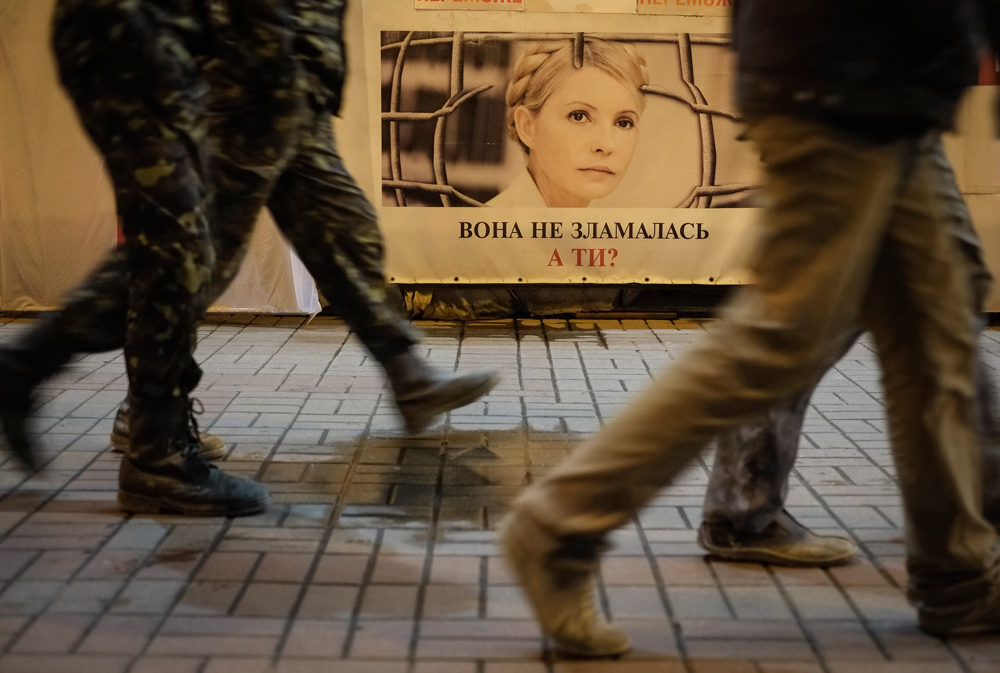
“She did not break. And you?" - Supporters of Yulia Tymoshenko turn to passers -by, who set up a tent camp in the center of the capital of Ukraine. Kyiv, November 2013
More recently, it seemed to many that the issue was practically resolved positively and the Eastern Partnership summit in Vilnius on November 28, where the association agreement (SA) would go to history (or not to sign). After all, Europeans markedly softened their demands on the fate of Yulia Tymoshenko: until recently, seeking the liberation and political rehabilitation of the disgraced ex-Prime Minister, now they are ready to be satisfied with the fact that she will be released for treatment abroad-in fact in the status of a criminal who received a “dismissal”.
But by the appointed time, which expired on November 13, the Ukrainian parliament, in which the supporters of President Yanukovych constitute an obedient and disciplined majority, actually refused to adopt a law that allows Tymoshenko to send the Chalit Berlin clinic. (Remember the “Seventeen Moments of Spring”? It was in the Hospital “Shait” the Soviet radio operator Kat betrayed himself when she screamed in Russian during childbirth-by the way, some sarcastic Ukrainian journalists recently called Julia Vladimirovna “Radist Kat.”)
Bottom line: the signing of the CA was in question. Yanukovych frequented to meetings with the President of Russia, Prime Minister Azarov spoke that the fulfillment of obligations by agreement would entail the expenses of almost € 160 billion (!) And that the primary task of the government is to normalize trade and economic relations with Russia. Rumors crawled around Kyiv: there will be an appeal either by parliamentarians, or the leading Ukrainian industrialists and employers (or both of them) with an appeal to postpone the signing of the SA for a year-in order to better prepare ...
Arguments of the pessimists
At first glance, it seems that the whole intrigue is concentrated around Tymoshenko’s fate. Such a picture develops, first of all, by the efforts of foreign ones, including the Russian media - they sometimes do not bother themselves with details, simplifying the situation to the limit: they say, Tymoshenko will be released - the EU agrees to sign the SA. They will not let go - there is no agreement.
In fact, on the political table is the most complicated solitaire, where the interests of the old and new states - members of the European Union, Russia, the USA, Ukrainian authorities, Ukrainian oligarchs, various detachments of the Ukrainian opposition and, finally, Yulia Tymoshenko, are mixed.
As always, there is a dispute between pessimists and optimists. Pessimists-and in their own way they are right-they say: in fact, almost no one wants to sign the SA.
Russia does not want - here, probably, everything is clear. Although a few years ago, Moscow, resolutely counteracting the North Atlantic integration of the republics of the former USSR and, in particular, to receive a plan of Action on NATO membership, it did not mind the expansion of the cooperation of these countries with the European Union.
Now it seems that the EU is perceived in Moscow about the same as NATO in 2008, at the peak of the expansion of the alliance. But then in the Kremlin they were not yet passionate about the idea of reviving the empire under a new sign. And now - what is the empire without little Russia?
We go further: SA does not want President Yanukovych. Not even because Tymoshenko stubbornly is not ready to let go of the lattice under any kind, including treatment abroad. The president has an election on his nose - in just a year in a small one he will have to compete for a re -election for a second term. And Ukrainian presidential elections are always serious. Here is a real struggle, the most acute competition with an unpredictable outcome. The current president must approach the elections with good economic indicators. In any case, its supporters must, figuratively speaking, are fed and drunk.
In the economy, on the contrary, continuous problems. There are less and less money in the treasury, at the end of the year he loomed the ghost of the crisis of non -payments to state employees. And then Moscow began to strictly overlap borders, introduce new customs rules. Ukrainian industrial enterprises that supply products mainly to Russia or depending on the supply of Russian raw materials or components, were at risk of stopping with all the ensuing consequences. Moreover, the employees of these enterprises, mostly located in the east or southeast of Ukraine, are most often voters of Yanukovych and his party.
"
Moscow allegedly offers huge loans: there are rumors about $ 5-10 billion - just do not sign anything with Europe
"
Experts also warn that the implementation of an agreement with the European Union can indeed be at first to lead to economic difficulties that will have to survive. But how to survive if there is no money? Meanwhile, Moscow allegedly offers huge loans on favorable terms: there are rumors that we are talking about $ 5-10 billion - just do not sign anything with Europe.
Pessimists say: the signatures of the SA secretly do not want the leaders of the Ukrainian opposition. In words, they were a mountain “for”-tactically it was impossible to substitute for possible accusations from the authorities that the signing fell due to their improperness. Therefore, deputies from opposition parties demonstrated miracles of conspiracy and expressed their readiness to vote for any bill that allowed Tymoshenko to release Tymoshenko. But at the same time, after all, the opposition leaders - Vitaly Klitschko, Arseniy Yatsenyuk, Oleg Tyagnyk - are also going to participate in the 2015 presidential election. And it will be much easier for them to fight for the victory against Yanukovych, the culprit of the breakdown of the EU, than against Yanukovych - a successful European integrator.
The Summit in Vilnius and some influential Ukrainian oligarchs, fearing the strengthening of the legitimacy of Yanukovych by signing the SA do not want the success of the summit. They are afraid that the president will begin to disperse them - in the image and likeness of how in neighboring Russia they dispossessed themselves know who.
SA and those large entrepreneurs who have a business depend on Russia (see above) do not want.
Some European leaders do not want. One does not want to complicate the already difficult relationship with Russia. Others are afraid that the decision on the Association will be extremely unpopular among ordinary voters who are little sophisticated in issues of foreign policy, to whom the association, the reception of new members in the EU are all one. But they are configured, moreover, for a long time, sharply against the further expansion of the European Union.
There are those who object to the signing of SA with Ukraine simply because they consider it not quite democratic, not completely compliance with European principles and values. For these incident Tymoshenko - like a red rag for a bull.
And by the way, does Yulia Tymoshenko herself want SA? Publicly, she also declares that for the sake of European integration of Ukraine she is ready for anything. Abroad for treatment without pardon, amnesty or political rehabilitation - please live, as in the old song is sung, the country is dear! But some observers say: in reality, Julia Vladimirovna would prefer to remain in the position of the victim, prisoner, martyrs than to be in the unclear of what status in the edges, where everyone can lose interest in her in a month.
Finally, it is not clear to what extent the Americans want the success of the summit, which are increasingly demonstrating a tendency to isolationism in foreign policy. To what extent are they ready to play an active role in Ukrainian affairs?
Arguments of optimists
What do optimists answer all this? They also have a set of convincing arguments.
The West, they say, cannot refuse to sign the SA for geopolitical reasons. It turns out that the EU lost to Russia the most important political party. After all, the Europeans became activated in the Ukrainian direction, seeing how Russia began to change after Putin’s entry into the third presidential term. As one high -ranking Western diplomat in Kyiv said in a conversation with your author, "we will not give Ukraine such to Russia."
The United States, too, turns out, will look losers - for the umpteenth time. We lost in the history of Syria, lost in Snowden’s case, another defeat is a bust.
European politicians and officials invested too much effort to achieve a compromise. It is no coincidence that the emissaries of the European Parliament represented by his former chairman Pat Cox and ex-president of Poland Alexander Kvasinevsky, who came to Ukraine 27 times (!) For negotiations between all interested parties about the fate of Tymoshenko, not having achieved a positive result to the deadline that came on November 13, as a result, they asked to extend their mandate until the day the Summit was opened in the very day of the opening of the Summit Vilnius.
Local political experts say: in Washington, unlike Brussels, they know a magical word for Kyiv
"
For most European countries, optimists say, the signing of the SA, in the end, is not such a fundamental question, for example, to the frank statement of Polish Bronislav Komarovsky, one of the main enthusiasts of the European integration of Ukraine: he called for signing part of the requirements for the ratification of this document to the EU and EU members. Read: abandon the hard "linking" CA with the liberation of Tymoshenko.
With Russia, optimists continue, it was not possible to agree on anything. Moscow allegedly rested and does not want to hear anything until Ukraine joins the Customs Union (TS). And this President Yanukovych does not want categorically, realizing that he will be very reduced to the role of the Little Russian Governor as part of the vehicle. All gestures towards the Kremlin, all the conversations that Yanukovych can prefer large Russian loans with Europe with Europe, optimists say - this is only a game with the aim of making the West more accommodating.
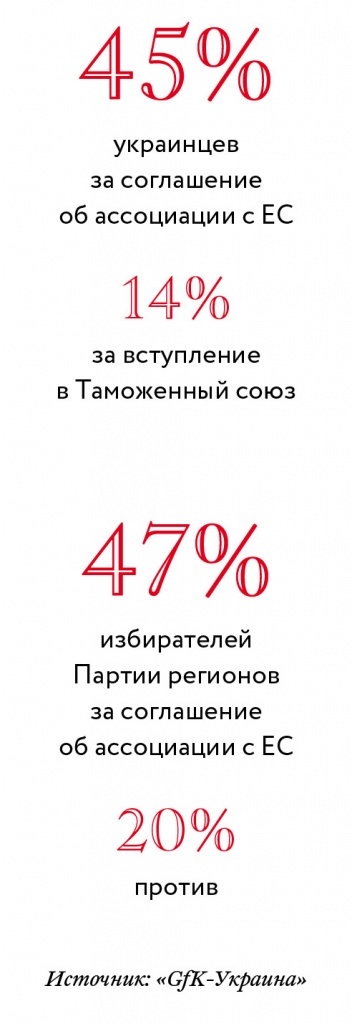
Finally, Yanukovych, they say, will not dare to abandon the SA, because it is a “blue European integration dream” of most Ukrainians. Political losses may be irreparable. This week, the GFK-Ukraine survey has been published, according to which there are only 14 % for signing CA, for joining the vehicle. Moreover, even among voters of the ruling Party of Regions, the number of SA supporters is more than two times more than supporters of the vehicle - 47 % against 20 %.
American signal
The author of these lines does not occupy in the dispute of the "European Pessimists" and the "Euro -optimists" neither the other side. But still I consider it necessary to notice: a lot depends on the position of the United States, although they seem to be only observers.
Local political experts say: in Washington, unlike Brussels, they know a magic word that can have a magical impact on the Ukrainian leadership.
One of these experts, Julia Mostovaya, is the editor -in -chief of the Mirror of the Week, hardly the most informed and influential Ukrainian weekly, wrote a curious thing the other day: “Sometimes it seems that, choosing between Russia and Europe, Yanukovych chose the United States. The President has always been understanding with Washington’s interests: from Uranus to Iran, from Shelf to Sleeza ... Yanukovych recognizes power behind the States. ” And she added that the President of Ukraine “considers ... American financial intelligence” the most powerful state in the world. ”
After reading these lines, for some reason I remembered the story that I once heard from another connoisseur of Ukrainian politics-on the terms of anonymity. In the days of the Maidan - as it is customary to call the events of the “Orange Revolution” on November 2004 - this person was invited to act as a translator in a very trusting conversation between two completely unofficial, but very influential people who came to Kyiv from Washington and two Ukrainian oligarchs, on whose position a lot depended on those hot days. American visitors had accurate bank details of offshore companies, addresses of real estate abroad and a lot of other delicate information about Ukrainian visuals. The “Message” of guests from the United States was extremely simple and understandable: if blood sags on the streets of Kyiv, then there are great troubles with all this property.
The authorities refused the idea of using force against the opposition street. Of course, for many reasons. But that conversation was, according to the interlocutor of the author of these lines, "one of the most good."
Now, of course, a completely different situation, and other people in power make decisions. But these decisions will still depend to a great extent on which signal will come to Kyiv from Washington.
Ukraine - EU: Last countdown
October 4 -observers of the European Parliament Pat Cox and Alexander Kvasnevsky petition President Viktor Yanukovych about the release of former Prime Minister Yulia Tymoshenko "for treatment and humanitarian grounds in the order of pardon." Yulia Tymoshenko accepts an offer to go to Germany for treatment.
November 5 - Viktor Yanukovych states that until 2020 Ukraine plans to completely abandon Russian gas.
November 6 - Viktor Yanukovych declares the European choice of Ukraine. Rumors are crawling around Kyiv: Tymoshenko is about to go abroad.
November 8 -The Ukrainian Pravda newspaper prints an article with a detailed retelling of the last round of Cox negotiations in Kiev: complete ambiguity, Ukrainian power plays with the EU in cat mouse.
November 9 - Viktor Yanukovych meets with Vladimir Putin: the Kiev agreement with the EU is the main topic of negotiations.
November 13 - the Verkhovna Rada of Ukraine rejects the bill that could allow Yulia Tymoshenko to go to Germany for treatment.
November 13 - Cox and Kvasinevsky announce the extension of their mission in Ukraine before the Vilnius Summit "Eastern Partnership" on November 28.
November 13 -Prime Minister of Ukraine Nikolai Azarov states that the main thing for Ukraine is good relations with Russia. He shares the fears of Ukrainian entrepreneurs due to a possible signing of an agreement with Brussels.
November 15 - Ukraine resumes the purchase of Russian gas.
November 18 - at a meeting of the Council of EU Foreign Affairs in Brussels, a decision is expected to have a decision on the fate of the Association with Ukraine if Kiev continues to delay the issue of the fate of Yulia Tymoshenko.
Expert opinions:
Alexander Okhrimenko, President of the Ukrainian Analytical Center (Kyiv):
“Ukraine has complied with all the EU requirements in relation to an association agreement. There are only two laws on European integration that have not yet managed to adopt - the law on the prosecutor's office and the election law. The authorities want to accept them this week. But the opposition is obviously aimed at disrupting the adoption of these laws and specially delayed the voting process.
As for the requirements for the liberation of Yulia Tymoshenko, it is specifically in the text of the contract and applications to it, it is not. At the moment, it is the opposition that inhibits the process, for he wants to disrupt the signing of the agreement and accuse the power of what happened. The next year there will be elections in Ukraine, and the opposition understands that the signing of CA will add points to Yanukovych, he may become president again.
And yet I am sure that the SA will definitely be signed. All talk about Tymoshenko is just a political PR. The EU cannot lose Ukraine for the sake of small political intrigue. Everyone forgets that the EU is more needed than Ukraine. For economic reasons, the EU really wants to tie Ukraine to himself, and therefore Tymoshenko does not have the multimillion -dollar income that they will receive at the expense of Ukraine. To sign an agreement with the EU, it does not matter whether Tymoshenko will sit in prison or not, but for the opposition it is very important that Julia remains in prison, so they make every effort so that Tymoshenko does not release. If Julia is free, all three opposition leaders will immediately become secondary pawns, and they are very afraid of this.
What is the problem of Putin and the entire foreign policy of Russia in this regard? The fact is that in Moscow they can not abandon the meaningless idea of “collecting Russian lands”. Therefore, in order for Ukraine to be friends with Russia, you just need to stop reviving “Holy Rus'”. Now in Ukraine, due to the latest actions from Russia, anti-Russian sentiments have become common to everyone. In fact, today any Ukrainian president cannot be pro -Russian.
In Ukraine, the signing of CA is beneficial primarily to large business. Ukrainian businessmen have already accumulated good money, but they do not really want to invest them in Ukraine, fearing the change of political climate. The way out is to invest in the EU, with the hope that in Ukraine in 10-20 years it will be possible to invest in business without fear, and that this business will not be taken away later.
Unfortunately, it will be pointless to invest in Russia and now in 100 years: the business can be selected quickly and or buy for free. Therefore, Ukrainian business does not see its future with the Customs Union and Russia.
But as for the ordinary population, now it is more prone to the current lifestyle in the country - with salaries in “envelopes”, with earnings in Moscow, cheap and poor -quality goods from Russia and Ukraine. Everyone suits people. Therefore, the population does not see for itself the great prospects from signing SA with Europe. And the idea that after 10 years the economy of Ukraine can become a little more European is unattractive for ordinary Ukrainians.
It is worth recalling that SA allows Ukraine to conclude an agreement with the Customs Union. And Ukraine invites Russia to join the part of the vehicles of the vehicle. In general, Russian business is more profitable for Ukraine to be in the EU, and not in the Customs Union. For at the expense of joint ventures, Russian business could have been able to sell its goods to the EU through Ukraine. ”
Alexey Bluminov, political expert, publicist (Kyiv):
“Behind all games in signing/non -signing are serious interests of the parties. The reality of Ukraine is such that the basis of its well -being is the real sector of the economy, and more precisely - that small part that produces an export product and gives the country currency, forms the budget. This is metallurgy, mechanical engineering, a military -industrial complex, chemistry, agriculture and food processing. The traditional markets of these enterprises are located in the East, but not only sales markets. Often these enterprises themselves are located inside cooperative chains created by large Russian corporations or depend on them in terms of the supply of components or raw materials. And, of course, gas - do not forget about it. Of course, in recent years, the critical dependence on the import of Russian gas in Ukraine has decreased significantly. We now do not even enter the top three largest Gazprom clients, giving way to even Belarusians, whose economy is three times less than ours. But even in these conditions, the dependence is still tangible.
It just so happened that the club of owners of the aforementioned enterprises is simultaneously a collective owner of the ruling party of regions or is close to its orbit. Separate exceptions in the form of the Poroshenko semi -opposition oligarch do not significantly change the picture. Since politics is, as classics teach us, the essence of the concentrated expression of the economy would be strange if the authorities for a long time spent a course that did not take into account the indigenous interests of large business. Such experiments usually end very poorly to the authorities. Or the power nationalizes the business and speaks on his behalf itself. But this is another story, which has nothing to do with the topic of our conversation.
So the Ukrainian Euro -integration tread was somewhat slowed after Yanukovych met with the captains of the Donetsk industry, and Azarov publicly admitted that their collective will forced the power to be distracted from dreams of a bright future in favor of ensuring the business of real rear in a not very rainy present.
The subchorative factor also played a role, namely, the unwillingness of Yanukovych to release Tymoshenko. But this is an option. The main thing is the economy. The authorities need loans and confidence in the prolongation of the regime for the next five -year term. Business needs confidence that the practical implementation of the provisions of the Association with the EU will not turn into a disaster for him, and the balance of acquisitions and losses will be at least zero.
Will the Association Agreement be signed? Rather, yes than not. To transfer it to 2015 does not make sense primarily for the EU, since with a high degree of probability they will have to resolve this issue again with the same Yanukovych. I think that the result of current trading will be the presence of some formula that suits all. Perhaps this will be the signing without the liberation of Tymoshenko and under the guarantees of Kyiv to solve this issue in the future. After all, there are already precedents. When Ukraine was admitted to the Council of Europe in 1995, they also put up a whole package of conditions, starting from the abolition of the death penalty, ending with the adoption of a new criminal and a number of other codes. Nevertheless, no one then put the cart in front of the horse, the next seven years in Kyiv went to the inspectors and patiently waited for Ukraine to fulfill the conditions set by it. If Brussels have political will, he will do the same now. The lack of a law on the prosecutor’s office and the law on treatment cannot. ”
Recorded by Konstantin Shiyan, Kyiv
Photo: Gleb Garanich/Reuters