
Translated material
The hero of our timelessness
Director Alexander Veledinsky - about the geographer that the globe drank
The film “Sprung Globus”, shot according to the novel by Alexei Ivanov, became a screen hit. Prizes at festivals, success at the box office - what bribes spectators and film critics? The New Times asked the director of Alexander Veledinsky
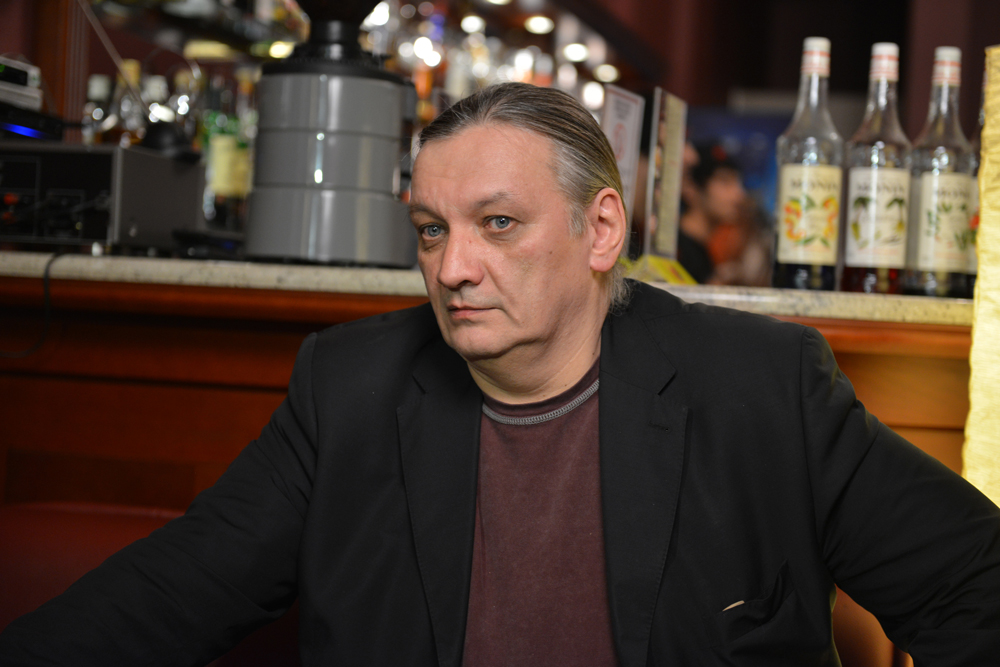
“Geographer” traveled a large number of festivals, received the Grand Prix of the main national festival “Kinotavr” and many more awards. There is a difference between what the film is seen in Russia and other countries?
In fact, everywhere our film is watched the same - I don’t know whether it is good or bad. Probably good. But it is interesting that in America and Switzerland he is perceived as a comedy. They do not feel any tragedy. Our viewers are more sensitive, capture shades, understand that laughter and tears can be at the same time. Apparently, our life itself in eternal inflammation has more responsiveness. We ourselves are ambiguous people.
Maybe it’s right that someone seems to be a pure comedy for someone? So, there is no chernukha in it. But you can find reasons to live on and rejoice at what you live.
This is what I want. The movie loves tough, honest, but in no case is black. Spectators should not feel crushed after what they saw on the screen, “Light at the end of the tunnel” must always be seen.
The genealogy of the hero
Teachers of geography, played by Konstantin Khabensky, have already managed to compare not only with Zilov from the “Duck Hunting” by Vampilov and the hero of the film Balayan “Flights in a dream and in reality”, but also with the main characters of the Russian classics - Oblomov, Prince Myshkin. In the process of work, such analogies occurred to you?
Yes, we talked about this with the bones, just preparing for filming. Once he called me at night: "Do not you think that Lev Nikolaevich is also on our side?" "Who are you talking about?" - I ask. “Well, about whom. About Lev Nikolayevich Myshkin. ” They discussed both Chekhov characters and heroes played by Oleg Dal and Oleg Yankovsky. Viktor Service from the novel by Alexei Ivanov, of course, is relatives.
"
Konstantin Khabensky said about our film at the premiere in Nizhny Novgorod: he is bleeding from love
"
And the surname Slovikin with a diminutive suffix does not refer to the Gogolevsky Bashmachkin? A humiliated person who is at the very bottom of the social ladder is deprived of the opportunity to rise and break through. Is there a similarity with him?
No. Servovykin does not suffer from any humiliation, he chooses the position of non -interference, because he does not want to fit into the system of false relations. And there are enough lies around, we know. Sometimes it’s even embarrassing to receive some high bonuses, it is disgusting that you have to decide what to do. It can be difficult to refuse, to take is unworthy. Nobody tempts Slovikina, and not for anything, but there are enough other situations in his life. Here he is the hero of our timelessness. Someone outrages this, they say: when will a real hero appear in Russia? That's when life changes, then it will appear. When in the 90s everything changed sharply, Danila Bagrov arose. Warm with the bad, defended good ones. I think if something happens to the country, Servkin will not be away.
Teacher's Day
Is it true that the state financing for the film was obtained by the category of "to the teacher's Day"?
Well, yes, the cinema fund allocated money to producer Valery Todorovsky in this section, such a regulation there. It’s good that they helped, but this classification simply touches me. The legacy of the scoop has not gone anywhere, it is alive, a little more - and the slogans will appear: “The economy should be economical” and so on in the same spirit.
How did real teachers evaluate the film?
The teachers recognized him, they are for the film. At one of the first views, an honored teacher of the RSFSR came up to me and said: “You showed what the teacher should not be, but what a person should be.” They correctly understood: we are not a production picture, we talk about a person. Which, with all the shortcomings, has decency and love for people.
Konstantin Khabensky is also a teacher?
Yes, Kostya has acting studios for children in eight million-plus cities: Ufa, St. Petersburg, Kazan, Perm, Voronezh, Yekaterinburg and others. This is his own initiative, he found sponsors and opened creative schools for children. He scored teachers from local actors, pays them a good salary. Children study for free, anyone can come there and engage in creativity - plastic, movement, theater.
They say that the film was shot in the very school where the writer Alexei Ivanov studied?
Exactly. She was looked closely in advance, and when I arrived to affirm the object, he asked me to show me the school where Lesha later worked. After looking both, I chose the first one. There is opposite the kindergarten, and I immediately took a scene, which later entered the film-where Khabensky-Servyzhkin, going out after work, jumps over the fence and finds himself in the kindergarten where his daughter goes. Then I found out that they once and little Lesha was taken into this kindergarten. In general, in Perm, everyone adore the novel “Geographer Globus drank” and Ivanov himself, and teachers with the names of Service, Chebykin, the very ones that were included in the book still work at the school.
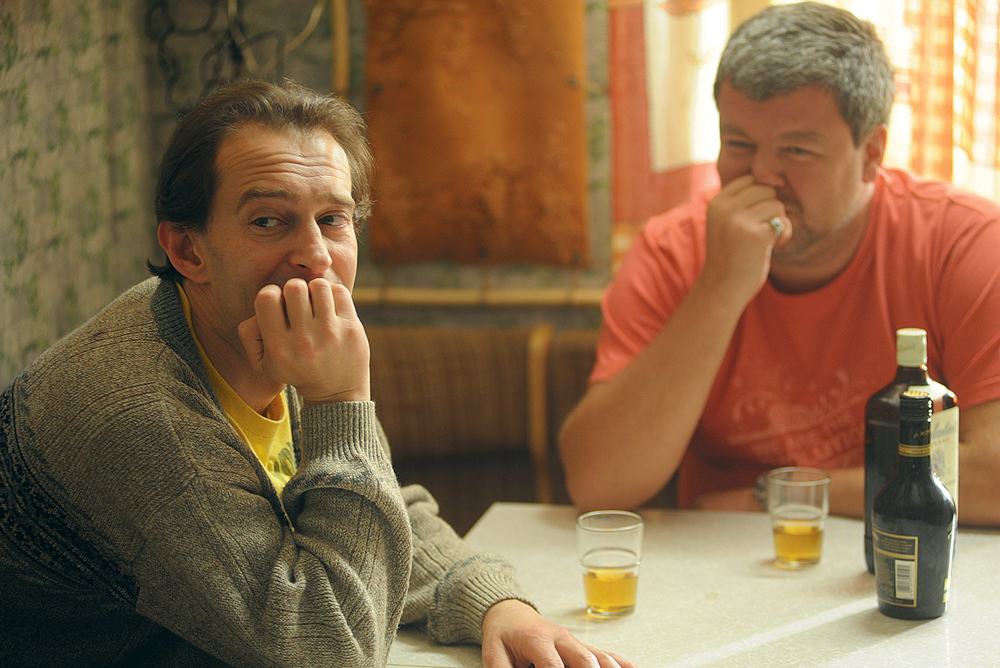
Servykin (Konstantin Khabensky, on the left), as is characteristic of a Russian person, is always not averse to drinking
Roman on the screen
Why was the script written without the author of the book?
And he immediately said that he was trusting us. To the fact that the film adaptation differs from his novel, Alexei does not just feel calm - he treats everything very well, he really likes everything, and besides, the circulations of his popular book grew again.
Fans of the novel doubt whether it was necessary to transfer the action from the 90s today.
Why shoot about the 90s, when the character lives among us, now and today? The archetype of the Russian man has not gone anywhere. Konstantin Khabensky said very well about our film at the premiere in Nizhny Novgorod: he bleeds love. But in general, I always put literature higher than cinema.
Isn't it strange for the author of films?
Cinema is an applied thing in relation to literature. You see, cinema, unlike other types of art, has a date of birth. It does not have painting, music, theater, but the movie has. And since the date of birth is known, then there may be a day of death.
Do you imagine such a situation?
Cinema may not die, but, apparently, it will turn into something completely different, interactive sight, where everyone can intervene at their desire.
So far, producers very often want to intervene in the fabric. With the "geographer" it was also. What did not suit?
The most amazing thing is that a person who wanted to change and reduce has always said that he likes the film in my directorial version. But he thought about business. About how to squeeze the film into more sessions in the cinema. Another producer - Valery Todorovsky - supported me, he himself the director and respects the author of the author. As a result, we showed the author’s installation on Kinotavr, the audience accepted it with a bang, the jury handed the Grand Prix and the prize to Khabensky for the best male role, and the distributors wanted to ride the picture in the form that they looked at the screens throughout the country now 650 copies.
The dashing nineties
In the same 90s, when Alexei Ivanov wrote a novel about the geographer, what happened in your life?
He entered the highest directorial courses to Valery Potrykhov and Alexander Proshkin. We had a very talented course, Igor Rublav and Alexei Sidorov studied with me, with whom we later wrote the script of the “brigade”, Lesha Poyarkov, Andrei Proshkin, but we were immediately told: no one is no longer, nobody needs you. At 36, I finished my studies, and I shot the first film only a few years later, when I was already 41 years old. I remember that there was a moment when in November in the hostel of VGIK, the water was turned off on the 16th floor, the toilet and a sink in the block where I lived, moreover, burned the substation, there was no light or a penny of money. I had a pack of defective, soaked cigarettes, donated, a bag of oatmeal and a candle. I lay in clothes under two blankets, smoked dried cigarettes, read the “Revelations of John”, “Masters and Margarita”, alternately. And somewhere on the third day I realized that you can’t murmure, despair, this is a real buzz, I will remember this time as the best in my life, I am free from all material and happy. And when the light was turned on, my fellow student came and brought the money that was engaged in six months ago, then they offered me a job - a malarus, and a month later I went to shoot the Russian Riot Alexander Proshkin, soon I Igor Rubblev and Lesha Sidorov began to write a “brigade” script, life in the cinema began to get better.
Russian
You have already accumulated the experience of film adaptations, do the authors of books seem to behave?
None of them intervened in anything, realizing that literature and cinema are different things. My first short film “You yes, yes, we are with you” I shot based on the story of Vyacheslav Pietsukha. I was a debutant, and he was a recognized writer, but trusted me. Then there was a large film "Russian" in the autobiographical prose of Eduard Limonov "Teenager Savenko." The script did not literally play a book, I took dialogs from other texts of Limonov.
He also did not interfere?
No. And he could not, he was sitting in prison then. But this is not the point, a large writer, as a rule, does not interfere with the director. Now I really want the novel Sankya Zakhara Prilepin to transfer to the screen, he also says: do it as you think it is necessary.
Only two people got out of my yard, survived until today, the rest disappeared
"
Limonov's prose, why did you hook you?
My youth was like. I also grew up on the outskirts of the industrial city. Savenko - in Kharkov, I am in Gorky. Youth was in the hard, gloomy area of Beketovka among the harsh guys. There they fought street on the street, some then in prison disappeared, others in the Afghan war. From my yard, only two people got out, survived until today. One became a famous ophthalmologist, and here I am a film director.
Where did you get a desire to work in a movie?
I don’t know, probably because thanks to my parents I read a lot, I was passionately in love with books. And I watched all the films that were possible. As Kira Muratova once said: if the cinema had not been invented, I might not be born. The hero of Limonov is a poet, and I dreamed of being a director. This feeling of yourself is different, the desire to break out of the usual life, probably, helped me, as once a teenager Savenko. Otherwise, I was, like everything, inscribed in the then reality, was friends, fought, drank a bottle of throat on a dispute.
Solovki island
Service, as is characteristic of a Russian person, is always not averse to drinking. Tell me about relations with alcohol.
He does not drink because someone does not understand him. On the contrary, because he understands everything, absolutely everything. He is not an alcoholic, dependent on alcohol, he is a normal household drunkard, for whom alcohol is the usual consolation. If we talk about me, then yes, I drank and sometimes very seriously, like many. Not always. When he entered the directorial courses in the 93rd year, he did not drink ten years at all. Much later, when we ran out of the money on the film “Russian” and we were in a simple one for six months, I, like Slovykin, cut off my friends at the birthday of friends properly. And not so long ago, a mysterious story happened to me. Prilepin and I flew into Solovki. One of the producers of the "Geographer" Leonid Lebedev asked if I wanted to make a film about Solovki. And my father was there at the Jung school in 1942 at the naval base. Of course, I agreed. And he suggested Zakhar Prilepin to write a script together. Lebedev equipped us there, we flew to Solovki. As soon as I stepped on this land, I, the only one of all, flew in the mobile phone all the names, only the numbers remained, I was cut off from the mainland. We traveled the island along and across, drank in the evenings, everything is fine. And when they returned, Zakhar offered cognac in the evening, and I suddenly tell him: you know, I do not want and will never be again. And all - since then I have not been drinking and I have not experienced the slightest desire to drink. That place was printed very strongly, not without reason the Solovki was called the Russian Vatican.
Do you make a movie about Solovki?
Hope. While Zakhar is preparing a novel, circles like a raven over the finale, as he says.
What will be there?
The 20s, unique to Russia, are very, by the way, similar to the 90s, which we remember well. Time fracture.
Heroes are the prisoners of Solovetsky prisons?
Well, who! There were no others on Solovki then.
Photo: Sergey Bertov/ITAR-TASS