
Translated material
Memory of Kennedy
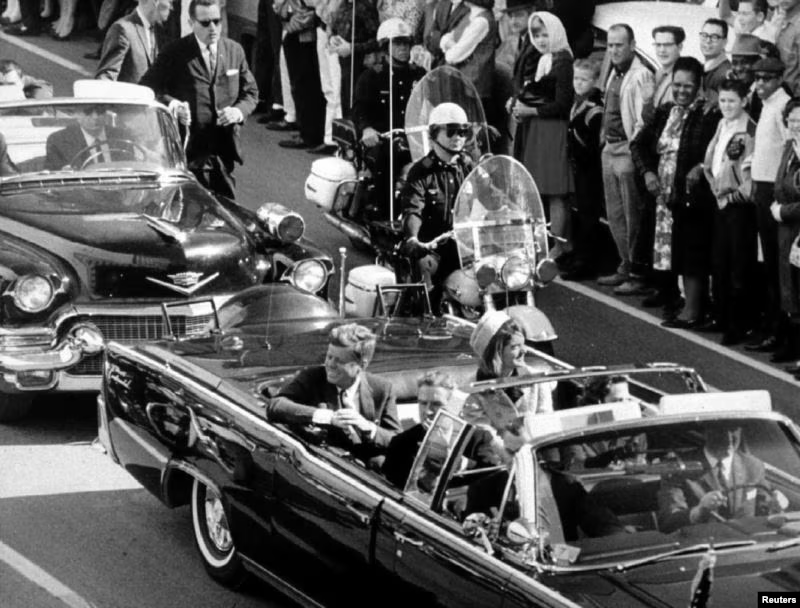
“Where were you when you killed John Kennedy?”
“I was not in the project,” they answer now most often, but I well remember the mourning that my family plunged into, ready to change the dead Kennedy for Living Khrushchev. I myself was small then, but Bakhchanyan - large, in any case, adults enough to serve as an artist in the Lenin corner of the Kharkov Piston Plant.
“The death of Kennedy,” said Bakhchanyan, “shocked ordinary Kharkov workers, and one of them wrote a poem in the wall newspaper.” It began on a alarming note:
Reported by Bibisi:
"Kennedy was killed in a taxi ..."
And it ended in catharsis:
The killer squeezed a rifle in his hands.
How he dared to kill him!
Where can I get the ruble,
To wash John Kennedy?
In New York, they are not joking at this 50 years later. Kennedy was neither the best (they are considered by Washington, Lincoln and Franklin Roosevelt), nor loved ones (many call them theodore Roosevelt), nor the only murdered president (the same Lincoln, Garfield and McKinley). No one will really tell you that Kennedy managed to do good, except that Khrushchev frightened the Caribbean crisis and launched
American space program, ending with a landing on the moon. Since then, however, nothing has changed in a cube or on the moon. Castro is still with us, and Kennedy has been in the Arlington cemetery for half a century.
Not life, but Kennedy's death surrounded his figure with such a mystical halo that it was a crime, as the murder of Julia Caesar, haunt anyone and always bore wounds.
Marina Efimova tells about this in her review of books about Kennedy
Marina Efimova: On November 22, 2013 it marks half a century since the death of President John Kennedy. Meanwhile, his rule, and personality, and death are still full of riddles and ambiguities - even for those who have spent years studying his
life and death. The author of the sightseeing article at New York Times, Jill Ebramson, considers one of the reasons that impede the impartial study of Kennedy's reign, the fact that his murder was for Americans of two or three generations
The most traumatic political event in their life, which overshadowed only “9 \ 11”.
Announcer: “Was Kennedy the great president, as most Americans want to see him, or a charming, but superficial and frivolous representative of the elite, or (even worse) just a“ star ”, a celebrity like Hollywood actors? To what extent his numerous
Personal failures and misconduct (which were hidden during his lifetime, but are now documented in detail) reflected on his policy and have they outweighed his achievements? And what is considered the achievements of his government - the fight against
Racism and with poverty - is it a merit of his successor Lindon Johnson? "
Marina Efimova: Not to mention the fact that the benefits of some radical measures taken then to combat racism and poverty are now called into question, since these measures have led to clearly negative consequences.
The main mystery of John Kennedy remains his death, despite the official version of the lonely killer - Lee Harvey Oswald, accepted by Tyan. Doubts in this version submitted by the Warren Commission were strengthened after the new investigation and report of the 1979 Congress Commission. The conclusion of this commission: the presence of a conspiracy. But the late, the frightening volume of the report and lack of evidence decided the fate of the new investigation - they forgot it. After that, a flurry of individual investigations and versions began, accusing President Khrushchev, Castro, CIA, Mafia and Lyndon Johnson of the murder. The most
Serious of these investigations have the same disadvantage - lack of direct evidence.
Kennedy has become an eternal theme: all over the world 40,000 books (!) Published after his death. But here is what the famous American biographer Robert Caro writes:
Announcer: “It is amazing that with such an interest in the whole country, not a single truly complete and good biography of Kennedy came out. This is especially strange because the history of his life and death is one of the most exciting stories in the history of America. ”
Marina Efimova: Some serious historians were afraid or did not want to take up the biography of the national idol - this would interfere with the objectivity of the study. This example is the work of Arthur Schlezinger ml., Who was the historian of the White House of Kennedy. In 1965, he published the book “Thousand Days: John Kennedy in the White House.” It has a considerable value of evidence of a living participant in events, but admiration for the deceased president made Schlezinger the main “architect” of the myth of Camelot and the new king Arthur, and prevented the creation of a convincing picture of Kennedy's presidency. Interestingly explains the lack of an objective, complete and talented biography of Kennedy
Nytims editor Jil Ebramson in the article “Kennedy. The elusive president ":
Announcer: “During his lifetime, John Kennedy conquered or outwitted the most powerful analytical and even intuitive minds, fascinated the most insightful and incorruptible observers. In 1960, Eskavir magazine seconded Norman Mayler to the Democratic Convention, which nominated Kennedy. Mailer published a stylistically virtuoso article “Superman comes to the supermarket”, in which John Kennedy described: “A 43-year-old man, with absolutely natural restrained dignity and with a friendly indifference to applause. In the debate, it looks like a good boxer - a quick reaction, accurate
Temporary calculation and a relaxing vacation in his corner, as soon as the gong informed the end of the round. But in it a strange ignorance of everything that he does. Being in the same room with him, you do not feel the "effect of presence." And me
It is unclear: to appreciate this property or fear it. What is this: the concentration of a supersensitive personality or the detachment of a person who seems unreal to himself. ”
Marina Efimova: Nevertheless, Norman Mayler succumbed to John Kennedy’s charm with his light irony and with the easy unrealism of his manner: “He was a hero that America needed then,” Mailer wrote, “a contradictory, mysterious hero that can excite a secret imagination and dormant life forces of the people.”
In addition to the mystery of the personality of John Kennedy, there were, apparently, the real secrets in his life and in presidency. And after his death, there were many people who jealously guarded these secrets. The historian found Hamilton, author of the 1992 book “JFK. Brustful youth ” - was the first author to work out to write a multi -volume biography of Kennedy. But starting the second volume, he immediately attacked.
In 2011, he wrote in The Huffington Post:
Announcer: “The family asked well -known historians - Schlezinger and Doris Goodwin - write an open letter of protest. I was warned that neither employees nor
John Kennedy’s friends will not allow me to talk to me. ”
Marina Efimova: It is possible that partly the reason for the pressure was the tactlessness of the biographer, who in the book about the youth of Kennedy did not neglect rumors and focused on the sexual escapades of the future president. True, and
Other biographers complained about the harsh control of the family.
William Manchester, a historian, chosen by the family himself a month after the death of John, suffered the most. In several later essays, he told the story of writing the book “Death of the President”.
Announcer: “Every friend and ally John made his bills and inserts in the manuscript. Robert once burst into my hotel room to demand new changes. Jackie did not read the manuscript, but, guided by the opinion of trusted
persons demanded the exclusion of “too personal” details - for example, phrases that she wears a cigarette in her purse.
When the magazine "LOOK" offered me 600,000 dollars for the serial publication of the book, she was so outraged that she filed a lawsuit with a request to ban publication.
True, she refused the lawsuit, and after the release of the book in 1967 she read it and called it "amazing."
Marina Efimova: Nevertheless, the family did not allow the reprint of the book. Only now, on the anniversary, the Little Brown publishing house issues a new circulation of the Death of the President.
According to critics, the best of the recent books about Kennedy is Robert Dallek (2001). The work of a famous historian has a lot of new information about the actual disability of John Kennedy, hidden from the public. And on the anniversary of the book “Court Camelotes”, Dallek selects another (though not new) object - the closest employees of the president.
A huge range of work about Kennedy is occupied by books such as “what would happen if ...”. The latest is also by the anniversary-the book of the television commentator Jeff Greenfeld “If Kennedy was alive. The first and second term of the president: a corrected story. " Another new book of this type - “The last hundred days of JFK” Clark, which states that Kennedy was alive, he would become a great president.
Time gradually removes prohibitions: David Nassau “Patriarch” came out - about the founder of the Kennedy clan. A very interesting American-Canadian television series “The Kennedys”, made based on the materials of the book by David Talbot 2007, “Brothers. The hidden story of Kennedy's times. " “But despite tens of thousands of portraits,” writes Jil Ebramson, “the image of John Kennedy remains as elusive as it was during his lifetime.” The further we leave Kennedy, the more likely, that no one will be able to restore the real image of the young president of America, whose short life and tragic death found a deep response in the heart of every contemporary.