
Translated material
From the life of muravs-tones
Cand. Biol. The sciences, a researcher at the Department of Zoology of the Vertebratic Faculty of Magic University of Moscow State University Pavel Kvartalnov talks about his observations in the tropics of Vietnam.

Two ants ( Oecophylla spp .) Inhabit the tropical forests of the Old World. They told me about stinging bites of these insects when I was just about to go to Vietnam to work in the Russian-Vietnamese Tropical Center. In fact, the Two ants turned out to be one of the most interesting creatures that I managed to get acquainted with the Kattienne Reserve.
Asian anti-tones ( OE. Smaragdina ) live in nests built of green leaves in the crowns of trees. Anthills are similar to large (with the head of a person) balls. Ants constantly build new nests and leave those where the leaves begin to dry. I managed to observe the construction.
When I went to a small tree, chosen by ants, the leaves were already pulled into a ball, and the building seemed finished, but its walls were held on live “scrapers”: dozens of ants cling to the edge of one sheet and “anchored” with claws on the surface of the other, pulled the leaves.

Having examined the nest attentively, I found an ant, holding a larva in the jaws. She highlighted silk from her mouth, firmly sewing the leaves for them. At first, I could not understand why ants do not use several larvae at the same time - thereby they could speed up the construction process and save the dozens of their comrades from hard work.
Soon I found a possible reason for such leisurely. Near the ant nest, a tiny (several millimeters) wasp from the Chalcididae family hung in the air. Like other parasitic wasps, halcides lay their eggs on other people's larvae, and in this case, the OSA was clearly interested in an ant binding. Ant larva was guarded by keen guards, ready to repel the attack, but the wasp did not leave the nest at rest, patiently waiting for a convenient moment. Later I read that such a wasps (genus Smicromorpha ) are famous parasites of muravs-tones.
Two ants have not only enemies, but also friends. On the inflorescences of the Liana ( Barringtonia Cochinchinensis ), I found an ant "pasture". As cows were the cicadas-horbatics of the genus Sextus (Sem. Membracidae). When I met such cicadas at a distance from ants, they immediately flew away, but the “tamed” humpbacks felt inviolable. They crawled a little, but were in no hurry to leave their “shepherds”. Near adult cicadas were larvae of different ages.

Ants, alarmed by my appearance, transferred young humpbackets to a safe place. The care of ants is not disinterested: the cicadas emit rich in sugar, which ants eat with pleasure. Along with the large “soldiers”, who played the role of shepherds, the smaller ants, “working” milkmaids, were also present in the colony of Gorbatka. The protection of muravs-tons also use, albeit undeservedly, some spiders that imitate their appearance and behavior.
A significant part of the year ants are spent in the crowns of trees. But with the advent of winter, the dry season comes in Kattien, the foliage on high trees falls, the forest dries, the feed becomes less. At this time, ants-tones descend to the ground and are looking for prey in the litter, among leaf dumps. They eat not only with any trifle.
In December 2006, I found in the forest of the deceased Krait ( Bungarus Candidus ). This deadly poisonous snake, apparently, killed a man and left to lie at the path. Two ants, having discovered a snake, first covered it with dry leaves. So they protected the source of food from the ubiquitous flies. When the fly managed to sit on the snake, she laid a larva that immediately proceeded to the meal. More often, however, the ants drove the fly in time or grabbed it and dragged it to the tree, in their nest - along with particles of snake flesh.

Two days later, ants continued to slowly divide the snake corpse. The larvae of flies, which avoided ant control, formed a live ball and ate a snake in the middle, while the head and tail completely belonged to the ants. A day later, the larvae began to leave the feed place and delve into the ground for pupation. The larvae were in a hurry, because, as soon as they separated from a swarming ball, they became easy prey of ants-port anthogs.
In addition, at that time, some black ants, also attracted by light hunting for maggots, began to run out of their Nor. Two ants successfully repelled their attack, at the same time allowing the larvae of flies “under the noise” to move to a safe place. Two ants ate a snake for a few more days, already without competitors, and left only those parts that mushrooms used to get untouched.
In addition to interesting behavior, ants-tones aroused my location to themselves by the fact that they did not encroach on bird nests. For all the time I spent in the tropics, they never bit me. These creatures often settle next to a person and know how to be not annoying: they do not get confused underfoot, do not climb into the bed, but, for example, they form a live lamp on a lamp of daylight, when they catch night insects. If you are lucky to visit the tropics, do not be afraid of ants, but try to get acquainted with their world!
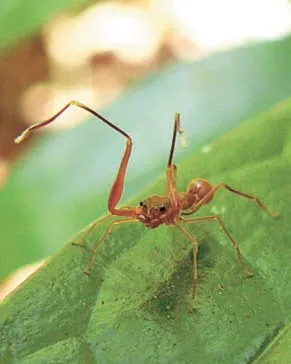 Mimic
Mimic 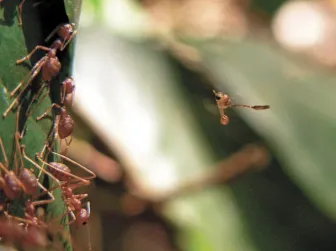 Osa Halcide observes ants
 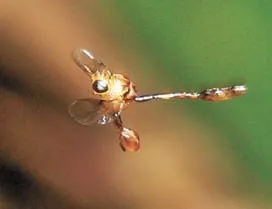 Close-halzide is close-up
 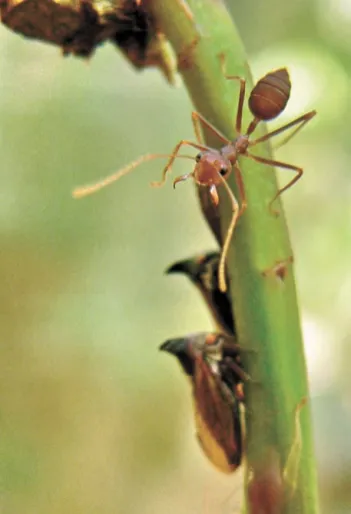 Defender "Herd"