
Translated material
To be continued
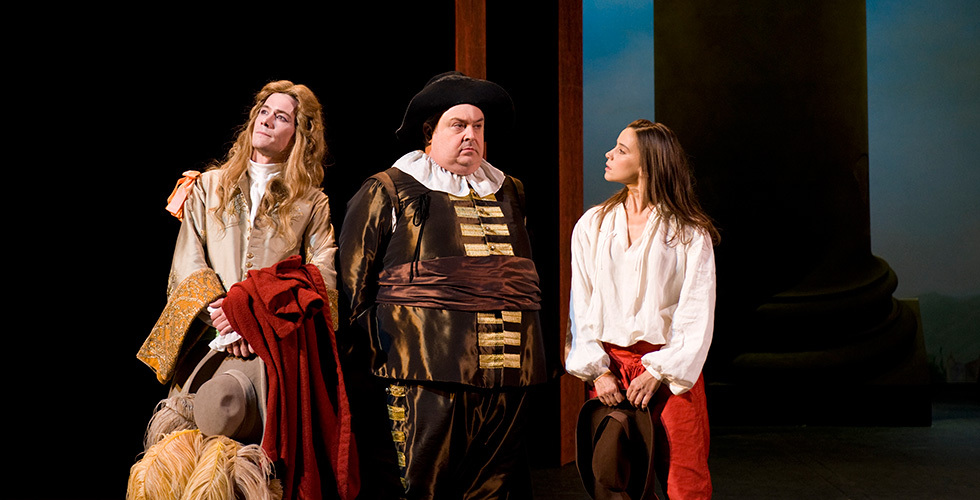
Don Juan, in the production of Jean-Pierre Vincent, goes on the Comedy Frances's stage for the second season, having resumed three weeks ago, and there would be no trace of writing a belated review of him, if there were already at least some other. But the only (!) Russian -speaking text dedicated to the performance is so insanely innocent, fits so organically into a sweet long -standing tradition of writing about the performances “Comedy Frances” as if according to the special order of the Society of the Blind - that not to tell how the best (after the death of Sherro) the theater director of France actually arranged the most mysterious play of the national repertoire. Forever leave the Russian reader in ignorance. How can it be.
In the past half a century, playing Don Juan in France has become even more impossible than ever. The exemplary, exhaustive performance of the great Louis Jew, who devoted the life of the Moliere play, to a lot of generations ahead, condemned the actors, who would dare to storm her again, to the condescension of comparisons. Loik Korbury, who was falling out to Don Juan now, is a thin actor and with a good training, whose skill skills even causes fears for his future on the French stage (which this skill is usually useless), while the ability to gradually change intonation with any, as it would be said now, “resolution”, moving like a chromatic gamut and uniformly distributing a semi -ox The speech tone is at least twenty minutes of the text, it dispels these fears. But with all his technique, he would inevitably lose to Juvus, it was a cleanly in the first half hour of the performance, if not for Viennan. Which Nanovo read the classic play by Moliere so calmly and consistently that after the performance you are inevitably rushing to check: fullness, is it still never occurred to anyone? Well, of course, it is obvious! .. But no. It became obvious. Made obvious.
As it should be in the theater, honoring the classic tradition (which, just in case, I will clarify it, means to be true not to it, but its logic), one of the main, carrying supports of the design of the performance of Vincent is light drama: when the action is obliged to lay at 24 hours, the course of time is not only most clearly, but also most accurately - in terms of the meaning of the lighting temperature. Therefore, the finals of Moliere's performances in the Comedy Frances are so traditionally gloomy-after all, they all end with a deaf night, and only some directors who insist on Heppy ends risk closing the circle and putting the first, watery-liquid dawn rays of the new day (as it was done, for example, in the “stingy” Carin Izhel). But if usually this dramaturgy is quite self -charged and only comments on the action, then Vincent in Don Zhuan makes a scenography respond to it.
The multi-hearted Jean-Paul Shamba-who once adjoined the “narrative figurativeness”, and then for many years the scenographer on the opera productions of Luke Ronconi, who had once been fashionable among the French artists-makes stage colors, at first wide and calm, more local and aggressive; The tougher and hot light, the denser and thick the color. The fracture occurs at the end of the 3rd act, when the statue of the command comes to life: the backdrop of landscape painting with a transparent heaven and a delicate red plain disappears, and from the 4th act, the scene plunges into black, from which only the dark-scarlet fraud of hellish gates, the dark purple camisole of the Don Juan and the poisonous-green cloth, and painfully imprinted under a painful spot imprinted under Golsniki. Nothing, however, unexpected; Even earlier, an elegantly tilted pine from the first act, replaced with a close -up branch in II, has grown in the III with a whole forest - which seems to be strictly in the text, with only one clarification: the forest of the III act in which Don Juan meets Don Carlos, grows from top to bottom, resting on the tops of the pines into the scene tablet. Vincent is not going to postpone the descent of Don Juan to hell for a spectacular ending. It is gradual here. Length in the performance.
Accordingly, the game of actors - Korbury himself in the first place. Relaxed, languid, almost lazy at the first appearance, he little by little - from a monologue to a monologue, from a replica to a replica - shakes tone and gesture and to the IV act of “reception of guests” literally exudes a quiet, evil threat. Monsieur Dimansha is not so much foolish here as they intimidate, and the stream of compliments that bring down Don Juan and which is usually played as a whirlwind of gags, virtuoso rhythmic exercise, is more likely akin to the warmer’s warning courtesy. Korberi completely spends the scene with his father (IV, 6), sitting in a chair with his back to the hall - and only on his only remark (“If you sat down, father ...”) rises sharply and evil, starting to pinch the upholstery of the chair and never looked at the partner until his departure. And the point here is not one thing, not in the “character evolution”: he is, of course, a soloist, but also partners, and all the world presented by the director change in the way with him.
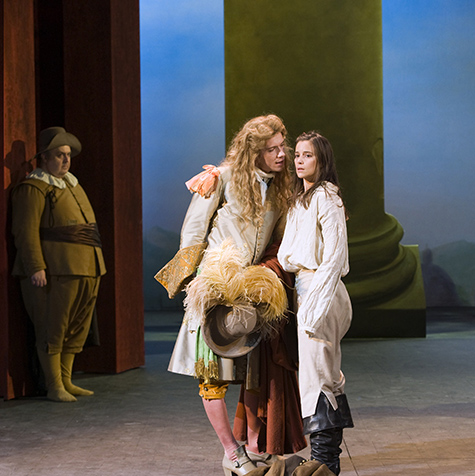 © Brigitte English
This change in Donna Elvira is most visible: and because her two appearance, in the I and IV acts, suggests herself for a comparison, and because she is played by Suliana Bryim, who debuted in the “Comedy” just four years ago and so rapidly “grown” to the current role due to a dizzying technique even by local standards. Her first scene is pure lyrics, dry and transparent; The second is a tense drama on the verge of exaltation, with a veil, turning into monastic boards, and a large red cross on a snow -white tunic. The maximum concentrated manner of playing in both scenes only emphasizes the difference: Donna Elvira I Act is full of quiet sadness and shame, IV - caustic bitterness and white anger. And when Don Juan, who is already almost in hell, tries to touch her, also leaving this world, but in the opposite direction, Elvira recoils from him as if in a culprit of horror. Not contempt, not disgust, not any other emotions, which, whatever one may say, is turned outside and connects; In this horror - not a shadow of “contact with the outside world” or “partnership”, only instinct, a reaction to evil. Thus, they are not back from the traitors or bastards - from the Salamander.
The fifth act is Korbury's masterpiece; Who does not know what the rapture of the “gloomy abyss on the edge” looks like - it looks like this. Don Juan does not “foresee” hell, does not even “seek” him; He, and you can’t pick up the other word here, rushing into hell with all his might, entering a disastrous excitement, reveling in the enthusiasm of the inevitable punishment, raising the heavens with blasphemy and Yernicha. The central scene here is with Don Carlos (V, 3); Exactly on the text of Don Juan, in response to each of his remarks, the sky remembers-but he turns his answers not to the partner, but to heaven, lifting his head and twisting under him with a back of him-and what is now for the matter to some kind of Carlos. Indeed, from the very beginning of the performance, whenever Don Juan spoke of heaven, thunder was heard (according to Vincan, a storm into which the heroes before the second act - the first warning fell), at first quiet, and now rumbling in full force; "There is a pattern!" -Don Juan rejoices, like a scientist who finally succeeded; Again shouts upstairs “Heaven!”, And again on top - thunder. And when the commander appeared, Don Juan will hold out his hand-but then he will pull off with the stupid enthusiasm of the bully, which will still be excluded, it will be excluded on the stage, it will reach again-it will touch it with a finger-and again mockingly retires, jumps to the advanced and will have fun there, the plumbing of the Burnt will not go into the spasm of agony from the splashes from the splashing. On the body of the cadaveric poison from that light touch.
In this undivided, accelerating overthrow of the hero in the final - the key to the plan of Vincent. “Don Zhuan” is usually set up from the great monologue-Credo from the I act about “twice two four”-and then carefully monitor the history of the hero, thus declared themselves, and gradually reach the end of the text. Vincent makes the main monologue Don Juan, about hypocrisy (V, 2), and explores his background: who is the person who came to this, where he came from and what brought him here? Played by Loik Korbury in pure despair, powerful and roaring, this monologue, however, casts reverse light not only on the internal logic of the play, but also on the causes of its appearance. Written only six months after the defeat of Tartum, Don Juan ends with a text that persistently refers to the forbidden play: here to “tear the flowers of pleasure on the rest of the one”, and “I will declare myself the guardian of public morality”, and “let me hurt <...>, I will hide the irreconcilable hatred” ... This reference will usually be interpreted as a trace The author, who could not retire from the vengeful kick (skillfully covered by an ambulance high -moraine denouement). And in other productions, the beginning of the 5th act rarely when it successfully embedns into the general line of the main role, presenting it rather by some unexpected wriggling: the last trick of the cunning, feverish throwing in the foreboding of the finals. Vincent, having transferred the center of gravity from the first act to the latter and making this monologue central, turned the vector of the performance itself - gave hypocrisy not as the hero’s maneuver “to the side”, but as the lower point of his fall in a straight line, behind which the viewer steadily observed the whole performance as a logical limit of personality decomposition.
As the space of the performance for two hours, like milk from acid, from wide landscape panels to caustic color spots scattered in the darkness - and the inner world of the hero, at first smooth and integral, turned into a stroke and lumps of vices into an adult of the elements of aggression.
In the finale, motionlessly laying on the forefront the entire monologue of Sganalel, Don Juan suddenly comes to life. And, as if nothing had happened, with a light gait runs away with the servant for the scenes, as if towards new adventures. Vincent is right. All he told is only a background. The prequel, written by Moliere to Tartufu. Having experienced the punishment of heaven and passing through a kind of “Poison Point”, which is still called death (modern doctors would add “clinical”), this hero will turn into another. Vincent’s interpretation turns “Don Juan” and “Tartuf” into a full -fledged, indissoluble, impeccably slender dilogy. And when Elmira, besieged by Tartuf, will try to appeal to his religious foundations: “But you think what awaits us for it!” - He will answer with the full basis: "Believe me, nothing." To whom to know, if not him. After all, he was once Don Juan.