
Translated material
Short course: kul-jazz
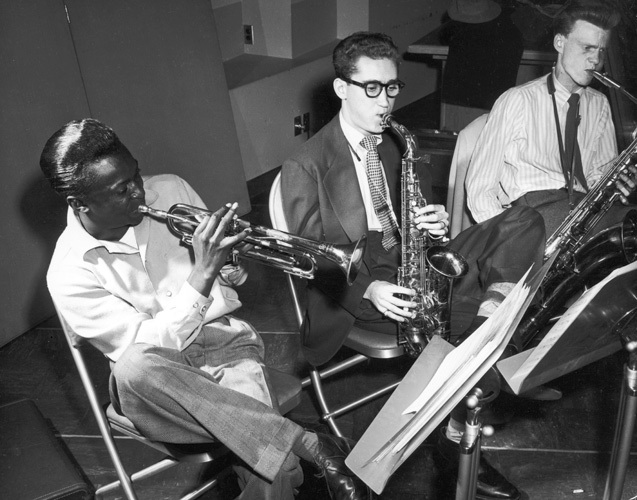
Colta.ru continues the encyclopedic series about the history of jazz: famous jazzmen intelligibly explain key concepts and phenomena from the history of the musical direction that changed the 20th century. We are talking about the period from 1940 to the 1970s-about jazz, which is commonly called "modern", or Modern Jazz. A week ago, it was about Bibep , now-about the birth of Kul-jazz.
1940-1950s. Kul-jazz. West Coast, "Third Current"
In 1949-1950, Nonet Miles Davis, consisting of the musicians of the ensemble Claude Thornhill, along with the arranger Gil Evans recorded twelve compositions, which in 1957 were released by one album “ BIRTH of The Cool " . These records led to the emergence of a new direction of modern jazz. They have already actively used many techniques of the academic composition - polyphony, improved texture and arrangement. Participants in the records by John Lewis and Jerry Malligan later played key roles in the development of this style. As obvious from the name, the kul-jazz was opposed to the “hot” sound and was characterized by restraint and severity. Many representatives of this style lived on the western coast of the United States, in addition, they were supported by the California Pacific Firm Jazz Records , which is why the term “West Coost-jazz” arose actually a synonymous kul-jazz. Interest in the composition, characteristic of this style, was further developed in the direction of the “third course”.
Miles Davis Nonet - "Boplicity"
German Lukyanov
Trubach, flogelhornist, ensemble "Cadans"
Miles Davis created such an aesthetics that was an antipode of an energetic, temperamental game of “hot” trumpeters. He understood that you could play melancholy, sparingly, use melodic minimalism. His fantasy was so bright, and the feeling of harmony and fret was so strong that it was very expressive.
Miles Davis & Gil Evans - "Miles Ahead"
Yuri Chugunov
Composer, arranger, teacher
In the 40-50s, musicians such as Stan Kenton are developing the “progressive jazz” style. It was a step forward towards composer music. He was picked up by people such as Gil Evans, who wrote a completely new type of arrangement and revolutioned in a swing orchestra. He abandoned the group of saxophones, strengthened the copper group, introduced wooden wind instruments, such instruments non -traditional for a jazz orchestra, such as a valtor, a tube, and even a harp. In fact, his arrangement is real composer music. It was not without reason that musicians such as Miles Davis, whom I consider to be a composer, despite the fact that he wrote a little plays collaborated with him. He has always been a stimulating beginning in the development of the main styles of modern jazz-and in Bibep he distinguished himself, and in Kul-jazz, and Fuzhn he began to play one of the first.
Modern Jazz Quartet - "Exposure"
Vladimir Tarasov
drummer, percussionist, trio "GTA"
Kul-jazz is one of many directions in jazz, and in no case he, as many believe, was opposition to Bibop. If only because one of the founders of both genres was Miles Davis. But the cardinal difference between them is that the basis of the Bibop is a direct syncopted rhythm, mainly by 4/4, and improvisations are more reminiscent of variations that are often unrelated to the topic and chained in rigid 12- or 16-tint repeated harmonic frames. Music is mainly built through “physics” and rhythmic energy - almost everyone at the Bibop’s concerts stuck with their foot and shake their heads to the beat. Kul-jazz is also odd, more relaxed rhythms, more free and developed harmony and, most importantly, compositional thinking. Of course, the influence of classical form formation is certainly. If in Bibope the improvisation is fixed in the framework of a certain square, then in Kul-jazz this is already a story from the beginning of the topic and, through improvisation, to the end of the work.
Most of the musicians felt remarkably performed by both Bibop and Kul-jazz, but there were many performers who remained stylistically “pure”, such as Modern Jazz Quartet . When I heard their record " European Concert ” , recorded in 1960, this music conquered me with its elegance, the amazing sense of the ensemble and compositional thinking. MJQ is one of the most striking representatives of not only kul-jazz, but also closely related to it, even more strict in the musical construction of the third course Stream ) , whose ideologist was Gunter Shuller. Who cares, I recommend the Modern Jazz Quartet recorded at the same time, in 1960, together with the Beaux Arts String Quartet , with Jimmy Juffrey on the Clarn, Jim Hall on the Guitar, called “ Third Stream Music " . Gunter Schuller conducts.
Kul-jazz is also odd, more relaxed rhythms, more free and developed harmony and, most importantly, compositional thinking.
In Russia, the most vivid representative of Kul-jazz for me is German Lukyanov, who, on the basis of this direction, created his own compositional style.
To the question of our trio (Ganeline -Tarasov -Chekasin): of course, this direction was close to us, because the built -up composition was the basis of our music. And we really did not want to drive Temecs, especially since our task was to find and develop our own musical language, which, fortunately, we managed. As a drummer, this music showed me that it is not necessary to play loudly and quickly - the ability to “whisper” on the drums and listening to pauses attracts me much more.
Stan Getz / Eddie Sauter - “I'M Late, I'M Late” from “Focus”
Yuri Chugunov
A special place in Kul-jazz is occupied by the suite of Eddie Soter, recorded with Stan Getz, called “Focus” . Only the hets possessed such a unique sound, with strings it merged perfectly. If not for the hetz, it would be quite traditional music. The hetz introduced his personal sense of music to it, and she perked up and appeared in a completely new quality. This, in fact, is the role of a musician as an organizing, inspiring beginning for a musical composition. The stylistics of such compositions is called the "third current."
Nate Walley
Trumpet, Nate Wooley Quintet
Gerry Mulligan Quartet - "My Funny Valentine"
When I want to imagine how the pipe should sound in its pure form, I return to the Baker, Net Edterley, Clark Terry and Miles Davis of the 1960s. If we talk about teaching a pipe game, even Baker was most important to me in the early period. I began to play at about 12-13 years and learned his simpler things to understand his lyrical manner of performance. His manner was very “vocal”, it went from Ellington’s musicians - such as Babber Miley and Kutie Williams. But the game of the couple really resembled singing. For me, he was the first to smooth out the tearing characteristic of this tool and made him sing. Nobody did this to him to such an extent, even Miles Davis. For me, the connection between the voice and the pipe was always important, and it was even Baker who first showed me this connection. The first musician to whom I began to truly admire whether Morgan was-I had all his notes, I tried to learn every solo. But over time, after that student period, I began to return to the couple more and more.
Dave Brubeck Quartet - "Take Five"
Andrey Razin
Pianist, Trio "Second approximation"
One of my first bright jazz impressions is the compositions of Dave Brubek. Brubek himself called himself "playing the piano composer", which, in my opinion, was very consistent with reality. It is known that he took lessons of composition from Darius Miyo; In the 60-70s, Dave Brubek created a lot of large-form music-cantata, masses, ballets, compositions for jazz-quartet and symphonic orchestra.
It is very interesting to use the Brubek knowledge gained from Miyo - in the compositions the pianist used polyphonic techniques, political education and polisite. Innovatives are the introduction and use of Brubek in jazz metric sizes - 5/4, 11/4, 9/8; Nobody allowed such “courage” to him (one of the best -selling discs in the history of Jazz - “Time Out” of the quartet of Dave Brubek - included the composition “Take Five” , written by the sagsophonist by the quartet by Paul Desmond for size 5/4).
By the way, in 2009, after the performance of the Trio “Second approximation” at the jazz festival in the Rochester (New York), I received a written response of Dave Brubek to our disc “ Event Space ” , which, of course, very inspired me and my colleagues!
Continuation next week: 1950s. Hard-bop .