
Translated material
What is a church?
Colta.ru continues the heading "Likbez" , in which experts share with us their views on the fundamental concepts and phenomena of culture. Today is an unusual issue. Father Sergius Kruglov - an Orthodox priest, a blogger and a poet - explains what the Christian church actually is and how it changes along with time.
Christianity is human religion, and the most important thing in it is a person. A person, as you know, is a measure of all things. Not ideas, not mood and fashion. The church is the God -man Christ and man himself, people. Everything else that we call conditionally the church is buildings, bells, dome, relationships, institutions - all this is already completely side.
God and man are intended to live together - this is an axiom, this is the basis of Christianity. God is the Father, and people are children. The biggest difficulty is that a person cannot be without God, and any actions that a person takes independently, without God, sooner or later ends funny, and more often such a tragic and terrible. As if the child tries to imitate his mother and waves his lips in his face, puts on his mother’s dress - this is ridiculous, and when the child begins to turn on the gas stove, all this can end tragically. It so happened that a person broke away from God and decided to live independently. Many interpret the departure of man from God (what we call the sowing) precisely as the act of such a puberty teenager who grew up, realized his freedom and began to realize it: he completely broke off all relations with his parents, fled from the house and began to live himself. The people sometimes believe that the return of a person to heaven would be a blessing, but this is not so - a person cannot be returned to infancy, he must live on, collect all his cones, make all his victories and discoveries, and know all his tragedies. This is life, and it must grow.
Sooner or later, the moment will come when he understands that this connection, which he once broke, is needed. This is for this and you need a church. God cannot drag man by the ears to heaven, otherwise it would not be a man. A person is a child, it is impossible to act on him by force. He came himself. This is the normal logic of the one who loves. I cannot force myself to love, but I can follow him and be with him, whether he wants it or not. God has become nearby. The coming of Christ into the world is dedicated to all this. And why did the church appear? Just because God cannot be instead of man. He did what depended on him, and then, as the famous Christian song says, "we will act." So we act.
The church is a god -human organism. But this is not a system, not something symmetrical and once and for all. It is like a tree that lives, grows and is still unknown where it grows up. A tree that lives for a long time and in different periods can be different trees: sometimes it is a palm tree, sometimes it is a fir, sometimes a bonsai.
The church is always changing. As soon as it was born, and began to change. This is quite clearly visible if you carefully read the gospel and especially the acts and messages of the apostles, that is, those books that are part of the New Testament corps. There are many spotlights who believe: let's restore everything as it was in the first centuries of Christianity - and everyone will be happiness. But in fact, there was no special gospel and well -being in church life in apostolic times, otherwise there would be no need to write numerous “messages” to the apostle Paul.
The people sometimes believe that the return of a person to paradise would be a blessing, but this is not so.
The church is a person. A person who had childhood, youth, maturity. At what age the church is now very difficult to determine. Father Alexander Men said that the church is still young and is still beginning. In a sense, he is right. At least in the human sense that youth has not come from a person. It can be lost over time, can be forgotten somewhere, but it can be pulled out, updated, implemented again. The girl who in an old old woman lives inside somewhere inside, with her dreams, feelings, with all the ardor-she is somewhere.
Looking at the church organization, you see that the church lives the way a person lives: he is sick with all human diseases, subject to old age, hemorrhoids, corns, etc. The wonderful church ascetic Sergei Iosifovich Fudel called these signs of diseases of the Church “The Dark Double of the Church”. Diseases are more or less tolerable, decent, there are indecent. Nevertheless, the personality of a person itself is always alive. The disease can be cured, and sooner or later it will pass. It is precisely the essence of the faith of Christians: any disease, any evil will end sooner or later. The good that is invested by God, including the personality of man - it will never end. The person will never end. But this is all the thorough, which is glued, hung - it will fall off. Even now we see examples of how it falls off in pieces. The church is always alive, in it is the source and result of this eternal life.
In different historical eras of the Church, the Church occur differently. Say, during the revolution of 1917 and all that happened after her, many regarded what was happening as the collapse of the church and something terrible. In fact, these are such severe breakdowns of the disease and the falling off of Korosta. Even the most direct result is how many new martyrs this era gave us. Those who were not Christians moved away, but the core of Christianity remained. And now the same thing happens: maybe an increase in the disease, some kind of designation.
How do you understand from the side of what is happening with the church? You can’t understand in any way. An important human question immediately sounds like this: why do you need to know what is happening in the church? You personally - why? Then a person begins to think: how do I feel about the church?
But this is only the beginning. The most important thing is to step over the threshold of the church. And before paying attention to this - whether the church is in a crisis or not - first turn to myself and ask: do I need it, why do I need a church? And when a person tries to answer these questions to himself ... I do not want to say that everything will be decided immediately. There are much more questions in the world than answers. God does not give answers, or rather, He answers in a completely different way. Father Alexander Shmeman once said very good words about this: when God comes, he does not answer our questions, he takes us by the hand and leads us to where the questions themselves disappear. Therefore, when a person himself tries to give himself an answer to the question “Why do I need this?”, He will change his eyes, he will look in a completely different way. This is very important.
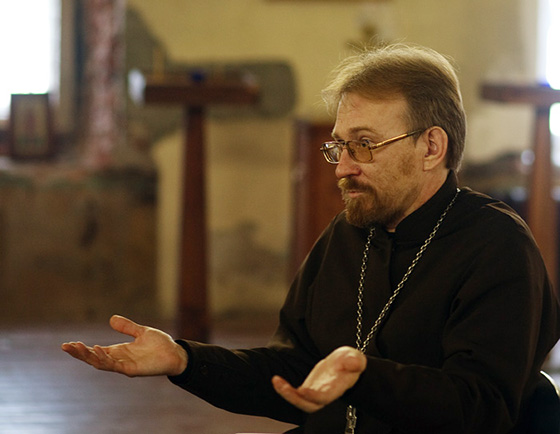 Pravmir.ru Sergius Kruglov
Well, of course, everything that happens with the church is always a reminder for those who consider themselves a Christian. Fortunately, the church is not only priests, but all those people who consider themselves Christians (if only priests were the church - this is a pipe business, it would be necessary to flee a thousand kilometers). There are many such people who call themselves Christians, and at the same time do not even think that, calling themselves as such, they automatically take responsibility for this church and must also be responsible for it. Priests perform only some functions. Another thing is that some priests because all this lead fatigue and all this abomination of life are piled on, sometimes they themselves like to maintain such a “priestly” mood. A man came, looks at you from the bottom up. Firstly, it's nice. Secondly, it is pleasant and good for a person to make it clear that you are a specialist and pros, you can do what a person who has come can not: do a certain mysterious action, so “knock into a tambourine” and conjure so that a person leaves completely satisfied that he was not in vain invested. Such a kind of shamanism. This temptation is completely clear. Although, in principle, any person can and should pray at the liturgy himself. The normal look of the church is very simple: the whole community, the whole parish - all appear before God, and the liturgy is the highest point of the church, when all the children of God (and those who run around the world, and those who decided to stay at home) gather together in the same house.
They enter the church through baptism, but this is only the beginning of everything, as a birth. There is no reason to believe that a baptized person is something better than unbaptized. The children are all the same: drowned, snotty, capricious. Only these are at home, and they have a chance. This is only a chance, because the very fact of entering the church, baptism, does not mean that you have automatically changed. This is only the beginning: the seed is planted, but how will it grow further? And all that exists in the church is the sacraments, prayers, worship and so on - this is only means to maintain this life further. It’s like a child who needs to put, feed, dress, educate, learn to speak, walk, etc. This is a huge process. And all these things-canons, rituals, dogmas-each of them has some sense in order to grow this “child” further. Among them, the sacrament of the sacrament occupies a unique position. Many ancient and modern theologians say that this is the central moment of the life of the Church, around which everything else is being built.
Nowadays, people live completely atomized. Even if you look at the people gathered in some service in the temple: it feels like these people are praying by each other. While the church is a family, people should be together. Indeed, a person can do everything alone: he can read the Gospel, pray anywhere. But to make the communion, the secret evening - to taste the bodies and blood of Christ - this is alone, for this everyone should get together. For this, temples are built, for this the domes shine, so that it can be seen where to go, the bells are calling to be heard. And everything else is already applied. This is the main sacrament of the Church in some ways comparable to the child’s nutrition process. The sacrament of participle is the most important liturgy in the church, and all other worships go back to it. She makes the church a church. During the sacrament, the priest and all the other parishioners in front of God are equal, as all children are equal in front of the mother, equal in love. She loves everyone, but only in different ways, because the children are different. There are famous words of the church: mainly - consent, in secondary - diversity and in everything - love.
There is no reason to believe that a baptized person is something better than unbaptized.
Love is the basis of everything. A priori acceptance of each other in love. Children can fight and argue among themselves, but they love each other, because they remember that they are brothers and sisters. And in this regard, both the priest and parishioners are exactly the same. And at the same time they are not the same. One is given one, the other - the other. One person composes poetry, the other has the ability to medicine, and the third is given the ability to earn money. On this score, John Chrysostom said remarkably that people are different because they should serve each other with their differences: rich in the poor, healthy patient. The ideal of normal family life.
The attitude of the church to minorities? Recently I fell into the hands of a book by one American Catholic theologian. He himself is gay, he went all this way. And the book is not devoted to the problems of gays as such, not all of this, but a more important, deep problem - the problem of an outcast in a church family. It doesn’t matter what basis he is an outcast, just not like everyone else. In our country, this takes a variety of forms: A, so you pray not like that; Ah, here in your temple they read the gospel not in Slavic, but in Russian; You are not so dressed, entered the temple without a handkerchief. Here is the root of the problem. I don't know how to solve it. The priest in general is considered a person who knows the answers to all questions. And many priests behave like this: here, we know the answers to all questions. Only they should say something, they open their mouths, climb into the department and begin to teach. In fact, this is not so. There are a lot of things that, even having tested in your own skin, and then you will not recognize. What to do, what to do?
It is clear that the word "sin" sounds scary for modern society. When one of my acquaintances of gays says: well, I can’t do anything, I have nature-it is absolutely right, this is nature. But who said this is a good nature? Science says that we have known the laws of nature. And who said that we knew the laws of the correct nature? Nature is spoiled by the fall, this is not a real nature. What is the difference between the laws of the kingdom of God and the laws of nature? Suppose we take a man of an armless, legless, blind and deaf. We study this person thoroughly, and on the basis of this person we derive the standard. But this is a cripple, a real person is not like that. This is the root of the problem: the person who claims this acts in accordance with his nature, he really cannot jump out of it, but the nature itself is crippled. When I tell a person “crippled nature”, for him it sounds evaluative. This is the problem - to tell the patient that he is sick. But you just need to talk about it, speak kindly, a priori accepting a person. It doesn’t matter how it is, let it be with his shortcomings, but we must talk about it, and love should be the basis. We generally have a lack of love. Everywhere and, in particular, we have in Russia. For many reasons. Therefore, this is a question not just a church, it is a question for our whole life. The husband does not hear his wife with whom he lived for thirty years.
Looking at the church organization, you see that the Church lives the way a person lives: he is sick with all human diseases.
A person who is afraid to love can be understood. To love is scary. This means substitute. There is a famous place in the poem about the love of the Apostle Paul: “Love will bend, merciful, love does not envy ... does not seek its own ... does not think evil”, etc. As for “do not believe, do not be afraid, do not ask”, then in principle there is nothing new for Russia. There is a certain shade in our Russian situation - this attitude towards success fell on Russian soil. Russian soil is criminalized through and through, that is, it is the soil of camps, Gulag soil. The whole country went through the camps, this is really some kind of Satan experience. He in many ways remained in the blood, in the genes of the Soviet man. These camp laws - “do not believe, do not be afraid, do not ask,” which are completely opposite to love - this is a terrible thing. This can, for example, say about this, any priest who makes his ministry in the zone or in prison. Outwardly, all this is welcome: they build temples, chapels, priests. But as soon as the priest begins to try not only to externally perform some church rites, all this external sentimentality ends. Archpriest Gleb Kleda, who first came, even during perestroika, wrote that a person in the zone is a person who lives in hell, because all laws are completely opposite. The Christian laws of love, mercy, tolerance, mutual assistance are completely not accepted there. And if you not only declare them, but really try to put them in life like a seed, then priests used to be killed. And so in any closed educational institutions, in cadet corps, in the army - this Gulag spirit and system everywhere. Therefore, it is natural that when this religion of success, or, in the Orthodox language, the “mamona religion”, which must be successful, manage all ahead of all, when it fell on Russian soil, it took completely wild forms.
In the metropolis, a person is started, he runs in a circle. Although I like to ride the subway. I do not see the crowd in front of me, I see people. Sometimes you imagine the life of a person with all its hardships and pray to yourself: Lord, I know this person for two seconds, I will forget for the third, but you, Lord, do not forget. What is a person in a metropolis and what is this terrible religion of everyday success? For what? Sometimes in order to pay a mortgage, a person is ready for anything. A woman comes to my temple and cries with such tears: Father, what should I do, I want to go in the subway to rush under the train. What's happened? Here, our store director is pestering me, forces me to cohabit. When I tried to convey to her a simple thought that it wasn’t better for the director to go and rushed under the train, she replied: so he would fire me! The main thing for a person is not to lose this work! Because children, because she gained some loans, because all life is tied to this. When a person sees this huge mountain of problems in front of him - now I will lose work and it will all fall upon me, everything else is leaving. And it's scary. This happens, of course, not only in a metropolis, just a metropolis is a very special habitat that is not the best for humans. But the longer I live, the more I am convinced of one thing: life cannot be changed. However, the most important thing is that it doesn’t matter which world, it is important what you are.
The sacrament of participle is the most important liturgy in the church, and all other worships go back to it.
In such a big city, a person has more opportunities in church terms: some sources of information are closer, some temples, priests, some trends, horizons are wider. And so here I meet more thinking, attentive Christians, who really somehow are responsible for their faith. But just as throughout Russia, there is a distrust and there is such a sad phenomenon when the church is turned into a plant of ritual services. A man seems to be baptized, believing, comes to church, and he must religiously serve him. Проблемы, беды и грехи, с которыми человек приходит на исповедь или за советом, в принципе, везде одинаковы, но здесь, в Москве, гораздо чаще встречаются проблемы семейной жизни, одиночества и распада семьи. Есть в Москве еще такая специфическая проблема — чрезмерная свобода выбора: очень много храмов, разных общин. И все зависит только от свободы передвижения человека: сегодня я поехал в одно место, завтра в другое. Это касается именно человека, который хочет, чтобы ему сделали религиозно приятно, религиозно удовлетворили.
То, что сейчас называется «вызовами времени» и информационной революцией, — это нормальный, закономерный этап в жизни церкви, когда пришла пора людям церкви думать. Не просто по самому факту, что вот я батюшка, у меня крест блистает на пузе, я вышел на амвон и буду что-то говорить, а все будут, открыв рот, слушать. В 89-м или 92-м году это бы еще прокатило — церковь была еще экзотикой, и считали, наверное, что если он батюшка, то у него крылья за спиной. Теперь этого, конечно, нет. Время этого младенчества прошло, и сейчас, мне кажется, время довольно жесткого взросления. And that's good.
Бог всегда все делает открыто. Он соблюдает принцип свободы человека.
Сейчас священники настолько открыты для интерактивного общения, что старшие священнослужители и архиереи иногда пытаются дать по шее младшим. Это не запрещено, конечно, интернет — это часть жизни. Есть уже достаточно большой православный сектор рунета, это ни для кого не секрет. И у меня, грешного, должна скоро выйти книжка, которая называется «Стенгазета». Это книжка выдержек из моего ЖЖ за несколько лет. Когда я ее издавал, у меня тоже были размышления на тему, как себя должен вести священник в интернете. Хотя виртуальная жизнь имеет какие-то свои особенности, но это такая же жизнь: там кипят точно такие же страсти, выясняются такие же отношения, завязываются какие-то вещи. Поскольку интернет просто вошел в нашу жизнь и стал ее частью, было бы странно, если бы батюшка сидел при свече и скрипел гусиным пером по бересте. А многие бы хотели, чтобы батюшка скрипел гусиным пером, хотят видеть какой-то образ.
Между словами «осуждать» и «запрещать» есть разница. Под словом «осуждать» церковь имеет в виду предупредить и дать информацию о том, какие последствия могут произойти и какие негативные явления усматривает церковь. Предложить человеку эту информацию. Воспользуется он ей или нет — дело его. То, что церковь открыто говорит о каких-то вещах, — это все нелицеприятные вещи, и это многих раздражает, но гораздо опаснее, когда не говорят и манипулируют тобой. Здесь принцип Бога и сатаны: Бог всегда все делает открыто, он соблюдает принцип свободы человека — он говорит человеку нелицеприятные вещи, может его наказать, пытается с ним взаимодействовать. Сатане открытость совершенно не нужна, для него не важно, верят в него — не верят. Еще лучше, если человек — атеист и не верит. Он действует обманом и какими-то своими методами и добивается своего результата. Манипуляция — это метод сатаны. Это не метод Бога. Поэтому пускай церковь говорит — пускай в нее кидают тапками и плюют, что она всем надоела своими вяканьями. Но из ста человек, может, один прислушается.
Всегда надо мыслью возвращаться вот к чему: церковь — это не организация, которая едина, не система, где все «скованы одной цепью». Мы привыкли, что церковь — это начальник. Это советское сознание и чисто советский стереотип. Глава церкви — Христос, и он давным-давно все ясно сказал. Открываем Евангелие и читаем. Вот то, что написано в Евангелии, то церковь и говорит.
Recorded by Julia Ryzhenko