
Translated material
Queen Anna
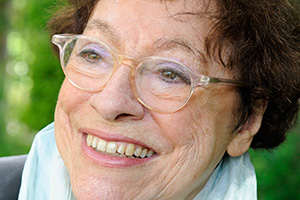
Already in Moscow, I realized that during an interview with Anna Kuneo, I played Mizancen from the musical “The Adventures of Pinocchio”, the television highlight of my childhood. A 77-year-old writer, calm and friendly, sailed like a Turtle Tortil, along the waves of her memory, and I, like a stupid Pinocchio, only smiled at her, dreaming of escaping from her pond as soon as possible.
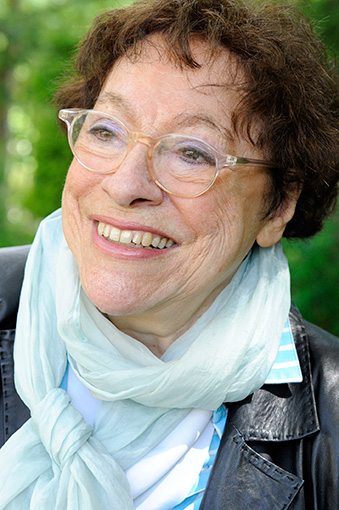 © AYSE YAVAS
This was the second day of my journey through Switzerland, organized by the Helvetia Foundation to get acquainted with its literary environment. The fourth interview in the day. Two hours later, we had to go to Basel - to a book fair, almost to the unknown, and in Zurich, who met us with oblique rain yesterday, as luck would have it, there was a dazzling sun. Anna Kuneo and I drank coffee on the terrace of a respectable restaurant inside a historical monument - the house of a guild of spices sellers, on the facade of which there were black camels. It was very clearly visible to me how the Limmat shines with the mother of pearl and how people are relaxed along its embankment, dodging the annoying cries of sellers of fried chestnuts. Listening to an elderly lady in a lot, I prudently thought about what to throw the question for politeness, so that her answer would not be too long, and also that I forgot dark glasses in Moscow, and to buy them in Switzerland - there is no money, no time, Basel train very soon, I practically did not see Zurich and sprisens so that it is painful to look at the pearl thread which constrained the neck of Kuneo. Damn, when will she finish?
Meanwhile, Anna Kuneo, who was presented as a famous French -speaking writer, television journalist, playwright and master of historical novel, set out the secrets of her skill. These secrets seemed to me the secrets of the police. Kuneo slowly circled around Maxim "The main thing for the writer is to be able to tell a story." She learned to tell stories from her colleagues - experienced television editors, who saved her plots from everything superfluous, gluing only the most significant scenes with each other. Now, laying out our conversation in the memory as on the mounting table, I understand that our crumpled conversation was doomed, we entered it from the wrong point, I did not ask questions that I had to ask.
Frank to bruises on the hips of the prose of a young woman who splashes her world on the reader.
In a good way, we had to start from the very beginning. From Paris, the 1936 model, in which the future Swiss writer was born, or even earlier, from Milan, from where her wealthy family comes. I had to ask about the colors and smells of these cities, which she cannot remember, but as a master of historical prose, she could easily reconstruct again. Then Kuneo could tell how she-an 11-year-old girl who suddenly remained an orphan-ended up in a green-blue Lausanne in a strict Catholic Panestial Shelter, where she was left without food for the slightest fault. The years of Catholic education, according to the writer, said not to me, went through a hyperactive child with a club and repelled a sense of faith from him. In Lausanne universities, a young Italian also had a hard time - in French she spoke and wrote slightly as a foreigner, for which students and professors were bored with. In spite of mockery, she taught the language on the “three musketeers”, most likely then it was then Alexander Dumas who became an exemplary writer for her, whose unsurpassed skill she does not cease to admire stories.
Then I would have to ask her about the 1967th, in which her literary debut “ Gravé au Diamant” came out. Judging by the fragments I found on the Internet, this thing is as far from the name of historical novels as much as possible - frank to bruises on the hips of the prose of a young woman, splashing his world on the reader. It is interesting how the literary environment of Switzerland looked when the youth of Britain, France and the States went crazy with the coming of sexual and psychedelic revolutions, and black camels with the bas -reliefs of the House of Guild sellers, as now, walked over the Embankment of the limat to eternity.
I could talk to her about the 1979th-the year in which I was not born yet, and she was on a printing machine, possibly the very coquettish archaic that is depicted on her business cards, taped the book “Une Cuillerée de Bleu” with the subtitle of the “Chronicle of Amputation”. On the pages of this literary diary, the author, who was diagnosed with breast cancer, is engaged in introspection and self -hypnosis, rushes between depression and hope for tomorrow, between a description of his own drug diet and portraits of other patients found in clinics. You have to be a bold person to write your personal “cancer case”. Journalist Anna Kuneo, who went to hot spots, fought for the permission of abortion and the rights of migrants, obviously a bold person.
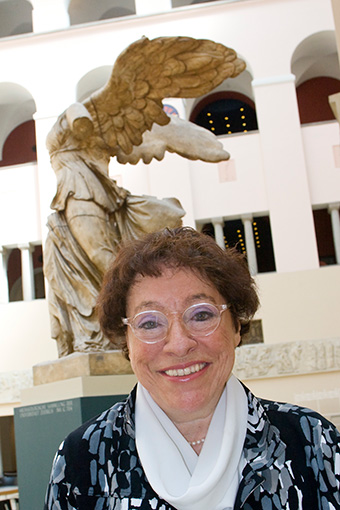 © Anne Spiller
Perhaps, with such a conversation, I would have a problem: Anna Kuneo has already written more than one candid book about her life that it makes no sense to retell the cup of coffee. In the early eighties, the writer, who received the Schiller Foundation, released a two -volume man with the subtitle “Portrait of the writer as an ordinary woman” and closed the autobiographical theme. And then she began to write about the people of extraordinary, even legendary, that is, who came to us from legends.
The new direction was prompted by a 95-year-old old man. This is to the question of how important it is to carefully listen to the elders in age, even if it seems to you that they were far away with a wave of memory. An venerable specialist in English literature, who first seemed to Anna a little confused, invited her to write a book about Emilia Bassano Lanier, a dark -skinned lady, whom Shakespeare (presumably) dedicated his dreams. The story of Emilia Lanier, who spoke in Italian Jewish, who became the first English poetess - was not seriously carried away by the writer, who made her will make her own French as a foreign literary effort. It was then that the lessons of Alexander Dumas came in handy, drawn from the "three musketeers". On the fields of the Shakespearean myth and in the gaps of the biography of Lanya, consisting of some gaps, the writer unfolded a large -scale and detailed panorama of Elizabethan England, which readers found equally exciting and convincing. So the author of mainly autobiographical prose became a recognized master of historical novel and founder of his own mini-series “The Life of Wonderful People”.
If you look at the list of characters to which Anna Kuneo devoted her inventive-true novels, you can identify some pattern of choice: Shakespeare's contemporary Francis Tregian-a collector of music of his time, according to the collection of which is now being studied by Verginal music; The French first printer Antoine Ozhero is the patron saint of poets and the teacher Claram Garamon, who has yet come up with a font popular; John Florio, brought up by Switzerland, is the author of the first Italian-English dictionary and a Montaena translator, a European polyglot and a teacher who may have taught (again) Shakespeare. These are figures not from the first row of textbooks of the history of Europe, but without them these textbooks may not have appeared. In their biographies stuffed on the Kuneo printed machine, we can see the details reminding us and the mistress of the machine - the popularizer of the culture of the Old World, the wise tortile, whose world, alas, is already far from the current Buratin, like the pavans and allemands collected by a threegy, from the hits of Rihanna. In the fate of the half -forgotten enlighteners of the Shakespearean era, the writer saw her reflection.
“You know, Switzerland is a small pond. It is easier for lilies to live in it than in a large one. ”
The final chord in the ZhZL of Anna Kuneo is a biography of an ordinary Swiss long -liver of Zaida (Zaïda) , whom she gave the name of her great -grandmother: a hundred years old from the life of a woman born at the end of the Victorian era, who dared to engage in medicine and psychoanalysis, despite the social prohibitions of her time, and the difficult century that had lived, which fell out for which Industrial and social revolutions, two world wars and fascism. Anna Kuneo released this saga in 2007-to the 40th anniversary of her writer's career, closing the branches of her autobiographical and historical prose to each other. According to reviewers, the book “Zaïda” , whose action captures three countries and five generations, has a aftertaste. Namely, a bitter feeling that society makes a mistake, turning away too early from the elderly, depriving itself of their knowledge.
I still asked Anna Kuneo’s good question. Under the last sip of espresso, I asked her about what changed for her as a writer in zero compared to seventies and eighties. Having corrected the thread of the pearls, she answered with a long tirade that everything had changed, and not for the better: fanatics and obsessed leave the book business, the publisher enlarges, turning into a big business, they are being refueling by books and their authors, like bananas, and in the States, they say, together with the contract, they give instructions that they should write exactly that, they should write. Bestseller. But ... she does not want me to consider it a complaint about life - for almost five decades of writing, she was used to the fact that he is not easy, but not heavier or easier than others. After a moment, the one with whom I behaved like Pinocchio added: “You know, Switzerland is a little pond. It’s easier to live in it in it than in a large one ”-and dazzlingly, in a korolevsky smiled goodbye to me.
On November 27, on Wednesday, as part of a large Swiss program at the Non/Fiction No. 15 Fair, Anna Kuneo will take part in a discussion with the poet Alberto Nessie “To be a writer in Switzerland” (15:00, Swiss stand A1), November 28, Thursday, she will make a lecture “Source of Inspisition for the Writer” (13:00-13: 30, 30, 30, 30, 30, 30, 30, 30, 30, 30, 30, 30, 30, 30, 30, 30, 30, 30, 30, 30, 30, 30, 30, 30, 30, 30, 30, 30, 30 The Swiss stand A1) and will take part in the discussion along with Lucas Berfus and Alberto Nessie “His language, his source of inspiration” (17:30-18: 15, zone of seminars No. 1).
The editors thank the Helvetia Foundation, Swiss Air Airline and Switzerland Tourism Office in Moscow for helping a trip to Switzerland.