
Translated material
History "on order"
About the composition "Black myths about Rus'. From Ivan the Terrible to the present day "
The most powerful minister Medinsky is overthrowing the culture that he heads. The same that is inconceivable without history, philosophy, literature. With them, the minister fights desperately boldly, evidence of which is the composition “Black myths about Rus'. From Ivan the Terrible to the present day. ”
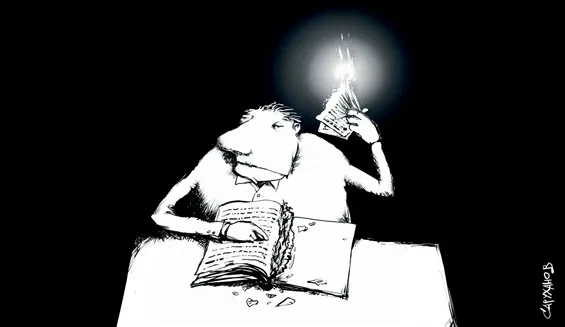
And I like Minister Medinsky. I love the overalls of the basics. It is most powerful that he overtakes the culture that he leads. The same that is inconceivable without history, philosophy, literature. With them, the minister fights desperately boldly, evidence of which is the composition “Black myths about Rus'. From Ivan the Terrible to the present day. ” In the film itself, the role of Vladimir Rostislavovich is somewhat obscure. He here is given among other oversees - from Yampolskoye to Narochnitskaya. But in the generous announcements of the “news of the week”, Goskanal (the enthusiastic lips of Dmitry Kiselev) clarifies: the tape was created on the basis of the book bestseller of the Medinsky “Myths of Russia”. It was written even before the author became the Minister of Culture.
The holy truth. Long before this blessed moment, our hero sculpted the “myths about Russia”, which were devoted to film adaptations on the TVC channel. In total, V.M. Delassed twelve myths in twelve episodes. He, along with his then accomplice Prokhanov, “raked those miasms that accumulated since 1991,” that is, he fought with home liberals, not forgetting to spit in overseas enemies.
The ministerial position opened the eyes of Medinsky. Everything is much more serious. The infection began in the Fatherland because the West has been waged by information wars against Russia for 400 years. Black raven anxiously croaks in full screen. He would not still croak him - there is such a thing there! They sang, reptiles, the bright name of Ivan the Terrible. And they began to lie at once. The third year of the Livonian war (1561) is going on, and Europe is already spreading the leaflets about the atrocities of the Russians. “Here, it turns out, why Gutenberg invented the printing,” I only managed to guess how the authors rushed to jump. For some reason, Ivan III, Ivan the Terrible (IV). They rushed behind them: adventurer Henry Staden with his “Notes about Muscovy”; traitor Andrei Kurbsky with his revealing letters to the Russian king; Jeanne Friske (apparently, as a symbol of tabloid aesthetics), which was replaced by personnel of the Novgorod massacre. Ivan the Terrible ran again. All the time nearby, the shadow of Paul I wanders. These are two main characters in the film. They are temporarily pushed to the periphery by Anna Yaroslavovna (daughter of Yaroslav the Wise), the queen of France. She surprised the barbaric city of Paris in that she often washed, and Europe until the beginning of the twentieth century did not like this occupation. And why? And therefore - there was no firewood. But we have - there are a lot of forests. What is not a reason to go to Russia by war? If anyone in elementary school taught the poem “Farewell, Unwashed Russia”, forget about it. These are not Lermontov, but the ideological sabotage of the West.
However, the very last thing is to try to believe the Medina harmony of the algebra of history. She has nothing to do with it. Our overthrust is the genius of interpretation, not factology. His mission is completely different: he is p’s -story. And PR is as far from reality as a minister from culture. But the views of V.M. At the peak of the trend: “If you love your homeland, your people, then the story that you will write will always be positive.” In a word, the teachings of Marx are all upset, because it is true. Medinsky is a zealous Leninets. It goes the right road.
Through the infuriated installation of the film, the fragmentation of synchrones, the galloping text is visible by the main idea of the composition. Why, one wonders, the West was most rotten by Ivan the Terrible or Paul I? The answer is simple: this very West always spreads rot strong and exalt the weak rulers, whether it is Nicholas II or Gorbachev. The subtext remains cardinal: Putin is a strong ruler, from here you should know what. This thought indirectly confirms the true decoration of the film - Elena Yampolskaya. The jewelry looks like a sovereign of a concubine: all in gold, pearls, lurex. And she has golden speeches, they say, it’s good that the West thinks about Russia. We have our own civilization. As soon as she rises, they begin the struggle with her. “One hope - now we will rise to the highest point of this circle and again create our civilization.” The Yampolskaya was clearly modest here - they had already risen, have already created.
There is, however, a certain problem associated with the mismatch of declarations. In the announcements of the film, emphasis is placed on his truthfulness, on the final breakdown of all the integrations, and the viewer is waiting for only a set of false versions, only in the opposite interpretation. In the ordered text, the suffered thought of Medinsky about the law of information wars sounds: "A competently propagandized myth is perceived by the children of its creators as the truth in the last instance." It turns out that we are fed in the state of state - competently propagandized by myth.
In general, the frankness of Medinsky, not obvious, but hidden in the comments of completely different events, amazes the imagination. All our enemies, it turns out, write about Russia "on order." But if they even wrote well, it would not be broadcast. In the information wars, only negativity is generously spinning.
The minister clearly adopted this creative method. He changed the signs - and now another story is ready, "on order." In it, Ivan the Terrible White and Fluffy. In it, Pavel I is again Russian Hamlet. In it, Russia again the heiress in a direct Byzantium, and therefore, Greece and Rome of the heyday, to which Europe still grow and grow. All this would be funny if it were not for the gloomy seriousness of the authors and performers, coupled with the state post of the main author-performer. And then, after all, a reverent viewer can finally believe that we have culture and propaganda - synonyms.
I have one question left - to Dobrodeev. How, and most importantly, why did Oleg Borisovich, a professional historian, launched it on the air? Myths can also be debunking , but why is it so non -talented, clumsy? Is it really decided to spread the mammoth to the entire channel somewhere in the mountain spheres? But even mammoths, it seems to me, would make a more elegant ending than the one that is given in “black myths”.
Under the curtain in the film, the culprit of many Russian troubles was found in our Palestines. You will not immediately guess who it is. It turns out that Russian literature of the XIX century. She made her hero a reflective person. They forgot the ungrateful classics about the cardinal: the Russians opened Antarctica, conquered Turkestan, mastered the Far East. And why, one wonders, in these same minutes, when I write a note, the descendants of the classics are going to resurrect domestic literature under the leadership of Putin (and, probably, Medinsky)?