
Translated material
Hatred people and people freedom
A few weeks ago, Alpina Plisher published a book that seriously improves karma for everyone who was related to its exit. This volume was edited by the deputy director of the Institute of Philosophy of the Russian Academy of Sciences Sergey Nikolsky and prisoner Mikhail Khodorkovsky. This is a reflection on institutions, the conditions of the existence of civil society, its relations with the authorities, about which the state can become effective. As the book on the book “Liberal Mission” Nikolsky told the book on the book on the book, the book was preparing for two and a half years. Editing a volumetric volume from prison is non -trivial experience.
The text of the articles opens the text of the Khodorkovsky himself, which today reprints Colta.ru . The main Russian prisoner writes about freedom as an unobvious good. A decade spent in captivity is increasingly setting an MBH in a philosophical way. Indeed, “freedom is better than non -freedom” not for everyone. Not everyone is vital for everyone. There are people everywhere, "for whom not free is a more comfortable environment." And the people in Russian history often could not cope with freedom, fled from too difficult a choice , or, with the words of Khodorkovsky, from his worst enemy - himself.
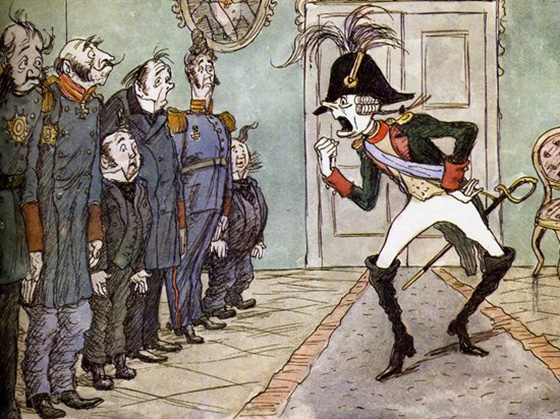 Kukryniks. Illustrations for the "History of one City" by M.E. Saltykov-Shchedrin. 1939
This, however, does not mean that someone (usually the state) freely decide who is worthy of freedom and who is not and what kind of freedom. The algorithm for determining maturity is impossible here. In the post -tank philosophy, freedom of citizens should be perceived by power as a given. In return from her (this shows Erich Soloviev from the Institute of Philosophy), one can not demand kindness, wisdom, coincidence with the ideal. It would seem to be a minimum-state-legal guarantees. But this is a minimum of reliable, creating the possibility of social development, the rule of law, the republic (democracy). It is only necessary from the authorities, Kant wrote, “the consent that people are able to independently, selflessly arrange their lives.
The expression cannot be considered good: the famous people have not matured for freedom. The fortress landowner (as if) was not ripe for freedom, and for freedom of faith people did not ripen at all. But with such assumptions, freedom will never come, because it is impossible to ripen for it if you do not pre -introduce people into the conditions of freedom (you must already get freedom in order to be able to use on their own at large). The first manifestations of freedomovalia can, of course, be rude and are usually accompanied by more difficulties and dangers than those in which everything stood not only under orders, but under the care, however, they ripen for the mind only through their own attempts. ”
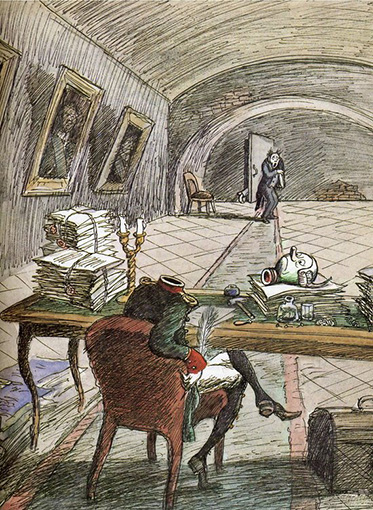 Kukryniks. Illustrations for the "History of one City" by M.E. Saltykov-Shchedrin. 1939
You can’t learn to walk “theoretically” - not having the opportunity to try to take the first steps. Trust should be proactive. Mamardashvili spoke a lot about freedom as work, as Brazin. If you do not relate to freedom as a duty, the lack of external "bastards" easily turns into an "inert evil entropy", "indifferent mock chaos." The world in which people, like the heroes of Dostoevsky, want light, unlimited freedom, capture "terrible idols of passion, soil and blood." That is why the collapse of the totalitarian state in most countries of the social camp led to a dive (more or less long) in the jungle, an antisocial state, a war of all against all.
Freedom is impossible without a severe and continuous search for thoughts, order, harmony, said Mamardashvili, with whom the MBH was tonced this time. It is no coincidence that the 500-page volume ends with the beloved Mamardashvili Kant-"The answer to the question" what is education "." I think approximately such a mental design led the MBH to philosophers. In addition to Nikolsky, Erich Soloviev, Svetlana Neretin, Vladimir Porus, Vadim Mezhuev, Alexander Ogurtsov and others participate. However, not only philosophers: retired judge Sergey Pashin, Natalya Zubarevich, Alexei Levinson, Vladimir Ryzhkov, Evgeny Gontmamer and others.
“For freedom, one cannot ripen if you do not pre -introduce people into the conditions of freedom.”
The introductory text of the MBH, where the problem of constructing the state is set, the system of rules, within which people can be free, is organic instruments of the book dedicated to freedom and the state of the book. Adam Mikhnik (a very successful decision of the editors of the book), one of the participants in the “solidarity” and the “Citizens Committee”, which led Lech Valens, continues. But Mikhnik did not talk about the Polish experience of movement from non -freedom to freedom, but gave his preface to the book of Vaclav Gavel “The power of the powerless”, where he tells how the Czech Republic went to freedom. By the way, 15 years before the Czech Republic gained Freedom Gavel, he worked as a loader at the brewery, and Mikhnik was in prison three or four years before the “velvet revolution”. There, in prison, Mikhnik promised himself : 1) never to enter into any veteran organization, where they will give orders for the fight against communism; 2) Never avenge anyone. I really want to hope that I gave some similar in meaning to himself and the MBH. Otherwise, being free, he, by his own reasoning, will be less free than now. In general, I would give out books by Mikhnik and Gavel at opposition rallies: they very clearly show that "the dissident subculture had its own traps." The uncompromising position of “people of hatred”, fighters with a tyrannical, despotic state, easily leads to the Stavroginsky demon - through conformism in its own environment and “angelization of oneself”. Now this path, alas, intensively goes the leaders of the Russian opposition.
 Kukryniks. Illustrations for the "History of one City" by M.E. Saltykov-Shchedrin. 1939
The anatomy of this transformation, according to mihnik and Gavel, is psychologically simple:
“In the subconscious of those who hate, there is a feeling that they are the only real owners of truth, that is, some super-enormous people or gods ... Hatred is a devilish line of the fallen angel: this is a state of mind that wants to become a member of God or God himself, although it is always painfully convinced that they are not ... for the hatching herself, he can quickly change her objects, although his attitude towards them remains that his attitude to them remains. the same ...
The hateful person does not know a smile, it is replaced by a grimace. He is not capable of real irony, for he is alien to self -irony. Only one who knows how to laugh at himself really laughs ... who hates a particular person is almost always able to succumb to the hatred of collective and actively participate in it ...
Collective hatred frees people from loneliness, a sense of abandonment and powerlessness, anonymity, so that they get rid of a complex of inferiority and unsuccessfulness. Instead, she offers a community and creates some kind of special fraternity ... They can constantly vyingly certify each other in their own significance, competing in the manifestations of hatred of some group of imaginary culprits of their insults. ”
The uncompromising position of “people of hatred”, fighters with a tyrannical, despotic state, easily leads to the Stavroginsky demon.
But this simplicity does not interfere with all new and new generations of freedom fighters to turn into hatred people.
So, there is little freedom. And people of hatred, fighting the “bloody regime”, are gradually likened to their crowned persecutors. This is evidenced by Erich Soloviev, recalling the "justification of the good" of his namesake Vladimir Solovyov:
“The task of law is not at all that the world lying in evil would turn to the kingdom of God, but only that it does not turn into hell before time.”
Paradise on Earth is impossible: there is no such state of the world in which the inter -human contradictions will be eliminated, complete harmony will reign and everyone will be satisfied with social institutions, power and each other. And do not look for the impossible: the differences in the interests, goals and the image of thoughts cannot be smoothed out, but in legal way you can at least, according to Kant, streamline the clashes of human claims. This is necessary, in particular: 1) recognition of the primacy of human rights; 2) the real and effective supremacy of the law; 3) the equality of all citizens before the law. Actually, in the coming years, the opposition and the authorities have to agree on these three points (plus the rules of replacement of power) if it decides to suddenly join the Basic General City Treaty.
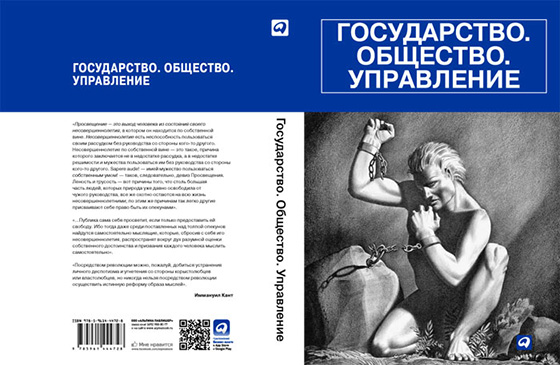 © Alpina Plisher
The ruler cannot be educated, enlightened, Soloviev and Kant continue. This illusion is inherent, alas, not only to experts trying to inspire certain ideas to the current leadership of the country, but also to those who are trying to educate in a spiritual sense to grow their replacements. Nothing comes out of these attempts. The activities of rulers can only be limited by the power of the law. If we all succeed in agreeing on this, the task of public arrangement will simplify markedly. This is also evidenced by Vladimir Porus (HSE): without legislative restrictions, we are doomed to have not a real (working as a clock) bureaucracy, but only a miserable parody of it, serving its own interests.
The rest is a tongue twister. Svetlana Neretina (Institute of Philosophy) perfectly shows the evolution of power from her sacred-dense perception (from where our paternalism comes from) to the modern one. State unity in our opinion is collectivity, a community of ideological slogans. This means that in Russia the “state” is still a synonym for the “kingdoms”, the monarchy. And the English state is just a state whose meaning can vary depending on social and economic relations. Neretina offers language reform - for example, to abandon the word “manage”, which implies vertical relations, and speak in relation to the state on regulation, management (horizontal coordination).
In the interesting work of Sergei Nikolsky, a fresh description of the attitude towards the state and society in the literature of the 19th century was given: Fonvizin, Pushkin, Herzen, Saltykov-Shchedrin, Dostoevsky, Sukhovo-Kobylin, Leskov. To the surprise of those who have not returned to the classics since the study of the school curriculum, it turns out that they discussed exactly the same issues that we are now. In another article, Nikolsky proves why on the way to democracy it is impossible to “jump over” the stage of the national state-which, unlike the feudal-clan empire, we never had.
The ruler cannot be educated, enlightened. The activities of rulers can only be limited by the power of the law.
Evgeny Gontmamer (KGI) very clearly describes the symptoms of decaying the modern socio-economic structure, which has developed within the framework of the personalist regime of Putin’s power, the transformation of all institutions into its opposite. Further, it gives a project how the executive branch can be made more compact and effective. Sergei Pashin demonstrates the same substitution on a specific example, showing how the state in Russia replaced justice in the last centuries, and whether it should become a “third authority”. The text of Pashin is a good addition to the Plan for the Police Reform recently published by the European University in St. Petersburg.
The meaninglessness of the vertical of power in the regional management brilliantly shows Natalya Zubarevich (Moscow State University). Centralization only interferes with development. Albert Aleshin (RSUSU) is trying to identify the irrational nature of anti -capitalist sentiments in broad masses. Alexei Levinson (Levada Center) and Dmitry Frobnitsky ( Terra America ) draw a system of political views of the middle -born class that is presenting the demand for stability and freedom.
Greek and German philosophers, like Russian writers and authors of the reviewed collection, were well aware: the watershed between people of freedom and hatred people do not pass through the line of political confrontation or civil resistance. It passes inside each of us.
State. Society. Control. - M., Alpina Pablisher, 2013. Edited by S. Nikolsky and M. Khodorkovsky