
Translated material
Freedom, equality and brotherhood
Noblesse Oblice : Legends (especially theatrical) are better to remain legends - a clash face to face with them in the vast majority of cases turns into no need for anyone. Lev Dodin, who opened the Winter Festival in St. Petersburg and just shown in Moscow at the NET festival Peter Brook’s “magic flute” is a rare exception to this unshakable rule: in the production of the Paris company Bouffes du Nord the legend of the twentieth century Theater looked equal to itself.
It is paradoxical that it was this performance of the late Brook - and not, for example, “Warum Warum” - domestic (mainly Petersburg) near -theater scholiasts perceived the exercise in the genre of “Tales of the Old Grandmother” and commented on it with the appropriate complacency: quoting the Pasternaki formula for unlimited simplicity from inappropriate use. And experiencing “mixed feelings of emotion and surprise” from how allegedly “childish” the Brukovsky Opus Magnum is arranged.
As if not.
It is worth taking a closer look at the performance more closely to understand: the imaginary simplicity is deceiving. The Russian public has not encountered a long time with the directorial gesture of such heretical freedom and courage, such unheard of radicalism-in this sense, Brukovskaya “La Flûte Enchantée”, if you figure it out, will even be stronger than some “Mahabharata”. The 75-year-old classic explodes the Galaxy of the “Magic Flute”, begging (or, more precisely, sending to Ignor) the tradition of being the Mozartov text in the European (including theatrical) culture of recent decades.
However, one should not think that radical - means necessarily remote from the original. The latest history of the theater knows at least a few staging interpretations of the Magic Flute (from recent - the grand performance of William Cantryge in Brussels La Monnaie ), but Brook’s version is perhaps the closest letter and the spirit of the original source.
 © Alicia Peres
One of the commentators penetratively saw the intertextual nature of the Bouffes du Nord performance: this “magic flute” is a child of its time, it could not be born earlier than the first decade of our century. Exhibiting Mozart's music from the Procrustean bed of interpretation, Brook consciously or unconsciously composes the intertext of the entire theater biography of the score - and to the leaning short era of the directorial Sturm und Dranga to read the Peter of the Concavor and Ahim Frander, and to the fixed fatigue of Mozartovsky from the endless amount The versions of Martin Kushey performed on him, and to the ugly "bubbles of the Earth" like the film version of the poppy, the capture of Kenneta Brana.
Brooke offers to read the Mozart text, as it were, from the clean sheet, and the Prima Vista - without taking into account the extensive corps of later intellectual discoveries made in the score. What will happen if you reject the knowledge of the “magic flute” as a Masonic catechism, about the compensation of philosophical maxims and reduce all this read from the score (and counted in it) complicated content - will the design of the Mozart universe withstand?
Answering these questions, the director appeals to the genetics of the work, forcing him to recall that actually the “magic flute” was written for Emanuel Shichedra and his Theater Auf Der Wieden -who was in the Vienna's suburbs and made a bet on the general public and a democratic repertoire.
Refusing the usual cliches, Brooke removes from the “magic flute” all unnecessary and soil, exposing the archaic universal in his humanism parables and depriving the sound of Mozart music of the expected concert gloss. The viewer does not seem to watch the performance, but the rehearsal going under the piano is a pianist on the go (and at each presentation in different ways) in real time here, and now formates the texture of the original, presenting the public not ready glossy glossy of the result, but an unprocessed cheese of the process.
The original musical text is cut in the living, important in the dramaturgy of the number of the number, the numbers are stopped one after another, only introductory chords are completely left from the overture - but they are indistinguished so much that the bills do not notice: at the Brook play - and thanks to the rare meaningfulness of the work of the brotherhood of his artists - you understand why Asafiev called the music of intoned meaning.
Actors play barefoot, touching the feet of a wooden tablet of the scene. The “image of the performance” is minimalist and environmentally friendly - the legendary “empty space”, zero of opera cabinism, zero of the bourgeois chic organically inherent in the genre: this is the path that the scene went to understand the Mozart text from the romantic times of Karl Friedrich Shinkel to today.
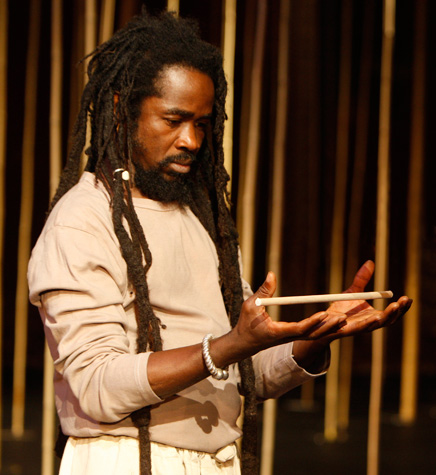
The theater is also reduced to zero, to the beginning, to the start of the reference point-to a childish direct game, to the naive consciousness of the actor ready to get into it and ready to become its participant in the viewer. The scene of the performance is the imagination of heroes and the public. According to the protagonist’s hand, the charming Abdu Ulogem - a person from the theater whose color merges with the blackness of the backstage - the bamboo flute turns into a crashing weapon, and this transformation is equally undoubtedly for the actor, for the viewer: we, who have accepted the rules of the game, believe in it as well as in the two vertically delivered bamboo pashes. Entrance to the dungeon. The “Magic Flute” is read by the universal metaphor of the Brukovsky Theater and at the same time its formula - update through the revolution: the director returns the initial strength and meaning to the drama, recharging it from the simplest primary elements.