
Translated material
Get stuck forever
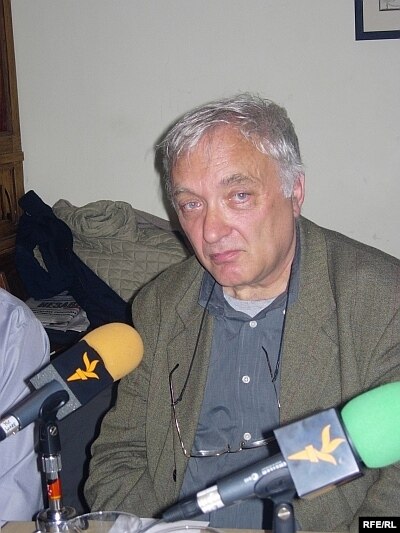
He also proceeds early to impassive analysis, without fear and without passion-some passions are still raging. There will not be a common, detached look at the events of the fall of 1993 in Russia for some time, although there are already some prerequisites for its formation. In France in May 1968, phenomena occurred, which are still called "events" because no one knows what to call it. There were several names at the conference: a political and controversial crisis, a coup, a bourgeois revolution and a glimpse, but still the word "putsch" sounded.
I think it was a coup d'etat, but it's not what I think. Behind the word that will be chosen, there is a vision of the history of Russia for the last decades, and this is an important discussion.
We discussed the question of the struggle between the branches of power. But some said: you can’t talk about parliament, because it was not a parliament, but a Soviet sovereign council. But in the same way it is impossible to talk about the president of the new Russia. Without saying, for example, about the building that Yeltsin inherited in Old Square; However, he inherited everything else from the Soviet regime. Therefore, I would not talk about the struggle between the branches of power, but rather about the impossibility of separation of one government. The fact that the Soviet government was not divided-at first it began, some division was planned, but it did not end. 1993 was the final defeat of this evolution, and Russia returned to the system of simultaneous. I was very struck by what fear today they say about the "biased". But actually there are three authorities in democratic countries, and this does not scare anyone. And here - two authorities scared!
In the center of the idea of Soviet power is the idea of unity of mind, according to which only one person should stand at the very top. Hence the idea that the presidential power was the most suitable for Russia. The idea that in the absence of the upper house of the parliament, the Senate, in the absence of a working parliament for the country of such sizes as Russia, the best system, when all the power in the hands of one person, of course, is delusional. It is necessary to have a platform where representatives of different regions, different political directions, and different local elites can negotiate. But people who made the decision in Russia, of course, proceeded from their ideology, and this ideology was (I do not want to talk about communism) the idea of unity of command: we need, strong power.
As if parliament is not strong power!? By the way, the English parliament is a stronger power than any dictator in South America. They said that the transition to democracy from totalitarianism should go through the authoritarian period. And that the main character of this period is General Pinochet. We remember the discussion around the concept of "iron hand". There was an idea according to which you can gradually move from authoritarianism to democracy. It seems strange to me, but suppose that this is possible. The only question is that no one ever gave guarantees that it is possible to move from an authoritarian system to a democratic one without stuck in authoritarianism forever.
What happened in 1993 depended on a similar vision of history, the development of the country. Russia supposedly had to "go" through a power that would not depend on the population. Here, both Soviet performances came together (what the people thought that society thought did not care much of the rulers), and technocratic moods. Technocrat, in fact, does not think that the minds of society need to take into account. He thinks about making "technically correct decisions."
The 1993 conflict was very often read as a dilemma: "A return to the past, to the Communists" or "Forward, to democracy." This is also one of the stamps of that time. It was as if "go forward" could necessarily be for democracy! Well, with a call through authoritarian rule, but as if democracy is promised to us as a bright horizon of mankind ... In general, few in Russia thought about how to ensure that the future was democratic. Such forces at that time looked marginal.
The lessons of 1993, the ratio of those events with the current time, seem important to me. How does the current regime come from 1993? And therefore, it seems to me that passions in Russia did not subside, because 1993 is still alive. What is the 1993 lesson for ordinary citizens of the country? How did people go from the street, what is their impression of all this? It is important to think about the social component of events. My conclusion is this: the Russians learned a lesson that the authorities have the right to use force. Well, sideways: the fact that the parliament is not where the power is, it is a saying.
Historians know that evidence is a fragile thing; that people remember not all; that they are rebuilding their memories. Nevertheless, an oral story allows you to hear how Mandelstam would say, the noise of time is better than many documents.
Alexis Berelovich is a French Slavist, a sociologist and historian, professor at the University of Paris-IV (Sorbonne), an employee of the French Center for Research of Russia, the Caucasus and Central Europe.
Preparations for the press of Anastasia Kirilenko