
Translated material
Russian epic Ian Fraser
Siberian adventures of an American writer
What Russia and what Siberia did the American writer have seen and loved

“Traveling in Siberia” is the name of the book of an American who traveled through all of Russia. Ian Fraser, Krasnoyarsk, November 2013
Amazement is the first feeling that the American writer Ian Fraser experienced in relation to Russia. He read the young man about the Second World War, and he met a description of one Soviet military operation. It was necessary to throw landing from the air into German territory, but just before the flight it turned out that there were no parachuts. Then the military authorities ordered to fly very, very low over the territory of the enemy and jump to the ground without parachutes. Both soldiers and commanders knew that some of the people would die, part would be crippled and only a few would survive and be able to complete the task. It was decided to greatly increase the number of paratroopers so that the survivors were enough to complete the assignment.
| *In November 2013, the fair took place for the seventh time. More than two hundred exhibitors - publishers, book -industrialists, linguistic and cultural centers, libraries, literary agencies, museums, and educational institutions participated in it. The cultural program included presentations, discussions, creative meetings, film screenings, performances, concerts, reading plays and master classes. |
Freyser this semi -mythological story struck "neglect of human life." When he arrived in Russia, he was convinced that here "and the truth in relation to people is a lot of cruelty." However, something forces the American writer to constantly return to Russia (he was here already five times, drove in a car from St. Petersburg to Vladivostok, visited Baikal, Yakutia and Chukotka, and such places where they had never seen tourists, not to mention foreigners), to issue his work on the “Traveling of Siberia” at the Krasnoyarsk Fair of Book Culture (Kryakk*) To argue that "American optimism is simply necessary to dilute to Russian stoicism."
Tell me, what does your personal image of Russia consist of? What people, what situations make it?
I remember how in 1993 first flew to Russia. Our plane landed on Chukotka, and we rushed through the runway. To the right and left stood broken aircraft and helicopters. Along the entire road are dozens, even hundreds! We went out - and explosions thundered around us ... Russians destroyed their military base. They did not want to export ammunition, planes and other equipment to a deserted place and therefore blew up everything in warehouses.
Then we went boats to the bay. It was terribly cold. And every time the Chukchi made a halt, they brewed tea. Boiled water with welding machines in some special metal bowl! (Laughs.) Tea was brewed almost instantly! None of us, Americans, could even touch these hot cups, and the Chukchi quite calmly picked them up and sipped tea. The Chukchi laughed at the Americans ...
I remember how in 2001, after I made a trip from St. Petersburg to Vladivostok, I was in the Primorsky Territory, in the Nikolaev Bay. It was a bright, cloudless day on September 11, 2001. And I received the SSMES on what happened in New York ... none of those who were with me on the shore had mobile phones, and I, slightly moving away from the shock, told them about the tragedy that had happened. The news quickly spread along the shore. Nearby stood several young guys who smoked cigarettes, chatted ... I sat on a log on the shore and began to look at the ocean. I almost cried. Suddenly one of the guys came up to me, handed a huge, just caught salmon and said: "I am very sorry." It struck me! And the next day I found out that these were poachers, and the fish that was presented to me was caught illegally! And this salmon became even more expensive to me! (Laughs.) My guide Sergey was a wonderful cook, and he prepared a steak, ear from salmon, salted, salted caviar ... And the feeling that the fish was stolen made it much tastier. (Laughs.)
Americans are children and Russian-adult
When did you have a desire to see other countries and describe your impressions?
I did not have any impulse to see other countries! I always wanted only to Russia! And even this desire did not arise immediately. The fact is that I always did only America - I wrote about America, lived in America. When the Russians began to come in the 70s, I saw the world differently. This happened because I made friends with the artists Komar and Melamid. Then my American centrism disappeared. Other ideas about life were crushed. For example, from the point of view of my father and many other Americans, America won the Second World War. The Russians told us: "No guys, you arrived late." They opened a new look at our history, made it clear how subjective our assessments of historical facts were. In the war with the Germans, 450 thousand Americans died, and how many Russians died? You ask if an ordinary American knows about this. A clash with Russia, with the Russians changed my understanding - myself and the place of my country in history. And another important point: the Americans are very optimistic, we have progressive thinking. It seems to us that history is developing from bad to good, and then to a very good one. When you think about the history of Russia, communicate with the Russians - you understand that this is not so that everything is much more complicated. It sometimes seems to me that the Americans are children, and the Russians are adults. But, of course, like any comparison, this is not very accurate. But observation of Russian life deprives you of naivety. After traveling around Russia, I had the idea that the Russians need to be relocated to America: since they coped with this nature, since they were able to survive and develop - can you imagine what heights they would achieve in the best conditions? (Laughs.)
"
Russians opened a new view of history, made it clear how subjective our assessments of historical facts were
"
I'm afraid the US government does not share your ideas.
(Laughs.) Not yet.
Was there something that you decided not to include in the book for considerations of political correctness or some other?
All my travels were connected with a mass of household inconvenience, and I described them tirelessly in the book. And the wife, having read, said: “Ian, why are you complaining all the time? This is not a mournful book, but a book about a trip! " And I listened to her - removed almost all my walls. I spoke Russian very poorly, I did not know anything about your country, but still did not want to show the reader to what extent I depended on my guide Sergey. And I decided from the American reader this fact to simply hide. (Laughs.) Otherwise, I would have to mention Sergey, his help, literally on every page. By the way, Sergey said to all the people we met, said that I am writing a book about the Decembrists. I explained to him again and again that I was not writing about the Decembrists, I begged him not to say so anymore, but it was useless. (Laughs.) Sergey for some reason called me Senya. When I began to yearn in America or once again terrified from household inconvenience, he came up to me, stroked his head and said: "Senya, you do not be upset like that." My other conductor was more silent and even in Russian did not try to console me. But I must say that in the 90s in the entire space from St. Petersburg to Vladivostok, I met only one person who spoke English. And it was an Englishman. Yes, one more interesting detail: the police stopped our car all the time - but it was still a great time when one American cigarette could get rid of your policemen! I do not compose - they really had enough one cigarette.
So, when I began to yearn, my silent conductor pronounced only one phrase: "So, all, call my wife." And I called. I remember how I called her from Birobidzhan: “Dear, I'm on the shores of Bijan, I'm scared, lonely and cold.” And she calmly answered: “Do not worry, everything will be fine, you yourself wanted all this, so now bring the matter to the end.” How many times have I called her! And she constantly repeated only these words ... I remember how she called her from Yakutia after a completely monstrous breakfast - we ate ice cream sausage. I got out of the tent in a forty -degree frost, dogs gathered around me and began to howl. I immediately dialed my wife's number. And then she was finally scared ... (Laughs.) Until now, she recalls this call with howling dogs, calling him "the worst conversation on the phone in life."
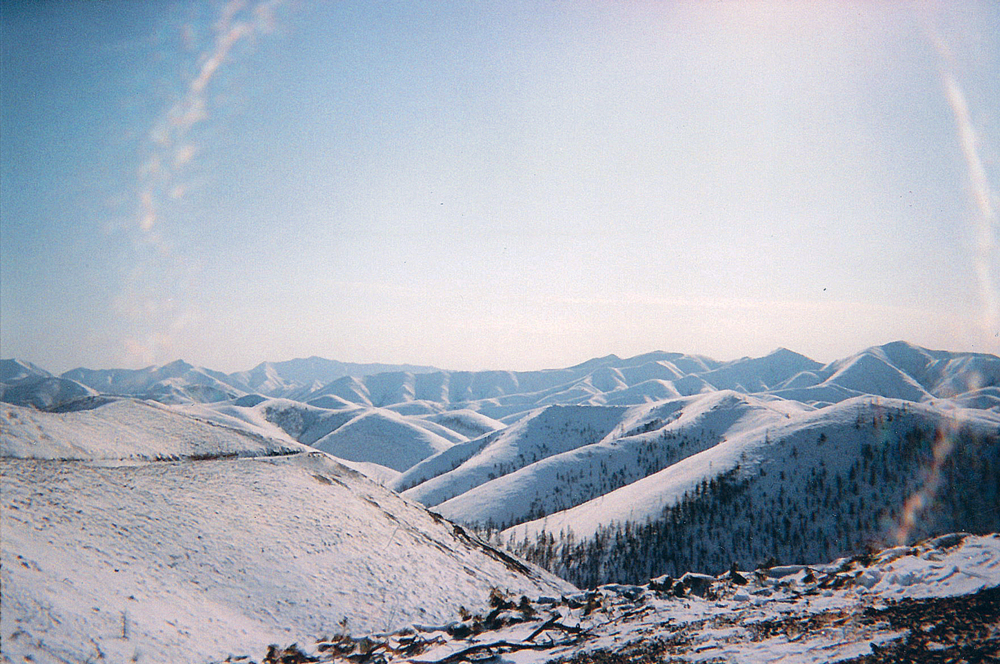
Yakut hills. The end of the 90s
Why is Russia not America
There were many Stalinist camps in Siberia. Do you feel that these camps that are invalid now are nearby?
Oh yes! In modern cities, in villages, sometimes very much is felt. In some cities that are near the camps, there is a feeling that the place itself is degrading, as if destroyed due to the fact that it happened very close ... It is felt in everything-in everyday life, in the atmosphere of cities, even in the behavior of people. For example, the city of Chernyshevsk is a decaying, degrading place, garbage everywhere, the sewer system does not work, children in the streets ask for alms. Drunkers, flies ... But in general, if we talk about the mentality ... I don’t know how much this is the trace of the Gulag, but I was amazed that when it does not happen - for example, the train suddenly stops - all passengers are silent. I was shocked by Russian humility. No one complains, no one will protest. Everyone is silent. Everyone is waiting. I do not want to say specifically so as not to offend anyone with my memories, but I saw with my own eyes that the Russians are ready to accept horrors, cruelty without complaint and protest.
And at the same time, the feeling does not leave that a miracle can always happen here. For example, in the city of Severobaikalsk, among the snow, at a temperature of minus forty -one heroic woman created a winter garden. Tropical! I remember the mistress of this garden with great tenderness. I began to speak Russian with her: “I am an American, I am a traveler,” and she nodded her head so kindly, as if I were a five-year-old child ... (Laughs.) So: in the wilderness, among snow and ice, a person arranges a garden where tropical plants and flowers grow.
I saw that people are ready to accept horrors, cruelty without complaint and protest. But a miracle can always happen here
"
Did you feel the longing for the USSR in people?
Yes, and this longing did not leave-it was in the 90s and now. Many believe that they used to live better. They say that in the USSR it was very difficult, but now it is even harder.
Cooling between our countries is coming now. Do you feel that relations between states affect relations between people?
I have always met a warm welcome-both in the 90s and now. But earlier in people there was a hope for improving life. Now this hope is not. And the Americans, it seems to me, thought that Russia would become like America, and were disappointed when this did not happen. Funny, of course, hope, but she was. The Russians also expected something from America, which-I still did not understand, but there was a wait. Now I don't feel it anymore.
When a law was adopted on the ban on gay propaganda, you said that you would not come to Russia anymore. However, they arrived at the book fair in Krasnoyarsk. What made you change your mind?
This is a terrible law. I am trying to imagine how I would feel in Russia if I was a homosexual. I would feel in constant danger. And so this law was unpleasant for me that I decided not to come to Russia anymore. But then he remembered the wonderful people whom he learned here. I thought about a book fair, which certainly had nothing to do with this repressive law ... and I decided that I would come.
Photos: Ian Fraser, Mikhail Prokhorov Foundation