
Translated material
Under power
The descendants of the Russian classics - Pushkin, Lermontov, Dostoevsky, Tolstoy, Pasternak, Sholokhov and Solzhenitsyn - initiated the Russian literary assembly, which was visited by Vladimir Putin. The picture seems to be from the story of Harms
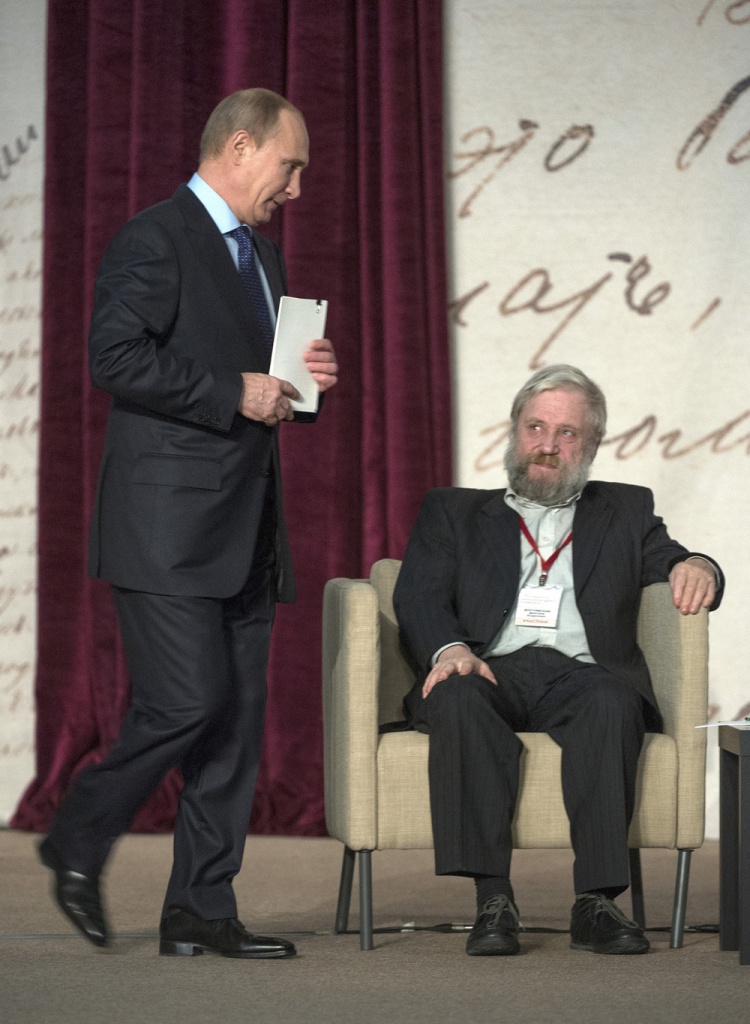 |
| President Vladimir Putin and great -grandson of the writer Dmitry Dostoevsky (sitting in a chair) at a meeting at the Russian University of Friendship of Peoples. Moscow, November 21, 2013 |
The presidential adviser Vladimir Tolstoy has long been organizing “descendants”. In Yasnaya Polyana, this great -great -grandson Lev Nikolaevich was already collecting congresses of his relatives. What did the “great ancestors” whispered to their great -grandchildren and great -great -grandchildren? What did they call from the graves of their today's colleagues?
The Russian literary assembly literally at all the respondents caused an understandable association with the first congress of Soviet writers, who committed the diversity of Soviet literary life and proclaimed the dogma of socialist realism. But today it is not the twenties, Lef and Rapp are not observed, and it is impossible to offer any general aesthetics. “Descendants”, as it seems to me, are rather concerned about the transformation of the social forms of the existence of literature. In the 1920s, writers fed from the sale of their books. They existed in the framework of the thin, Soviet, but the market. Since the mid-1930s, the writer’s market dependence on the reader has been canceled. There was a quick transition from limited market freedom to the archaic aristocratic system of existence of literature and art. Something like that is likely to be started today, since one of the goals of the Russian literary assembly proclaims the unification of the distribution system of state grants intended for writers.
Sartre defined the writers of the period of the monarchy as parasites on the classes of parasites: “In the XVIII century, the very fact of the existence of a hereditary aristocracy simplifies everything; A professional writer, whoever he is by origin - an illegal child, the son of a knife -haireder or judges - entered into direct contact with the aristocracy through the head of the bourgeoisie. Know it contains it, it punishes it; He directly depends on the nobility, receiving from her hands both income and social dignity; He is “aristocratic” due to the fact that the aristocracy devotes him to the fraction of his “mana” (supernatural power. - The New Times); He also falls from her idleness, and the glory, which he hopes to achieve, is the reflection of the immortality that gives the royal family her hereditary title. With the death of the noble class, the writer is completely stunned by the roar of the crash of his patrons; He has to look for new support. ”
The Soviet literary system was a deformed copy of the aristocratic model, which freed writers from caring for bread and market pressure. Loyalty exchanged for privileges. Russian writers are still stunned by the collapse of the class that allowed them to parasitize. They suddenly felt the loss of their own significance, which turned out to be directly related to the fate of the Soviet nomenclature. But now this class of parasites rebelled from the ashes and sends unambiguous signals to them. After the collapse of the aristocracy and the monarchy, the writer, who hated the bourgeoisie to the depths of his soul, from which he himself was, was forced to adapt to the market. The same thing happened in Russia. But despite the dramatic, and sometimes successful stinging of the market, nostalgia lurks in the soul of a Russian writer in a lost close close of the authorities, which only gave him disproportionate significance in society.
"
Putin’s ritual exit to writers as a patron transfers writers into the category of “clients”, as they called in ancient Rome Zhizhovalov
"
Among the few writers who refused to go to the meeting, Boris Akunin, a pioneer of market literature, frankly not wanting to go to the courtiers. But even such a successful professional in the market as Dmitry Bykov, who did not appear at the meeting, recently at Echo of Moscow said that the writer could write for the authorities and be heard by it. He dreams of the writer's proximity to the throne, about the right of the singer “to speak freely” with the king. These speeches are quite imaginary in the lips of Boailo or Lomonosov: “The literature remains the opportunity to reach power. Just people are unprofessional, so they do not try to explain something to the authorities. <...> For example, I know how to write a novel, but I just can not do it, because I have Vladimir Putin, I already said, it does not seem to be a key figure now. But I can imagine how to write a novel that would hook Vladimir Putin. <...> And I roughly understand what to tell him. It would be unnecessary at one time to turn to Medvedev and somehow stimulate him <...>. By the way, it seems to me that it would be possible to write a novel, and quite convincing, from which Vladimir Putin would understand how good he is in the history of Russia, how to preserve an excellent image in the history of Russia, one of the best. Such a novel can be written. ”
The first step towards the revival of the monarchical (or Soviet) literary institution takes the form of Putin’s ritual exit to writers, during which the president announces his role as a patron and priority of literature in Russia. This gesture itself immediately converts writers into the category of “customers”, as they called in ancient Rome the Rains with rich and influential. Writers, however, receive what many of them secretly dream of - symbolic access to the body of power. Nevertheless, it is funny that the meeting is, as it were, is organized not by writers and not the presidential administration, but on behalf of the dead classics. This gives the event a shade of already familiar absurd and shows that a return to the past, more frank, causes a slight discomfort for the organizers themselves. The living avoid responsibility for this step, and therefore transfer it to those who are revealed among us in bronze and marble, and therefore they will endure everything.
Photo: Dmitry Azarov/Kommersant